-
-
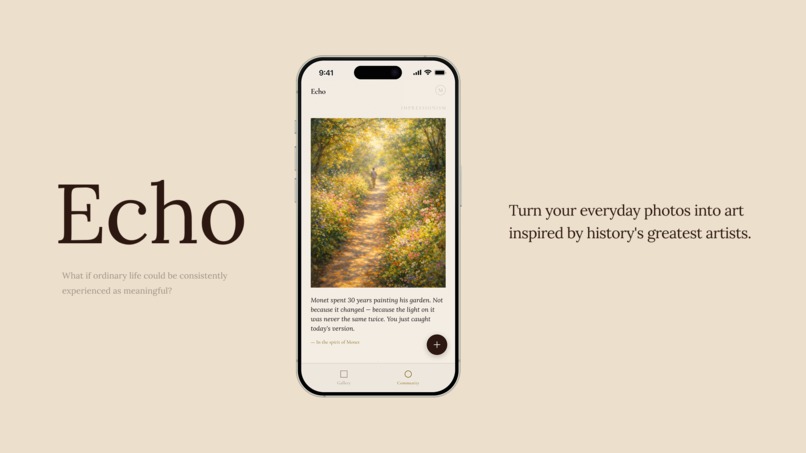
Cover
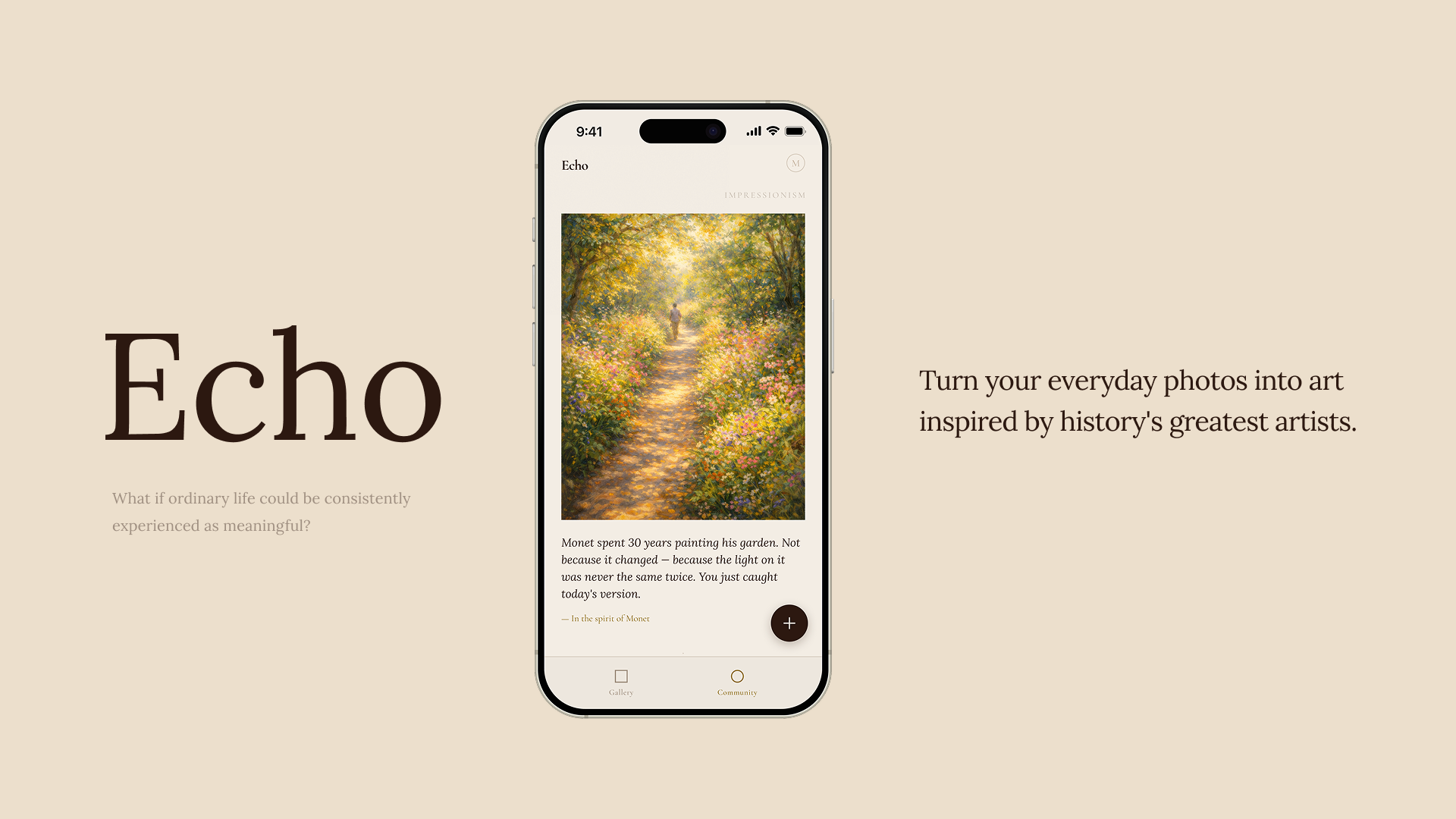
Inspiration
Many people today feel that their daily life is repetitive and lacks meaning. They are not depressed or in crisis. Their days simply feel gray and interchangeable.
At the same time, people constantly capture small moments with their phones. We photograph coffee, rain on the street, sunlight through a window, or the quiet view from a commute. Something in those moments catches our attention even if we do not think much about it.
Most of these photos are never revisited. They remain in the camera roll and slowly disappear among thousands of images.
Echo started with a simple idea. What if those photos were already evidence that we were noticing meaningful moments in our lives? What if technology could reveal that meaning instead of asking people to work harder to find it?
What it does
Echo transforms everyday photos into artistic resonances connected to human history.
When a user uploads a photo, Echo interprets the visual mood of the image and transforms it into an art style inspired by painters across time. A rainy street might echo Impressionism. A quiet room might echo Dutch Golden Age painting.
Alongside the visual transformation, Echo reveals a short line of text that connects the user's moment to artists, poets, or thinkers who noticed similar moments in the past.
The result reframes an ordinary photo as part of a much larger human story of perception and creativity.
Over time the user's gallery becomes a collection of these resonances. It becomes a visual record of the moments that caught their attention in daily life.
How we built it
We built the Echo prototype using Figma Make to quickly generate interactive product flows from prompts.
We used prompts to construct the core interaction experience including photo upload, the developing moment, the resonance reveal, and the gallery view. This allowed us to rapidly test how the product would feel as a real interface rather than just a static concept.
After generating the base structure with Figma Make, we refined the visual system directly in Figma. We adjusted layout, typography, spacing, and visual hierarchy to create a calm and museum-like interface.
The final prototype combines prompt generated interaction structure with manual design refinements to achieve the intended aesthetic and experience.
Challenges we ran into
One challenge was avoiding the feeling of a simple photo filter tool. The goal of Echo is not just to stylize images but to create a meaningful interpretive moment.
Another challenge was finding the right balance between artistic transformation and recognizability. The output needs to feel artistic while still preserving the original moment so users can recognize their own experience.
We also spent time refining the tone of the resonance text. The language needed to feel reflective and poetic without sounding academic or overly dramatic.
Accomplishments that we're proud of
We successfully built a working prototype that demonstrates a new kind of product experience that sits between wellness, art, and everyday photography.
The resonance reveal moment creates a strong emotional interaction where an ordinary photo becomes something reflective and meaningful.
We are also proud that Echo works with behavior people already have. It does not ask users to adopt new habits. Instead it builds on something people already do every day which is noticing and photographing small moments.
What we learned
This project taught us how powerful perception design can be. Small shifts in how people interpret their surroundings can significantly change how meaningful their daily experiences feel.
We also learned that wellness tools do not always need to demand effort from users. Sometimes the most effective design reveals value that already exists in people's daily behavior.
Finally, we learned how important atmosphere and narrative are in product design. The emotional tone of an experience can shape how people perceive the value of the product.
What's next for Echo
Next we want to refine the resonance generation system so that visual styles and textual connections feel even more personal and context aware.
We are also interested in expanding the anonymous community layer so users can see resonances from others around the world who noticed similar moments.
Our long term vision is for Echo to become a perceptual companion that helps people rediscover meaning in the ordinary moments of everyday life.
Built With
- figma


Log in or sign up for Devpost to join the conversation.