Inspiration
After a campus event, an organizer can count survey ratings in seconds. Reading every comment to understand what broke takes longer. We wanted the speed of a theme overview while keeping the person who mentioned a quiet corner visible alongside the five who discussed workshop audio.
What it does
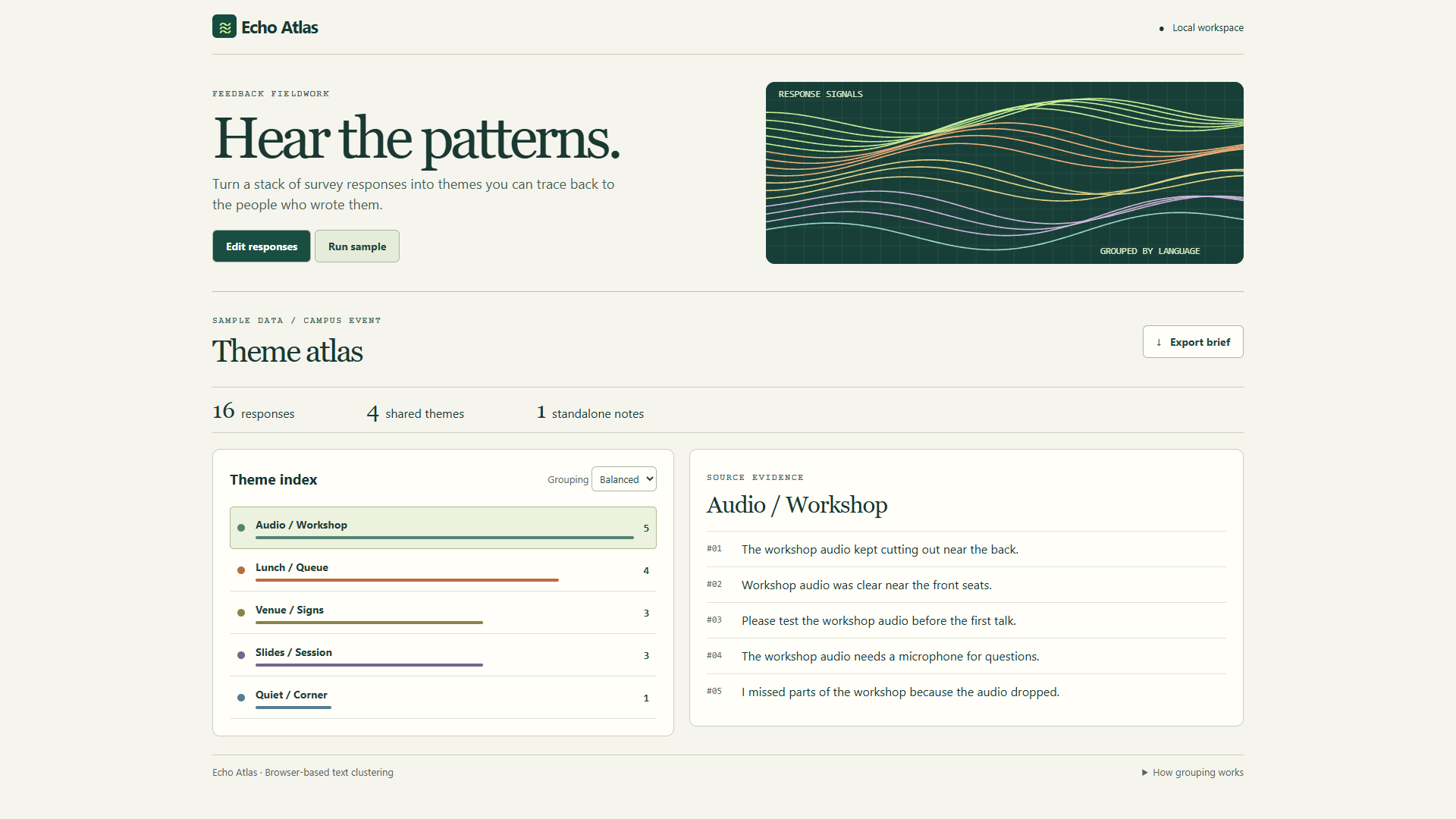
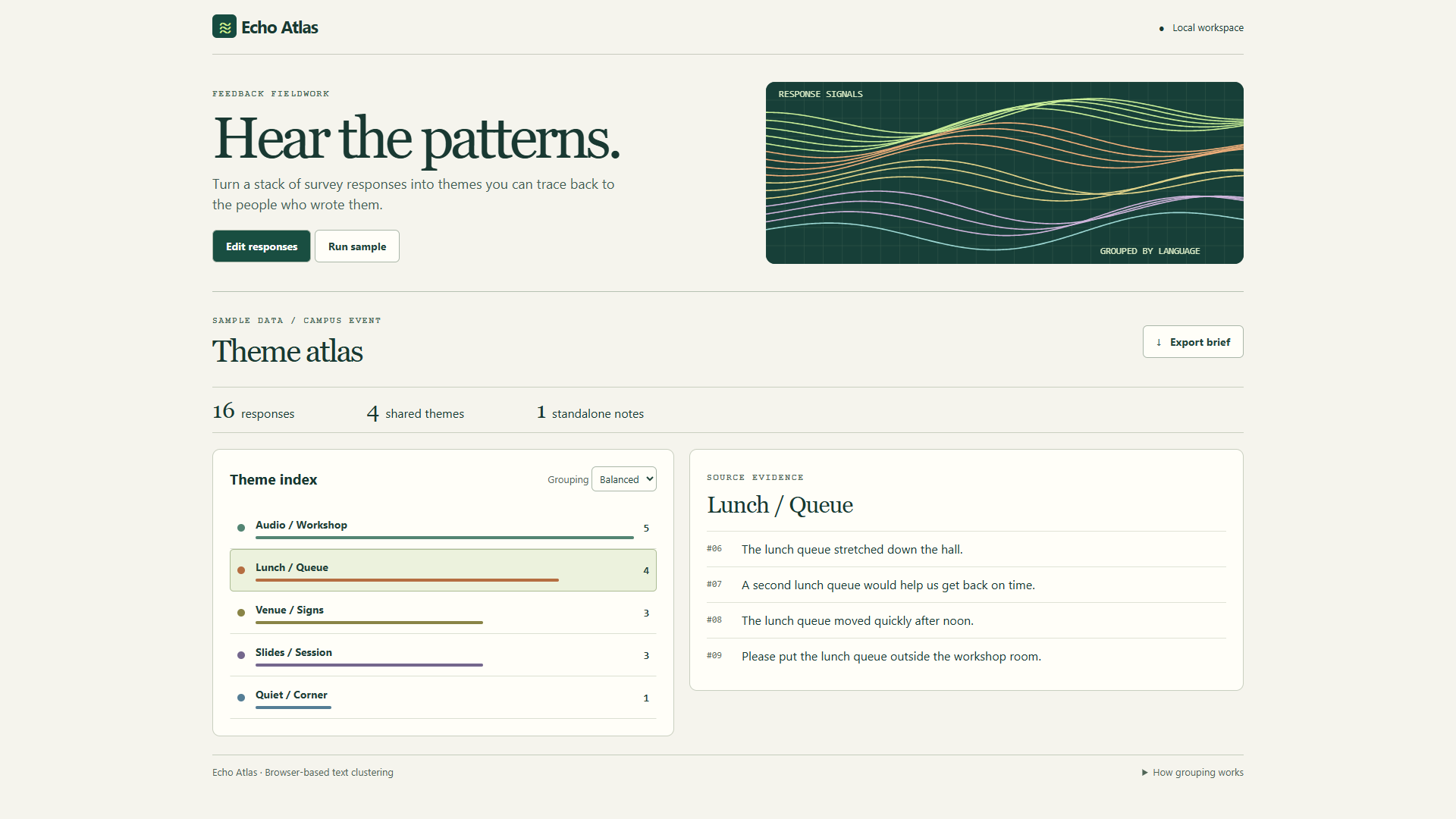
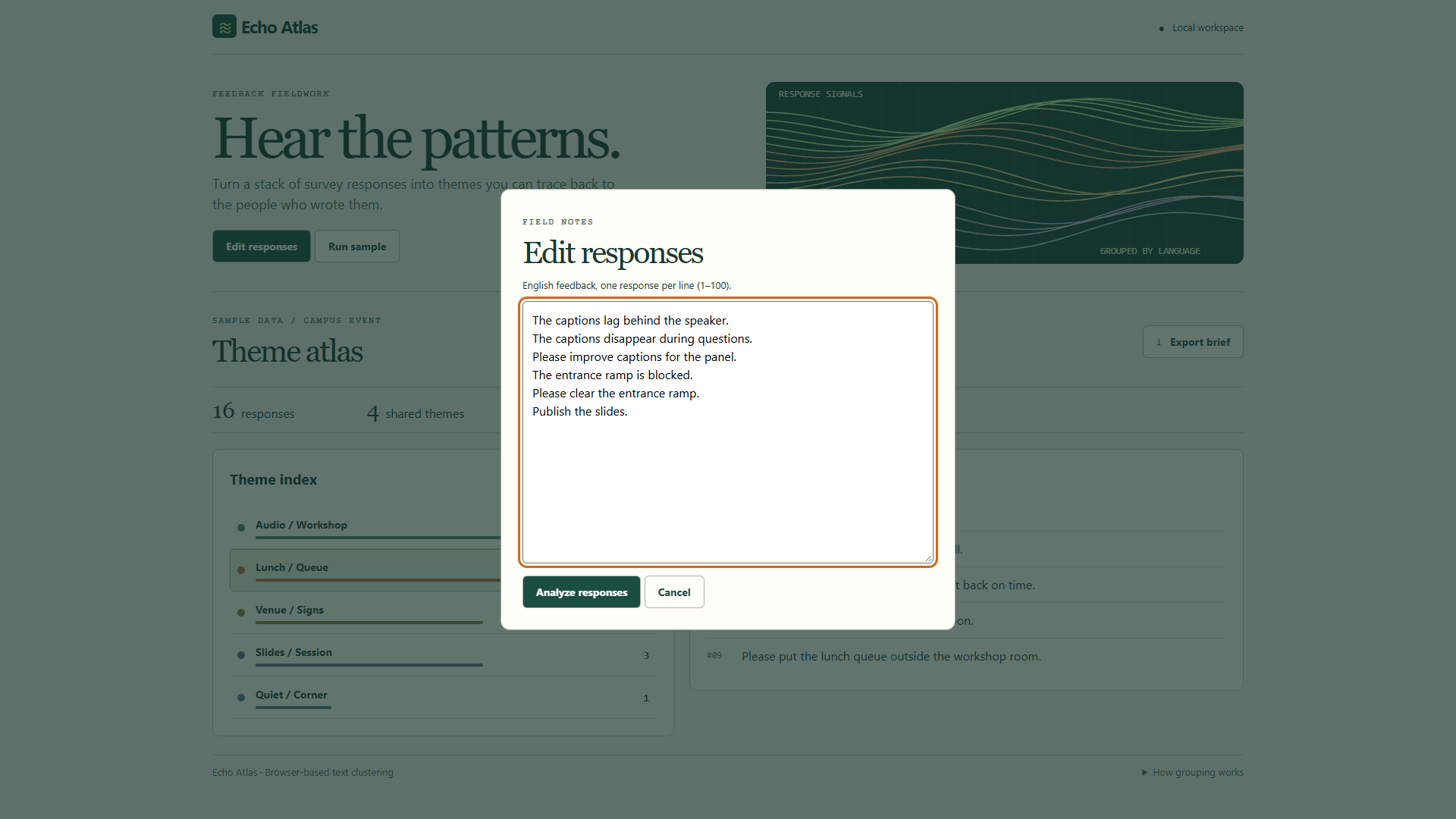
Echo Atlas groups short English survey responses by shared vocabulary in your browser. Open the campus event sample and select the workshop audio theme. Two people can mention the same microphone and have opposite experiences. Their original words sit together for comparison. Change the grouping threshold, paste your own responses or download a brief containing every numbered source note.
How we built it / AI implementation
A dependency-free JavaScript pipeline learns TF–IDF weights from the current batch. It computes cosine similarity and performs average-link agglomerative clustering. Each merge must meet a user-selected similarity threshold. The interface names groups using their two strongest weighted terms and draws response-to-group paths on canvas. All survey processing happens locally.
Challenges
Forcing a fixed number of themes can bury a one-off concern. A similarity cutoff lets an isolated response stand alone. Word overlap can also connect praise and criticism, so every theme opens directly onto the unedited evidence.
Accomplishments
The built-in sample turns 16 responses into four shared themes and one standalone note. The organizer can follow the quiet-corner request from the atlas into an exported brief without losing its source number. The static build needs no account, model download or API key.
What we learned
A theme count answers how often a subject came up. It cannot tell the organizer whether people agreed. Showing the quotes beside the count makes that distinction clear.
What's next
Test the tool with student event organizers and evaluate grouping quality on paraphrases. Explore multilingual tokenization and user-edited theme names.
AI disclosure and limitations
Under human direction, OpenAI Codex wrote the program, synthetic sample and submission copy. The shipped AI is local unsupervised clustering. It handles up to 100 English responses per batch and relies on word overlap. Its output needs human interpretation. We have not measured accuracy on real surveys.
