-
-
architecture
-
data path
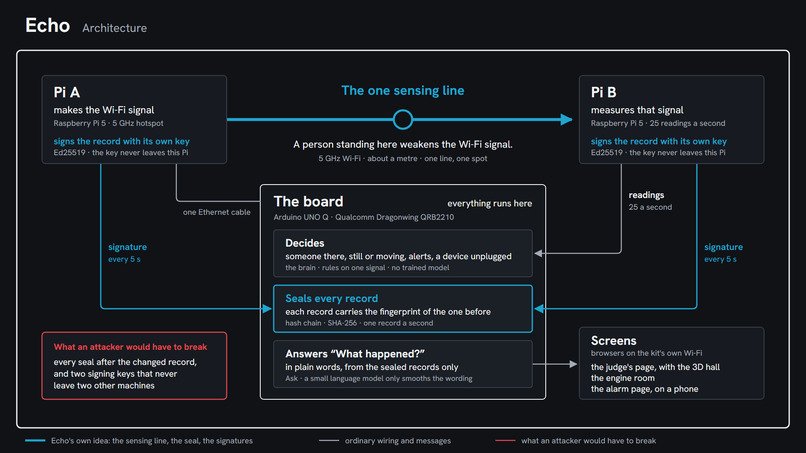
Echo senses whether someone is standing at one spot from the strength of a Wi-Fi signal, and keeps a sealed, signed record of it on an Arduino UNO Q. It has no camera and no microphone; ask it "What happened?" and it answers from that record, and it can show the record has not been changed.
Inspiration
Some places need a record of when someone was there, and cannot have cameras: server rooms and network cabinets, evidence rooms, labs after hours, restrooms, hotel rooms. A camera is too much in those places, and a log that someone can quietly edit is not enough.
We wanted a witness that can't see you, can't be edited, and still tells you exactly what happened. We built Echo at MadHacks 2026 for the Qualcomm / N+1 Institute track and the theme "Let's Dig In": we dug into what an ordinary Wi-Fi signal already knows about the space it crosses.
What it does
- Found you: two small computers sit a metre apart. A body between them weakens the Wi-Fi signal. From that one line the board knows someone arrived, how long they stayed, whether they are standing still or moving, and when they left. Walk straight through without stopping and it records that too. Stand still long enough and a no-movement alert asks for a check-in: step aside and back.
- Intrusion alert: armed, the spot should be empty. Step in and stay, and the board raises an intrusion alert on a phone page.
- A device goes quiet: if one of the two Pis stops answering, the board records which one and when. The record carries on, and the gap itself is recorded.
- What happened: everything Echo senses, and every event, is a record on the board. Ask "What happened?" and a program on the board answers in plain words from the sealed record only, showing its steps and the records it used.
- Engine room: a second screen shows the sealed record counting up, the signatures arriving and a prove-it check. The check changes one record in a copy, verifies the copy and names the record that broke the seal. The real record is never touched.
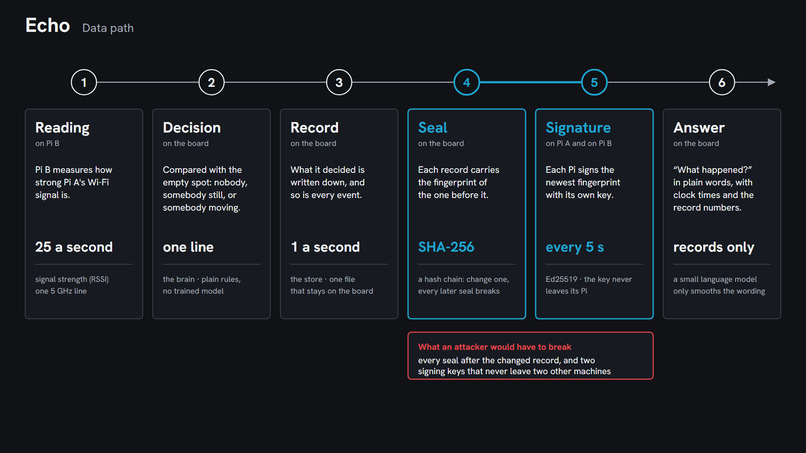
It seals what it sensed. Each record carries the SHA-256 hash of the one before it, so a changed record breaks every seal after it and the board can name the record that was changed.
Two more machines countersign it. Each Raspberry Pi keeps signing the board's newest hash with its own Ed25519 key, so the record up to that point cannot be rewritten later without both Pis' keys. The signatures show the record was not changed afterwards; they do not show the sensing was right, which is what the Proof section is for.
The model on the board has one job. Echo runs a language model (Qwen2.5 0.5B in llama.cpp) on the UNO Q's Dragonwing CPU, beside the sensing, the database and the web server, with no internet connection. We gave it the one job a small model can be trusted with: wording. Everything it is not allowed to get wrong (whether someone is there, when, for how long, and whether the record is intact) is decided by plain code over the sealed record.
What it does not do
Echo does not know who a person is, and it does not know which part of a room they are in. It senses one spot. To be recorded as standing there, a person needs about a second on the line; a quicker crossing is recorded as walking through. It does not tell a thing from a person: a bag that blocks the line as much as a body reads as a person standing still. It does not count people, and it has not been tested through a wall. There is no camera and no microphone on the kit.
Proof
One person, one night, replayed from recordings taken on the kit. The recordings were split into a tuning set and a held-out set before the settings were chosen, and these numbers come from the held-out set only. Each has its method in PROOF.md in our repository.
- One person stood on the spot for ten seconds, ten times, and Echo found them 10 of 10 times; with this few trials the true rate is probably between 69% and 100%.
- Five of those ten stands were with the second device hidden in a backpack, and it found 5 of 5; with this few trials the true rate is probably between 47% and 100%.
- With nobody on the spot it said somebody 0 times in 9.4 empty minutes; with this little time the true rate is probably under 0.4 a minute.
- Once the signal dropped, the decision came 0.50 to 0.58 seconds later; that leaves out the time a person takes to step in, which we did not record.
- In one session of standing still, 167 of 170 decisions said still, and in one session of stepping about, 154 of 170 said moving: one session each, so it shows it can work, not how often. Every miss was in the first seconds: the word takes about 3 to 5 seconds to change.
- With the second device low on a chair seat it found 0 of 5 stands. That is a limit: the device has to be at about desk height.
- Only the Wi-Fi line decides: in the open a person took 11 to 24 dB off it and the empty line dipped 2 dB at most, while the Bluetooth lines dipped 7 to 14.5 dB with nobody there.
- Those numbers are one spot, one person and one night, replayed from recordings taken on the kit. In one run with the board deciding by itself at the time, it said an arrival for 10 of 10 stands and none in the two empty minutes after.
On the kit itself, in one run with one person: Prove it altered record 1627 in a copy and the check named 1627; the real record then verified, 1,926 records in 84.2 ms. With Pi B unplugged, the board showed it silent within 13.9 seconds, and the record kept rising and stayed verified. In another run on the kit, one person walked straight through five times at a normal pace and Echo recorded all five.
How we built it
The effect Echo uses, a body shadowing a radio link, is the physics behind radio tomographic imaging and Wi-Fi sensing (IEEE 802.11bf). Echo uses it on a single link. It reads signal strength only (RSSI), the simplest measurement a Wi-Fi radio gives.
What runs on the UNO Q
Every decision, every record and every answer is computed on an Arduino UNO Q (Qualcomm Dragonwing QRB2210, four Cortex-A53 cores, 4 GB of memory), all on the Dragonwing CPU:
- the decision from the Wi-Fi readings: nobody, somebody still, somebody moving, somebody walking through;
- the alerts: intrusion while armed, no movement, a device gone quiet;
- the record in a small SQLite database, and the SHA-256 seal on every record;
- the check of each Pi's signature, and the check of the whole chain;
- a small language model (Qwen2.5 0.5B, running in llama.cpp on the board) that words the one-line narration and, for a question the plain rules do not recognise, picks which look-up to run. It never supplies a fact, a time or a number: those come from the sealed records by plain code, and if the model changes one, its text is thrown away;
- the web server for every screen.
Neither Pi runs a model: Pi A makes the Wi-Fi signal, Pi B measures it, and each signs the record. The private keys are made on each Pi and never leave it. Echo needs no internet connection and calls no cloud service.
The screens are browsers on the kit's own Wi-Fi: the judge's page, the engine room, and the alarm page on a phone. The 3D room on the judge's page is a model of the actual lecture hall, built from an iPad LiDAR scan, with a faceless figure standing on the spot when someone is there.
Challenges
We tried seven ways of sensing a person before choosing one: Bluetooth from dedicated beacons, Bluetooth between the Pis and the board, a short Wi-Fi line, the Wi-Fi line across the gap, a laptop's own Wi-Fi reading, a long-range Wi-Fi adapter, and ultrasonic sonar from a laptop speaker. We kept the Wi-Fi line across the gap: it was the only one that was both steady with the spot empty and quick enough to decide on. The Bluetooth lines dipped by themselves with nobody there, the laptop's reading worked but refreshed too slowly, and people could hear the sonar. The Wi-Fi against Bluetooth comparison is a measured row in PROOF.md; the rest are our notes from the night. An early design also used a camera to label the radio data; we removed it on purpose, and rebuilt around the one line that worked.
A build that passed every simulated test failed on the board in its first minute, because no test had started the real programs cold. After that, every build had to pass a cold start with real recordings before it went on the board.
Placement matters more than we expected. With the second device low on a chair seat the system found nobody, so the device has to sit at about desk height. A person walking straight through is in the line for under a second, too brief for the one-second rule we started with. On the last morning we added a second rule for short, deep dips, and in one run on the kit it recorded five of five crossings. That same morning, a device nudged by its own power cable changed how much a body blocked the signal, and a rule we had added to tell a left object from a person started calling a very still person an object. We switched that rule off.
Accomplishments
Sensing, the sealed record, the answers and a language model all run on a single Arduino UNO Q, with no internet connection. The decision itself comes from one ordinary Wi-Fi signal by plain rules, with no camera and no microphone, so every decision can be explained and checked.
The record is hard to rewrite: to change a past entry, someone would have to redo every seal after it and forge signatures from two keys that live on two other machines.
We only say what we measured. Every number above has a method and a count behind it, and a range wherever it is a rate, and the limits are written next to the results.
What we learned
One good signal beats several weak ones. Measuring each radio line on the real kit, before building on it, changed the whole design.
A record is only worth trusting if it can show it has not been edited. Sealing and signing turned a sensing demo into something that can act as a witness.
What's next
More people, more nights and more rooms, so the ranges on our numbers get narrower. Then live measurements on the board itself for every result, not replays of recordings, including a measured count of the bytes the board sends outside its own network.
After that, running the same idea on the Wi-Fi a building already has: an access point and the devices already connected to it, with no extra hardware in the room.
Team
- Ivan: team lead; message contracts, the screens, the sealed record and the witnesses
- Alexander: hardware, radio links, the Pis and board bring-up
- Izet: the on-board decision and the proof measurements
- Alejandro: simulation and rehearsal tools, the first on-board record store and question answering, docs
Built With
- llama.cpp
- openssl
- qwen2.5
- three.js
- typescript
- vite
- websockets
