-
-
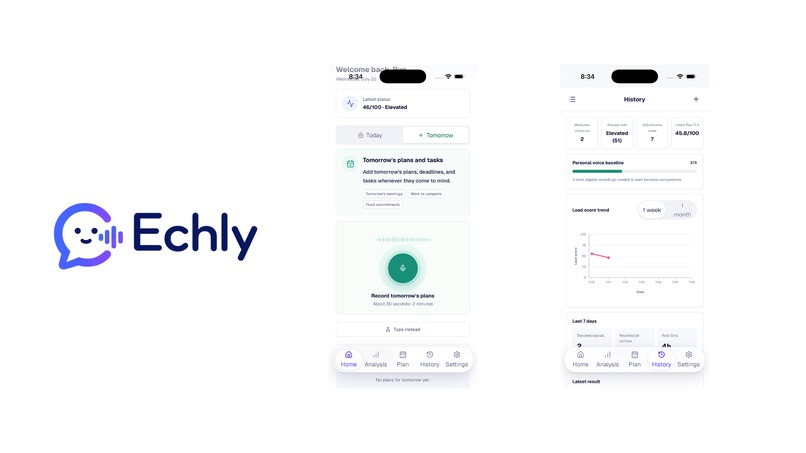
Echly-PWA
Inspiration
Most productivity tools require users to manually enter tasks, organize their thoughts, set priorities, and adjust their schedules. However, the moments when people need support the most are often the moments when they are too tired or overwhelmed to do any of those things.
We created Echly to solve this problem.
Echly is a Voice AI Partner that allows users to reflect on their day, talk about tomorrow, and share whatever is currently on their mind. Instead of asking users to organize everything themselves, Echly listens to their voice, transcribes the conversation, identifies signs of mental and conversational load, and turns their unstructured thoughts into a realistic plan for the next day.
Our core idea is simple:
When you are tired, you should not have to organize anything. Just talk, and tomorrow becomes lighter.
What it does
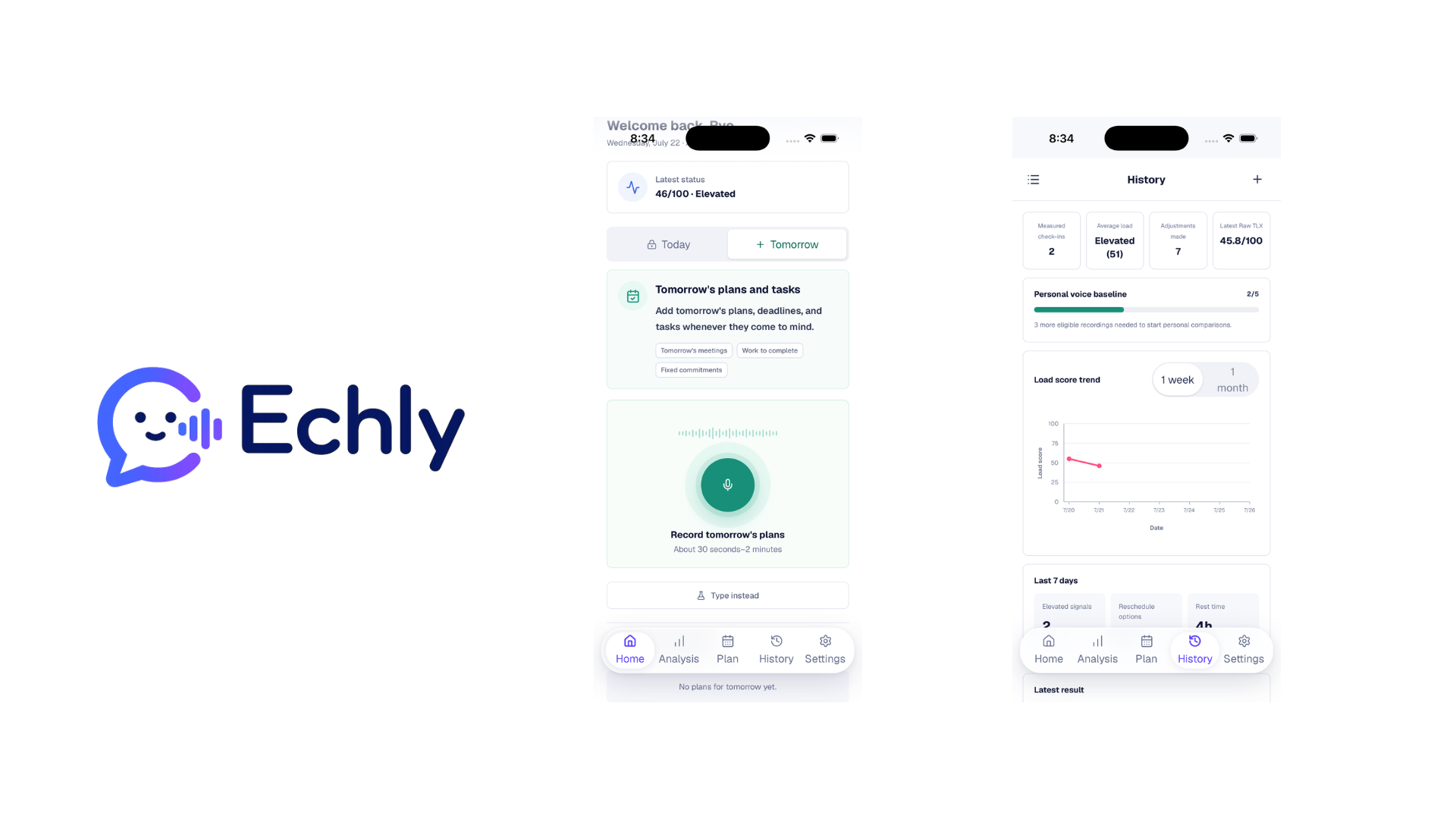
Echly provides a simple, voice-first daily reflection experience.
Users can naturally talk about:
What they accomplished today
What they still need to do
Their plans and deadlines
Concerns or sources of stress
Anything that remains unfinished in their mind
Echly then turns the conversation into structured and actionable information.
Its main features include:
Voice recording
Automatic speech transcription
Editable transcripts
Analysis of conversational load signals
AI-generated summaries and insights
Automatic task extraction
Planning for the following day
A calendar-based schedule
Easy drag-and-drop rescheduling
Automatic saving after schedule changes
A history of previous reflections and plans
Although speech transcription is already highly accurate, mistakes can still occur. For that reason, we allow users to edit the transcript before continuing with the analysis.
Echly is built as a mobile-first web application and can be installed as a Progressive Web App, providing an app-like experience without requiring a native application.
How we built it
We designed Echly around one principle: the user should be able to begin without organizing anything.
The experience starts with voice recording. The recorded audio is processed using open-source speech recognition technology, including Whisper, to create a transcript. Echly then analyzes the transcript and related voice signals before presenting the results in a structured analysis screen.
The upper section of the analysis screen presents the transcript and detected load signals. The rest of the experience helps the user review the generated insights, tasks, and schedule for the following day.
We used Codex and GPT-5.6 extensively throughout the development process.
Codex helped us:
Explore and understand the repository
Follow the project's existing architecture
Implement new features without breaking existing functionality
Build and connect UI components
Integrate audio recording and transcription
Refactor existing code
Investigate and fix errors
Create and run tests
Verify each implementation
Our development process repeatedly followed this cycle:
Inspect the repository
Understand the existing design
Define what could safely be changed
Implement the feature
Test and verify the result
This made it possible to add new functionality quickly while maintaining consistency across the codebase.
GPT-5.6 also helped us understand unfamiliar areas of development. This was our first time working deeply with audio processing and speech transcription, so we began with limited knowledge of the field. GPT-5.6 helped us understand relevant technologies, compare implementation approaches, solve technical problems, and improve the user experience.
Challenges we ran into
One of our biggest challenges was working with audio.
Audio recording and transcription introduced technical considerations that are uncommon in ordinary text-based web applications. We needed to manage recording states, audio formats, browser compatibility, upload and processing time, transcription accuracy, and error recovery.
Another challenge was creating a simple interface around a technically complex process. Echly analyzes transcripts, load signals, tasks, and schedules, but showing all of this information at once could easily overwhelm the user. We therefore focused on organizing the analysis screen so that the most important information remains easy to understand.
We also needed to balance automation with user control.
Echly automatically generates summaries, tasks, and schedules, but AI-generated results should not be treated as final or irreversible. We made transcripts editable and allowed users to adjust generated tasks and move scheduled items easily. Schedule changes are saved automatically, so users can reorganize their plans without additional steps.
Finally, we had to add features quickly without damaging the existing application. Codex helped us understand the established architecture and implement changes within a safe scope, allowing us to continue development without repeatedly breaking existing features.
Accomplishments that we're proud of
We are proud that Echly turns an unstructured voice reflection into something users can immediately act on.
Rather than stopping at speech transcription or summarization, Echly connects the entire experience:
The user speaks naturally
The conversation is transcribed
The user's condition and load signals are analyzed
Important tasks are extracted
A realistic plan for tomorrow is created
The user can review and adjust the result
We are also proud of the simplicity of the experience. Users do not need to begin by filling out forms, categorizing tasks, or setting priorities. They can simply talk.
Another accomplishment was successfully integrating open-source audio technology despite having little previous experience in this area. With the support of Codex and GPT-5.6, we were able to understand unfamiliar technologies, implement them within the existing product, and create a working end-to-end experience.
We are especially proud that new features were implemented while preserving the project's existing design and structure. Codex helped us work within the repository rather than producing isolated code that did not fit the rest of the application.
What we learned
Through this project, we learned that Voice AI is about much more than converting speech into text.
A useful voice-based product must understand what the user is trying to communicate, organize unstructured thoughts, preserve the user's ability to make corrections, and turn the result into a meaningful next action.
We also learned how important it is to design for people who may have limited energy. In those situations, reducing the number of decisions, taps, and manual inputs can be more valuable than adding more features.
From a technical perspective, we learned about:
Audio recording in web applications
Open-source speech recognition
Audio processing workflows
Asynchronous transcription
Handling transcription errors
Designing voice-first interfaces
Turning AI-generated results into practical product features
We also learned how effectively Codex can support an existing project. Its value was not limited to generating code. It could inspect the repository, understand existing patterns, implement changes within those patterns, and verify the results through testing.
GPT-5.6 gave us confidence when entering an unfamiliar technical field. When we encountered something we did not understand, we could ask GPT-5.6, evaluate the proposed approach, and continue moving forward.
What's next for Echly - Voice AI Partner
We want Echly to become more personalized and useful over time.
Our next steps include:
Personalized planning based on previous reflections
Long-term analysis of workload and condition trends
Calendar integrations
Smarter automatic schedule adjustment
Improved load-signal analysis
Better task prioritization
Additional language support
More advanced notifications
Native mobile and wearable integrations
In the future, Echly should understand not only what a user needs to do, but also how much they can realistically handle.
Echly is not designed to create more tasks.
It is designed to help each user build a tomorrow that fits their current condition.
Built With
- codex
- gpt-5.6
- gpt-oss
- next.js
- react
- speech-to-text
- typescript
- webaudioapi
- whisper


Log in or sign up for Devpost to join the conversation.