Inspiration
My inspiration for this project stems from the critical need for clear and accurate ECG signal recordings in the field of medical diagnostics. Environmental noises, interference, and artifacts often compromise the quality of these signals, potentially leading to misdiagnosis or inaccurate assessments of cardiac health. We aimed to tackle this challenge by developing advanced noise cancellation techniques that can enhance the precision and reliability of ECG data.
What it does
My project focuses on real-time noise cancellation of ECG signals using adaptive filters, specifically the Least Mean Squares (LMS) and Discrete Wavelet Transform (DWT) algorithms. It empowers medical professionals with the ability to obtain clean and interference-free ECG recordings, ensuring accurate diagnoses and assessments.
How I built it
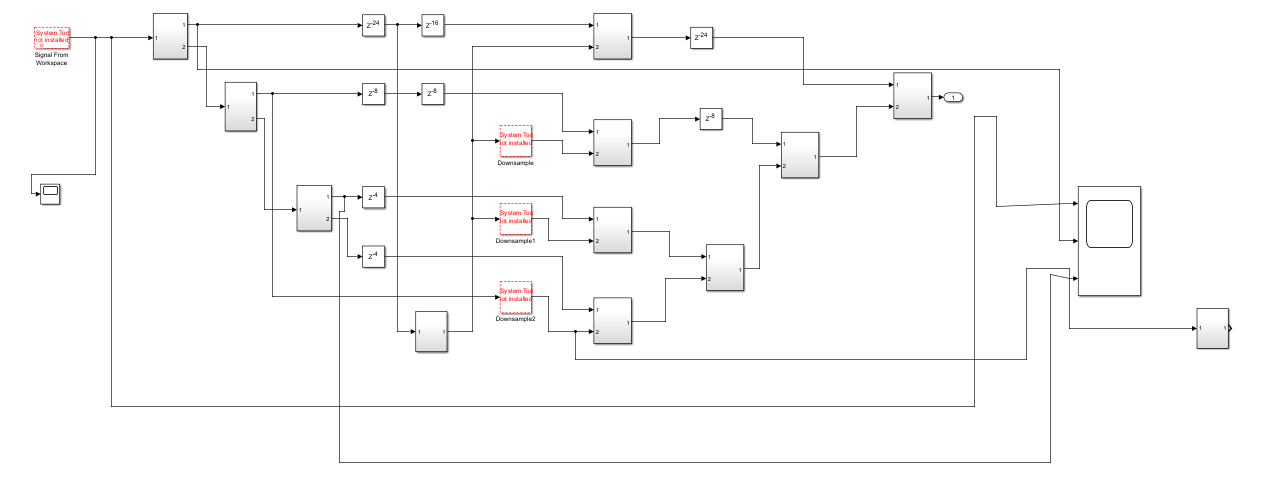
I built this project using MATLAB Simulink, a powerful tool for signal processing and simulation. My development process involved:
- Designing and implementing adaptive filters with 4-tap and 8-tap options.
- Utilizing the LMS algorithm for known reference input.
- Employing the DWT architecture for unknown reference input.
- Incorporating Symlet wavelet decomposition for effective noise removal.
- Conducting a comparative analysis of filter performance using Signal-to-Noise Ratio (SNR).
- Providing project files and Simulink models for ease of exploration.
Challenges I ran into
Throughout the project, I encountered several challenges, including:
- Ensuring optimal parameter tuning for filter performance.
- Addressing real-time processing complexities.
- Managing data integration and synchronization.
- Validating and interpreting SNR results accurately.
- Optimizing computational efficiency in Simulink models.
Despite these challenges, we persevered and achieved meaningful results.
Accomplishments that we're proud of
I am proud of several accomplishments in this project:
- Successful implementation of both LMS and DWT-based adaptive filters.
- Achieving significant improvements in ECG signal quality.
- Demonstrating the practicality of real-time noise cancellation.
- Providing a valuable tool for medical professionals and researchers.
What I learned
Working on this project provided me with valuable insights into:
- Advanced signal processing techniques for noise cancellation.
- The practical application of adaptive filters in healthcare.
- The nuances of real-time signal processing.
- MATLAB Simulink's capabilities for medical diagnostics.
What's next for ECG Noise Cancellation
In the future, I plan to:
- Explore and implement more advanced algorithms, such as Recursive Least Squares (RLS).
- Optimize the computational efficiency of the noise cancellation process.
- Extend the project's capabilities to handle a broader range of medical signals.
- Collaborate with healthcare institutions for real-world testing and validation.
- Continuously enhance the project's user interface and usability for medical professionals.
Built With
- matlab
- simulink

Log in or sign up for Devpost to join the conversation.