-
-
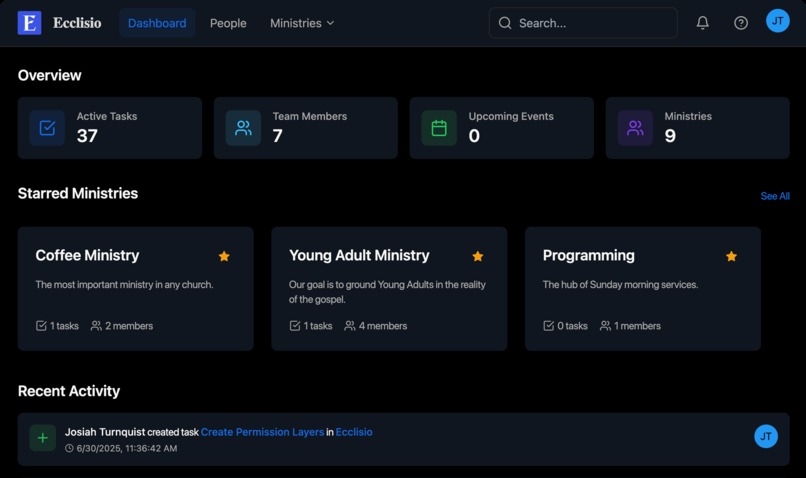
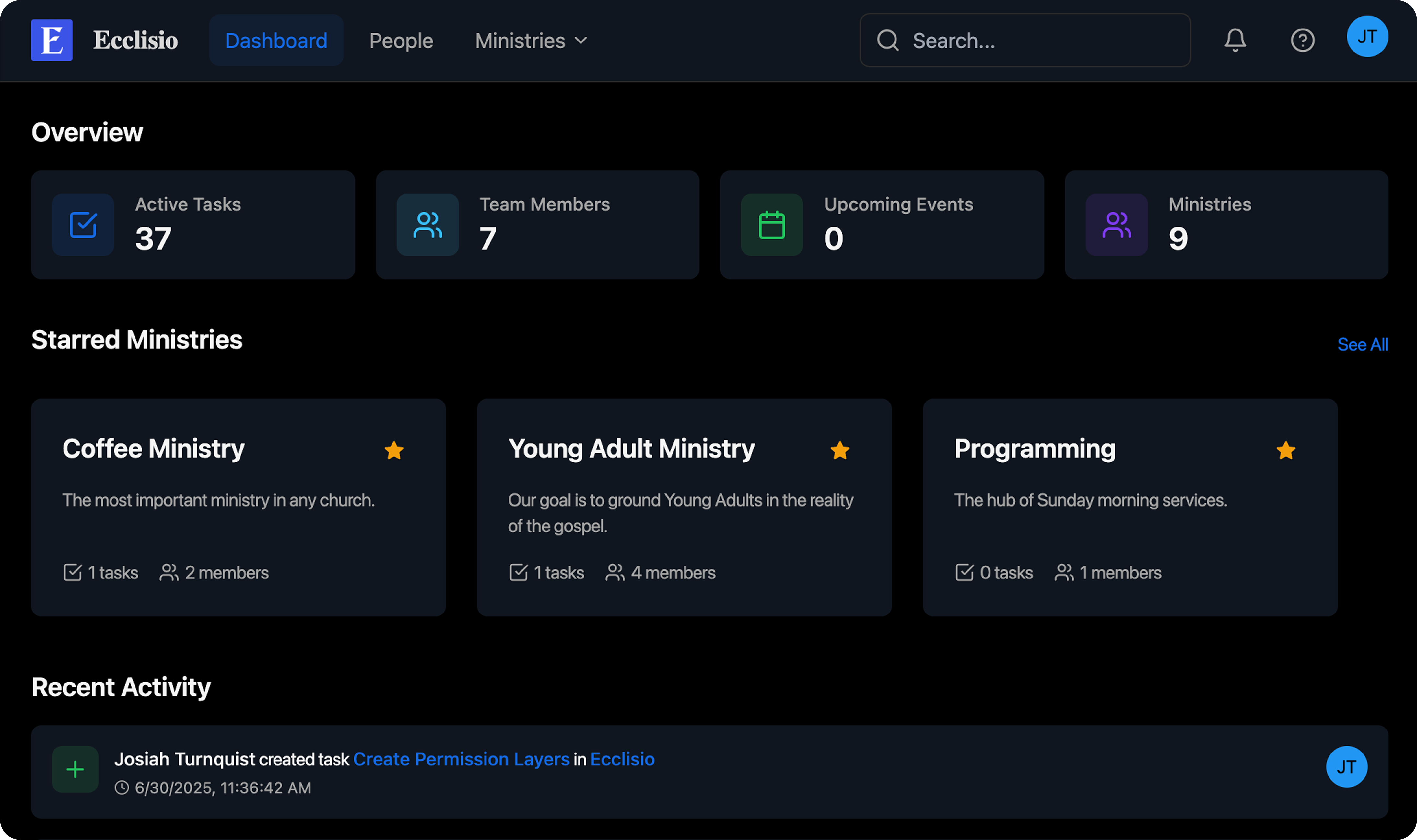
The home dashboard for a fully-configured church.
Inspiration
After years in tech, I’ve had the privilege of working with world-class teams and launching apps I couldn’t have imagined when I first started. Along the way, I picked up skills across the entire product stack—from design to fullstack engineering.
But being in bi-vocational ministry, I’ve also had a front-row seat to how broken the current Church Software landscape really is. Industry leaders like CCB and Rock RMS are generating millions in revenue while shipping clunky, outdated platforms. Many of them even outsource their own engineering work—to agencies they own—just to keep the money moving. It's not just poor design; it's a business model built on dysfunction and greed. Not to mention churches are still left using a dozen of uncooperative software services instead of a one-for-all package. And no- the services do not communicate with each other as you would imagine is needed.
Meanwhile, some of the most gifted and spiritually grounded teams I know are stuck using software that actively gets in the way of ministry. I've never seen such deep hunger for tools that actually serve the Church well.
So I decided to build something better. Ecclisio is my first business venture. Made by churches, for churches.
What it does
Churches are one of the most complex and dynamic organizations in the world. The software has to be robust and versatile, ready to fit in for multiple church variations. Ecclisio is a highly configurable -- but extremely intuitive -- all-in-one package for churches. It allows churches to manage events, configure and schedule large-scale concerts and events, communicate with teams, track labor in a Jira-style fashion, and even write sermons using the Theology agents.
How we built it
With thousands of hours of experience in ministry as well as dozens of meetings with church staff, we used a mixture of Bolt design and our own in-house expertise to refine the user experience from top-to-bottom, with intuition and simplicity as our guiding principles.
Challenges we ran into
Unlike many industries, there is no such thing as a customer that understands how the tool "should work". This needed to be utterly basic in its interface while also being capable of complex and robust action under the hood. While pastoral staff may hold wisdom, they tend to be behind the times with technology. We had to put an excessive amount of hours simply deciding how to structure navigation, production scheduling pages, forms, and so on.
Accomplishments that we're proud of
Community Church Builder has remained completely unchallenged for years since no other company has been able to mirror even a basic scheduling matrix for ministry. Though it does not yet boast of the full feature list needed, we can proudly say that all our users agree we have a better interface that is easier to use.
What we learned
We learned that designing for the Church is unlike designing for any other sector. Pastors, volunteers, worship leaders, and ops staff all think in different mental models... and they don't use language the way most corporate orgs do. That forced us to ask better questions, listen more deeply, and resist the urge to just "ship features." Focusing on simple, complete, and lovable (SLC) features instead of the "minimum viable product" (MVP) has created a user base that loves the software instead of dreading the next time they have to use it.
We also learned that excellence matters. Churches are used to settling for clunky, bloated tools because that's all they've been offered. But when we showed them something thoughtfully crafted—software that feels like it was actually made for them—the response was immediate. The Church deserves good tools, not just spiritual ones.
What's next for Ecclisio
We’re currently rolling out early access to select churches and ministries who want to partner with us in shaping the future of the platform. From here, our roadmap includes:
- Collaborative editing for sermons, service planning, and task boards
- Theology-trained AI agents like Spurgeon, C.S. Lewis, and other late geniuses to help craft home-run sermons and other messages
- In-house documentation that allows churches to keep everything in one place (instead of having Google for next gen, Microsoft for staff, and Dropbox for production...)
- Tagging and task references to unify communication across teams
- A component-based document editor built for liturgy, lesson planning, and pastoral notes
- Multi-campus support with flexible permissions and scalable team structures
In short: we’re building the operating system for the Church.
Built With
- bolt
- css
- javascript
- react
- supabase


Log in or sign up for Devpost to join the conversation.