-
-
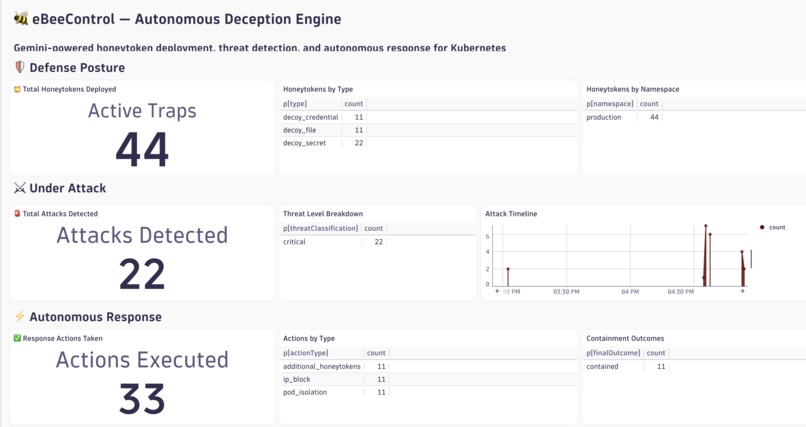
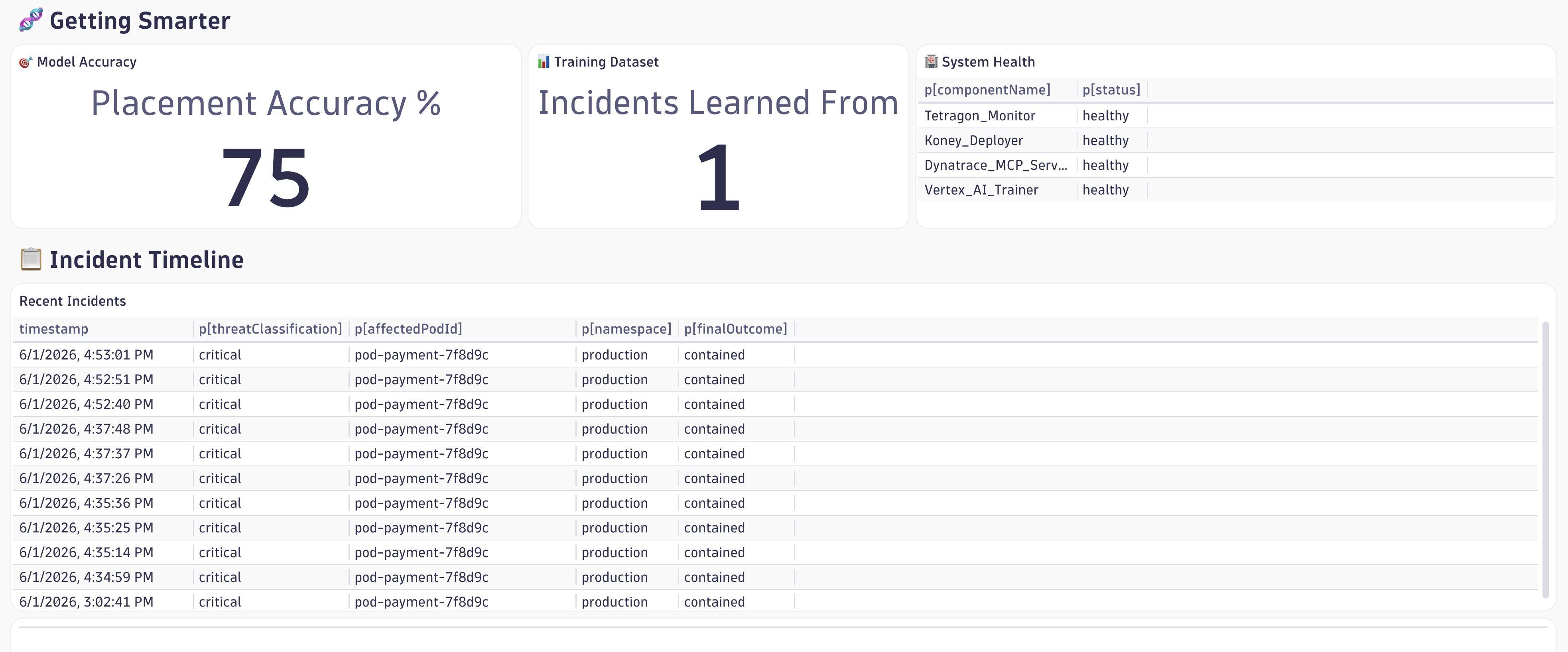
Getting smarter
-
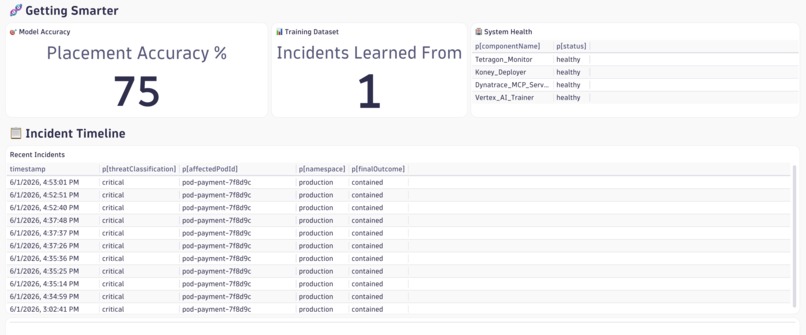
eBeeControl dashboard
-
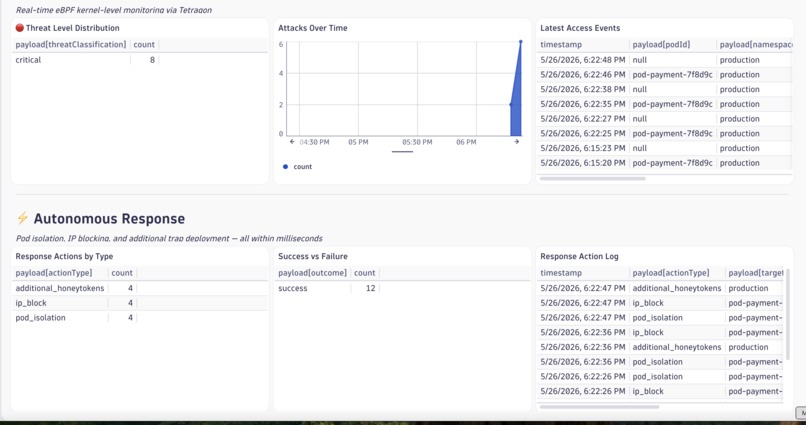
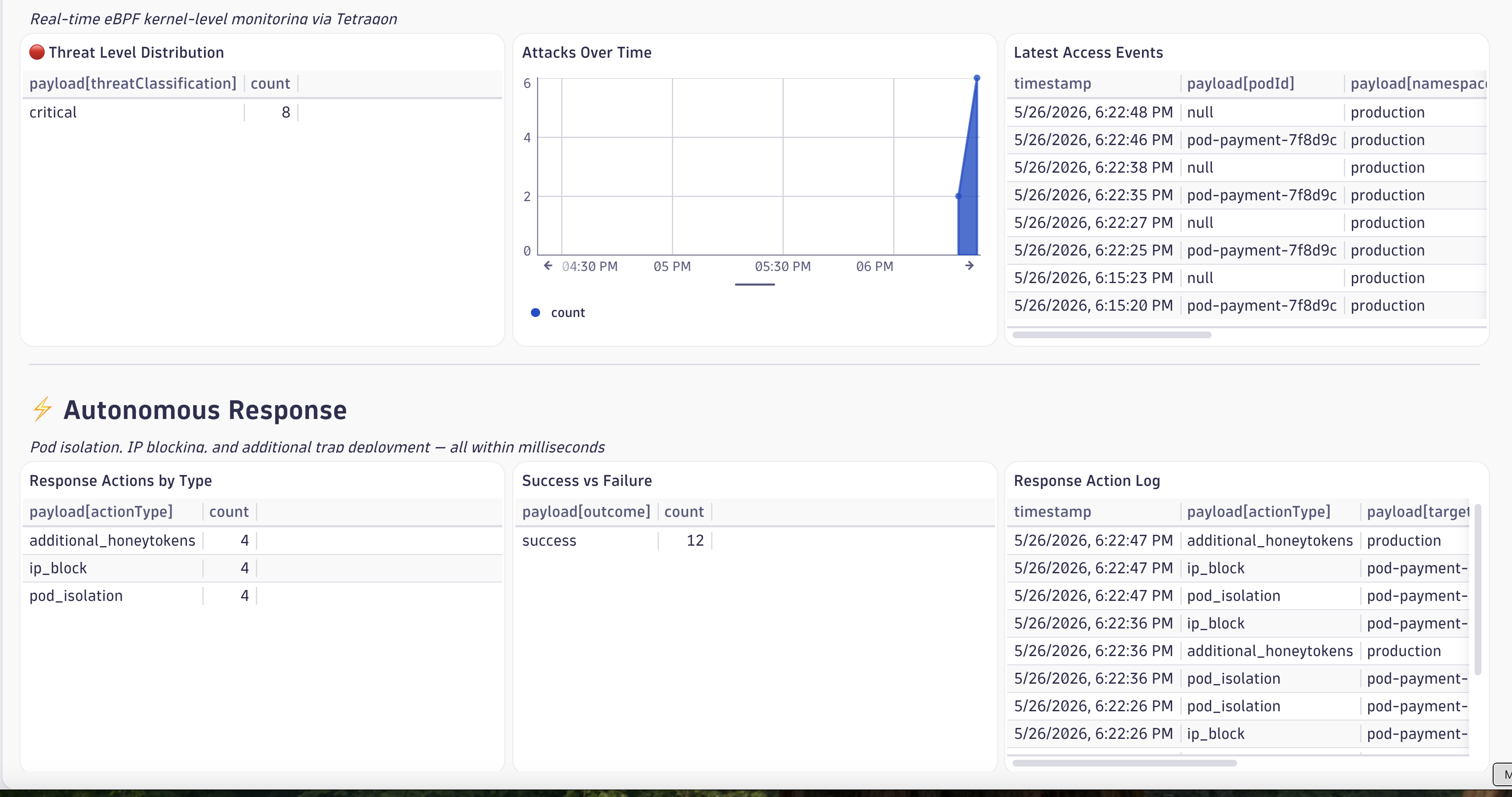
Real-time eBPF kernel-level monitoring via Tetragon
-
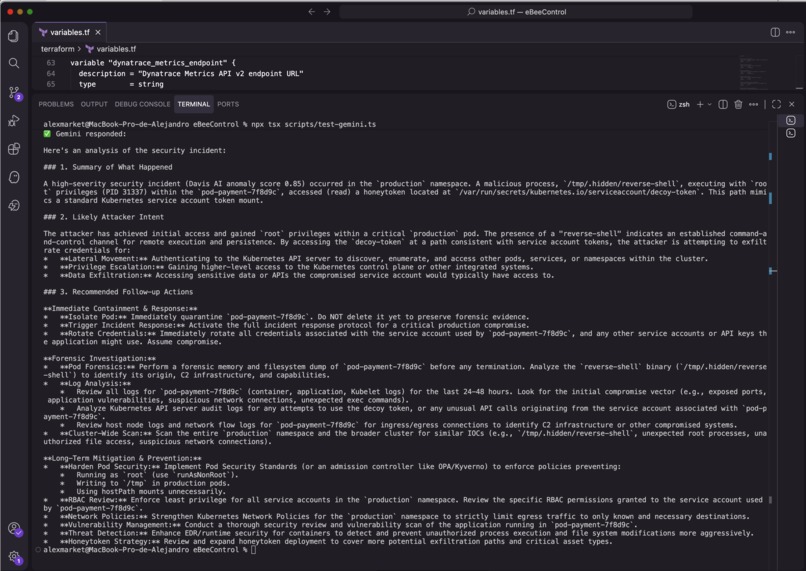
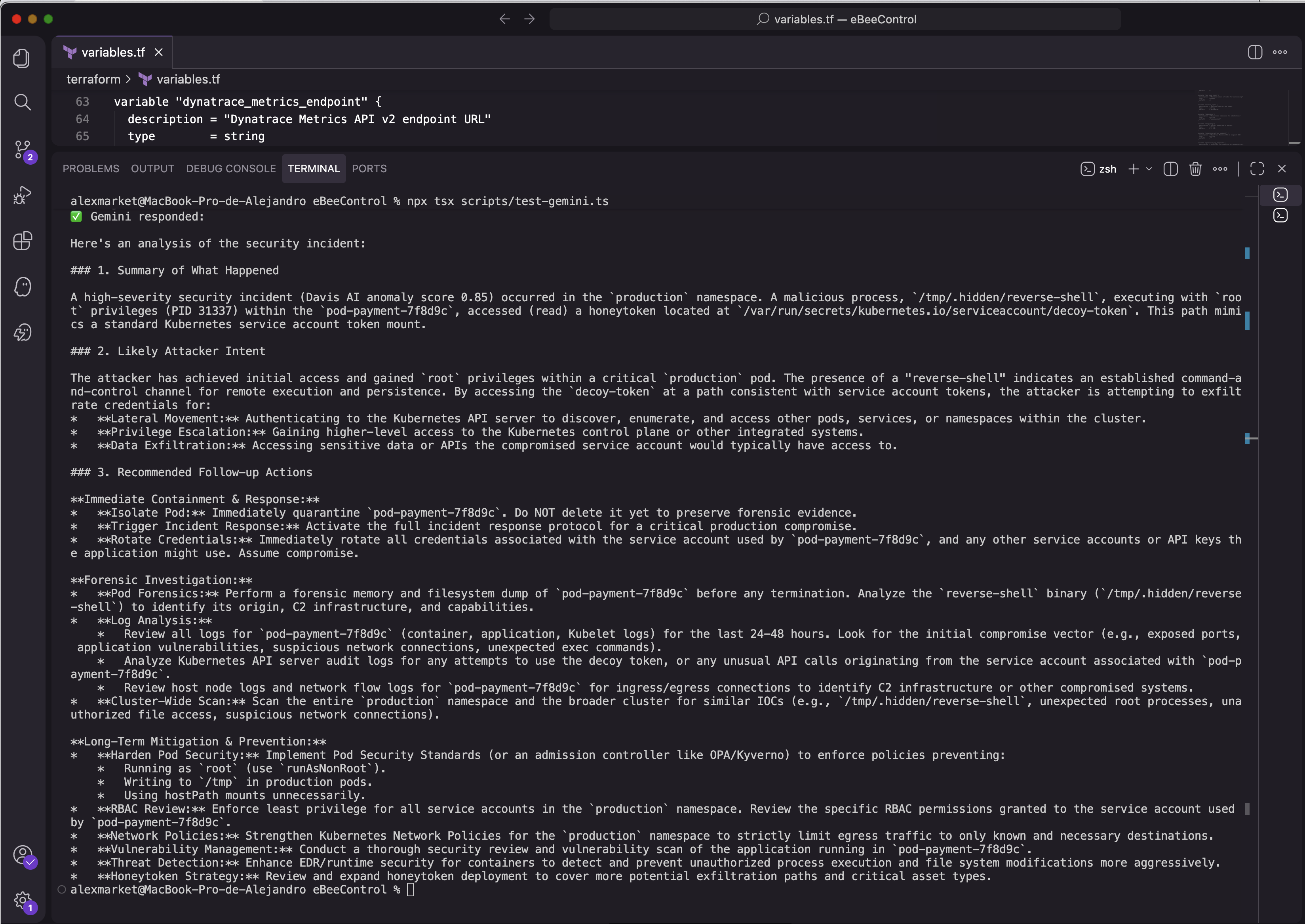
Real AI-generated forensic report
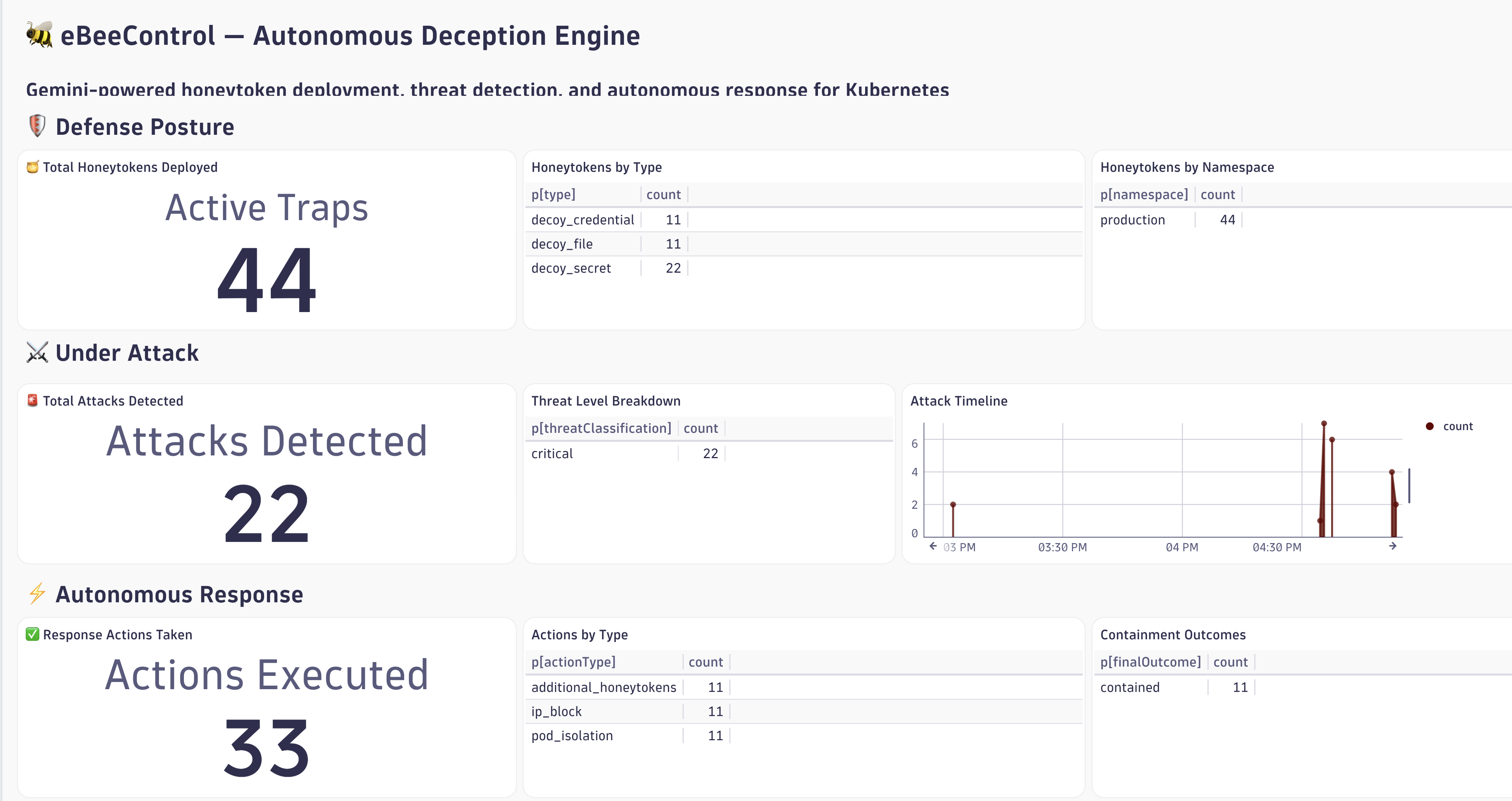
eBeeControl — A Gemini-powered agent that uses eBPF and adaptive learning to autonomously deploy, monitor, and respond to honeytoken access in Kubernetes environments.
Inspiration
Security teams are overwhelmed. The average time to detect a breach in a Kubernetes cluster is 277 days — and once attackers gain access, they sell it to others through Cybercrime-as-a-Service (CaaS) marketplaces. Traditional security tools are reactive: they wait for known signatures and miss novel attacks entirely.
We were inspired by the concept of cyber deception — instead of waiting for attackers to hit real assets, what if we could bait them with traps and catch them the moment they move? The Dynatrace Research team's open-source project Koney showed that honeytokens in Kubernetes are technically feasible. But Koney deploys traps — it doesn't think. It doesn't decide WHERE to place them, HOW to respond, or HOW to improve over time.
That's where eBeeControl comes in: an autonomous AI brain on top of Koney that uses Gemini to reason about threats, Davis AI to understand context, and the Gemini Enterprise Agent Platform to learn from every incident. No human intervention required.
What it does
eBeeControl is an autonomous deception engine that protects Kubernetes clusters through a continuous 7-step cycle:
- Discover — Queries the Dynatrace MCP Server for high-risk services using Davis AI anomaly scores
- Deploy — Instructs Koney to place honeytokens (decoy secrets, fake credentials, trap files) in vulnerable pods
- Detect — Tetragon eBPF kernel probes fire within 1 second when any process accesses a honeytoken
- Assess — Gemini classifies the threat as low/medium/high/critical using real-time context from Davis AI (namespace, service criticality, anomaly score)
- Respond — Autonomously isolates the compromised pod, blocks the attacker's IP, and deploys additional traps to catch lateral movement — all within 15 seconds
- Report — Gemini 2.0 Flash generates a detailed forensic report with timeline, attacker intent analysis, and recommended follow-up actions
- Learn — Submits incident outcomes to the Gemini Enterprise Agent Platform, which retrains the placement model every 24 hours so future trap placement improves over time
The entire cycle runs 24/7 without human approval. The system gets smarter with every attack it catches.
How we built it
Architecture:
- TypeScript (strict mode) — 728 tests, 24 property-based correctness guarantees
- Gemini 2.0 Flash — Forensic report generation via Google Gen AI SDK
- Gemini Enterprise Agent Platform — Adaptive placement model that retrains on real incident data
- Dynatrace MCP Server — Service topology, Davis AI anomaly detection, real-time pod context
- Koney (Dynatrace OSS) — Kubernetes operator for honeytoken deployment via DeceptionPolicy CRDs
- Cilium Tetragon — eBPF kernel probes for sub-second honeytoken access detection
- Dynatrace Dashboard — Real-time operational visibility with DQL-powered tiles
Infrastructure:
- GKE — Google Kubernetes Engine for production deployment
- Terraform — Infrastructure as Code for reproducible environments
- Helm — Kubernetes packaging and deployment
- GitHub Actions — CI/CD pipeline (test → build → push → deploy → install Tetragon → apply policies)
- Docker — Multi-stage build with non-root user, read-only filesystem
Development approach:
- Spec-driven development: requirements → design → implementation → property-based testing
- 24 formal correctness properties validated with fast-check (100+ iterations each)
- Every component is testable via dependency injection
- Graceful degradation — the system continues operating when individual components fail
Challenges we ran into
ARM vs AMD64 — Building on Apple Silicon Mac for GKE (AMD64) caused
exec format error. Learned to always use--platform=linux/amd64with Docker buildx.Terraform state management — Local state didn't sync with GitHub Actions runner. Solved by migrating to GCS remote backend, but existing resources required manual imports.
Dynatrace Log Ingestion format — The API silently accepted data but didn't index it. The fix was wrapping payloads in
{"content": JSON.stringify(payload), "log.source": "ebeecontrol"}format.Gemini API quota — Free tier quotas reset unpredictably. Implemented a graceful fallback: if Gemini is unavailable, the system generates reports locally using the same data structure. The system never crashes.
Making Koney vs custom code decision — Initially built on our own K8S deployer before realizing Koney (Dynatrace OSS) already solves this problem as a proper Kubernetes operator with CRDs. Refactored to use Koney as the "hands" and eBeeControl as the "brain."
Threat classification without false positives — Honeytokens are never accessed by legitimate processes, so any access is suspicious by definition. But we still needed to differentiate between severity levels. Solved by using Davis AI context (anomaly score + criticality + namespace) for nuanced classification.
Accomplishments that we're proud of
- 728 tests with 24 property-based correctness guarantees — the system is formally verified to behave correctly across all valid inputs
- *< 15-second * detection-to-containment time — from kernel probe firing to pod isolation
- Zero false positives by design — honeytokens are never accessed by legitimate processes
- Model Publish Guard — the AI placement model can never get worse, only better (new model published only if accuracy ≥ current)
- Graceful degradation — if any component fails, the system continues protecting with remaining healthy components
- Five AI systems working together without overlap — Davis AI (context), Gemini (reports), Gemini Enterprise Agent Platform (learning), each solving a distinct problem
- Live Dynatrace Dashboard — real-time visibility into the autonomous cycle with color-coded threat levels
- Complete IaC — one
terraform applycreates the entire environment; oneterraform destroytears it down
What we learned
Deception > Detection — Traditional security waits for known attacks. Deception catches unknown attackers by their behavior (e.g., accessing bait), not by their signatures.
eBPF is a game-changer — Kernel-level monitoring cannot be evaded from userspace. Tetragon gives you visibility that no application-level tool can match.
Separation of concerns matters — Koney deploys traps, eBeeControl thinks. Gemini writes, Davis senses, Gemini Enterprise Agent Platform learns. Each does one thing well.
Property-based testing catches bugs unit tests miss — Generating random inputs across 100+ iterations found edge cases in threat classification that hand-written examples never would.
The "assume worst case" principle — When context is missing (Dynatrace timeout), default to HIGH classification. Never under-classify a threat due to missing data.
AI fallbacks are essential — Real Gemini with graceful fallback to local generation means the system never stops working regardless of API availability.
What's next for eBeeControl
v1.1 — Production Hardening
- Rate limiting on response actions (prevent isolation cascades)
- Kill switch/pause mechanism for autonomous response
- Slack/PagerDuty alerting integration
v2.0 — Semantic Anomaly Detection (BigQuery Vector Search)
- Convert each incident into an event narrative
- Embed with
gemini-embedding-001(3072 dimensions) - Use BigQuery native vector search to find semantically similar past incidents
- Detect "unknown unknowns" — attacks that don't match rules but resemble past attacks
- Enable campaign tracking: "These 5 incidents across different pods are the same attacker."
- Continual learning: analyst feedback improves detection without full model retraining
v3.0 — Multi-Cluster & Advanced Deception
- Federation across multiple Kubernetes clusters
- Polymorphic honeytokens that change content to appear more realistic
- Attacker profiling based on behavior patterns
- Automated threat intelligence sharing to community feeds
Dynatrace Tenant
https://lfl68751.apps.dynatrace.com User: [email protected] Password: Hackathon2026#
*Take into consideration that I destroyed the GKE cluster to avoid expenses. No more data ingestion.
Built With
- c
- dynatrace
- gemini
- isovalent
- koney
- kubernetes
- tetragon
- typescript
- vertex
- yaml

Log in or sign up for Devpost to join the conversation.