-
-
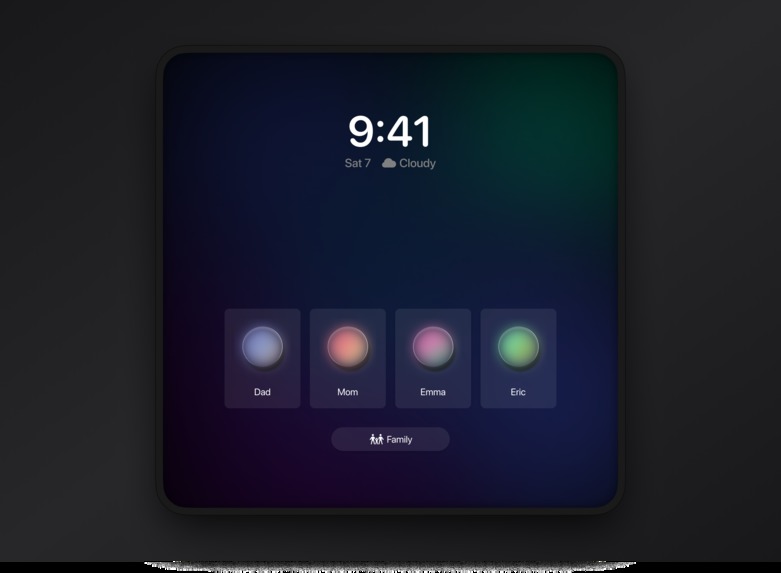
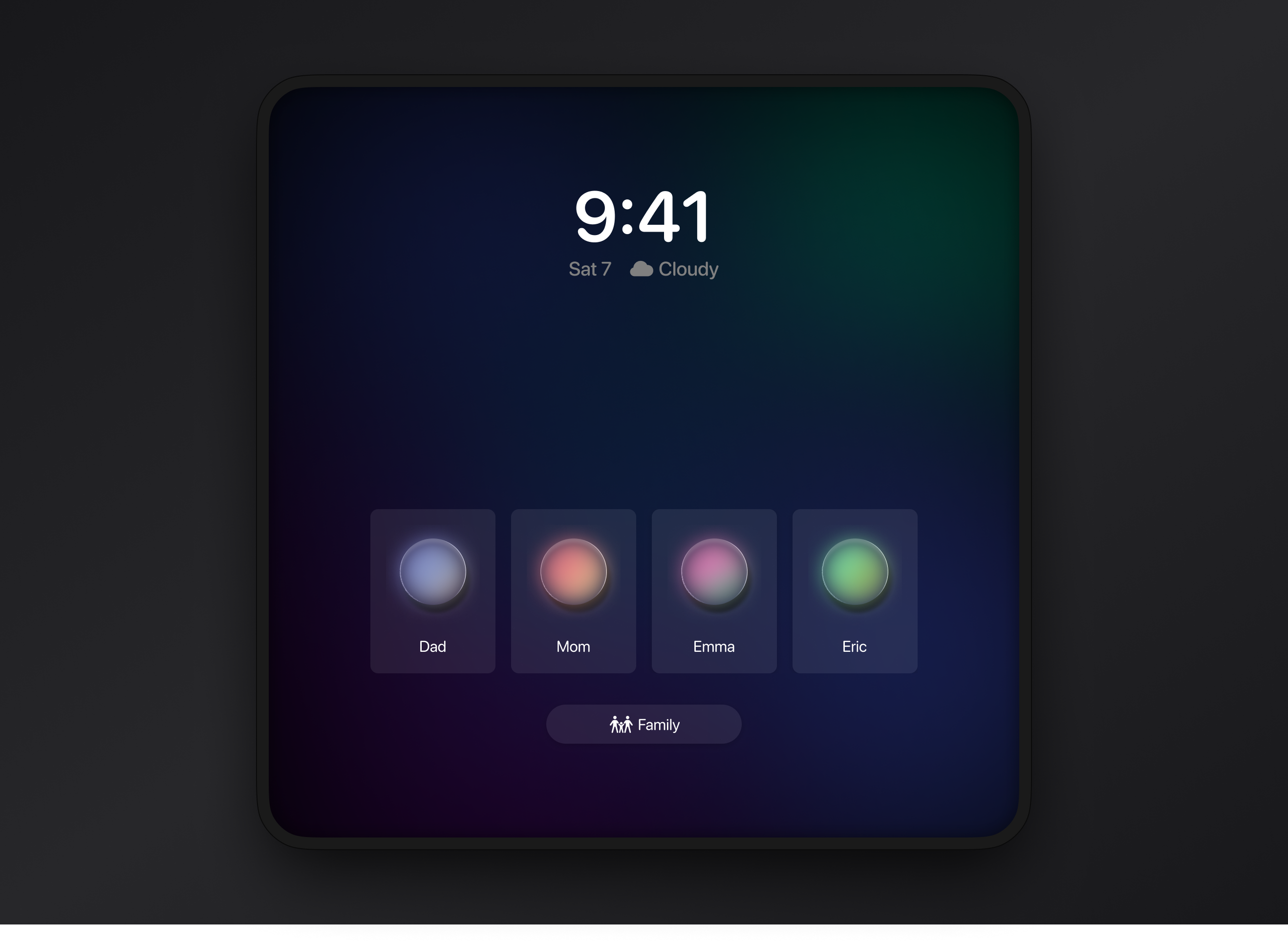
Select a family member to view log in. Each orb shows their profile picture.
-
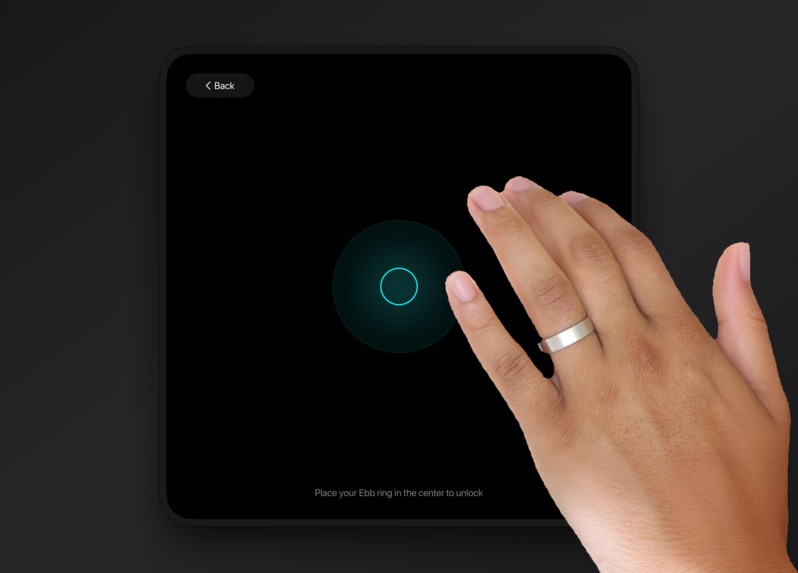
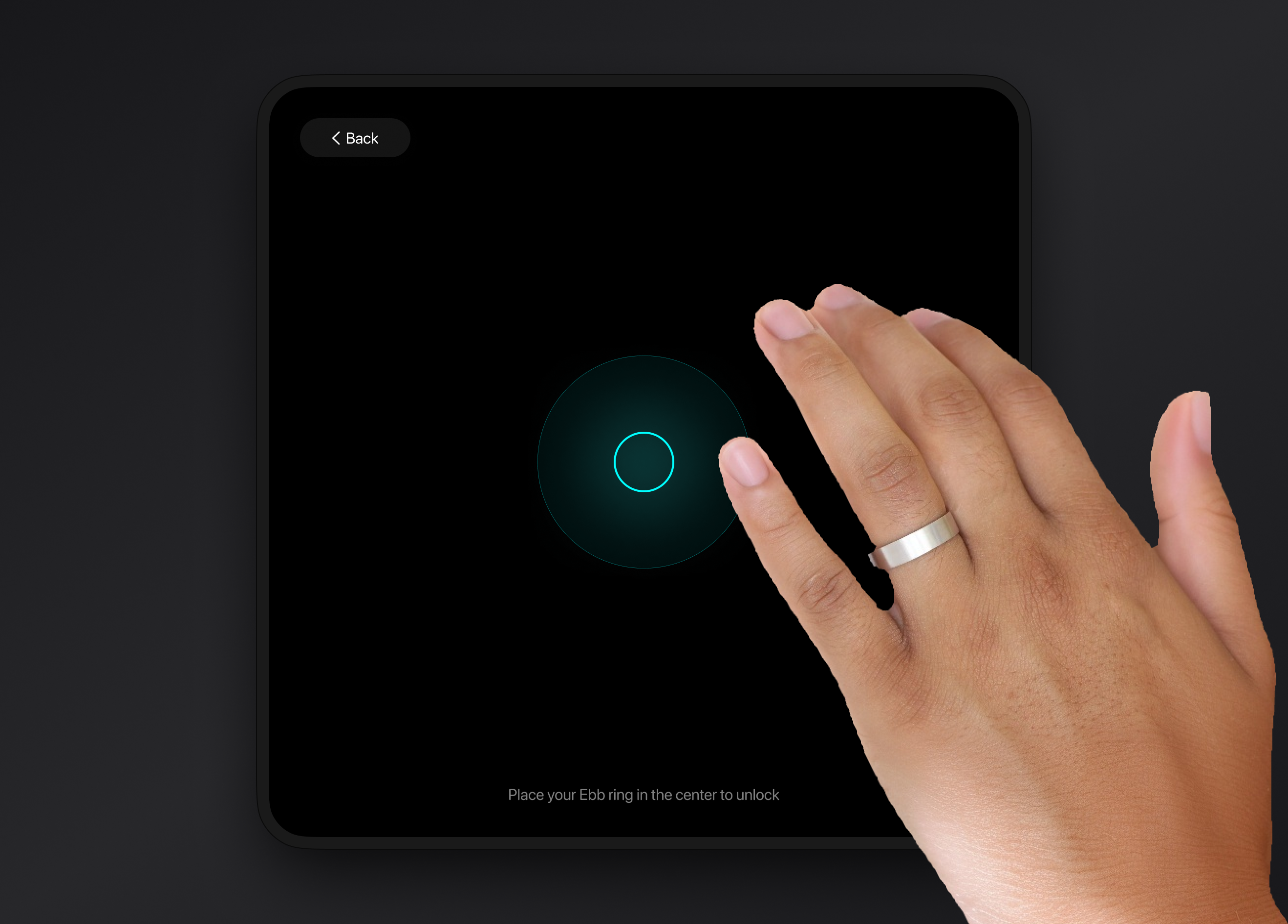
Place your Ebb ring on the tablet to access your personal data.
-
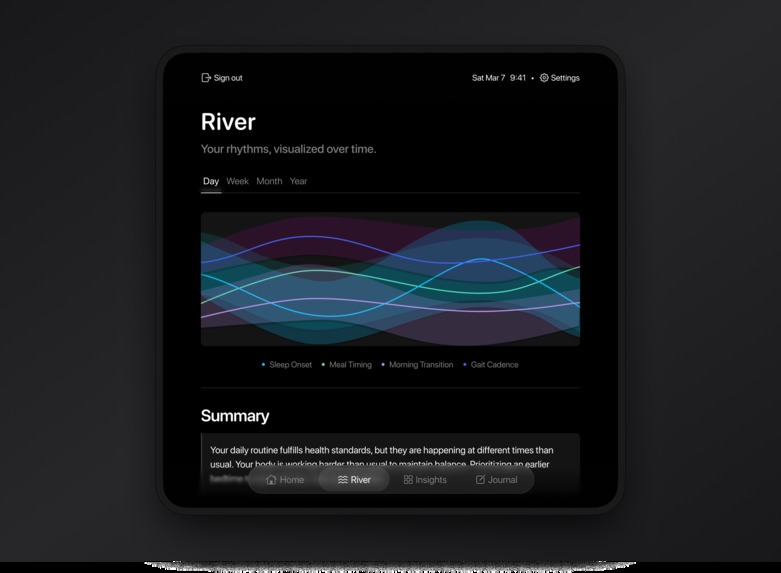
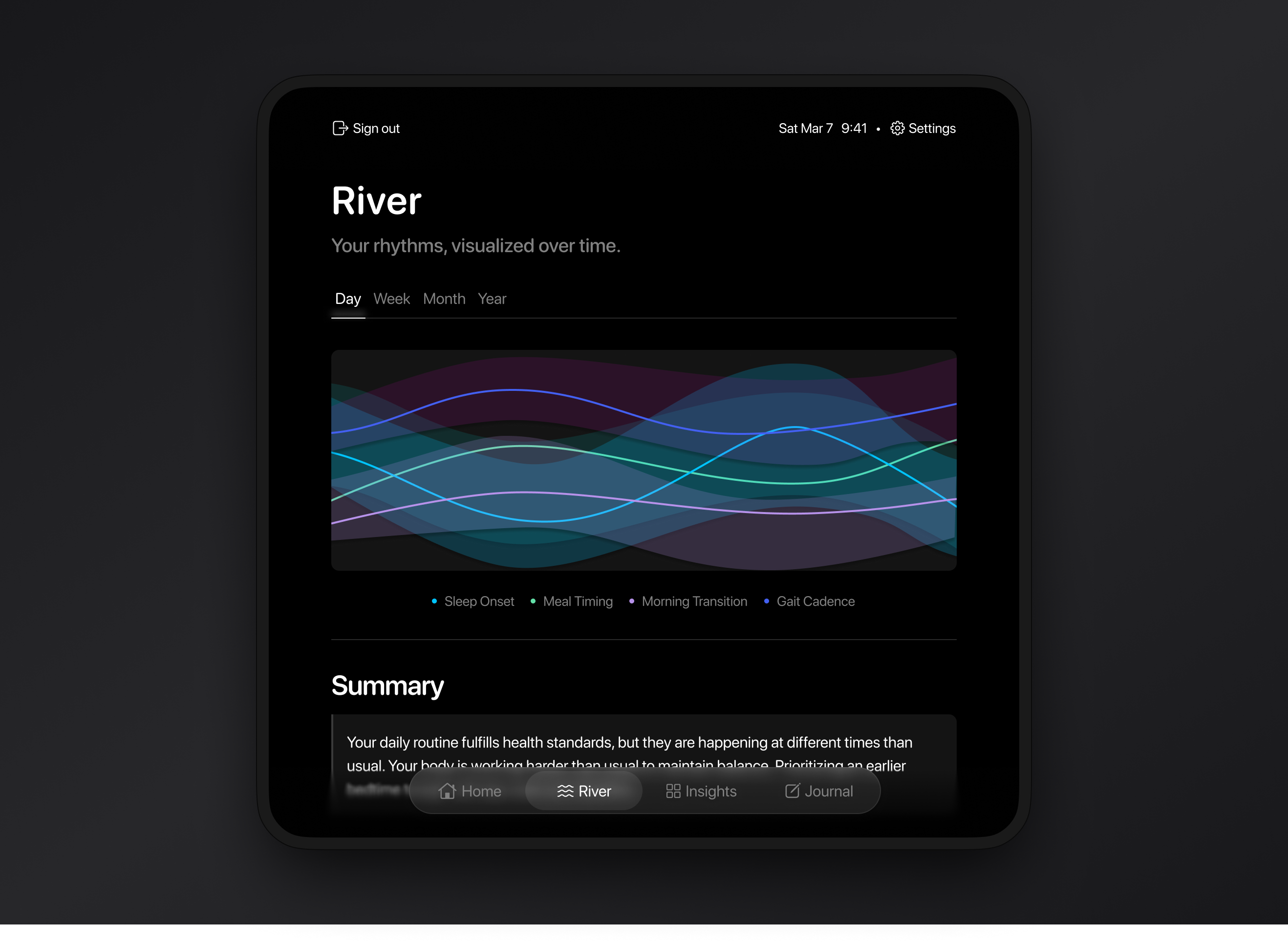
Your four rhythm signals visualized over time. Switch between day, week, month, and year.
-
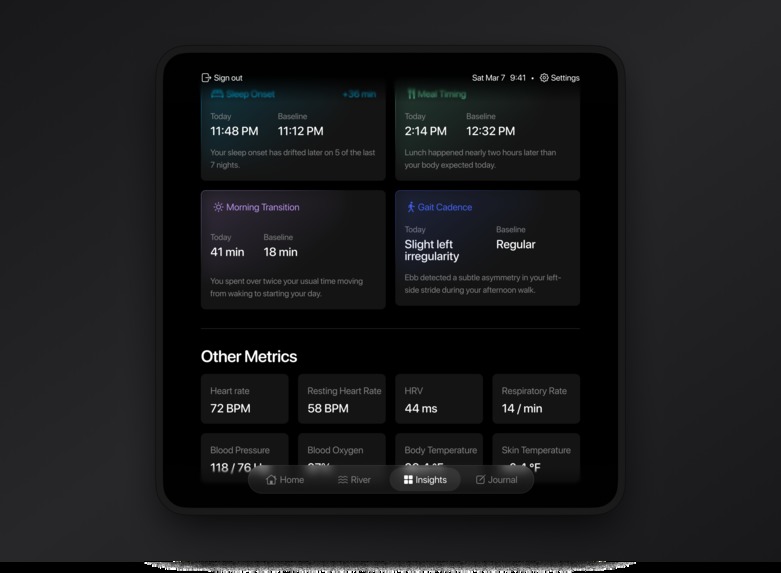
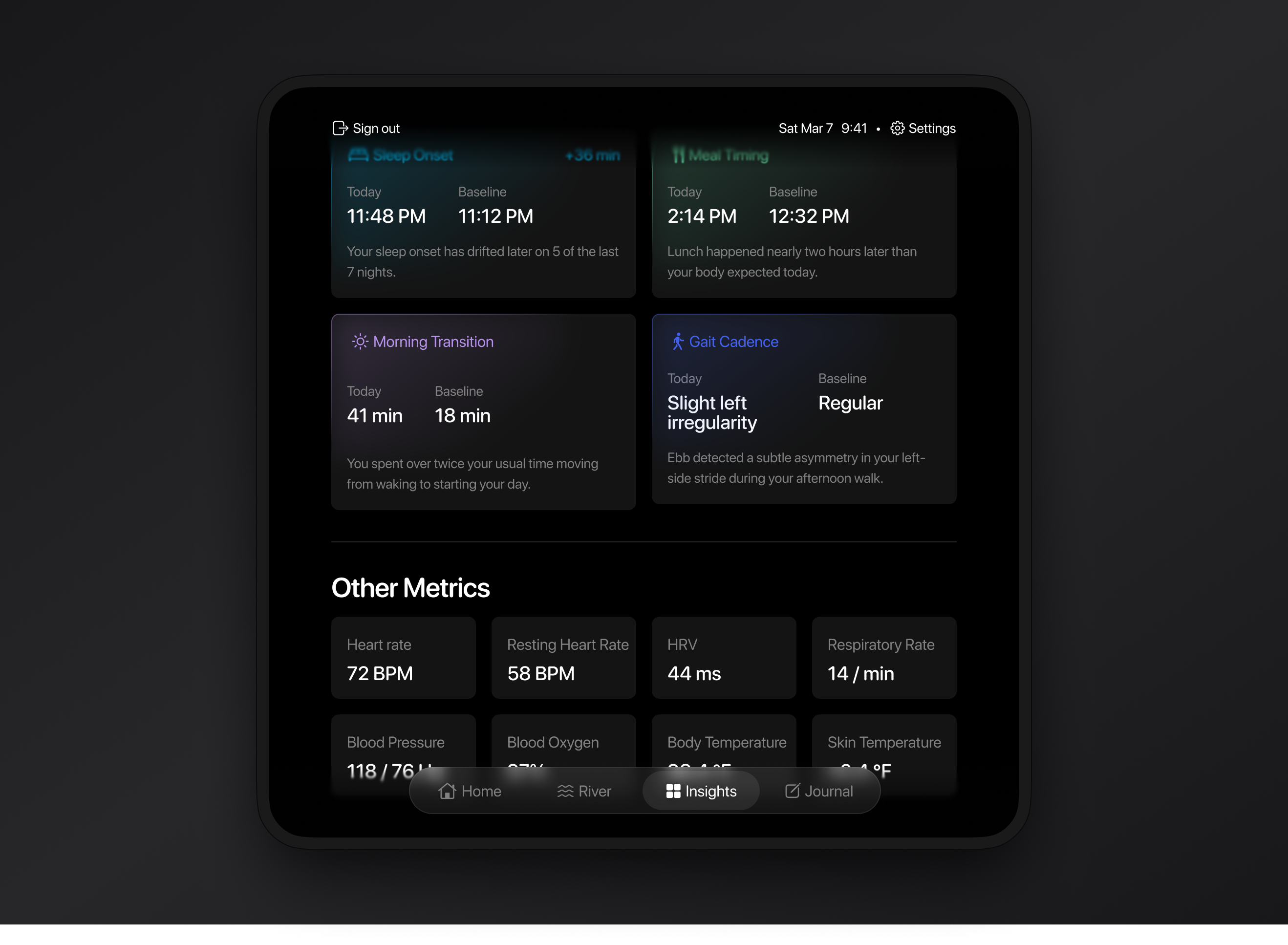
A breakdown of today's four tracked signals compared against your personal baseline.
-
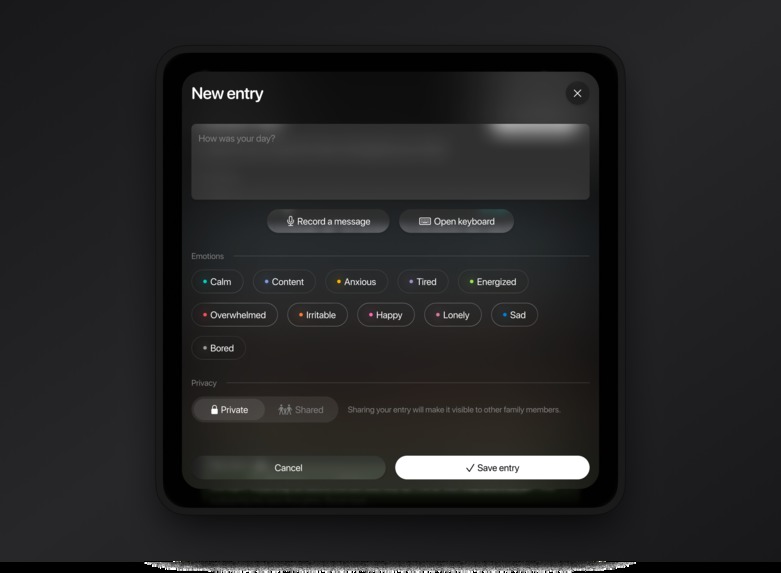
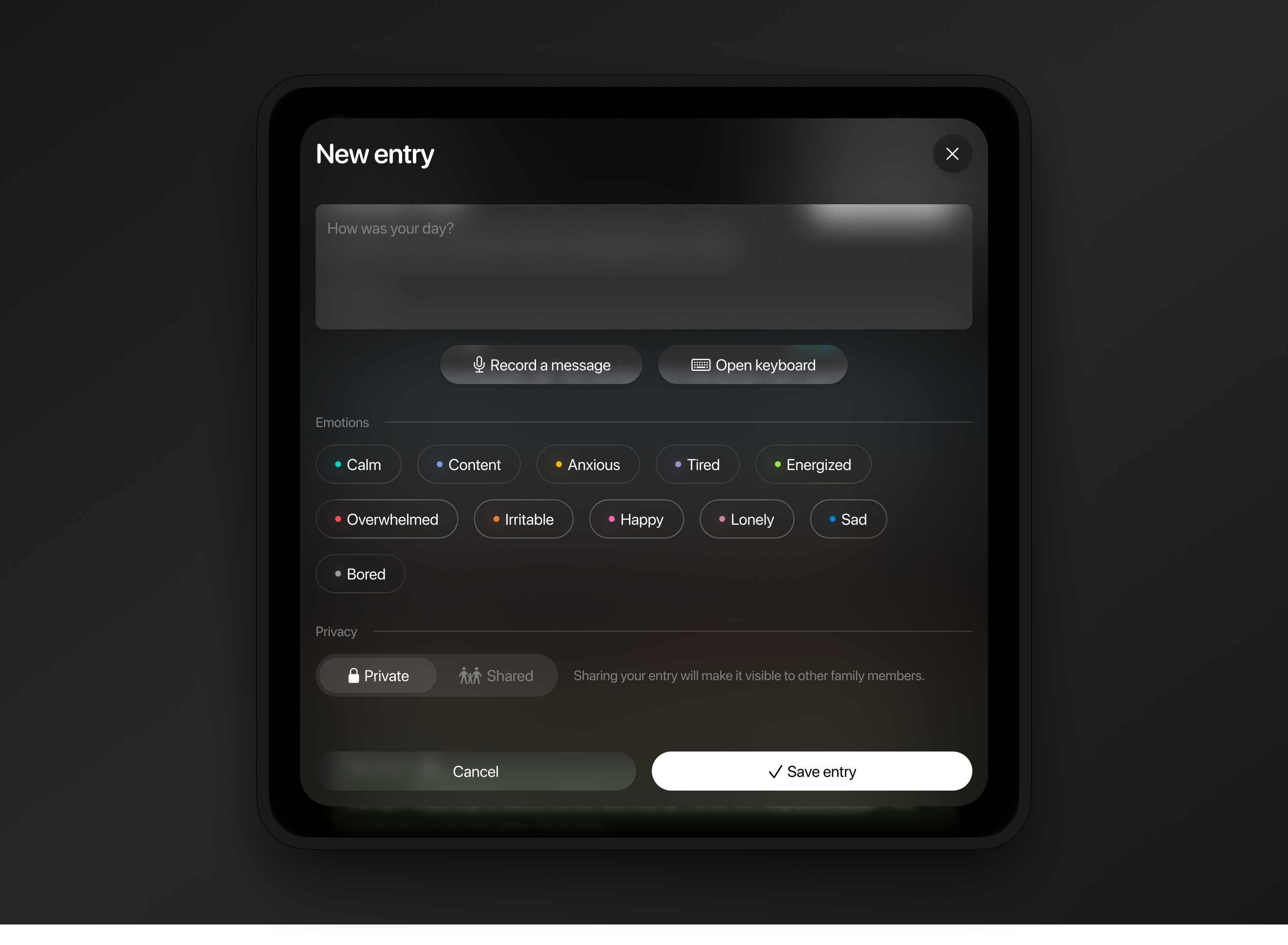
Record how your day felt. Each entry can be kept private or shared with your family.
-
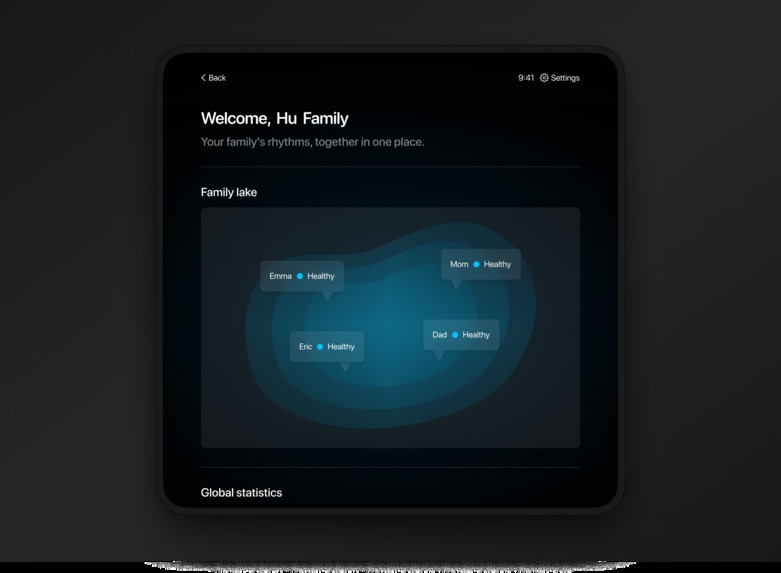
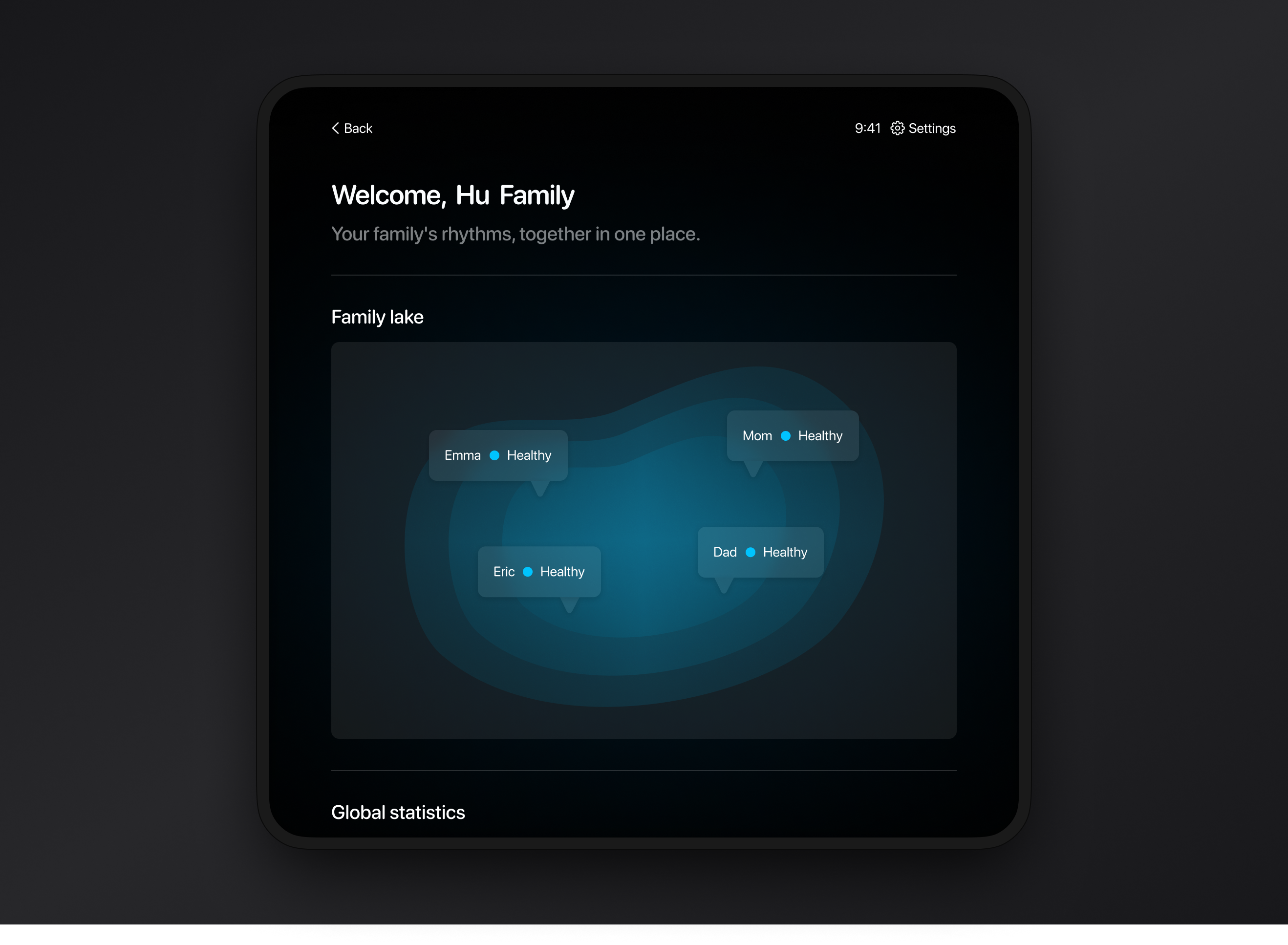
A combined view of all family members' shared rhythm data in one place.
Ebb & Flow
Ebb & Flow is a biometric ring and ambient tablet that tracks four daily signals (sleep onset, meal timing, morning transition, and gait cadence) to measure your body's internal rhythm over time. It surfaces early shifts in those patterns before they become something harder to ignore.
Inspiration
We started with a question that felt almost too simple: why does time feel different depending on how you're living?
In our user interviews, we kept hearing the same experience from people in very different stages of life. A 17-year-old grinding through college applications, a 63-year-old lawyer still sharp at work, and a software engineer quietly burning out all described a similar feeling about time.
Our literature review (e.g., here, here, and here) pointed us toward a deeper explanation: chronoception, or the brain’s internal sense of time perception. Cognitive science suggests that the brain does not actually measure time. Instead, it constructs the feeling of time passing. That experience depends on a combination of factors, including new experiences, bodily rhythms, emotional intensity, and the way memories are formed. When these systems begin to break down due to stress or burnout, people’s sense of time can start to shift in subtle but measurable ways. For instance, daily patterns begin to shift, meal timing starts to drift, morning routines stretch or collapse, the way you walk becomes less regular, etc. These signals are subtle, and most of the time they go unnoticed.
This felt like the right problem to design for: the gap between what the body already knows and what people are consciously aware of and pay attention to. Currently, there is no everyday tool that surfaces these changes in people’s sense of time perception early.
So, we set off to build that kind of tool. Not a clinical test, and not another wellness app that reminds you to drink water! Something that quietly observes and tracks the invisible rhythms of daily life and reflects those patterns back to you in a visualizable way you can actually understand.
What it does
Ebb & Flow is a two-part system designed to make chronoception, the brain’s sense of time passing, visible in everyday life.
Ebb is a biometric ring worn throughout the day that quietly captures four rhythm signals: sleep onset, meal timing, morning transitions, and gait cadence. Together, these signals reflect the user’s daily patterns.
Flow is a home tablet interface that translates those rhythms into a calm visual representation of health over time. It doesn’t just show a raw data dashboard; Flow visualizes changes in daily routines and surfaces insights only when patterns begin to drift.
The system includes an individual view, where users explore their personal rhythm patterns, and a family view, where household members can stay aware of one another’s routines (with full privacy controls). Personal insights remain locked unless the user places their Ebb ring on the tablet, creating a physical consent step before data is shared.
Through these features, Ebb & Flow helps people notice subtle changes in their daily rhythms and better understand how their habits shape their experience of time.
How we built it
We started with in-depth research. We gathered insights through 24 user interviews, 12 literature reviews, and the 55 responses to our survey. From there, we collected some key findings using affinity mapping. We learned that time tends to feel empty when one lives a passive, unhealthy schedule. In contrast, people feel a stronger sense of meaning and fulfillment when their daily rhythms are synchronized. These insights confirmed our direction to make a product that improves well-being by detecting chronoception. It’s a product that refines bodily schedules not only for physical health, but also to build meaning in your life.
To support this concept, we designed Ebb & Flow as a two-part system consisting of a wearable ring and a shared home tablet. Because chronoception emerges from subtle daily behaviors that occur continuously throughout the day, the sensing component needed to be passive, subtle, but always present. A ring allows Ebb to capture the signals without requiring active user input. In contrast, the reflection and interpretation of these data from Ebb needs a more intentional interactive interface. Flow, as a home tablet, provides the visualization for the patterns that can be explored at meaningful moments rather than through some constant notifications.
For the Flow screens, we developed our designs from low to high fidelity mockups in Figma while using Midjourney to visualize the physical tablet and ring. When designing, we focused on crafting a non-judgmental experience for the user. We visualized the user’s daily rhythms in the calm metaphor of a river, signaling disruptions in routines as diverging streams instead of intrusive red dots and notifications. We also avoided the use of colors and phrases with a strong negative connotation, keeping the overall tone neutral and supportive.
We also enhanced our goal of meaning-building by implementing features such as The Journal (which allows the user to document daily thoughts and feelings, reinforcing the chronoceptic data) and The Family Lake (which visualizes the user’s rhythms next to those of other family members, prompting mutual support).
Challenges we ran into
The hardest design challenge was making this super vague concept of chronoception visible in a way that felt intuitive rather than clinical.
We mapped each user's rhythm across two axes: healthiness (how well their body signals align with a healthy baseline) and regularity (how consistent their daily patterns are). This created a design space where a stable, healthy person sits in one corner, and a person with chronic irregular habits drifts toward the other (see slide 27 with our chart graphics). The key insight was that someone can be healthy but irregular — like our lawyer persona, Henry, pulling late nights for a big court case — without that being cause for alarm. The two axes let us distinguish short-term disruption from long-term drift.
Translating this into the river visualization required several iterations. Each strand in the river represents one of Ebb's four tracked signals (sleep onset, meal timing, morning transition, and gait cadence). The solid colored lines show your actual rhythm today. The shadow bands behind them show the variability in your routine over time. When the solid lines flow within the shadow bands, your rhythm is stable. When they begin to diverge or cross irregularly, something is shifting.
Getting the visual language to feel calm, readable, and capable of communicating something as abstract as “chronoception”, or "time", required more iteration than any other part of our design.
Accomplishments that we're proud of
One accomplishment we are especially proud of is identifying and designing around a human sense that is rarely addressed in everyday technology: chronoception. The research we did on time perception and health really helped guide our explorations and designs.
Another achievement we're proud of is how deeply privacy is embedded into the experience itself, rather than treated as an afterthought. Every metric Ebb tracks can be individually toggled between private and shared, so a user might share their sleep onset with family while keeping their morning transition data to themselves. The most intentional moment is the ring-on-tablet unlock: to view a family member's data on Flow, that person must physically place their own Ebb ring on the tablet.
Finally, we’re really proud of all the animations and the craft we put into the prototype. Things like animating the unlock transition, the river, and all the micro interactions between the different pages and screens took time! But we’re really happy how it turned out! :)
What we learned
One important thing we learned is the power of visual metaphors. By representing the abstract concept of chronoception in the form of a river, the concept became easier to understand for the user. Moreover, we broke out of the stereotypical dashboard format of a wellbeing app that only shows the user cold numbers. The gentle metaphor of a river helps the user view their daily rhythm in a more neutral lens, learning to establish meaning through making changes instead of getting bombarded with different data.
What's next for Ebb & Flow
Looking ahead, we see several directions for expanding Ebb & Flow. One step in particular is working with neurology researchers to explore whether Ebb’s signals align with early signs of cognitive decline, such as Alzheimer’s or general dementia. We are also interested in expanding the types of signals the system can observe, such as subtle changes in speech patterns or fine motor movements that may reflect shifts in cognitive rhythm. Those would require us to find new metaphors to represent them in the user interface.
Built With
- adobe-premier
- figma
- figmamake
- midjourney


Log in or sign up for Devpost to join the conversation.