-
EasyWiki Logo
-
EasyWiki Homepage
-
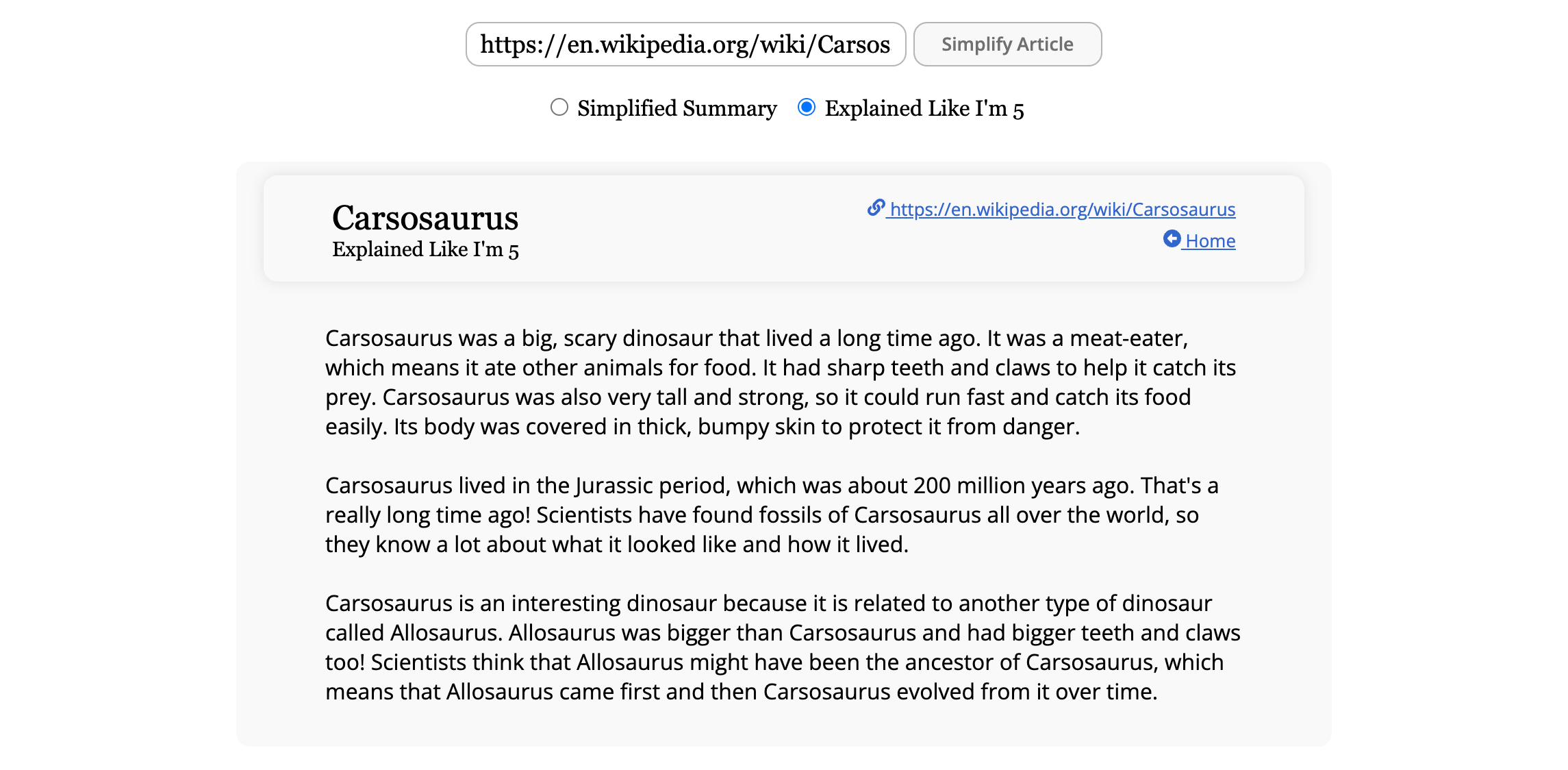
EasyWiki Result Page 1
-
EasyWiki Result Page 2


Inspiration
The inspiration for our hackathon project came from our own experiences struggling with understanding complex language and ideas as kids doing research in elementary school. We wanted to use OpenAI GPT-3's natural language processing capabilities to create a tool that would simplify the language and make the information in Wikipedia articles more accessible to a wider audience, particularly those who may have had similar experiences to our own.
What it does
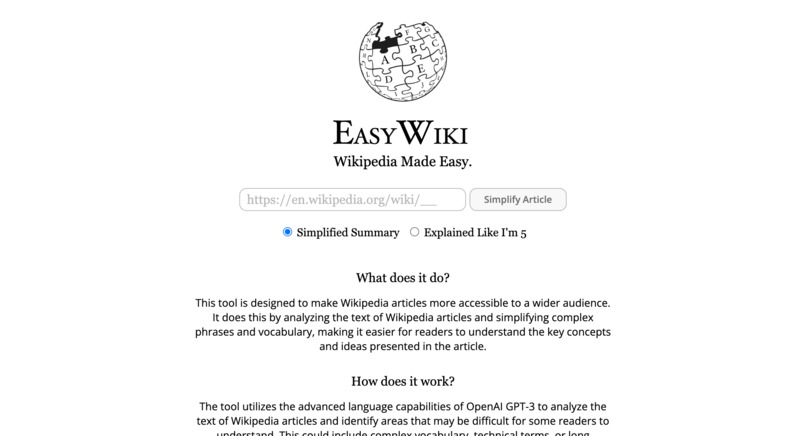
This tool is designed to make Wikipedia articles more accessible to a wider audience. It does this by analyzing the text of Wikipedia articles and simplifying complex phrases and vocabulary, making it easier for readers to understand the key concepts and ideas presented in the article.
Our project has two main modes:
Simplified Summary: This mode simplifies the language in Wikipedia articles, making them easier to comprehend for the average individual. It aims to identify and break down complex sentences, explain technical terms in layman's terms, and overall make the text more approachable and easy to understand.
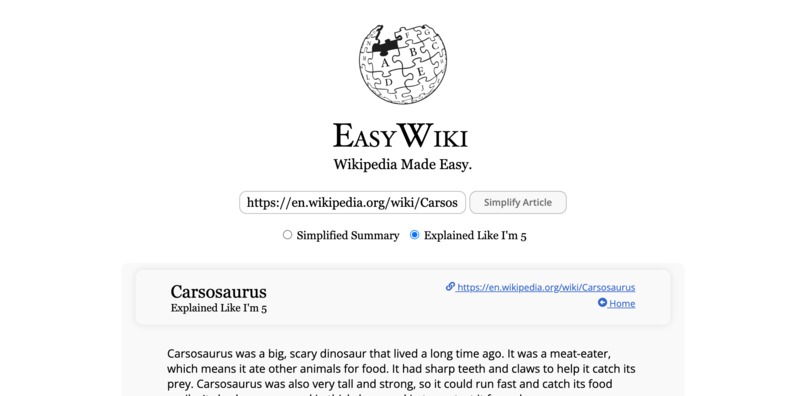
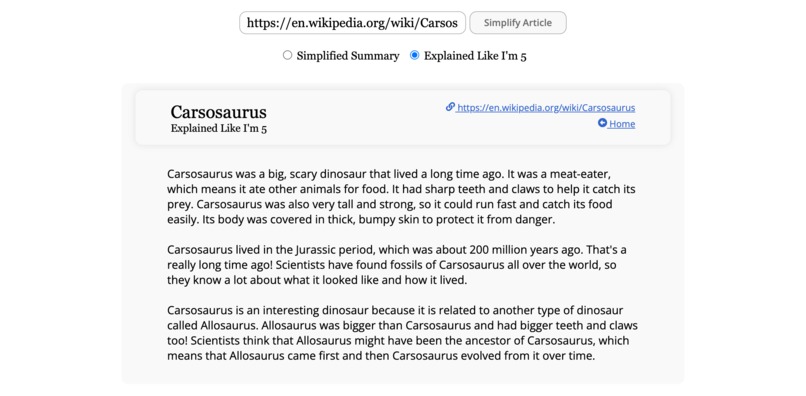
Explained Like I'm 5: This mode takes the idea of simplifying the language even further by explaining the text as if it were explaining it to a 5-year-old. It would use a more childlike vocabulary and simpler sentence structures to make the information more understandable for young children or non-native English speakers.
How we built it
The tool utilizes the advanced language capabilities of OpenAI GPT-3 to analyze the text of Wikipedia articles and identify areas that may be difficult for some readers to understand. This could include complex vocabulary, technical terms, or long sentences with multiple clauses.
Once these complex areas are identified, the tool uses GPT-3’s natural language generation capabilities to rephrase these sections in simpler, more accessible language. This process is done in a way that preserves the integrity of the original content and meaning, while making it easier for readers with varying backgrounds and reading abilities to understand.
Firstly, a mockup for this project was made in Adobe XD. Graphics and imagery for this project were created using Paint.NET.
Significant portions of this project were developed using Node.js and Express. The EJS library was used for efficient server side rendering. Web app is hosted on a Digitalocean web server within a Docker container accessible through a domain using a Nginx reverse proxy.
Challenges we ran into
One of the challenges we ran into while working on this project was the cost associated with using OpenAI GPT-3. Our original concept for the project relied heavily on using OpenAI's GPT-3 API. However, as we began to test our concept, we quickly realized that the length and quantity of API calls we were making was using up too many credits.
To address this issue, we had to streamline and optimize the prompts we were sending to GPT-3 in order to get responses quickly and with minimal financial strain. This involved carefully crafting our prompts to be as specific and clear as possible, so that the model could understand our intent and provide the desired output. Additionally, we also tried to optimize the way we store the data, so that we can make use of the previous responses and avoid calling the API for the same inputs.
We attempted to make a chrome extension that would go hand and hand with this website, however, google chrome requires a registration fee to post your extension and so we were only able to run it locally. This extension was capable of detecting when a Wikipedia site was open, copying the link to the keyboard and opening the main website allowing easy access for users.
Overall, we had to make some adjustments to our original concept in order to make it financially viable, but we were still able to achieve our goal of creating a tool that simplifies and explains Wikipedia articles in a way that is easy for the average person to understand.
Accomplishments that we're proud of
One accomplishment that we are proud of is the fact that we were able to make the tool work effectively in the limited time provided during the hackathon. Given the time constraints of a hackathon, it can be challenging to take an idea from concept to a working prototype within the allotted time. However, our team was able to work efficiently and effectively to develop a functional tool that was able to simplify and explain Wikipedia articles in a way that was easy for the average person to understand.
What we learned
This hackathon project was the first time any of us had used AI tools in our software design and solution. Experimenting with AI was a fun and rewarding experience for the team. We learned a lot about the capabilities and limitations of AI and how it can be applied to different problem domains.
Using GPT-3 specifically, we learned how to effectively use its API and how to optimize our prompts to get the desired output. We also learned how to handle the costs associated with using GPT-3 and how to make the most of the API calls in a cost-effective way.
What's next for EasyWiki
There are a few potential next steps for this project. One potential strategy could be to implement advertising services and use the funds from these new revenue streams to scale up the project.
Although we do not have an exact roadmap for where we'll take the project, the next steps would likely be to continue to refine and improve the tool, and to explore different strategies for scaling it up and making it more widely available to people who could benefit from it.
Built With
- adobexd
- docker
- ejs
- express.js
- git
- javascript
- node.js
- openai
- paint.net


Log in or sign up for Devpost to join the conversation.