EasyView: Clarity for Every Brain
Inspiration
For most people, the internet is simply a tool for information.
But for millions of neurodivergent individuals — including people with ADHD, dyslexia, autism spectrum conditions, and sensory processing differences — the web can often feel overwhelming rather than empowering.
Long dense paragraphs. Complex jargon. Flashing ads. Moving animations. Walls of text with no structure.
What many people see as a normal webpage can feel like cognitive overload to someone whose brain processes information differently.
For a dyslexic reader, letters may appear to move or blur. For someone with ADHD, constant visual distractions can break concentration every few seconds. For individuals with sensory sensitivity, flashing elements can cause discomfort or anxiety.
This means something as basic as reading an article, filling a form, or understanding instructions online becomes exhausting.
And when access to information becomes difficult, it doesn't just affect convenience.
It affects education, career opportunities, digital independence, and confidence.
As developers, we felt that accessibility tools often focus on visual disabilities, while cognitive accessibility remains deeply overlooked.
So we asked ourselves a simple but powerful question:
What if the internet could adapt to different brains instead of forcing every brain to adapt to the internet?
That idea became EasyView.
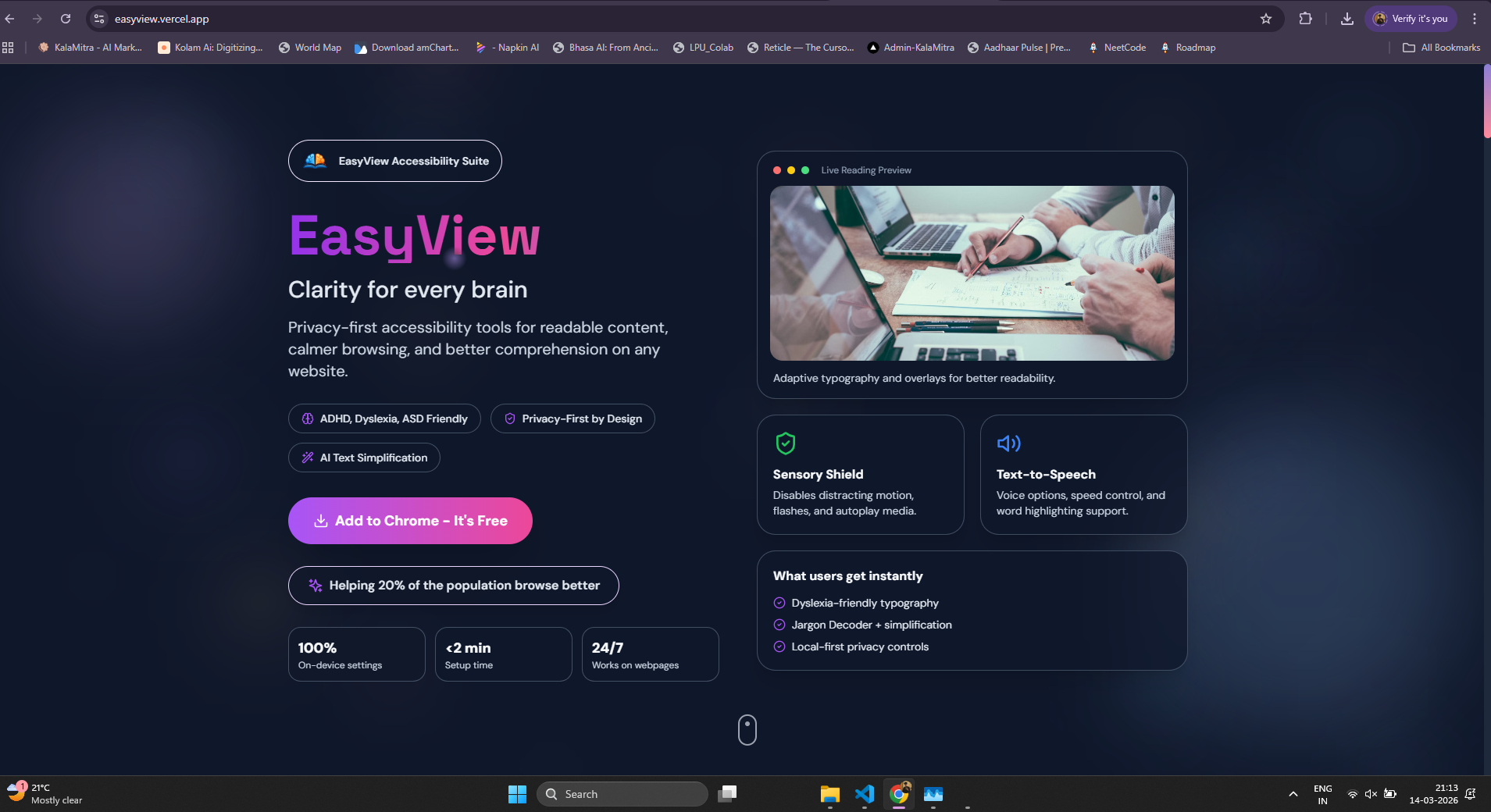
A Chrome extension designed to reduce cognitive friction on the web and create a calmer, clearer reading experience for neurodivergent users.
Instead of rebuilding the internet, EasyView works as an intelligent accessibility layer on top of it.
What it does
EasyView is an accessibility-focused Chrome extension that helps neurodivergent users navigate web content more comfortably.
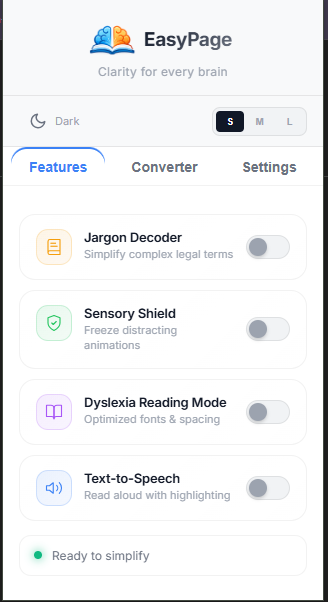
It introduces multiple assistive features designed specifically for cognitive accessibility.
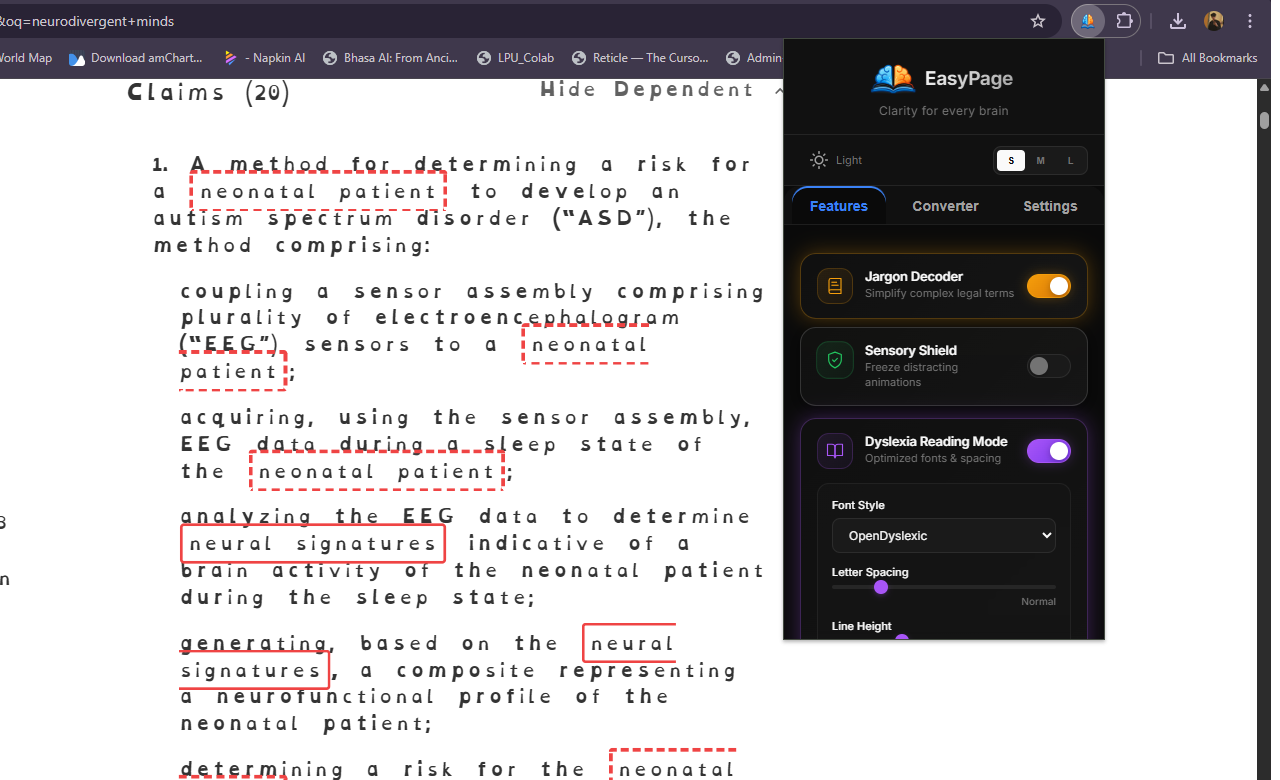
Dyslexia-Friendly Reading Mode
EasyView provides customizable typography settings including:
- Dyslexia-friendly fonts
- Adjustable letter spacing
- Word spacing controls
- Line height adjustments
- Larger readable font sizes
These changes make text easier to track and process.
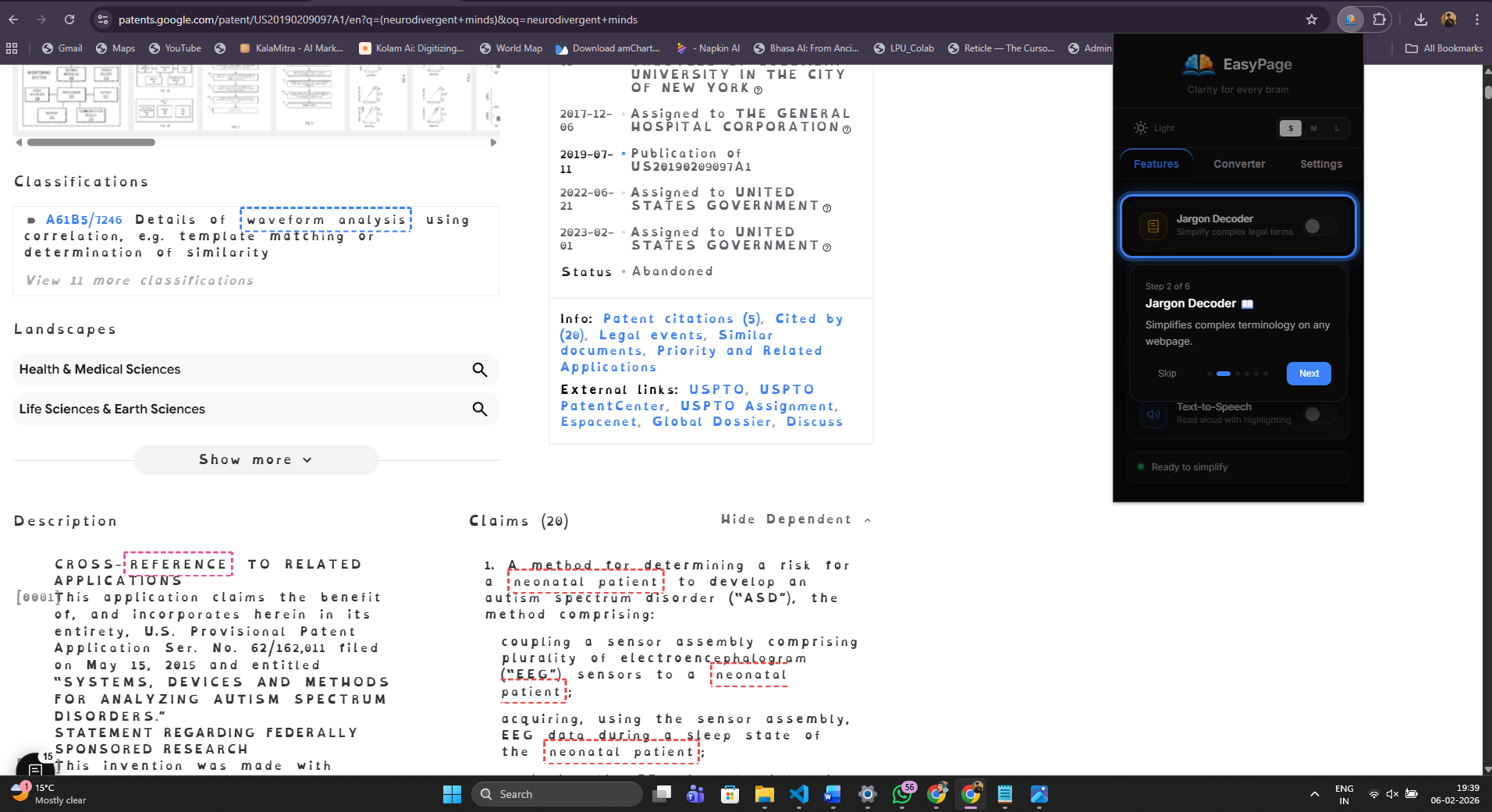
AI-Powered Jargon Decoder
Many online articles contain complex terminology, especially in domains like:
- medical information
- legal content
- finance
- technical documentation
EasyView simplifies difficult terms into clear and understandable explanations, reducing the mental effort required to read.
Sensory Shield
Many neurodivergent users are sensitive to visual noise.
EasyView can:
- pause flashing elements
- reduce distracting animations
- create a calmer reading environment
This helps users maintain focus without sensory overload.
Text-to-Speech Reading
Users can listen to webpage content through:
- natural speech voices
- adjustable speed
- synchronized word highlighting
This helps people who struggle with reading fatigue or decoding written text.
Bionic Reading Mode
EasyView implements bionic reading techniques, where the beginning of words is emphasized to guide the brain's reading flow and improve focus.
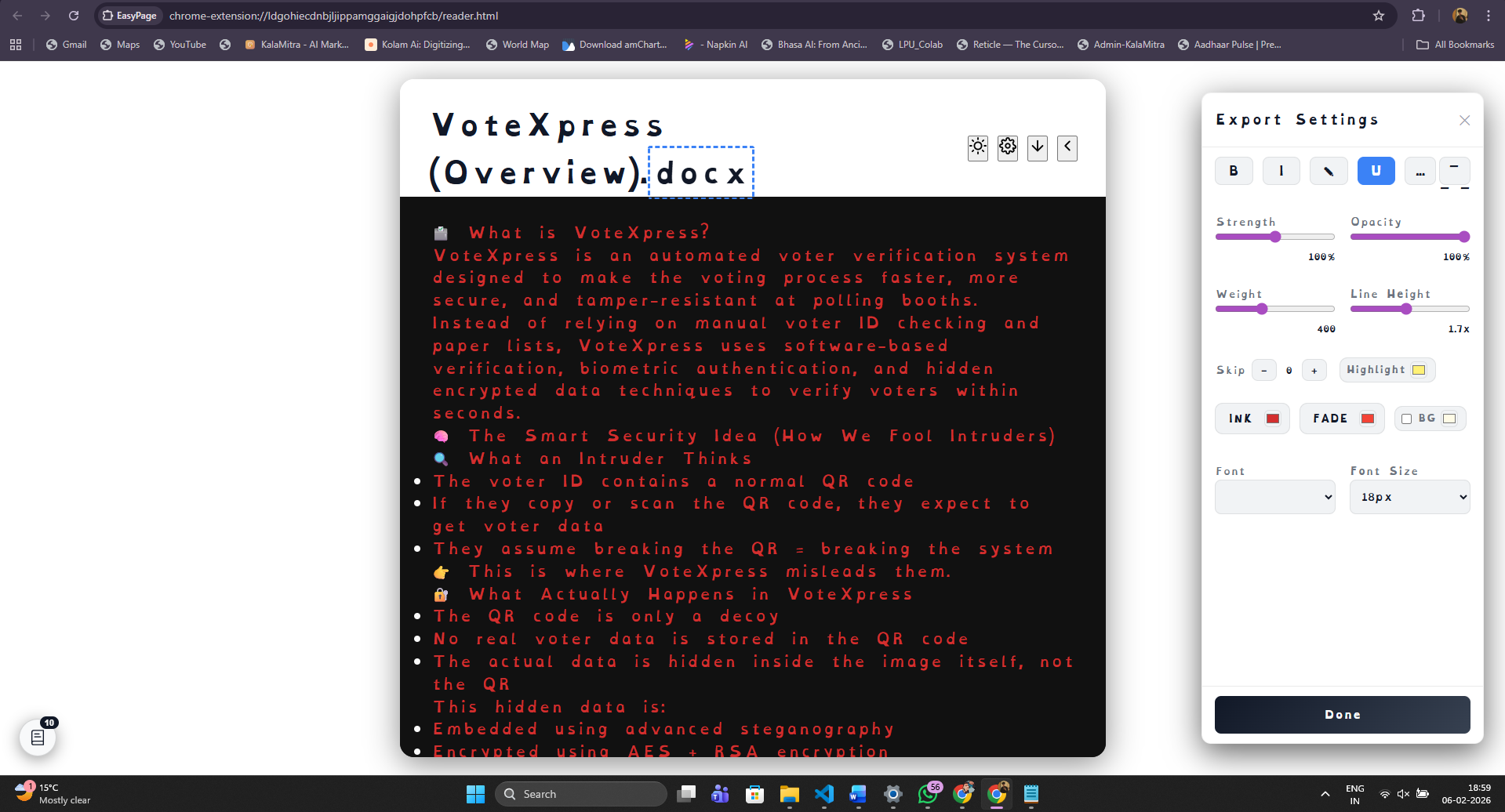
Customizable Reading Environment
Users can apply overlays and themes that reduce eye strain and visual stress.
The goal is not just readability.
It is cognitive comfort.
EasyView transforms overwhelming web pages into clearer, calmer, and more accessible experiences.
How we built it
EasyView was developed as a lightweight browser-based accessibility system.
Chrome Extension Layer
The extension captures the content of the active webpage and identifies readable sections such as paragraphs and headings.
This content is then processed through EasyView’s transformation pipeline.
Content Processing Engine
The system analyzes webpage text and applies cognitive accessibility transformations such as:
- typography optimization
- structural formatting
- jargon simplification
- reading assistance features
To enable intelligent language understanding and simplification, EasyView leverages Amazon Nova foundation models through Amazon Bedrock. These models help interpret complex sentences, decode technical jargon, and restructure dense information into clearer, more accessible formats — allowing EasyView to act as a real-time cognitive reading assistant.
Content Transformation Logic
The simplified output can be represented conceptually as:
$$ T_{accessible} = f(T_{web}, R_{cognitive}, S_{structure}) $$
Where:
- (T_{web}) = original webpage content
- (R_{cognitive}) = cognitive accessibility rules
- (S_{structure}) = readability improvements
- (T_{accessible}) = transformed accessible content
User Interface Layer
The processed content is displayed directly inside the browser, allowing users to toggle accessibility features instantly without leaving the page.
The result is a real-time cognitive accessibility layer for the internet.
Challenges we ran into
Building EasyView presented several technical and design challenges.
Preserving Meaning During Simplification
AI simplification must maintain the original meaning of content. Over-simplifying text can remove critical context.
We had to carefully refine processing strategies to balance clarity and accuracy.
Extracting Content from Different Websites
Websites use many different HTML structures, which made consistent content extraction difficult.
We had to design flexible extraction logic to handle multiple webpage layouts.
Designing for Cognitive Accessibility
Accessibility for neurodivergent users is not just about UI.
It requires understanding how different brains process information, which involved research into cognitive ergonomics and reading behavior.
Maintaining Real-Time Performance
Because EasyView runs inside the browser, the system needed to remain lightweight and responsive without slowing down the browsing experience.
Accomplishments that we're proud of
We are proud that EasyView:
- Addresses a real accessibility gap affecting millions of people
- Creates a practical tool that can be used every day
- Brings attention to cognitive accessibility, which is often overlooked
- Demonstrates how technology can support inclusive digital experiences
But most importantly, we are proud that EasyView represents technology built with empathy.
It shows that innovation does not always mean building something new.
Sometimes it means making the world easier to navigate for those who experience it differently.
What we learned
Working on EasyView taught us several important lessons.
Accessibility is not a niche feature.
It is a fundamental part of good design.
We also learned that:
- AI can act as a cognitive assistant, not just an automation tool
- Designing for neurodivergent users often improves usability for everyone
- Technology becomes meaningful when it solves human problems
The most important lesson was simple:
When you design for the edges of human experience, you improve the center as well.
What's next for EasyView — Clarity For Every Brain
EasyView is just the first step.
Our vision is to expand it into a complete cognitive accessibility platform.
Future plans include:
- Personalized accessibility profiles for different cognitive needs
- AI-assisted reading summaries for complex content
- learning-mode assistance for students with dyslexia and ADHD
- voice-guided comprehension tools
- integration with educational and research platforms
Our long-term vision is to create a system where the internet becomes adaptive to the mind of the reader.
A world where no one struggles to access knowledge simply because their brain processes information differently.
Because clarity should not depend on how your brain works.
Clarity should be universal.
Clarity should be for every brain.
Built With
- amazon-api-gateway
- amazon-bedrock
- amazon-cloudwatch
- amazon-nova
- amazon-web-services
- aws-lambda
- bionic-reading
- chrome-extension-api
- chrome-web-store
- cognitive-accessibility-design
- css3
- dom-manipulation
- git
- github
- html5
- javascript
- natural-language-processing
- open-dyslexic-font
- python
- web-speech-api

Log in or sign up for Devpost to join the conversation.