-
-
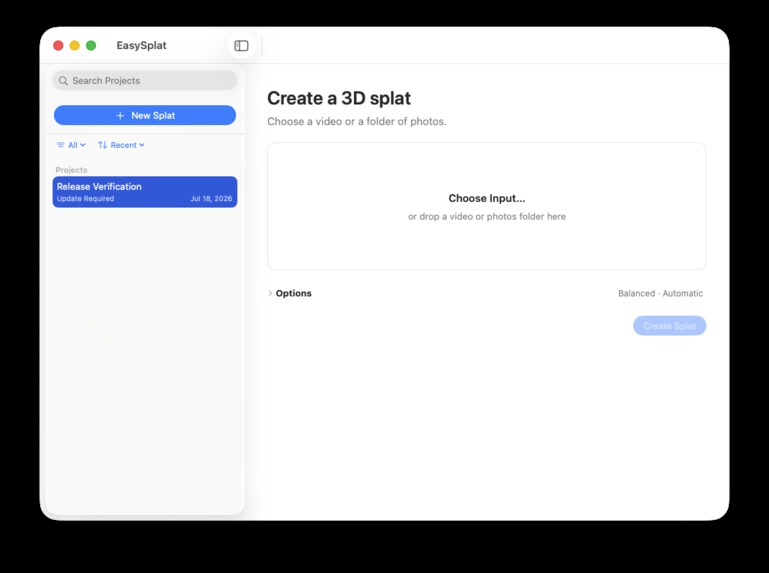
Primary interface for EasySplat
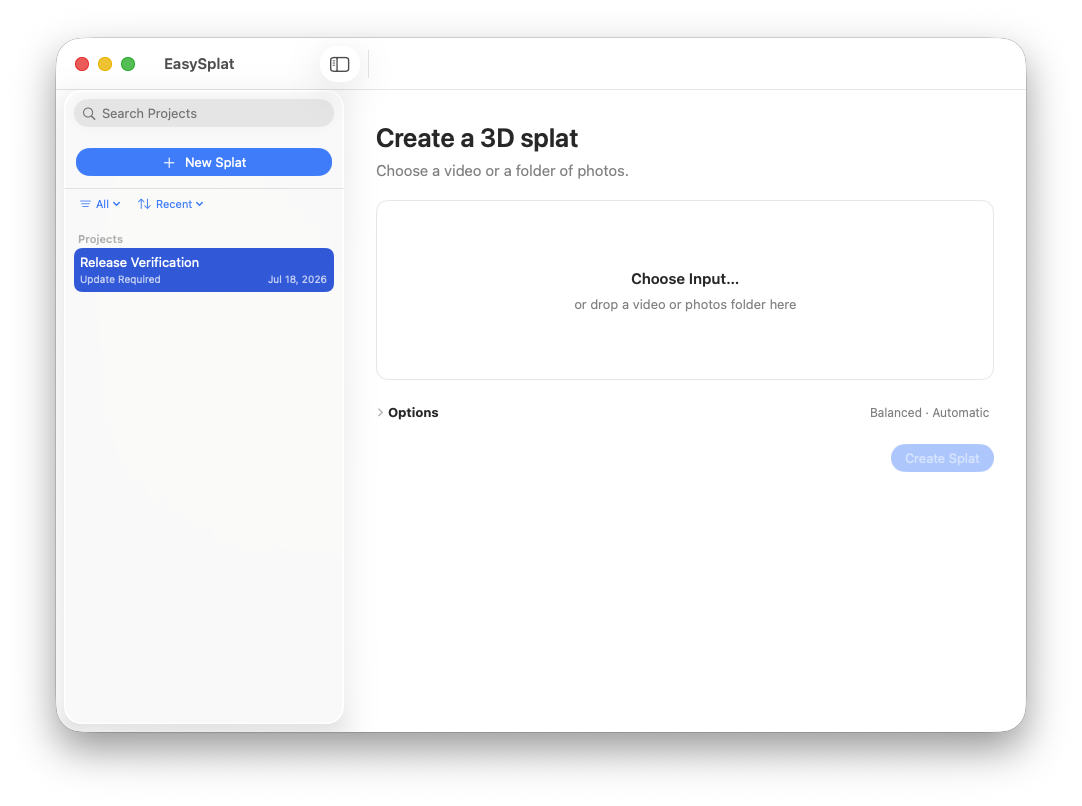
EasySplat
EasySplat is the fastest OSS app that turns photos or videos into a Gaussian splat on Apple Silicon Macs!
Drag in your files, wait, and EasySplat gives you a .ply. (No NVIDIA GPU required!)
Inspiration
Gaussian splatting is incredibly cool- even Corridor Digital has created videos on GS. But... creating splats on a Mac still felt unnecessarily difficult.
Most of the available research and software assumes you have an NVIDIA GPU and CUDA. Apple GPUs work differently, and a lot of the existing code either doesn't run on a Mac or performs poorly once it's ported.
I wanted a workflow that a normal Mac user could actually use: drag in photos or a video and get a splat back, without having to wait an eternity.
How I built it
I already had a working EasySplat baseline built largely with GPT-5.2 using COLMAP, Brush, and several other existing tools.
For Build Week, I gave GPT-5.6 Ultra in Codex the repository, a list of more than 100 potentially relevant research papers, and a very broad objective: make the application materially better, however you see fit. It could read the research, inspect the codebase, implement promising ideas, benchmark them, reject failures, and keep whatever actually improved the app. I gave it very little technical handholding. I didn't tell it which algorithms to test, which parts of the pipeline to rewrite, or how to implement the optimizations.
Most of my prompts were operational: continue from where you stopped, produce a working local build so I could test it, keep the project focused on a usable release, and stop spending time on low-impact details. I handled the product goal, tested the builds and outputs, and decided when it was time to wrap up. GPT-5.6 made the overwhelming majority of the research and engineering decisions itself.
Challenges
Research in academia tends to overstate their benchmarks! When you try to replicate a paper, your real world results don't exactly reflect the exact hardware, dataset, and evaluation setup used in apaper.
GPT-5.6 narrowed the original paper list to 23 plausible candidates, then implemented and A/B tested around 15-20 different ideas. Sadly, most of them failed. (It tested approaches involving SparseAdam, Skip-GS, MCMC densification, QuadBox, alternative feature extractors, several other methods; some did nothing, some reduced quality, some made the pipeline slower)
There were also licensing problems. (XFeat and ALIKE-Tiny had training-data restrictions that made them a poor fit for a commercially usable open-source project,SuiteSparse created a GPL-2.0 compatibility problem for the way EasySplat is distributed)
GPT-5.6 took individual ideas from different sources, adapted them to Apple Silicon, added custom Metal code, and combined them into one workflow.
Accomplishments
On a 250-frame drone video benchmark:
- Total processing time dropped from about 21min to 3 minutes and 14 seconds, about a 6.5× end-to-end speedup
- The 3D mapping stage became 1.68× faster w/o noticeable quality loss on the benchmark
- A custom Metal optimization reduced Gaussian-training time by about 20%
- The application's core download dropped from 159 MB to 9.3 MB
I gave it very little guardrails to follow! GPT-5.6 operated like an autonomous research engineer for almost a week: reading papers, inspecting a real codebase, implementing experiments, running benchmarks, rejecting regressions, and deciding what to try next with very little direction from me.
What's next for EasySplat?
EasySplat is now being released as an open-source project.
There's still a lot of room for Gaussian-splatting methods designed specifically for Apple GPUs instead of treating Apple Silicon as a secondary CUDA target.
Built With
- codex
- gpt-5.6

Log in or sign up for Devpost to join the conversation.