Inspiration
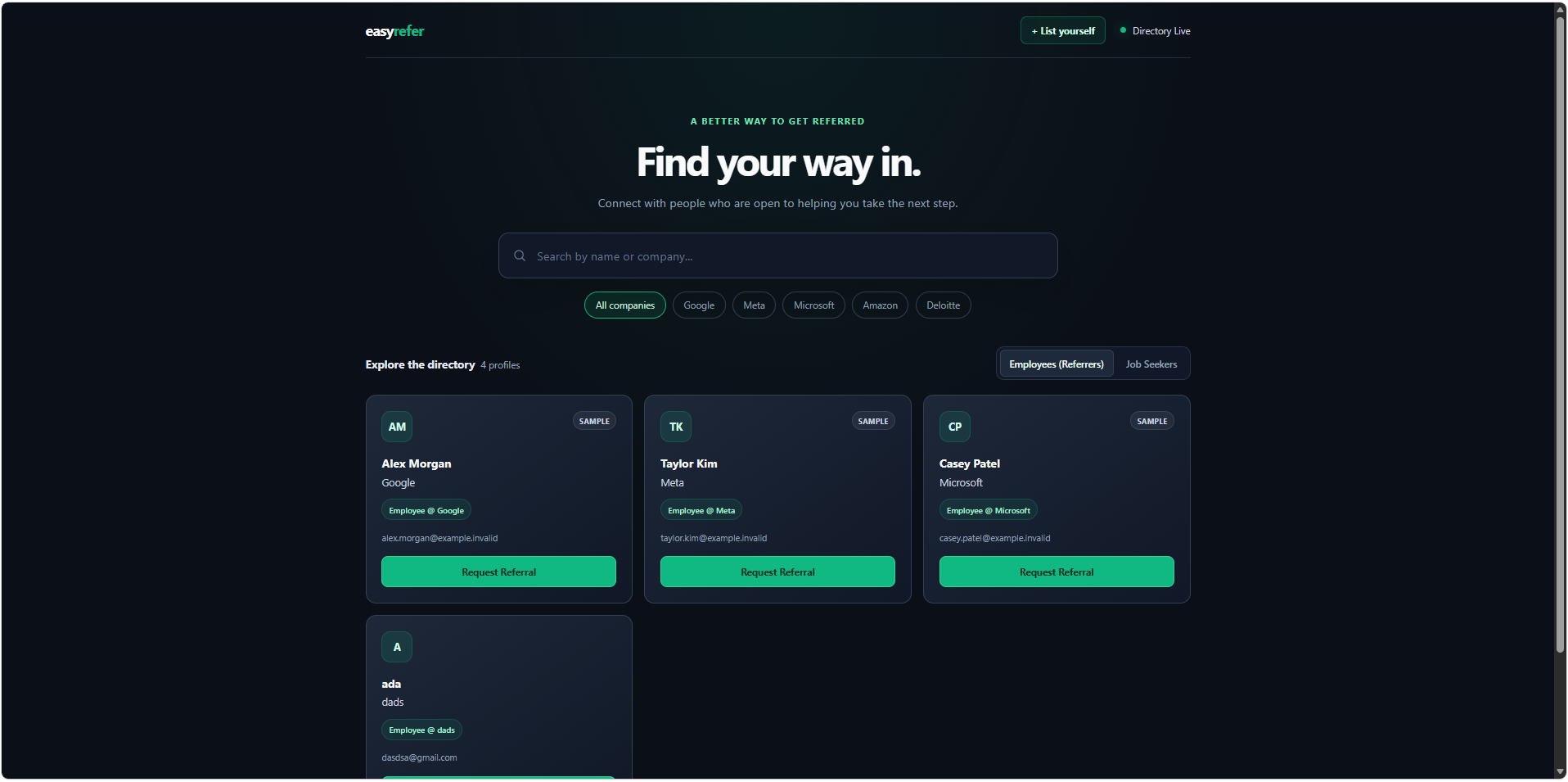
Getting referred for a job increases an applicant's interview chances significantly, but finding employees willing to refer you usually means cold messaging strangers and getting lost in spam folders. We built easyrefer to solve this: a minimalist, opt-in peer-to-peer referral directory that connects job seekers directly with employees actively open to providing referrals.
What It Does
- Opt-In Directory: Instead of a closed company directory, users choose to list themselves as either looking for a referral or open to giving one.
- Lightning-Fast Search: Real-time company and name filtering with popular company quick-tags.
- Direct Native Handshake: Clicking "Request Referral" opens a detail dialog and automatically pre-fills a native
mailto:email draft targeted directly to the referrer's work email. - Two-Way Ecosystem: Employees can toggle to the "Job Seekers" view to proactively offer referrals to candidates.
- Instant Onboarding: A clean form to list yourself in seconds, with profile validation and state persistence powered by browser
localStorage.
How We Built It
To keep the proof-of-concept lightweight, fast, and entirely dependency-free, we built easyrefer as a single-file application using:
- HTML5 & Modern CSS (Tailwind via CDN): For a clean, dark workspace aesthetic inspired by Linear and Vercel.
- ES6+ Vanilla JavaScript: For dynamic search filtering, modal controls, and robust input validation.
- Browser
localStorage&mailto:Protocols: To achieve instant persistence and direct communication with zero backend or database setup.
How the Devpost Learn Skill Pack Helped
The project was systematically planned and built using the official Devpost Learn Skill Pack inside our coding agent:
1-start&2-scope: Defined our core product boundary, keeping the PoC tightly focused on opt-in referral matching without feature bloat.3-prd&4-spec: Laid out our exact product behaviors, dataset schemas, and error fallbacks before writing code.5-build: Guided an ordered execution checklist to verify search performance, email fallbacks, and storage error handling.
Challenges We Faced
Balancing a rich marketplace experience with a zero-backend proof-of-concept required careful design choices. We avoided fake "verified" badges to maintain trust, opting instead for honest role labels and clear fallback behaviors for profiles with missing work emails.
What We Learned
We learned that a minimalist UI with high information density beats complex feature sets every time—especially when building utility-first tools under hackathon time constraints.
Built With
- ai
- coding
- devpost
- html5
- javascript

Log in or sign up for Devpost to join the conversation.