-
-
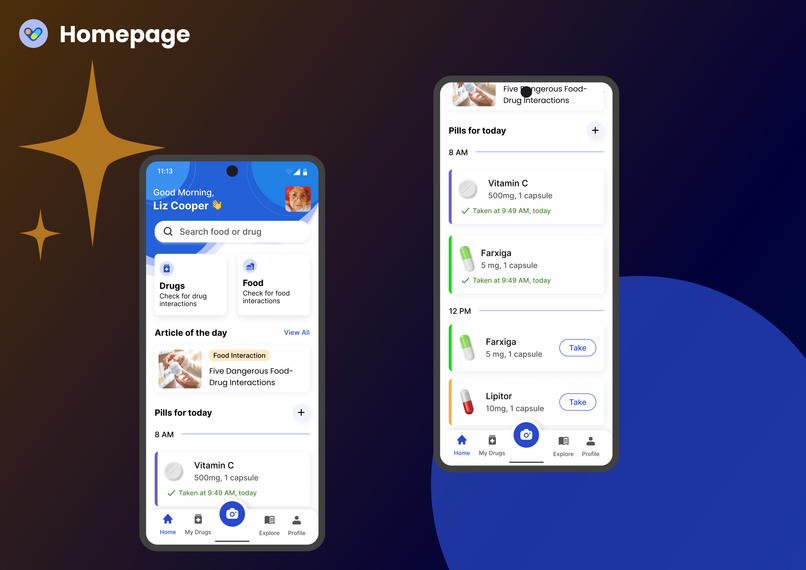
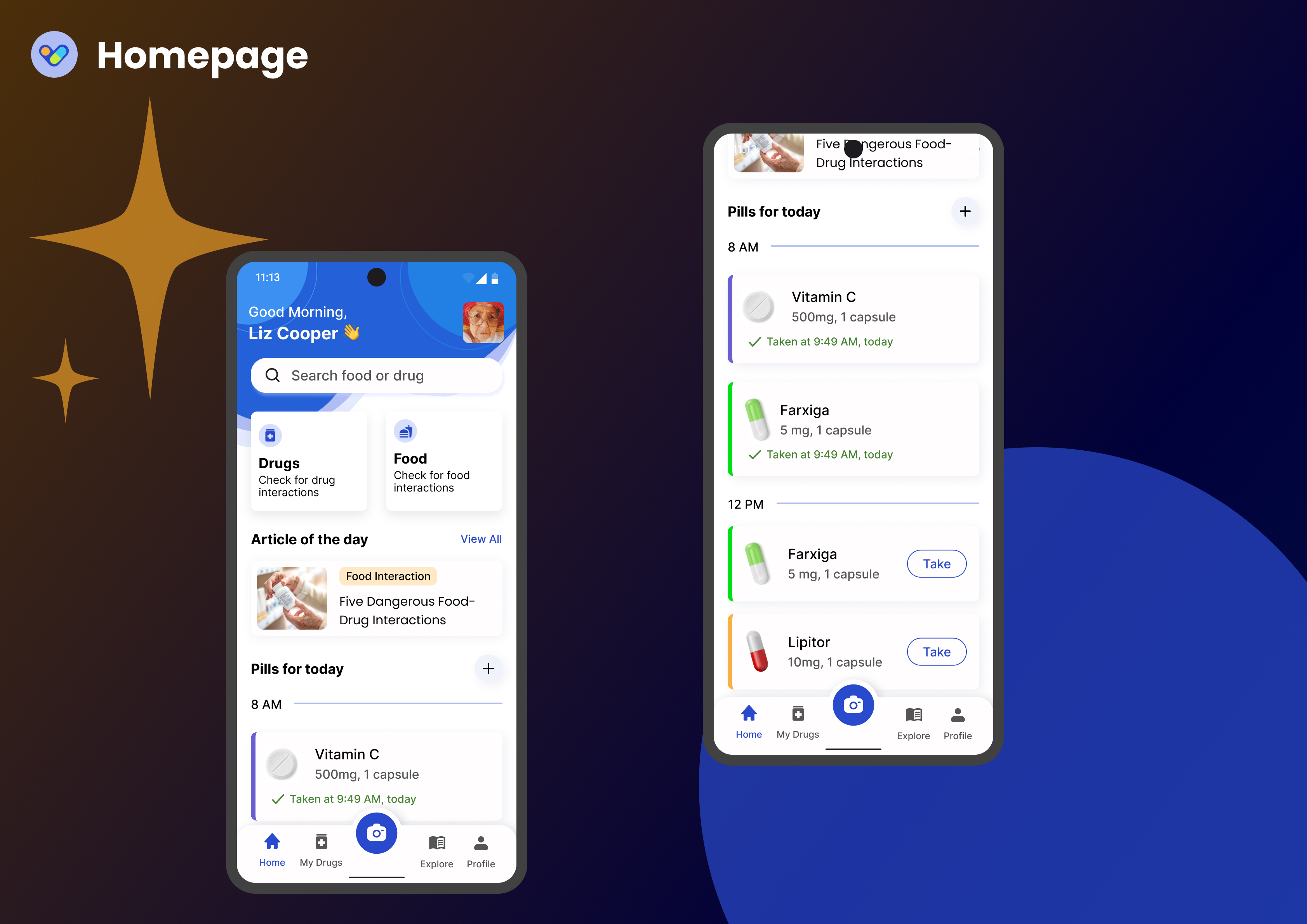
Homepage
-
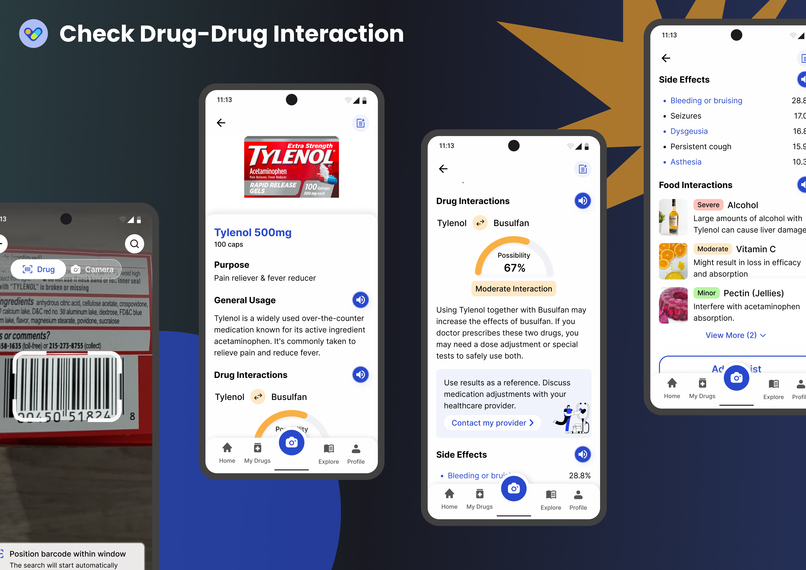
Check drug-drug interactions
-
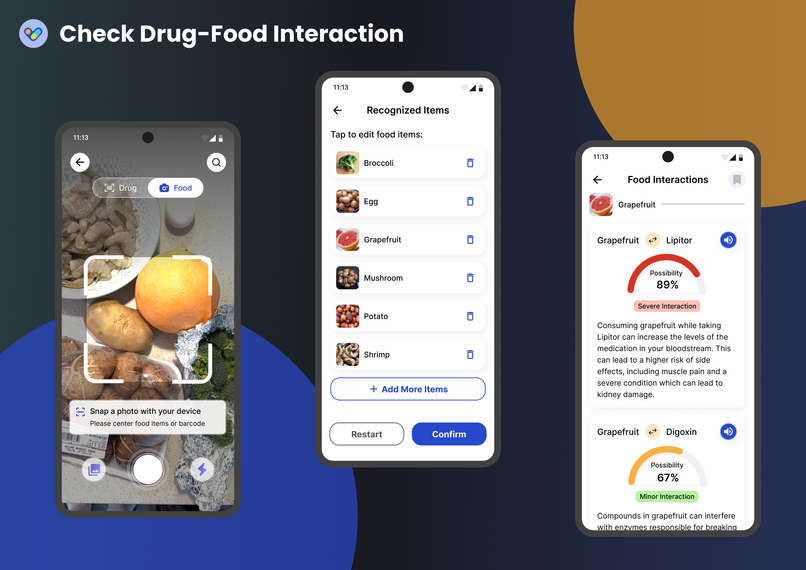
Check drug-food interactions
-
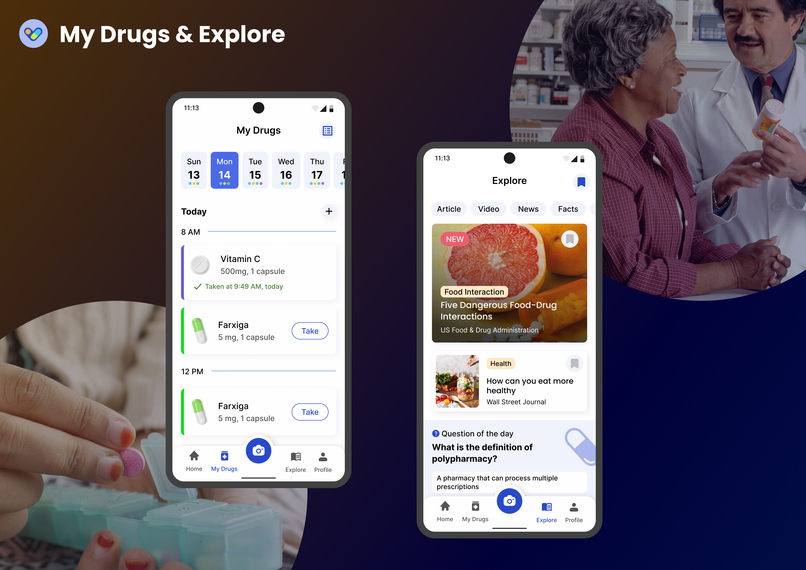
My drugs & explore
-
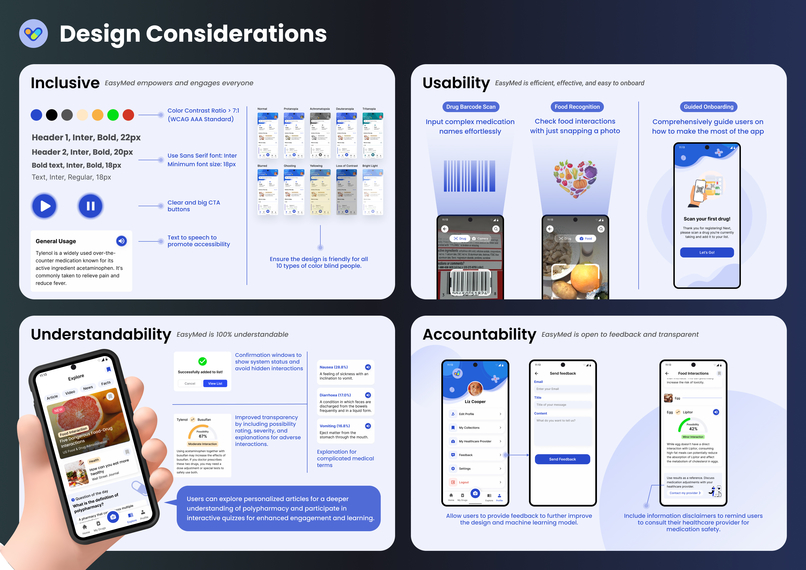
Design considerations
-
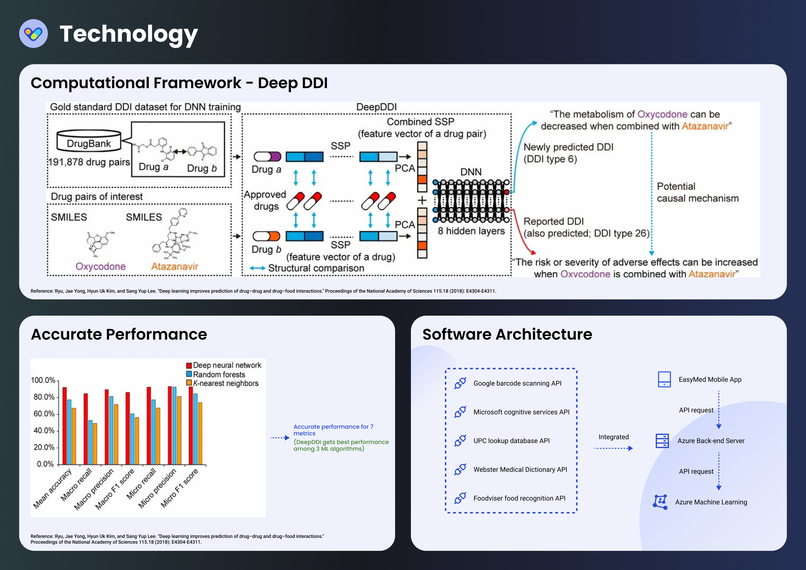
Technology
-

Inspiration
While we were taking a class called HCI for healthcare, we had the chance to visit many healthcare facilities around the San Diego area. The visit to the geriatrics department left a deep impression on us as the physicians told us that many older adults are taking many drugs and are often concerned about medical complications and potential interactions. However, the doctor often lacks time to explain every detail to the patients and they also have trouble managing the drugs prescribed by different doctors. To ease the concerns of many older adults or patients who are taking multiple drugs at the same time and reduce the workload for physicians, we decided to design an easily accessible mobile app to help them check any potential drug or food interactions.
What it does
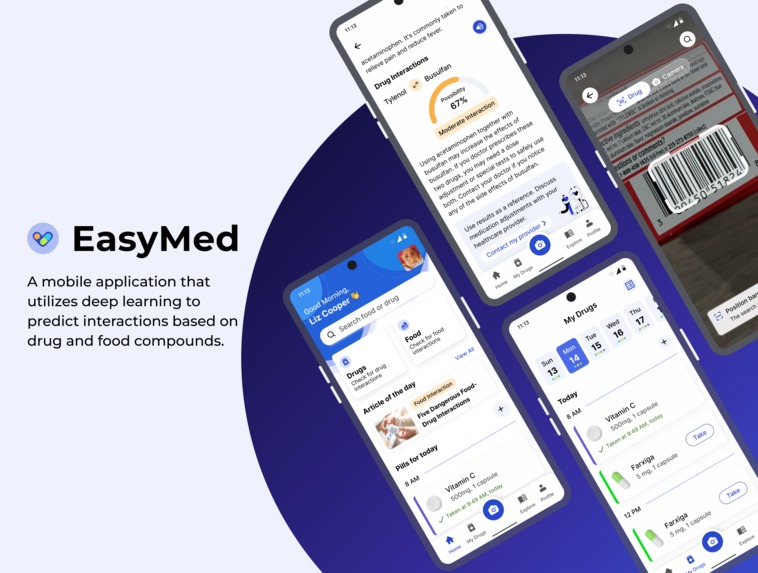
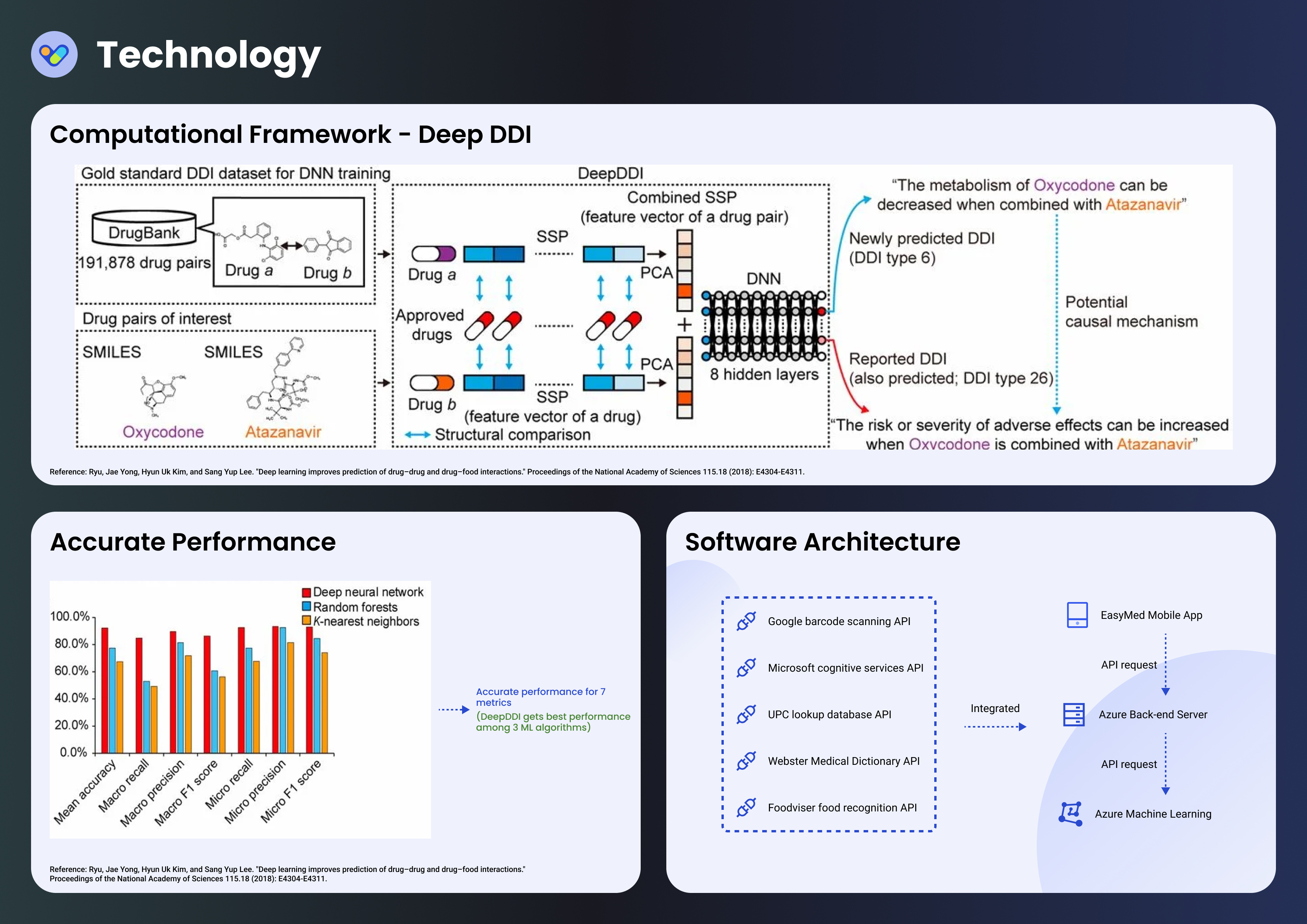
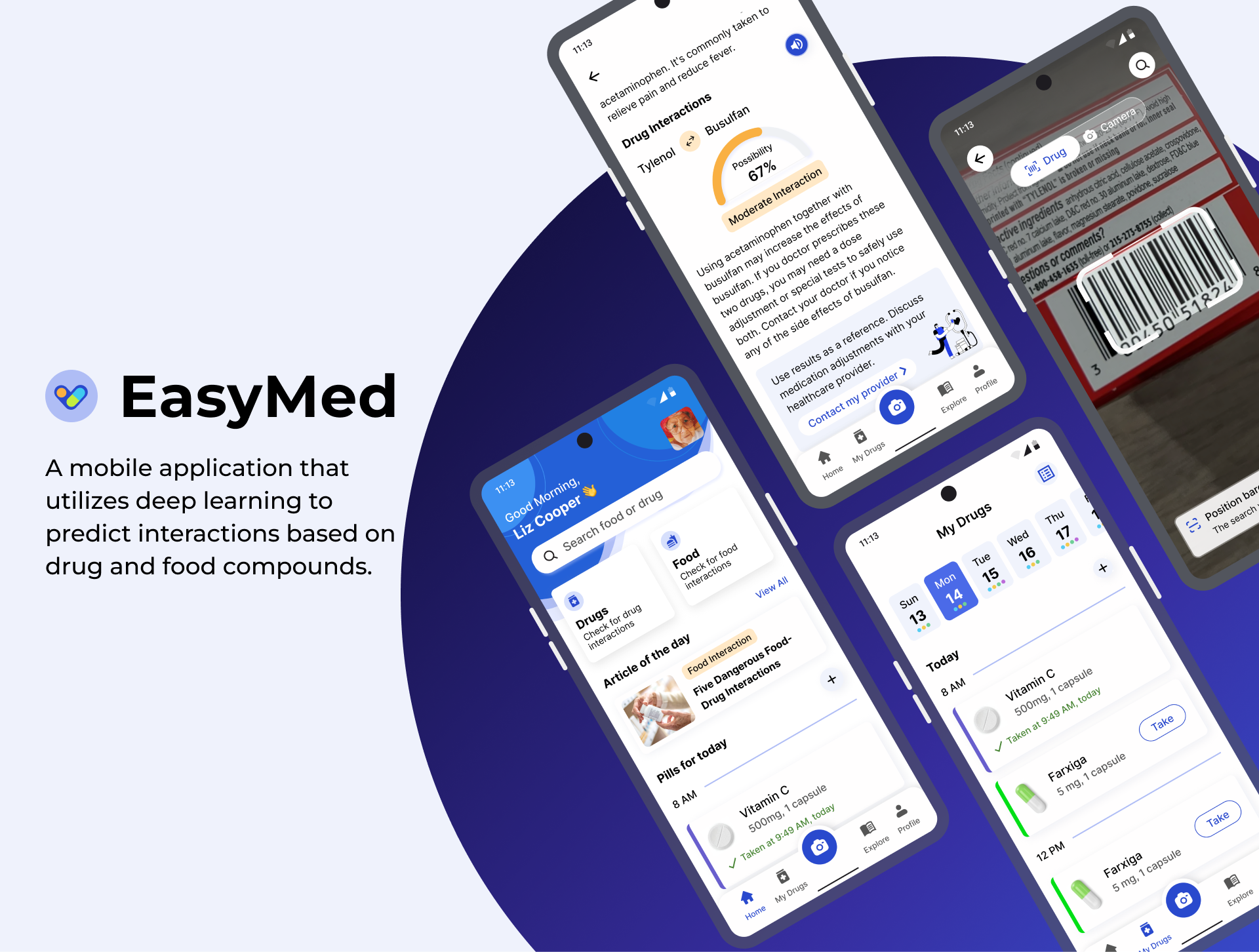
EasyMed employs cutting-edge machine learning technologies to predict drug-to-drug and drug-to-food interactions based on compounds. Choosing an app-centric approach ensures widespread accessibility, especially among the elderly, who often possess smart devices. EasyMed seamlessly blends state-of-the-art technology with a user-friendly interface, featuring legible fonts, full transparency, and supplemental information for enhanced accessibility. It aims to alleviate concerns for the elderly, lessen the burden on caregivers, and foster transparency between both parties.
Key Features:
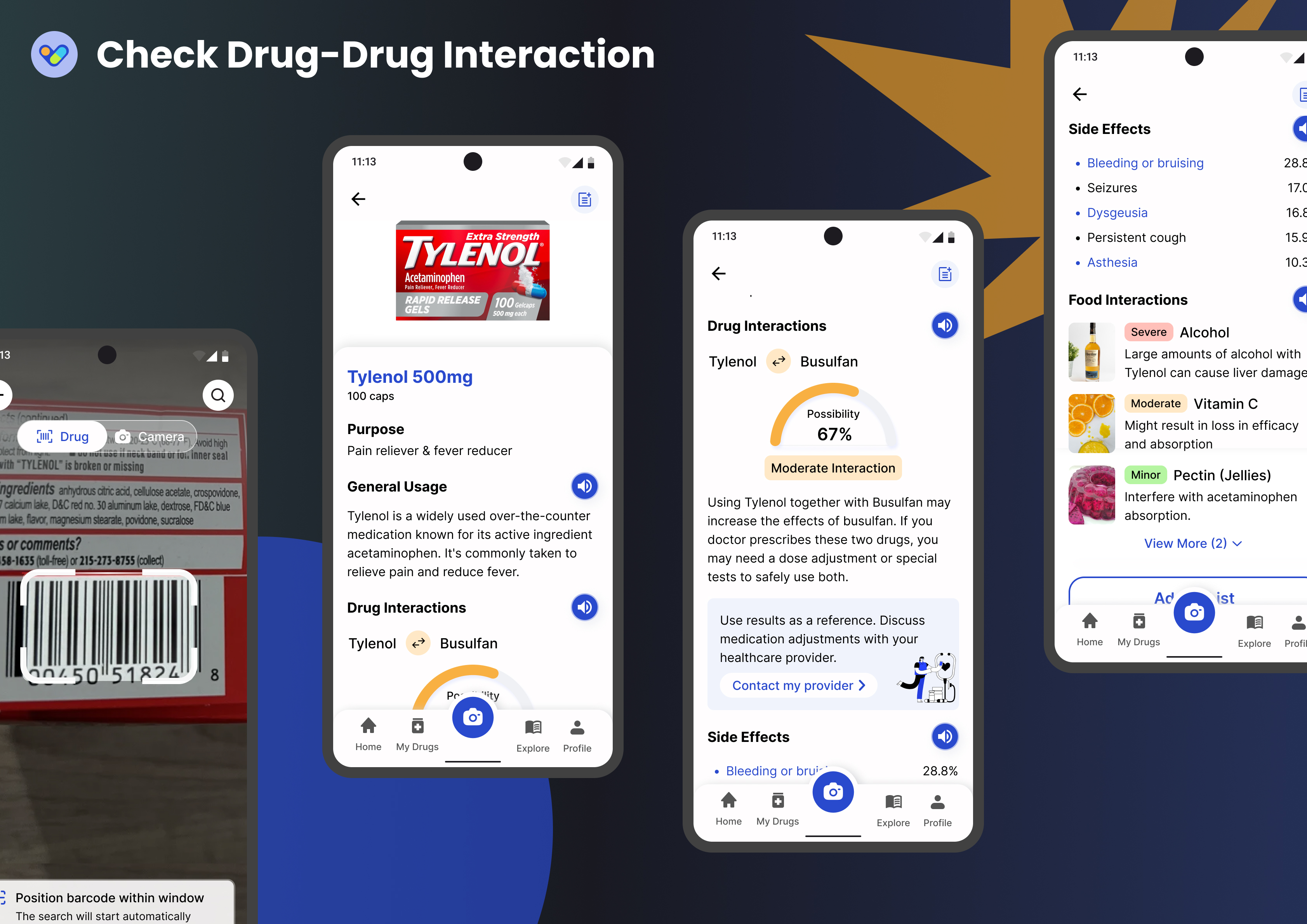
1. Scan or Enter Drug Information: Users can scan drug barcodes or input names for a comprehensive report on potential interactions, including general usage, likelihood, side effects, and food interactions. Encourages consultation with healthcare professionals for reliability.
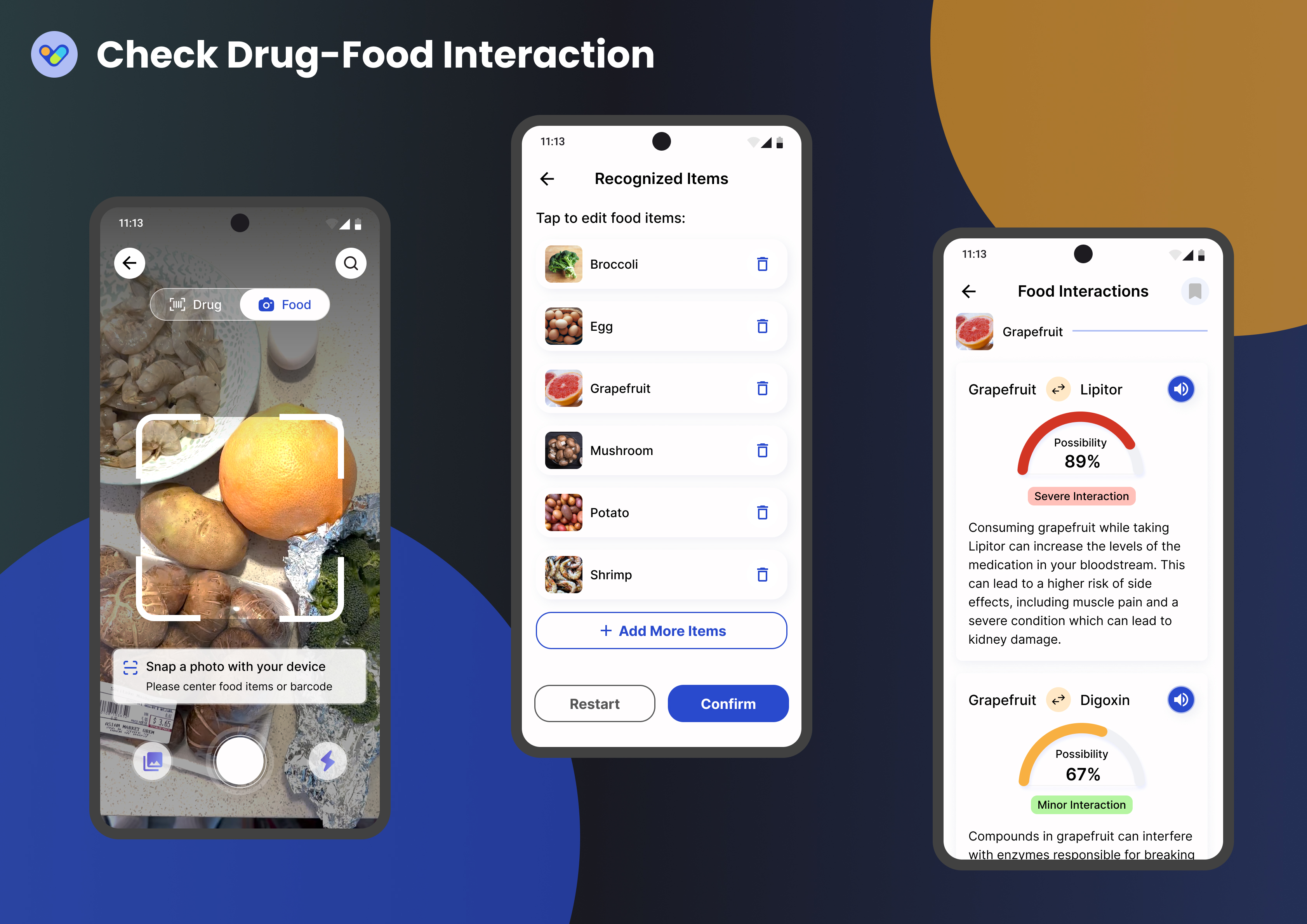
2. Check Drug-to-Food Interactions: Snap photos of food items or barcodes for instant analysis, alerting users to potential adverse interactions with medications.
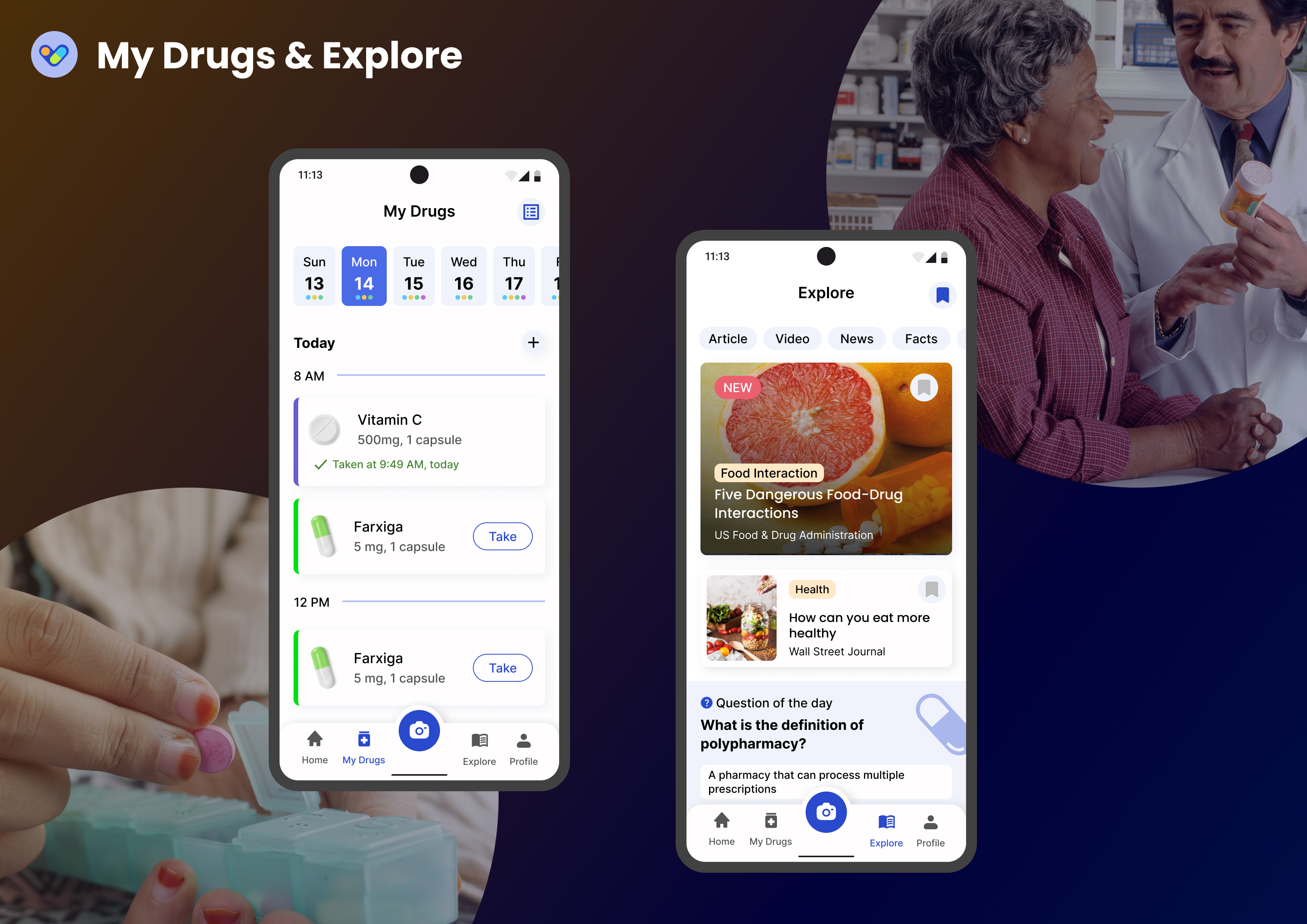
3. Drug List & Reminders: EasyMed helps users maintain a detailed drug list and provides personalized medication reminders for precise dosing, aiding during doctor visits.
4. Recommended Articles: Access personalized articles for a deeper understanding of polypharmacy, with filtering options and interactive quizzes. EasyMed aims to improve medication management and empower informed decision-making for better healthcare outcomes.
How we built it
Our approach seamlessly integrates AI into the human-centered design process, ensuring a consistent focus on user needs while efficiently leveraging various AI technologies. Our journey began with interviews with both elder adults and medical professionals, revealing challenges in medical records tracking and knowledge gaps. Subsequently, we generated potential solutions by applying both responsible AI and age-friendly design principles. We then prioritized essential features for our Minimum Viable Product (MVP) by utilizing an impact vs. effort matrix. These ideas were transformed into age-friendly design prototypes with accessible features such as legible fonts, improved color contrast, and transparent AI predictions. In addition, we explored various AI technologies aimed at simplifying the user flow, including features such as text-to-speech functionality, drug barcode scans, and food recognition. To test the effectiveness and usability, we conducted rigorous user testing with 12 elderly adults and 8 healthcare professionals. According to user feedback, we implemented detailed descriptions for medical terms and an informative onboarding guide. All our work focused on the mission: to alleviate the burdens faced by medical professionals and empower users to proactively avoid risks of polypharmacy.
Challenges we ran into
The first challenge we met was to research and study drug-to-drug/food interaction literature from prior arts. We need to read a lot of literature about DDI/DFI and compare their implementation method and accuracy to find the best one as our ML model algorithm. The second challenge is we can’t directly use the ML model from literature, we need to optimize its efficiency and organize the output which can be understood easily by normal users. Also, since many of our users are older adults, another challenge is how to build a friendly AI product for them. We interviewed older adults to learn their needs and pain points, and found it’s difficult for them to read a heavy text and understand medical terms, so we utilize the Azure text-to-speech service and medical dictionary API to help them use our application. We also made sure the text and font sizesare legible for elder adults and color contrasts are friendly to people with visual impairments.
Accomplishments that we're proud of
Upon finalizing the hi-fi prototype, we conducted comprehensive user testing with 12 elderly adults and 8 healthcare professionals, resulting in a remarkable 95.2% task success rate and 100% user satisfaction. In the words of one user, "I would definitely recommend this app to my friends," and as Physician Ryan stated, "I think this app is going to be a game-changer for us and our patients." EasyMed stands as a transformative solution addressing the critical issue of polypharmacy, with the potential to revolutionize medication management for all.
According to the user testing feedback and advice from our instructor, CS professor Nadir Weibel at UCSD, we continuously iterated our app 4 times in a short period of time. We are glad that we are able to accomplish the whole process from research, and design to development in less than one month. We believe we couldn’t achieve such accomplishments without a hard-working team and many people who are willing to support us on the way.
What we learned
This competition gives us a great insight into the difficult yet interesting nature of incorporating AI into products. We see how powerful and useful AI systems can be which allows us to develop great products in a short time span but incorporating all different services together was difficult for us. We also realized that there are many limitations and complications with AI systems since there are many ethical considerations to take into account. We kept responsible AI principles and age-friendly design principles in mind when crafting our solutions to ensure that our product is fair and understandable to all. Thinking about the practicability and ethical considerations of using AI was a great learning experience for us.
Although all of us had prior experience with product development to some extent, it was still extremely difficult for us to come up with a good idea and implement it in less than a month. We came up with many solutions related to AI initially but decided to settle on this one after interviewing several older adults. We learned that team collaboration, a clear roadmap, and pre-defined goals are extremely important. Although we have set project goals with milestones listed for each timestamp, we are still struggling with unforeseen risks that might hinder us from submitting on time. Since we are all taking finals around the submission time, we had to balance our own courseload and the project to achieve the best results for all. But we learned to work under constraints and time limitations which would be beneficial to us in the long run. In conclusion, the project was a great learning experience for all of us and we really enjoyed the process of tackling each challenge.
What's next for EasyMed
There are a couple of things we want to do for EasyMed including further improving the model, iterating on the features, and conducting more user testing. Although the model we used is already close to the highest standard in the industry, we still want to improve the reliability and accuracy of the algorithm through further iteration to ensure we are giving more trustable results to the users. From user research, we also realized that dosage information is important for analyzing drug interactions so we also want to further train our model with this parameter. Through user research, we also learned that doctors and patients use medical record systems like Mychart a lot so we also want to possibly integrate our app with it to improve user experience. In conclusion, the submission of the project doesn’t mark the end of our exploration, we would like to carry this project further and possibly launch it in the Google Store and develop the IOS version in the future so it can benefit more people.

Log in or sign up for Devpost to join the conversation.