-
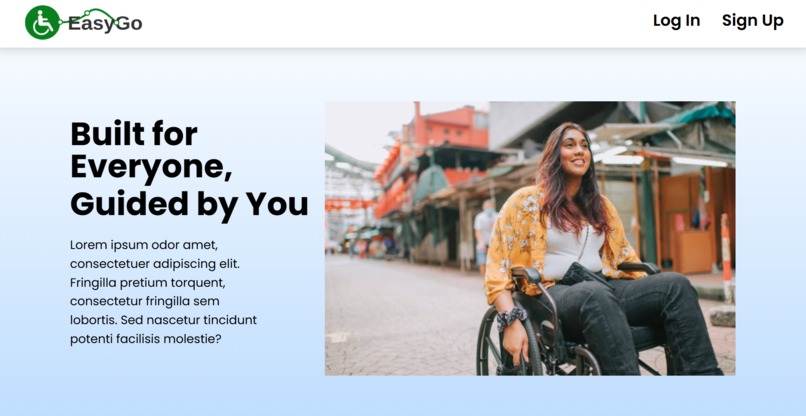
EasyGo Landing Page
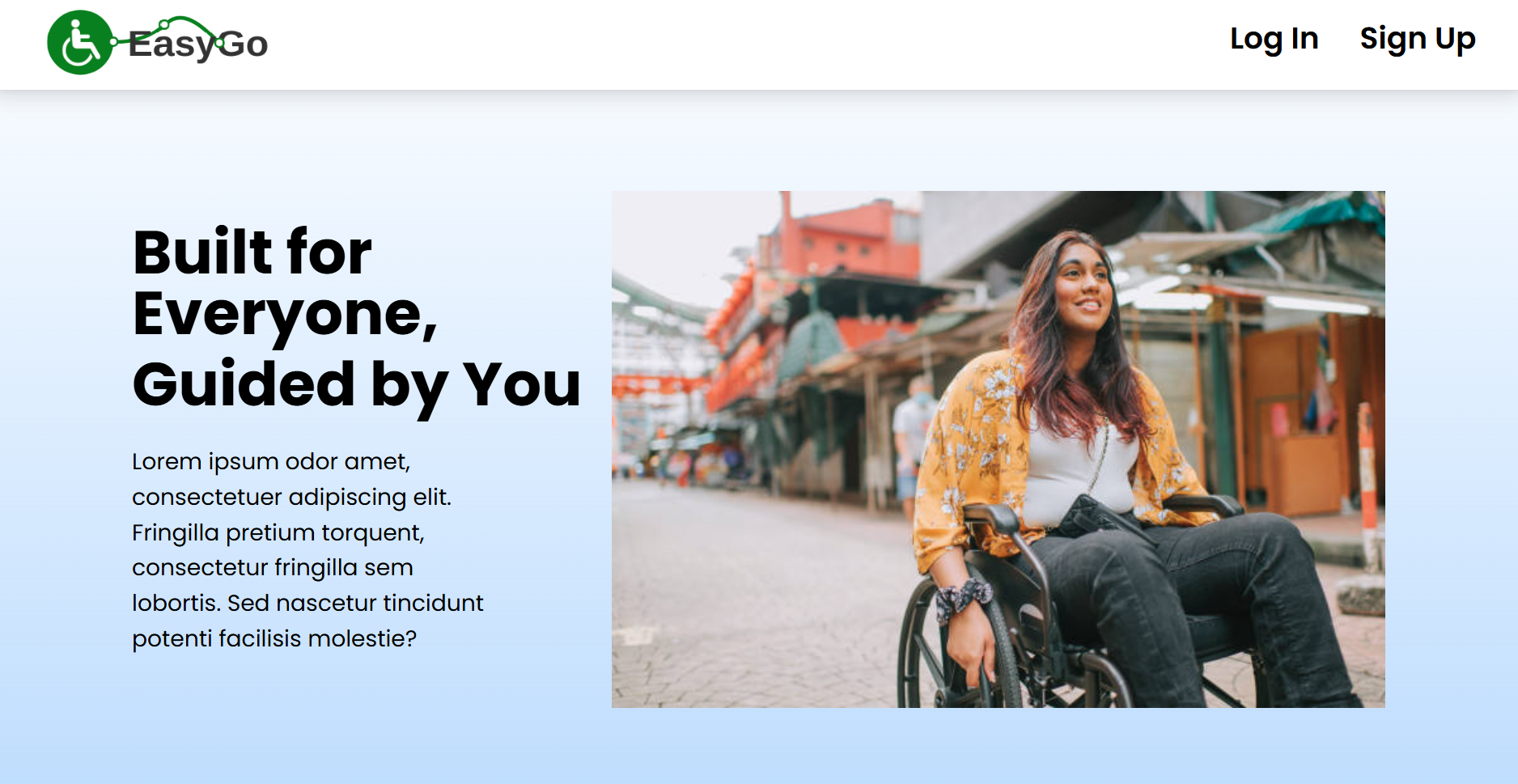
Inspiration
Our accessible route finder website was inspired by personal experience with an elderly grandparent facing mobility challenges. This motivated us to create a platform that helps people find accessible paths easily. Additionally, after listening to a speaker and participating in an exercise about the experiences of those with autism, we were inspired to help the community by building a solution that addresses diverse needs.
What it does
EasyGo uses data on path accessibility to identify routes that are wheelchair-friendly by avoiding stairs. Users have to input a start and final destination, and our route finder will suggest the most accessible path for you.
How we built it
For the frontend of our app, we utilized React, Leaflet, and TailwindCSS. React allowed us to create a highly interactive and responsive user interface. We used Leaflet was used for map rendering, allowing us to display accessible routes. TailwindCSS helped streamline the styling process. On the backend, we implemented NodeJS and ExpressJS to develop a fast, scalable API that manages data requests and updates efficiently. MongoDB served as our database, securely storing user login information. To optimize route calculations, we integrated Graphhopper, an open-source routing engine, which we used for route optimization.
Challenges we ran into
We faced several challenges while developing the algorithm that identifies accessible routes. One major obstacle was finding an API that provided accurate and reliable data on accessible paths. After experimenting with a few different options, we eventually integrated one that suited our needs, but it took considerable time and effort to refine and optimize it.
Accomplishments that we're proud of
We are proud of successfully integrating an API to provide accessible routes, allowing users to find the safest and most suitable paths in real time. We’re also proud of our ability to bring an idea to life that reflects our passion for accessibility and improving mobility for people with disabilities.
What we learned
We learned to use React and Tailwind CSS to build a dynamic and responsive web application. Building on our knowledge of HTML, CSS, and JavaScript, we quickly adapted to React's component-based structure, streamlining the development process. Additionally, we integrated Leaflet to create interactive maps and used GraphHopper for optimized route path functionality. This project provided us with valuable hands-on experience, allowing us to apply new development tools and APIs to solve real-world problems effectively.
What's next for EasyGo
We aim to focus on using more advanced algorithms to find better and safer paths based on topography and slope angles. We also plan to use machine learning to analyze user-generated feedback over time to predict common obstacles and recommend the best paths. We also wanted to use the user accounts to allow crowdsharing to include real time updates on things such as elevators, which we did not have the change to do.
Built With
- express.js
- graphhopper
- leaflet.js
- mongodb
- node.js
- react
- tailwind

Log in or sign up for Devpost to join the conversation.