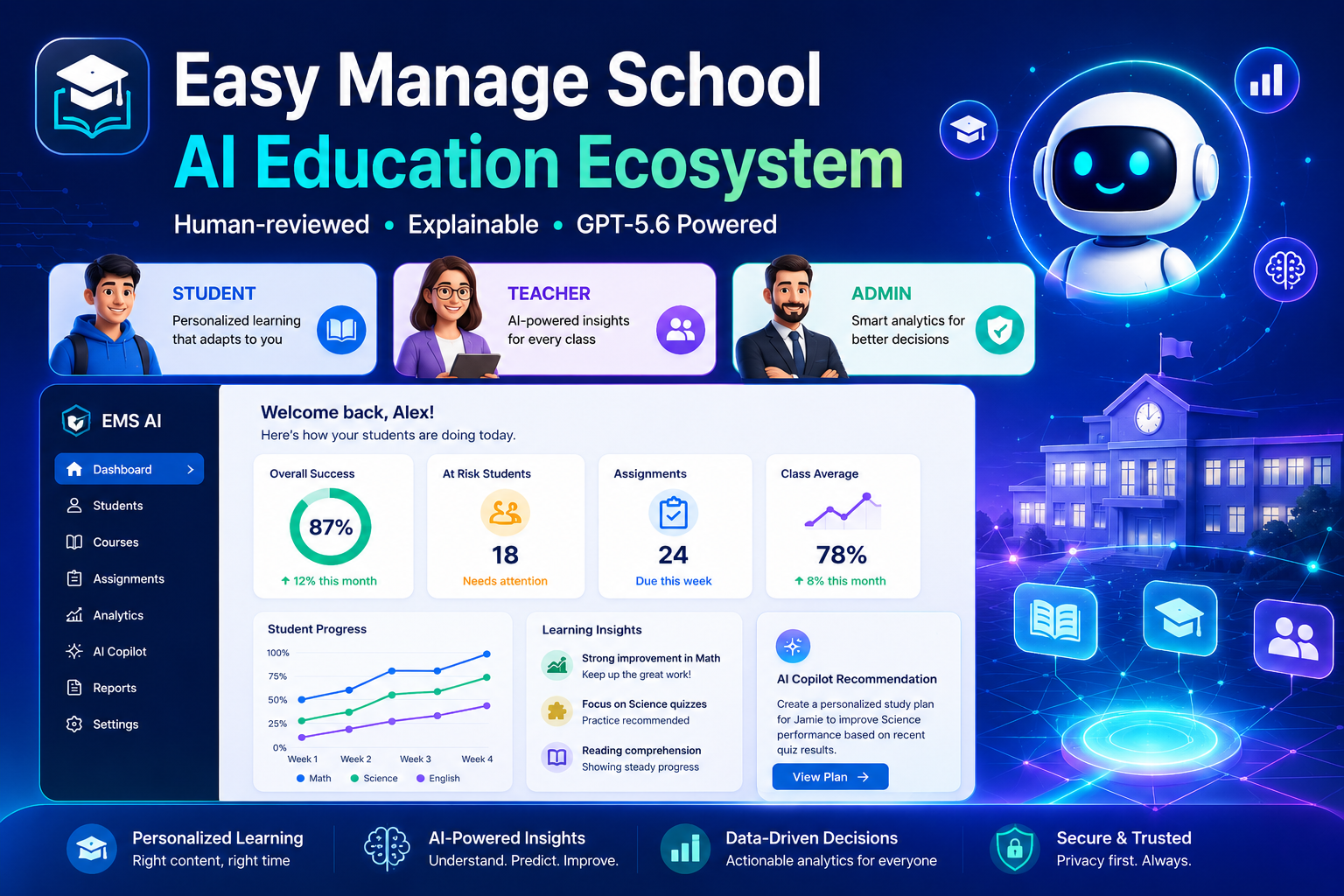
Easy Manage School AI Education Ecosystem A responsible, explainable, and human-reviewed AI layer for everyday school support
Easy Manage School helps school leaders notice learning patterns earlier, teachers turn evidence into practical action, students learn with guidance instead of copied answers, and parents understand how they can help—while keeping every important decision under human control.
Inspiration Schools already collect the information needed to support students: attendance, examination results, homework, assignments, learning activity, fees, student records, and teacher observations. The problem is that this information is usually scattered across different screens and reports. By the time a pattern becomes obvious, a student may already have fallen behind. A teacher may sense that something is wrong but not have a clear picture of the evidence. A parent may receive marks without knowing what to do next. A school administrator may have plenty of data but no simple, explainable view of which students need attention first. We built Easy Manage School AI Education Ecosystem to close that gap. Our aim was never to replace teachers or allow a model to make high-impact school decisions. We wanted AI to do what it is good at—organizing evidence, explaining patterns, and drafting useful next steps—while people remain responsible for judgment, approval, and action. The central idea is simple: use deterministic school rules for authority, use GPT-5.6 for explanation and bounded drafts, and require human review wherever the outcome could affect a student. What it does Easy Manage School extends an existing multi-school education-management platform with connected AI tools for students, teachers, parents, school administrators, and platform governance. Instead of adding a single chatbot, we built a complete support workflow around the school’s real operating data. Student Success Command Center The Student Success Command Center turns everyday school evidence into an explainable support process. It looks at structured indicators such as attendance, examination performance, homework and assignment completion, learning activity, and recent progress. The official student-support level is calculated by deterministic application rules. GPT does not independently decide whether a student is low, medium, or high priority. Once the application has calculated that level, AI helps explain the evidence in clear language and prepares practical, bounded support suggestions. From that workflow, staff can review: • an explainable summary of the evidence behind the support level; • a Student 360 view that brings relevant signals together; • a prioritized intervention queue; • a seven-day improvement-plan draft; • progress re-checks after an intervention; and • impact analytics that help schools understand whether support is working. Teacher Intervention Workflow Recommendations are not published automatically. Teachers review the evidence, adjust the proposed action, and decide whether it is suitable for the student. Teaching and intervention assets follow explicit states such as draft, approved, published, rejected, revised, and archived. A draft cannot jump directly to publication. Human review is enforced by application logic, not shown merely as a warning or an optional label. This gives schools a clear audit trail and keeps professional responsibility with the educator. Student AI Study Coach The Student AI Study Coach is designed around a Learn, Don’t Copy principle. It supports four bounded modes: Hint, Explain, Check My Answer, and Similar Practice. Hint mode helps the student move forward without revealing the final answer. Check My Answer can require the student to make an attempt first. Requests for live-exam answers or answer keys are redirected toward explanation, hints, and practice. Student-facing generation is protected by consent checks, role and tenant controls, moderation, rate limits, strict structured responses, PII minimization, learning-history controls, and safety-event monitoring. When a safety condition is triggered, the system does not treat the interaction as a normal successful tutoring response. Teacher AI Teaching Copilot The Teaching Copilot helps teachers prepare structured drafts for lesson plans, worksheets, classroom activities, common-doubt support, and differentiated learning. These outputs are working drafts for a teacher—not automatic instructions sent to a class. This distinction matters. The system can save time and offer a useful starting point, but the teacher still checks accuracy, age suitability, local context, and classroom needs before approval or publication. School Administration Copilot School administrators receive decision-support tools for operational summaries, questions about school data, communication drafts, student-support monitoring, intervention management, and impact reporting. Administrative AI remains advisory. It does not autonomously make decisions about admission, promotion, grading, discipline, financial action, or staff employment. Parent Guidance After a student plan has been reviewed and published, parents can receive simple, evidence-based guidance in English or Hindi. The goal is to turn school information into clear, practical steps without exposing unnecessary personal data or bypassing the teacher. Responsible AI Governance Responsible AI is not a separate page added at the end of the project. It is built into authorization, data preparation, generation, review, storage, and monitoring. The ecosystem includes: • tenant isolation and deny-by-default role authorization; • student consent controls; • fail-closed moderation for student-facing live generation; • multilingual PII minimization; • strict structured-output validation; • human-reviewed publishing workflows; • audit and usage logging; • error and safety-event monitoring; • prompt governance; and • configurable AI feature controls. How we built it Easy Manage School was already a multi-school PHP and MySQL education-management platform before Build Week. The existing foundation included role-based school management, attendance, examinations, homework, fees, reports, student and parent portals, responsive dashboards, a PWA foundation, and Android-ready APIs. During Build Week, we transformed that foundation into a coordinated AI education ecosystem. The work included Student Success analysis, Student 360 intelligence, explainable intervention planning, the Teacher Teaching Copilot, the Student Study Coach, parent guidance, administration copilots, progress and impact analytics, responsible-AI governance, structured GPT integration, schema reconciliation, adversarial security review, regression testing, and reproducible PHP/MariaDB release validation. Architecture and implementation The application uses a server-rendered PHP and MySQL/MariaDB architecture. The same backend supports school staff interfaces, student and parent portals, API endpoints, PWA delivery, and an Android Trusted Web Activity scaffold. AI orchestration is centralized in dedicated server-side modules. The model does not receive direct database access or unrestricted application tools. Instead, application code selects the relevant evidence, removes or minimizes personal data, sends a bounded request, validates the structured response, and only then stores or displays the result. The architecture deliberately separates two responsibilities: • Deterministic application rules calculate authoritative student-support indicators. • GPT-5.6 explains the evidence and creates bounded educational or operational drafts. That separation prevents generated text from silently replacing official school logic. Even if a model returns a different support level, the application preserves the authoritative deterministic value. How GPT-5.6 is used The ecosystem routes different workloads to different GPT-5.6 model profiles: gpt-5.6-terra for balanced educational and analytical work, gpt-5.6-sol for restricted advanced analysis, and gpt-5.6-luna for shorter utility and communication tasks. The OpenAI Responses API is used with strict structured-output schemas. GPT-5.6 produces bounded outputs such as evidence explanations, intervention-plan drafts, lesson and worksheet drafts, guided tutoring responses, parent guidance, communication drafts, and school-operation summaries. The model’s role is supportive rather than authoritative. Application validation checks the shape and permitted values of every response, and deterministic school values cannot be overwritten by generated content. How Codex helped us build it Codex served as our primary engineering partner during Build Week. It helped us understand the existing repository before changing it, trace how roles and tenants were enforced, identify risks across several connected modules, implement targeted fixes, and create repeatable checks. We used Codex to: • inspect the complete repository architecture and identify the Build Week AI surface; • audit role, tenant, and student-consent boundaries; • review under-18 safety, Learn-Don’t-Copy controls, moderation, and PII minimization; • review the structured-output integration and model orchestration; • find drift between runtime migrations, canonical schemas, and the migration manifest; • inspect PWA and Android-ready structures; • implement security and governance fixes; • create regression tests and adversarial checks; and • design a reproducible release-validation workflow. The most valuable part was not simply generating code. Codex helped us find interactions that were easy to miss during normal feature testing. For example, it identified unsafe behavior for unknown roles, missing early guards on monitoring pages, cross-tenant consent risks, unrestricted teaching-content state transitions, incomplete enforcement of human review, and moderation paths that could fail open. It also traced a subtle date-of-birth redaction bug. An English name rule could consume the nearby DOB label before the date rule had a chance to run. The final fix was contextual and bilingual, so personal birth dates are minimized without broadly hiding legitimate academic, historical, or classroom dates. Responsible AI and security decisions Deny by default Blank, misspelled, unknown, or unsupported roles receive no AI permissions. They are denied rather than treated as unrestricted. Tenant-safe access Consent, interventions, learning history, and monitoring records are resolved within the authenticated school tenant. A user cannot use a forged student identifier to cross school boundaries. Human-reviewed publishing Teaching and intervention content follows an explicit state machine. Drafts must be reviewed and approved before publication, and rejection, revision, and archival are recorded. Fail-closed student moderation Student-facing live generation requires a successful moderation result. If moderation is unavailable, malformed, timed out, or flagged, normal generation does not continue. The student receives a safe response and the governance metadata is retained for review. Safe flagged-output handling Flagged output is never shown as an ordinary successful response and cannot be recorded as passed. Safety events remain visible to authorized reviewers. Multilingual PII minimization A shared minimizer handles English and Hindi personal-data patterns, including contextual names, dates of birth, identifiers, phone numbers, email addresses, addresses, financial-number patterns, and IP addresses. DOB handling is contextual so ordinary educational dates, marks, fractions, and academic numbers remain useful. No autonomous high-impact decisions AI does not autonomously decide admission, promotion, grading, discipline, financial action, or staff employment. These remain human and institutional responsibilities. Challenges we ran into The first challenge was adding AI to an existing multi-school ERP without weakening tenant isolation or role boundaries. A useful AI feature often needs information from several modules, which makes authorization mistakes more likely unless access is checked at every layer. The second challenge was balancing student safety with genuinely helpful tutoring. A system that simply gives every answer is not a learning tool. A system that refuses too much is not useful either. The bounded modes—Hint, Explain, Check My Answer, and Similar Practice—gave us a practical middle path. Moderation reliability was another important issue. We deliberately changed student-facing behavior from fail-open to fail-closed, so a moderation outage or malformed response could not silently become permission to generate. Database compatibility also required careful work. Runtime migrations, canonical schemas, and the migration manifest had drifted apart. We reconciled the Build Week tables and created repeatable checks for both fresh installations and upgrades. Finally, multilingual PII minimization required careful rule ordering and false-positive protection. The DOB regression showed why safety controls need executable tests, not only documentation. Accomplishments that we're proud of We are proud that the project is not only feature-rich but governance-focused. The most important accomplishment is the complete support loop: school evidence becomes an explainable priority, staff review a practical intervention, students receive guided help, parents receive understandable guidance, and progress can be measured afterward. Technical accomplishments include: • explainable student-support scoring with deterministic authority; • enforced teacher review and publication states; • Learn-Don’t-Copy tutoring controls; • bilingual parent guidance; • tenant-safe consent and data access; • fail-closed moderation; • multilingual PII minimization; • strict structured AI responses; • safety-event and audit governance; • canonical validation for 122 database tables, including 20 Build Week AI tables; • PHP 8.2 linting and smoke tests; • fresh-install and upgrade testing with disposable MariaDB databases; • migration re-run and schema-drift checks; and • repository secret scanning. What we learned We learned that responsible AI is not a single moderation call or a disclaimer below a chatbot. It is a chain of coordinated application controls: identity, authorization, tenant isolation, consent, minimization, moderation, structured validation, human review, auditability, testing, and honest reporting of limitations. We also learned that deterministic rules and generative models work best together. Deterministic logic provides authority, consistency, and explainability. GPT provides language, personalization, and useful drafts. Keeping those roles separate made the system both safer and more practical. Most importantly, adversarial review and regression tests revealed problems that were not visible in a normal product demonstration. Testing the system for failure conditions changed several design decisions for the better. What's next for Easy Manage School AI Education Ecosystem Our next priorities are deeper teacher class-and-subject scoping, stronger detection of copy-ready answer leakage, better validation of meaningful student effort, scheduled retention cleanup, richer parent-consent evidence, browser end-to-end testing, production backup and recovery validation, Android build and signing, Digital Asset Links verification, and broader pilot testing with schools. We also plan to expand impact analytics so schools can compare interventions over time and understand which actions produce sustained improvement rather than only a short-term change. Current limitations Some validation remains deployment-specific. This includes live production OpenAI latency, billing, and network-policy behavior; complete production-hosting validation; browser-level end-to-end regression testing; every historical production schema-drift scenario; Android device, signing, and Play Store validation; and legal review of school-specific consent and safeguarding policies. AI assistance does not replace teachers, parents, school safeguarding processes, or professional judgment. The system is designed to strengthen those people and processes, not bypass them. Closing Easy Manage School AI Education Ecosystem shows how an existing school-management platform can evolve into a responsibly governed AI system without surrendering human control. Rather than replacing educators, it helps them notice patterns earlier, understand evidence more clearly, prepare better actions, guide students safely, communicate with parents more effectively, and remain accountable for every important decision.


Log in or sign up for Devpost to join the conversation.