-
-
System Architecture
1. Inspiration
As we all know, Dominion Energy is a very large American power and energy company with millions of customers. Providing and maintaining convenient energy use are the core businesses of Dominion Energy. However, at present, there is no perfect mobile app that provides customers and managers with some convenient functions for daily use, so as to increase the overhead and reduce efficiency. We divided the needs into customer's and manager's aspects.
Customer's aspect:
- Convenient billing and payment function. So far, people can only check bills and payments through web pages or telephones, which lacks portability.
- Monitoring of household electricity consumption and power generation. Households with power generation equipment often face the mismatch problems of power generation and power consumption, resulting in wasted electricity or insufficient electricity supply problems. And the current methods of monitoring electricity consumption and power generation are not convenient enough.
- Detection of equipment failure. When the equipment fails, the company can only know the fault information through the user's report by calling, which will lead to the lag of the information and the decrease of the user's satisfaction.
Manager's aspect:
- Difficulties in detecting the working state of the equipment. The maintenance personnel cannot visually find whether the equipment is working properly, such as a public circuit disconnection.
- Dispatch problems with maintenance personnel. Under the current circumstances, The dispatch of maintenance personnel is not immediate and requires artificial arrangements, and it may be not possible to dispatch them optimally, resulting in inefficiency.
2. APP and System Design
Our APP requires a system based on the acquisition, processing, and machine learning analysis of the power data. Internet of Things idea, as far as our concerned, may best fit our requirements, so we design a system based on IoT technology.
2.1 System Architecture
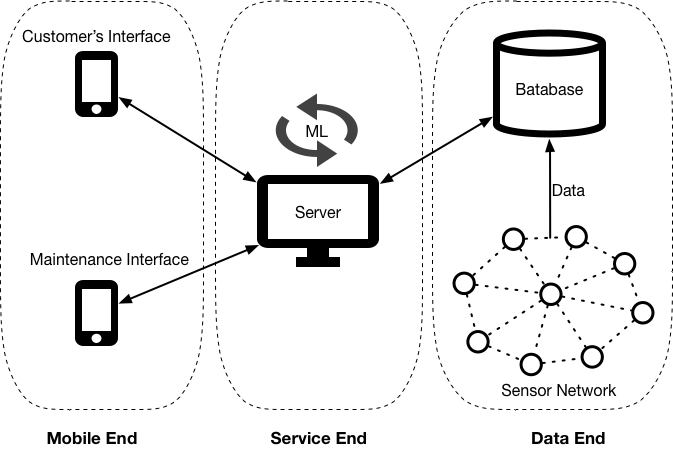
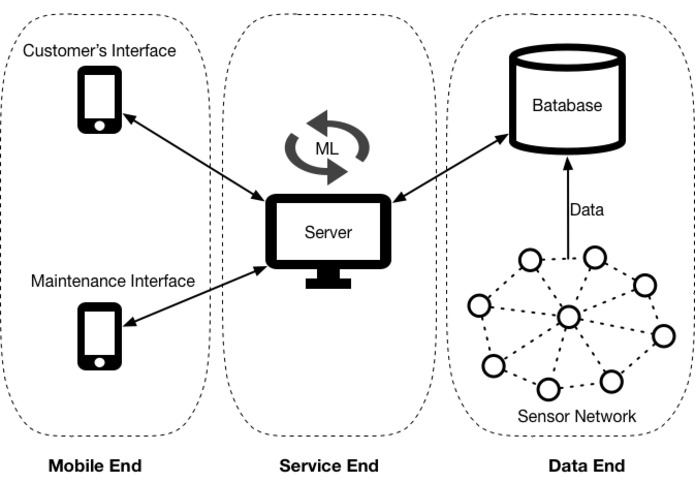
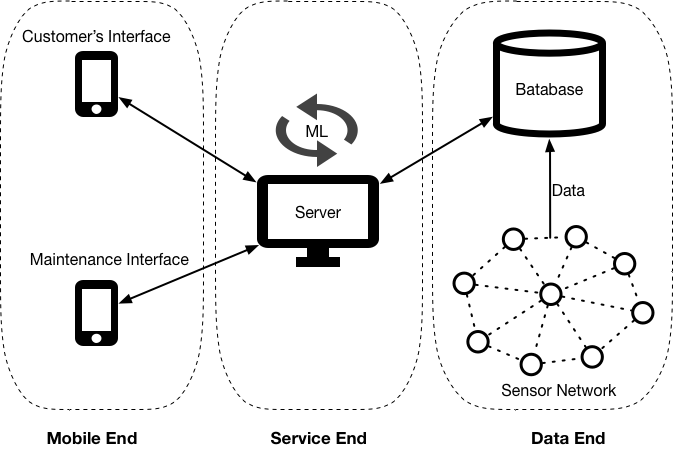
As Figure illustrated, our entire system consists of three parts: data end, service end, and mobile end.
In the data end, we designed an IoT-based sensor network to collect data. Sensors should be set up in each wire pole, transformer, line and so on. The collected data should be stored in the database.
The service end can call the data in the database to process, analyze by machine learning methodologies, and transmit the processed data to the mobile end to meet their requirements.
The mobile end interacts with customers and managers to implement the functions required by them.
2.2 Functionalities of Customer's interface
Billing & Payments. Customers can get electricity bills for the current month and pay, as well as browse historical bills and payment information. This function calls the power data in the database through the server, calculates the power charge and transfers these data to the APP terminal, thus showing to customers.
Power monitoring. Customers can know their home power consumption and generation anytime and anywhere (if there is power generation equipment in their home), the data comes from the meter sensor.
Electricity prediction. APP can provide customers with a forecast of power consumption and generation in the coming week. The forecast data is generated according to the customers' previous power consumption and generation data, combined with environmental information (such as weather conditions, surrounding power consumption), by using machine learning methods to analyze and forecast them.
Power recycling. For some households with power generation equipment, we recommend them to install household batteries to store excess electricity. The company can recycle excess electricity at a low price, which can help to save resources. Customers can judge whether the future electricity generation is enough according to the future consumption and generation prediction and then decide whether to sell the excess electricity.
Home circuit monitoring. We need to set up a sensor network in each home. The data collected by the sensor network determines whether the user is abnormal in power consumption, and then the APP will remind the customer. To be more specific, if the power consumption rate is too high or too low, the APP will ask the customer if it is the normal behavior. If not, directly report for repair.
Reporting. If customers find abnormal power usages, such as power outage or leakage, it can be directly reported to maintenance personnel with the APP.
2.3 Functionalities of Maintenance Interface
Data Visualization. We determine whether the devices are working properly by analyzing abnormal data monitored by their sensors. Then we visualize the data by mapping all the sensor nodes to an actual map, filling normal sensor nodes with green, and abnormal sensor nodes with red. The location that exists a problem can be clear to the maintainers by clicking the red node on the map.
Maintenance Request Receiving. After receiving the maintenance request from the customers, the server uses an algorithm to optimally assigns the task to the idle maintenance staff by notifying on the maintenance APP. The abnormal state of the sensor node on the APP will be automatically corrected after the maintenance is completed.
3. Advantages
- Mobility. Customers can view and pay bills, as well as monitor power usage and power generation on the customers’ APP.
- Environmental Friendliness. Through the prediction of electricity consumption and power generation, customers can recycle electricity reasonably and economically, thereby saving resources and protecting the environment.
- Instantaneity. Data collection from the sensors is relatively instant, so the company can know the fault information in an instant manner instead of waiting for customers to inform the situation.
- Effectiveness. The IoT-based sensor network is spread across the entire power network, therefore, real-time data monitoring and machine learning algorithms can be used to find out the problems that need to be solved.
- Visualization. Sensor nodes’ information is visually displayed on the map to help maintenance staff easily observe the working status of the electrical devices.
- Intelligence. We continuously feed the new data collected by the sensors to our machine learning model, constantly training and intelligently improving our model.
- Efficiency. Our APP enables the company to discover and solve the problems more efficiently.
4. Challenges I ran into
High overhead:
- Deploying a sensor network in the existing environment requires the purchase of a large number of sensors. And when the sensor exceeds its useful life, we need to replace it with a new one. Because the sensor network is very large, it requires a lot of human resources for replacement, which will be a large expense for the company.
- A large number of sensors will collect a large amount of data, which greatly increases the burden on the database and the database maintenance.
Security:
- Unsafe communication. Unauthenticated communications, unencrypted communications, authentication and authorization issues, lack of necessary network isolation, and some other communication issues will be the challenges of our IoT system.
- Hardware security. Our sensor devices are exposed to the environment, so anyone, including enemies, can get our sensor devices in an easy way. If the hardware devices are cracked or hijacked, it can easily cause harm to the server.
- Risk of data leakage. The data we collect at the customers’ house belongs to their private information. If the data is leaked, it will do harm to the privacy of the customers.
5. Accomplishments that I'm proud of
The basic interface of app。
6. What I learned
How to enjoy a hackathon with friends : )
7. What's next for Easy Dominion Energy APP with an IoT Support System
Hope we can set up IoT sensor network and collect data from it.
Built With
- app-development
- iot
- machine-learning


Log in or sign up for Devpost to join the conversation.