





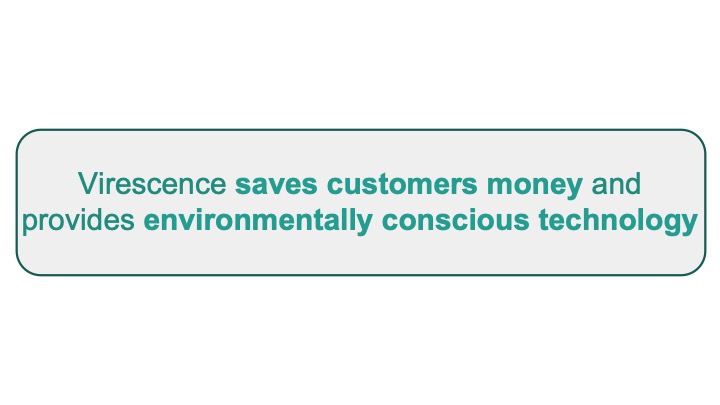






At Virescence, we develop energy storage solutions that are sustainable for our communities and our planet. We create lithium-ion capacitors from corncob-derived activated carbon to reduce the costs and carbon footprint of public transportation. We implement solutions to mitigate the global environmental crisis and aim to enable other industries to do the same.
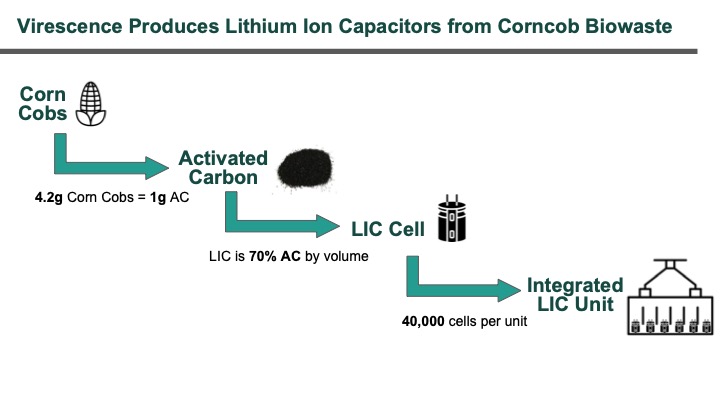
Virescence uses an innovative manufacturing process to turn discarded corncobs into a uniquely sustainable and high-performing energy storage device. We collect corncobs from farmers and process them to create activated carbon (AC) at our hybrid research and manufacturing facilities in Iowa. This corncob-derived AC is a raw material with high porosity, key to the electrochemical processes in our lithium-ion capacitors (LICs). LICs are energy storage devices which provide a high energy density for storage in addition to a high power density for instantaneous charging and discharging. Current energy storage options include lithium-ion batteries, which have high energy density but low power density, or supercapacitors, which have high power density but low energy density. No product balances the tradeoff between the two, and this is precisely the market gap we are targeting.
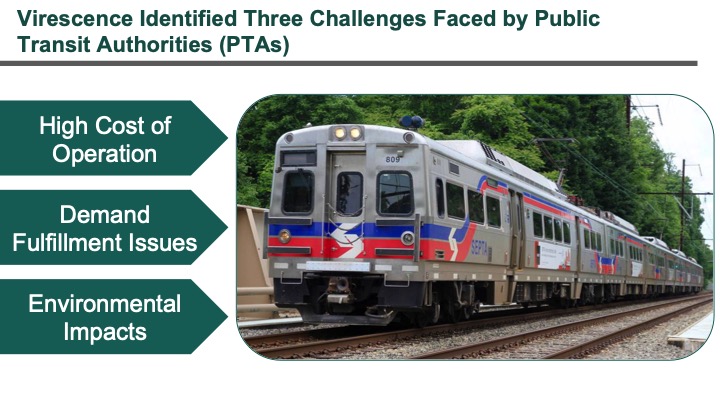
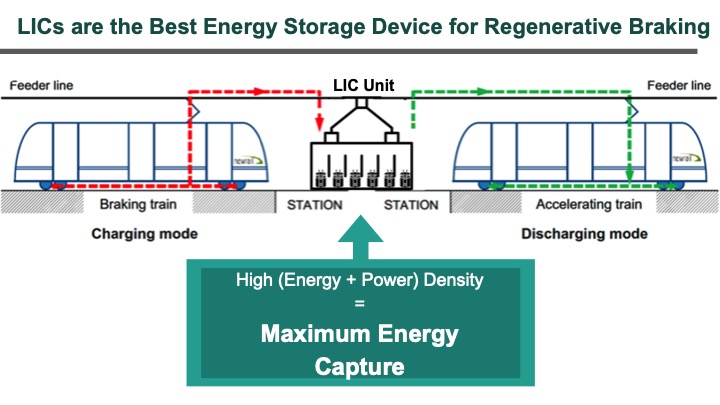
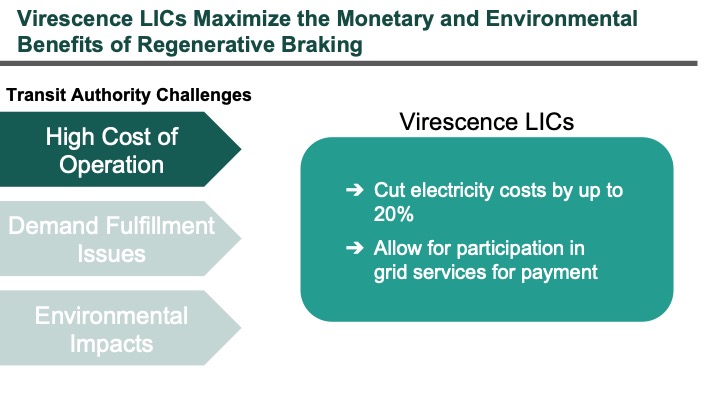
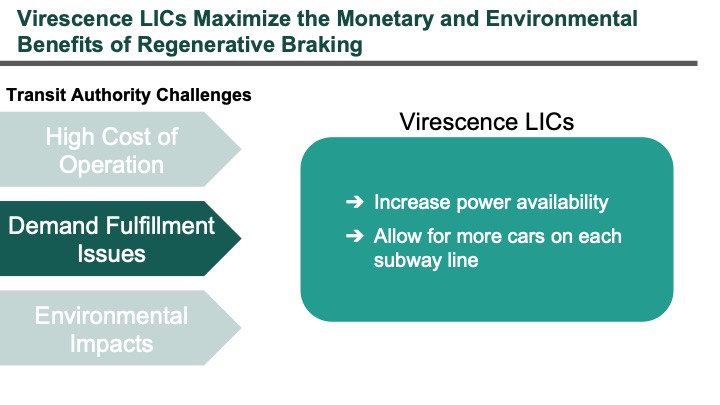
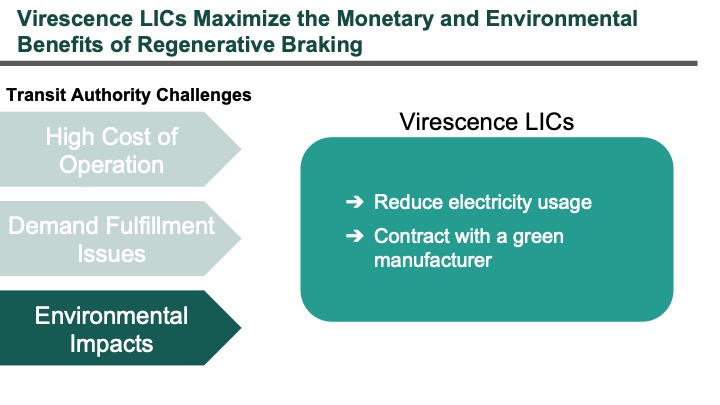
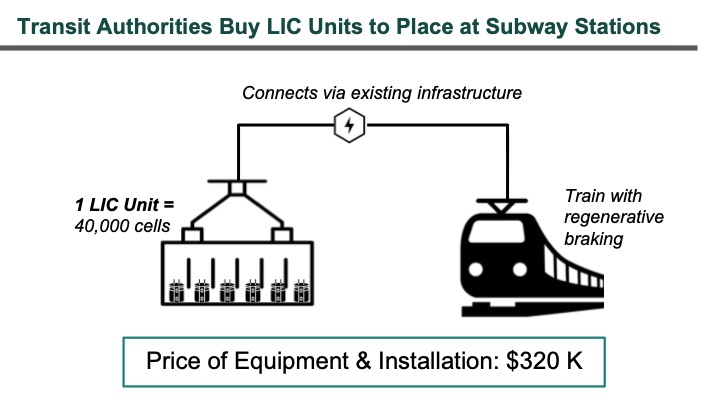
Our target customers for these LICs are US Public Transit Authorities (PTAs) wishing to implement regenerative braking into their subway lines. Many subway cars have braking systems which release energy when they come to a stop. If an energy storage device, like the Virescence LIC, is connected to the subway’s electric third rail, the energy can be stored and recycled to power the cars to their next stop. This regenerative braking technology allows PTAs to cut electricity bills by up to 20%, generate revenue by providing grid services, and place more cars on each subway line to increase ridership revenue. Our LIC’s high power and energy density allow it to capture the total amount of energy emitted during each braking event, whereas a battery or supercapacitor could not. By choosing the Virescence LIC, PTAs will maximize the returns on their investment in regenerative braking and reduce the impact their industry has on the environment.
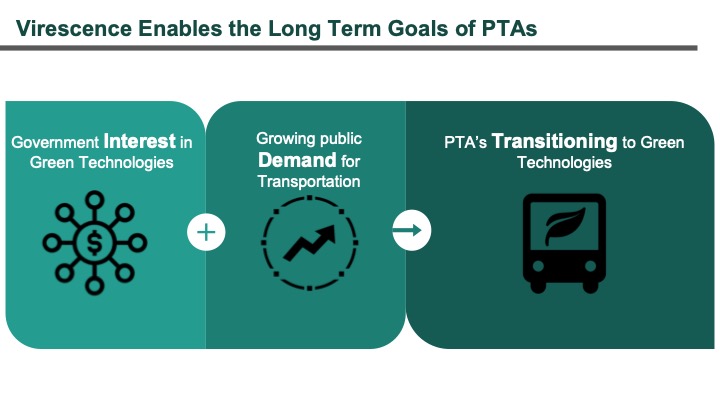
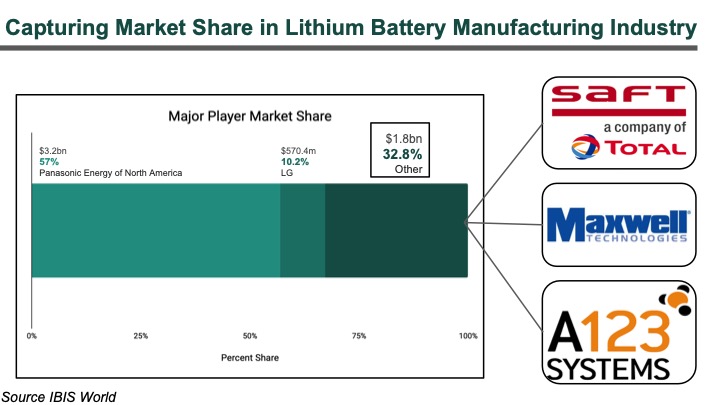
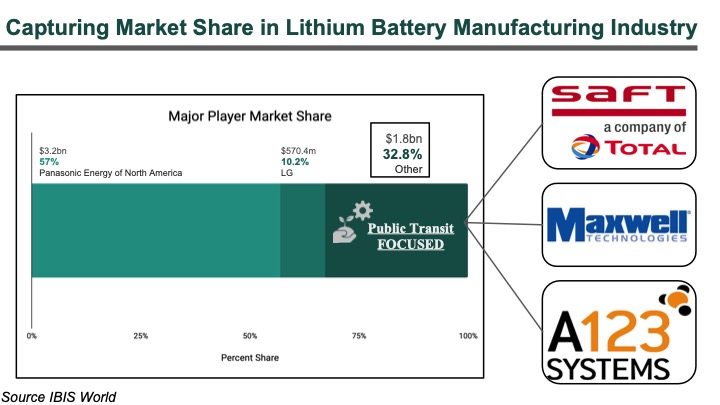
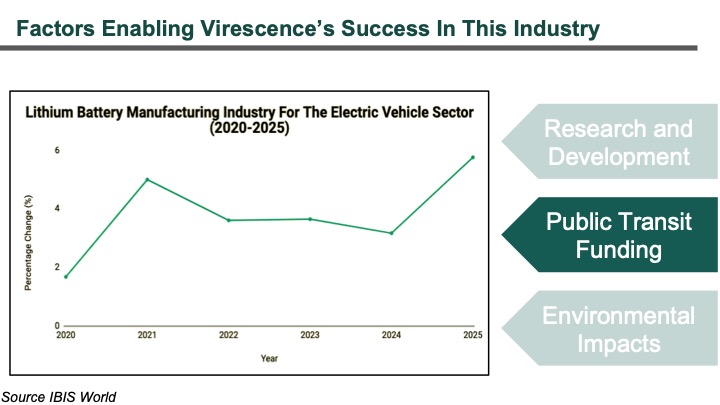
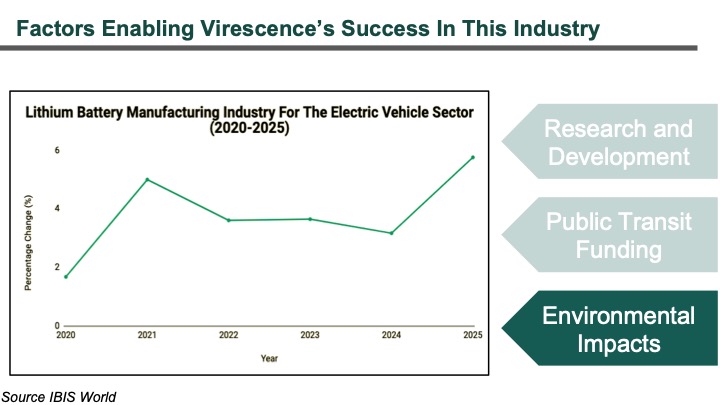
Our product is a part of a growing trend of environmental consciousness in transportation. According to Masters (2020), in the lithium battery manufacturing industry for the electric vehicle sector, revenue is expected to increase at a rate of 4.2% to $6.9 billion by 2025. Currently, the two big shareholders in this industry are Panasonic and LG having 57% and 10% of the market share respectively. Other small companies hold the remaining 33% percent, and Virescence aims to obtain a significant piece of that. While these companies focus mostly on cars, Virescence will differentiate itself by focusing on the public transit sector.
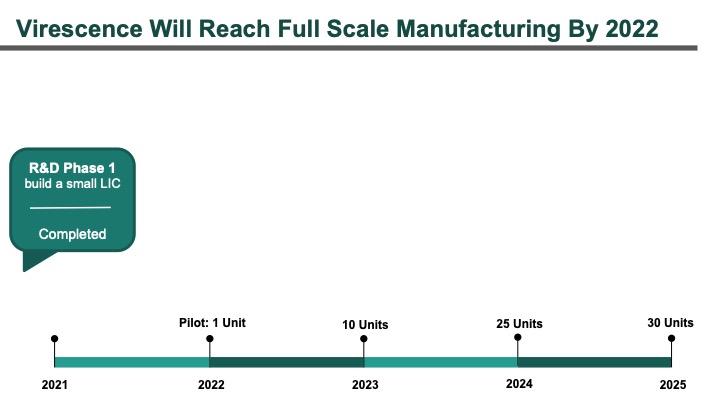
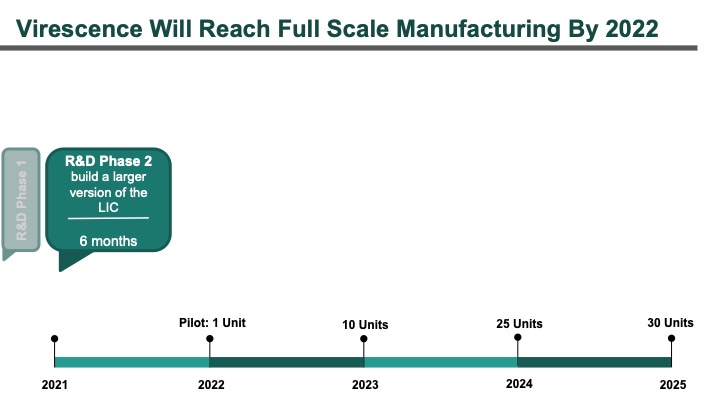
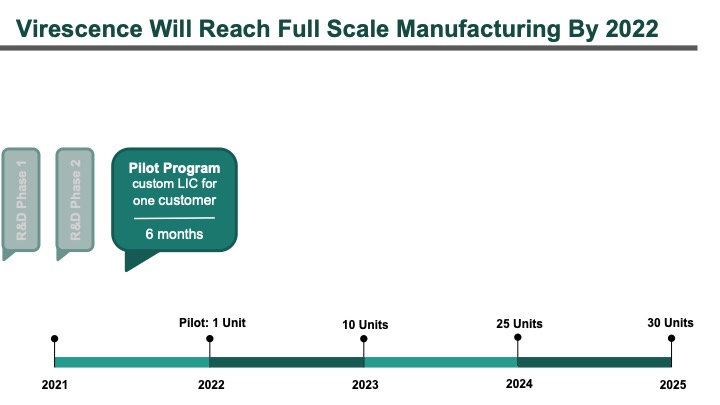
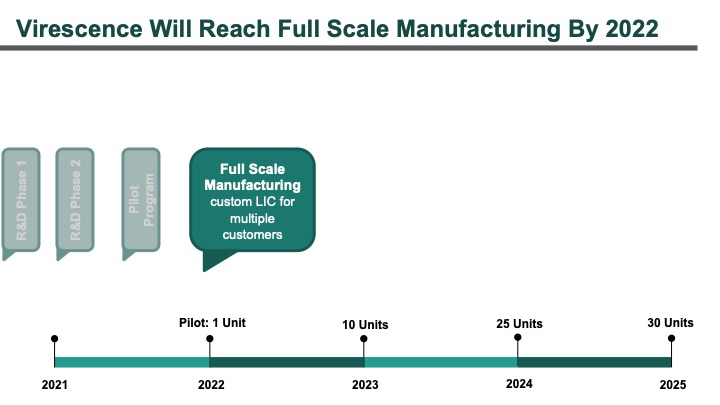
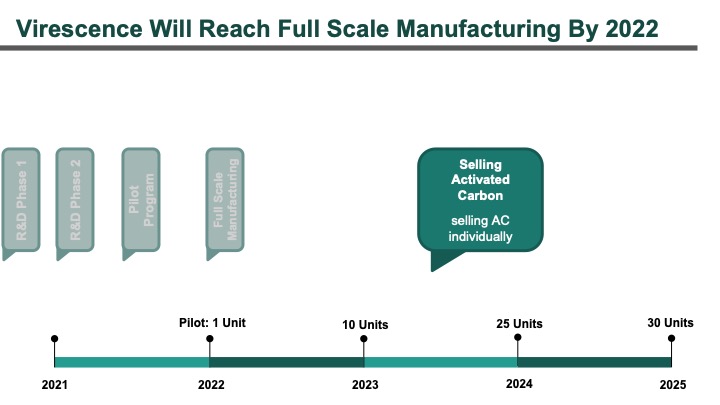
Virescence completed initial concept testing, having successfully built LIC cells made from our corncob-derived AC. Our next milestone is creating a scaled-up LIC unit containing thousands of LIC cells to power train cars by 2021. The unit will also contain the equipment necessary to connect it to the subway’s existing infrastructure. Then we will conduct a pilot program, building one LIC unit at our in-house research and manufacturing facilities to perfect the customization process. Virescence will reach full scale manufacturing by 2022, producing units for multiple customers. After Virescence has established itself and its technology, we will begin selling our raw activated carbon as a secondary product in 2023.
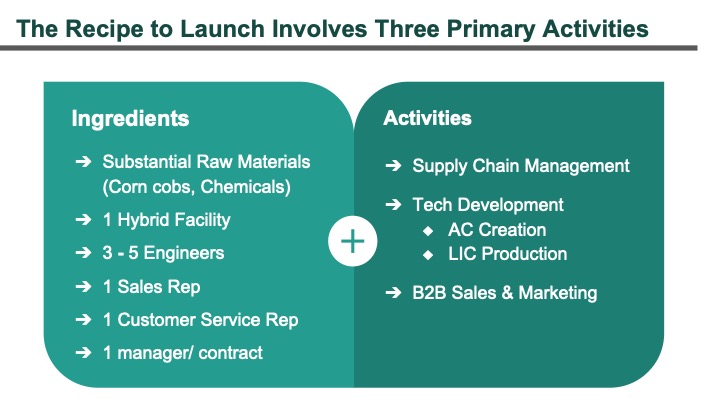
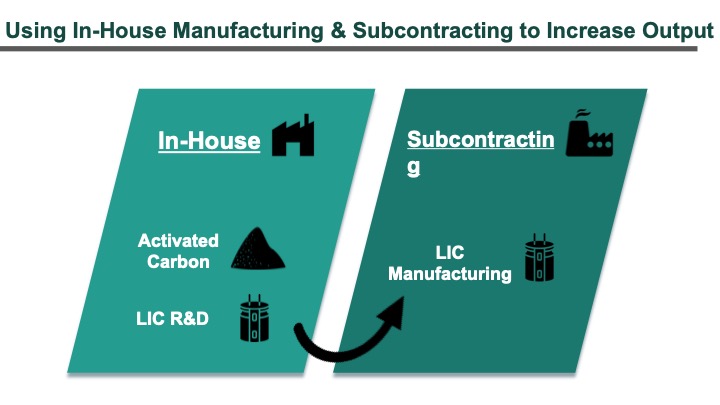
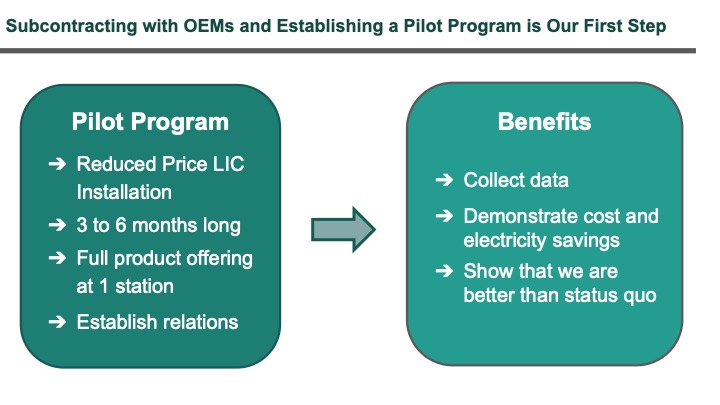
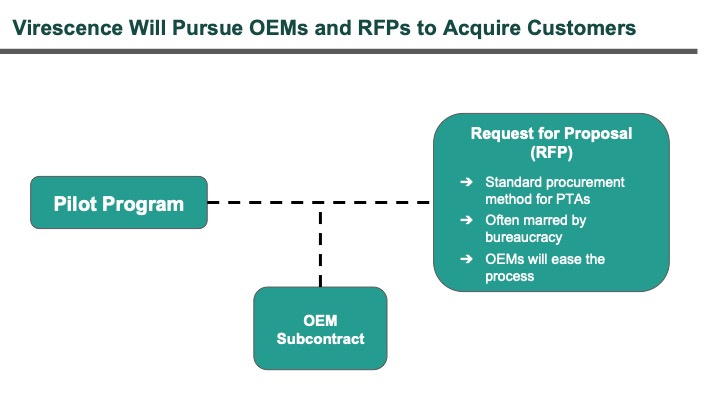
Two specific aspects of our operational strategy provide a competitive advantage. First, corncobs will be picked up from farms daily and stored in controlled facilities to preserve their quality. Second, we will strategically divide our manufacturing process, with certain steps occurring in-house and others being subcontracted. AC will be manufactured in-house using a proprietary process. While the process of creating LICs from corncob-derived AC is documented in research papers, further R&D efforts will help fine-tune this; all parts of our processes will be maintained as trade secrets. Additionally, we will create LICs in-house for one unit at a time, providing flexibility to modify and perfect the specifications of the contract. Once the specifications are finalized, the contract will be given to an outside manufacturer for completion, and another contract will begin in-house. Subcontracting will increase LIC unit output, while ensuring that each contract is given proper attention initially at our in-house facilities. To obtain our first contract, we will subcontract with an original equipment manufacturer (OEM). OEMs provide PTAs with technology, thus we can leverage their relationships to establish our pilot program. The pilot program will consist of a reduced price, short-term contract to install one LIC unit at one subway station, during which time we will collect data on cost and electricity savings. Once we have proved our technology is better than the status quo, we believe the pilot program will extend into a permanent contract via the more standard procurement process, a request for proposal (RFP). Virescence will continue to obtain OEM-aided RFP contracts until we have established ourselves in the public transit industry and can pursue RFPs independently.
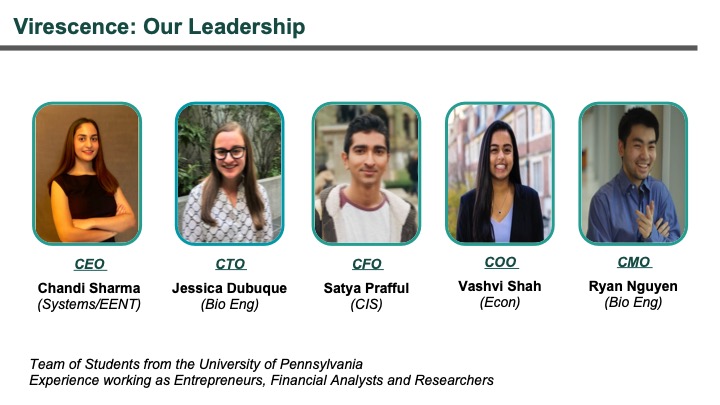
Virescence is managed by a team with diverse experiences and skill sets, ideal to bring the idea to reality. The Executive Officer, Chandni Sharma is a serial entrepreneur with experience developing ventures in consumer goods. The Financial Officer, Satya Prafful, has experience working as a technology analyst at large financial institutions. The Marketing Officer, Ryan Nguyen, has researched at the Wistar Institute and Neurosurgery Lab at UPenn. The Operating Officer, Vashvi Shah, has experience in venture capital and consulting and Jessica Dubuque, the Technology Officer, has experience in medical devices. The range of majors, from Systems to Bioengineering to Economics, will allow for the team to have the knowledge and skills to succeed with Virescence.
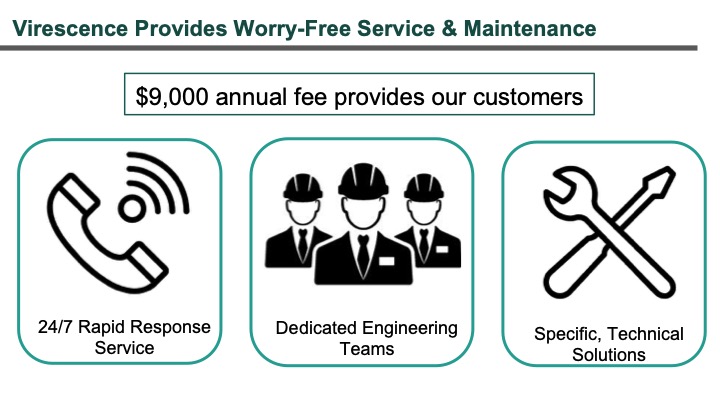
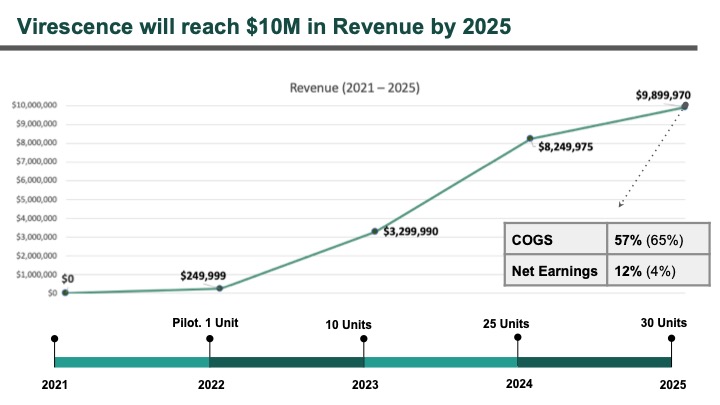
From a financial standpoint, Virescence will hit peak operational scale in 2025, selling 30 LIC units. A single unit sold to PTAs will be priced at $320K (cost $180K), with which we provide a worry-free maintenance and service package worth $9K for the first year. Therefore, in 2025, our revenues are estimated at $10MM, of which 13% are net earnings. Per our projections, we expect to hit positive net earnings as quickly as 2023.
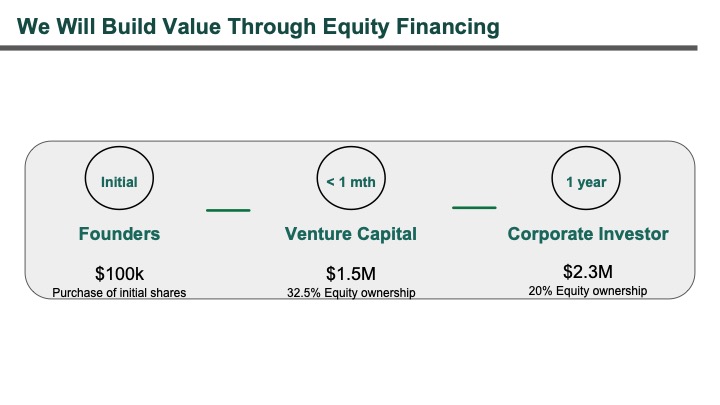
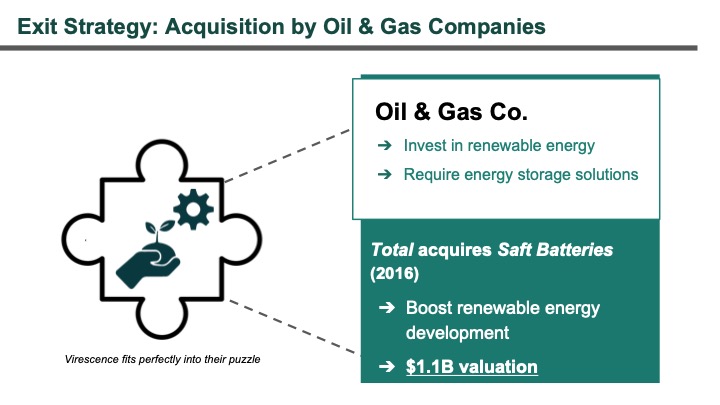
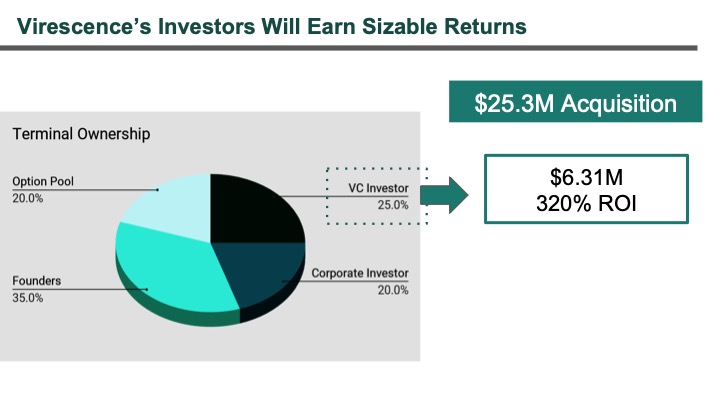
In order to build the value for Virescence that we envision, we are currently seeking a venture capital investment of $1.5M in return for 32.5% ownership and a board of directors seat. In one year, we will seek a corporate investment of $2.3M in return for 20% ownership and a board of directors seat. We require this capital to fund our hybrid research and manufacturing facilities and to hire engineers and sales teams until we reach positive earnings between 2023 and 2024. We will work to expand our venture and build Virescence into an attractive asset, and in 2025 we will begin the search for an acquirer. We believe in the promise of our corncob-derived LIC as a sustainable and technologically superior device. Virescence: Spare the Watt, Save a lot!
References Masters, N. (2020, March). Lithium Battery Manufacturing (US Specialized Industry Report OD4499). IBISWorld. Retrieved from https://clients1.ibisworld.com.


Log in or sign up for Devpost to join the conversation.