-
-
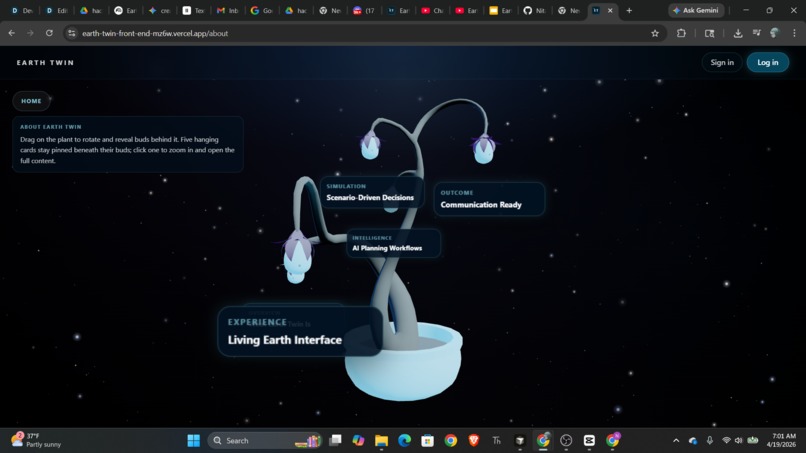
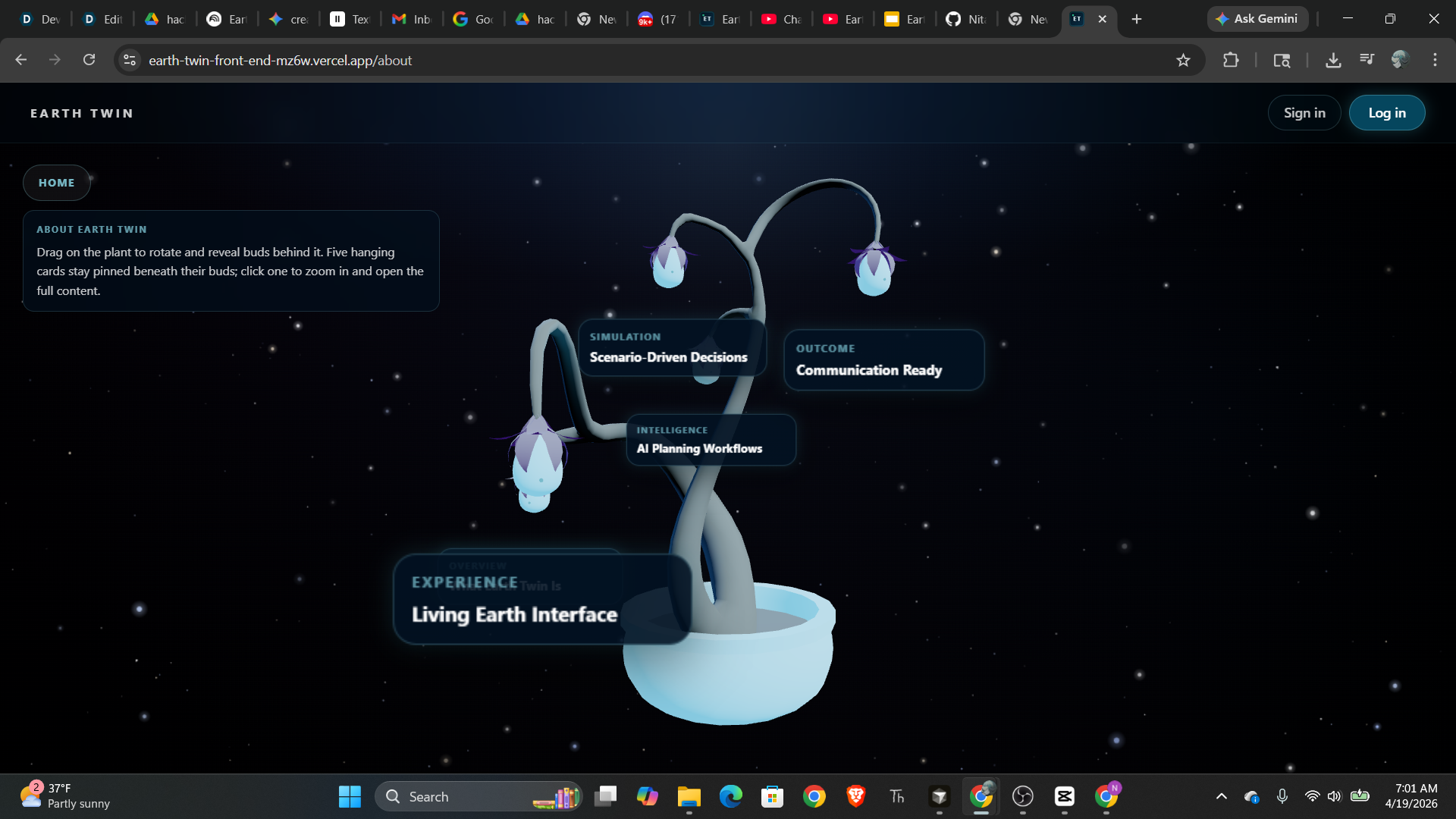
about us
-
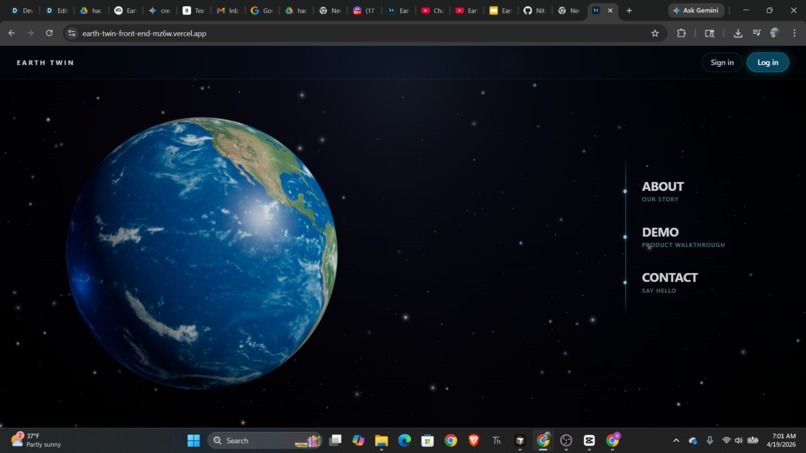
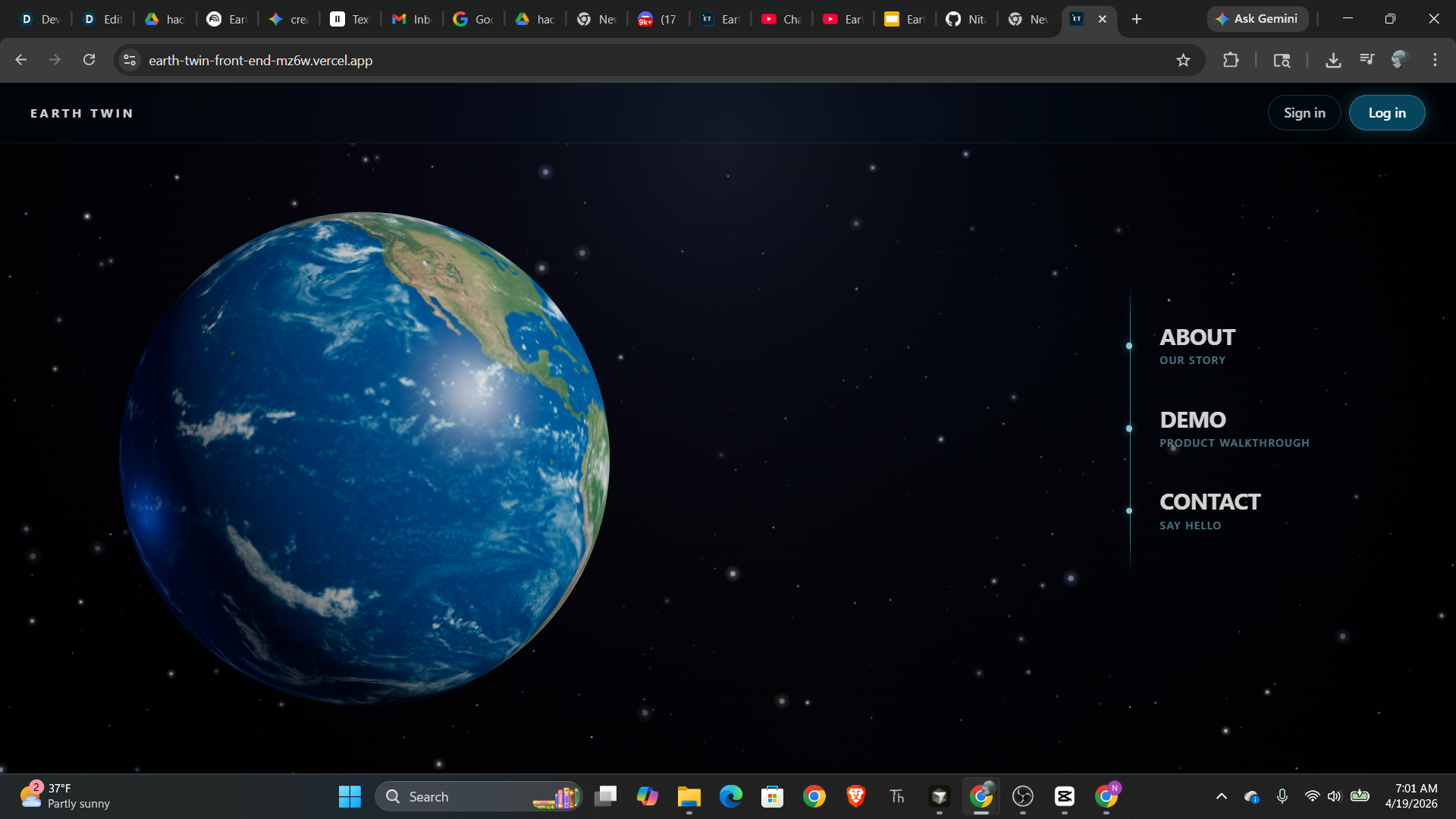
landing page
-
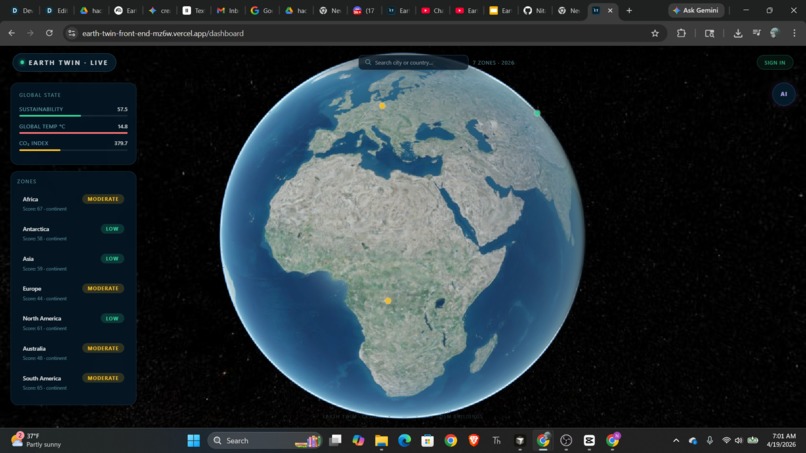
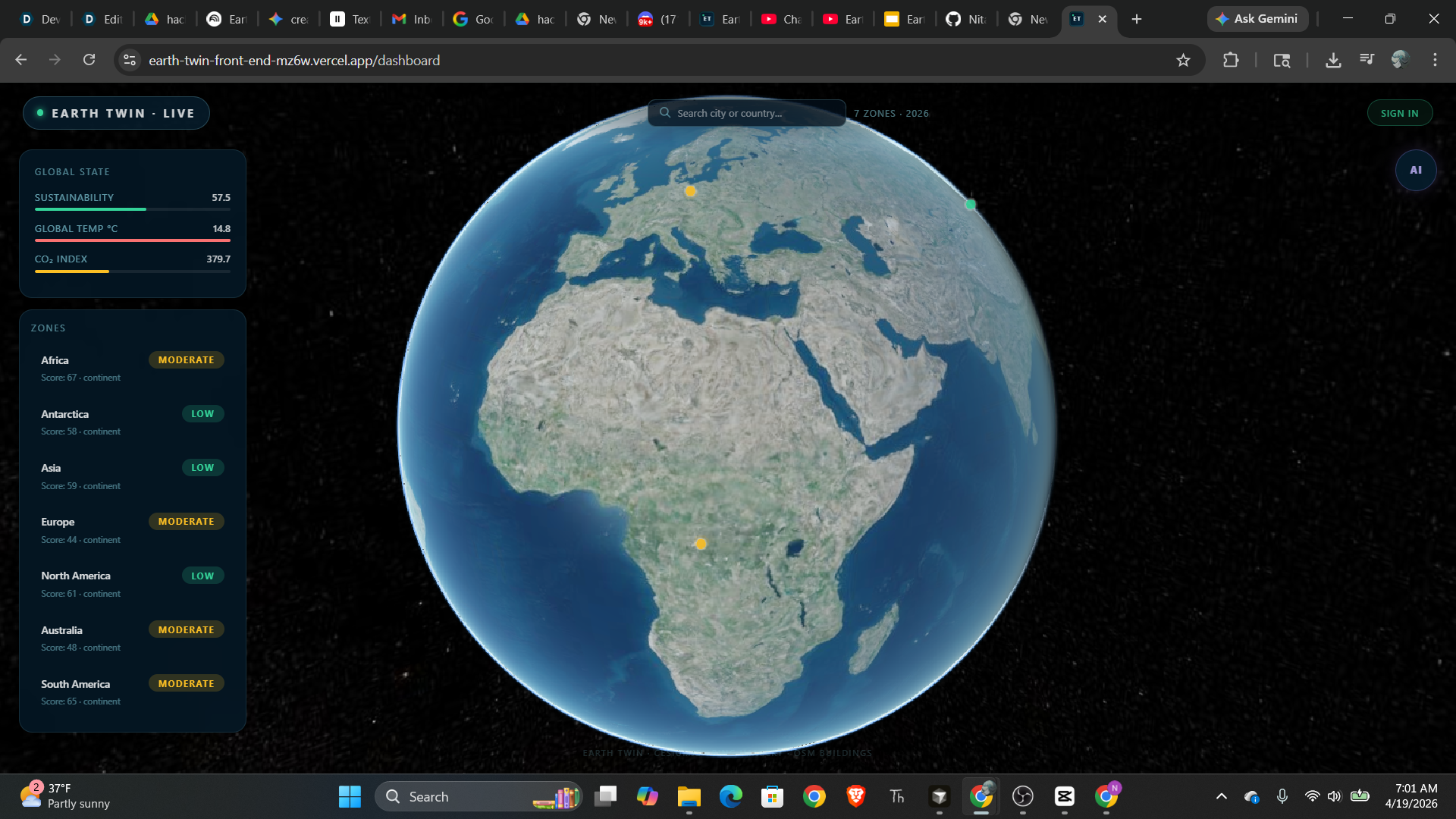
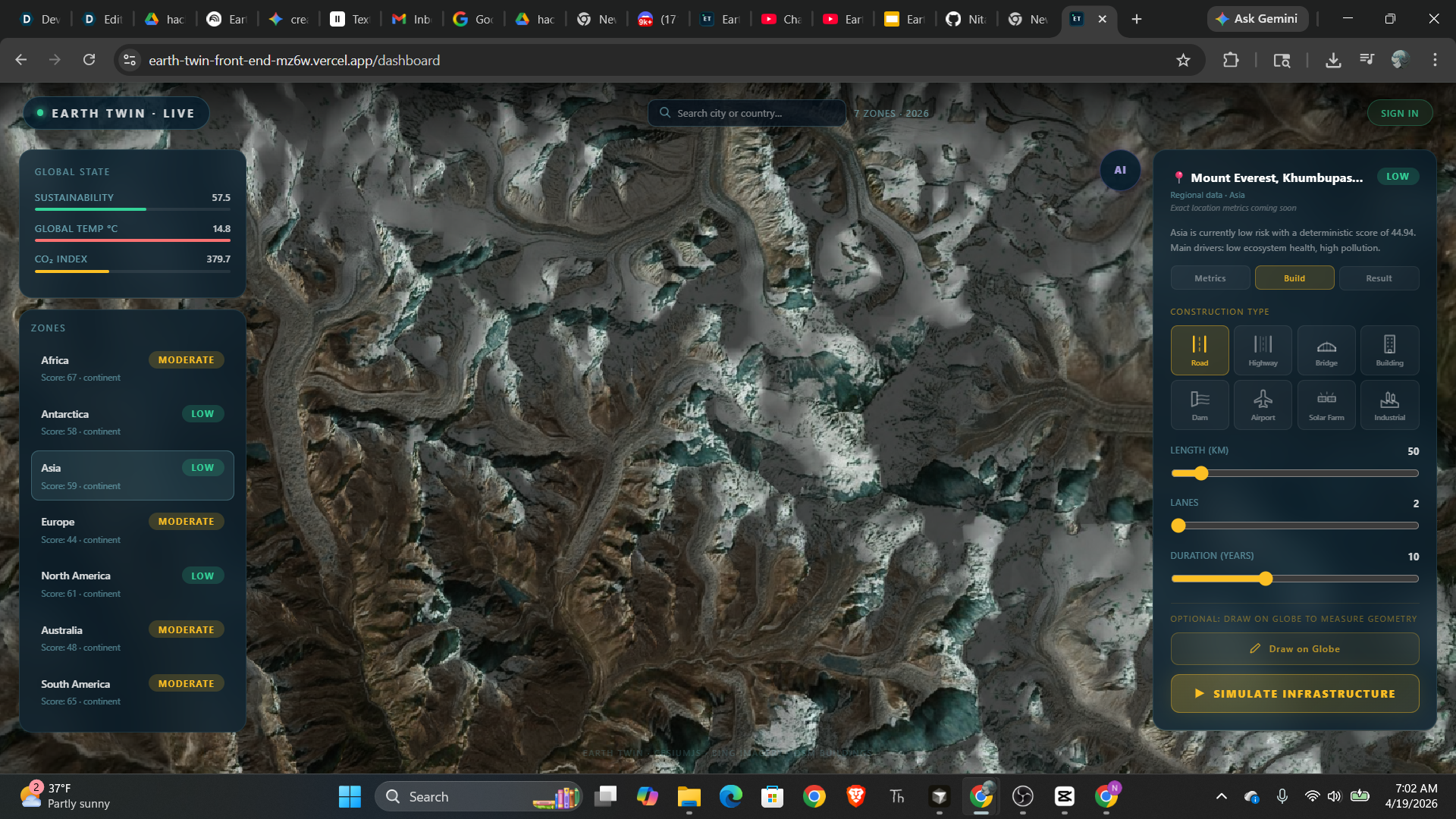
world simultion page
-
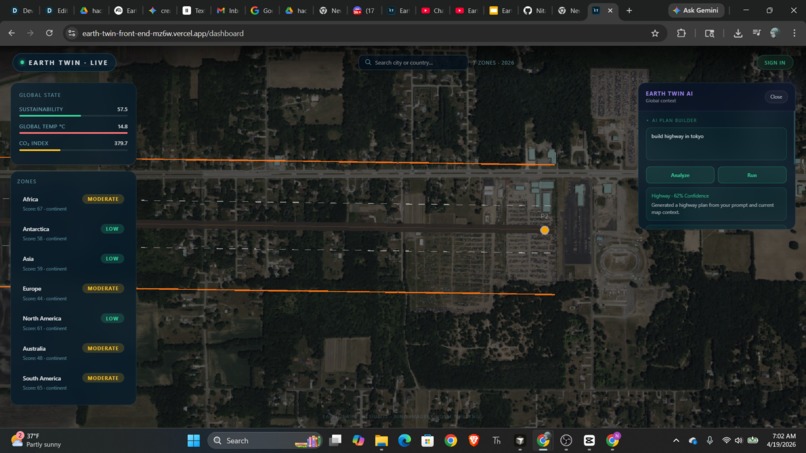
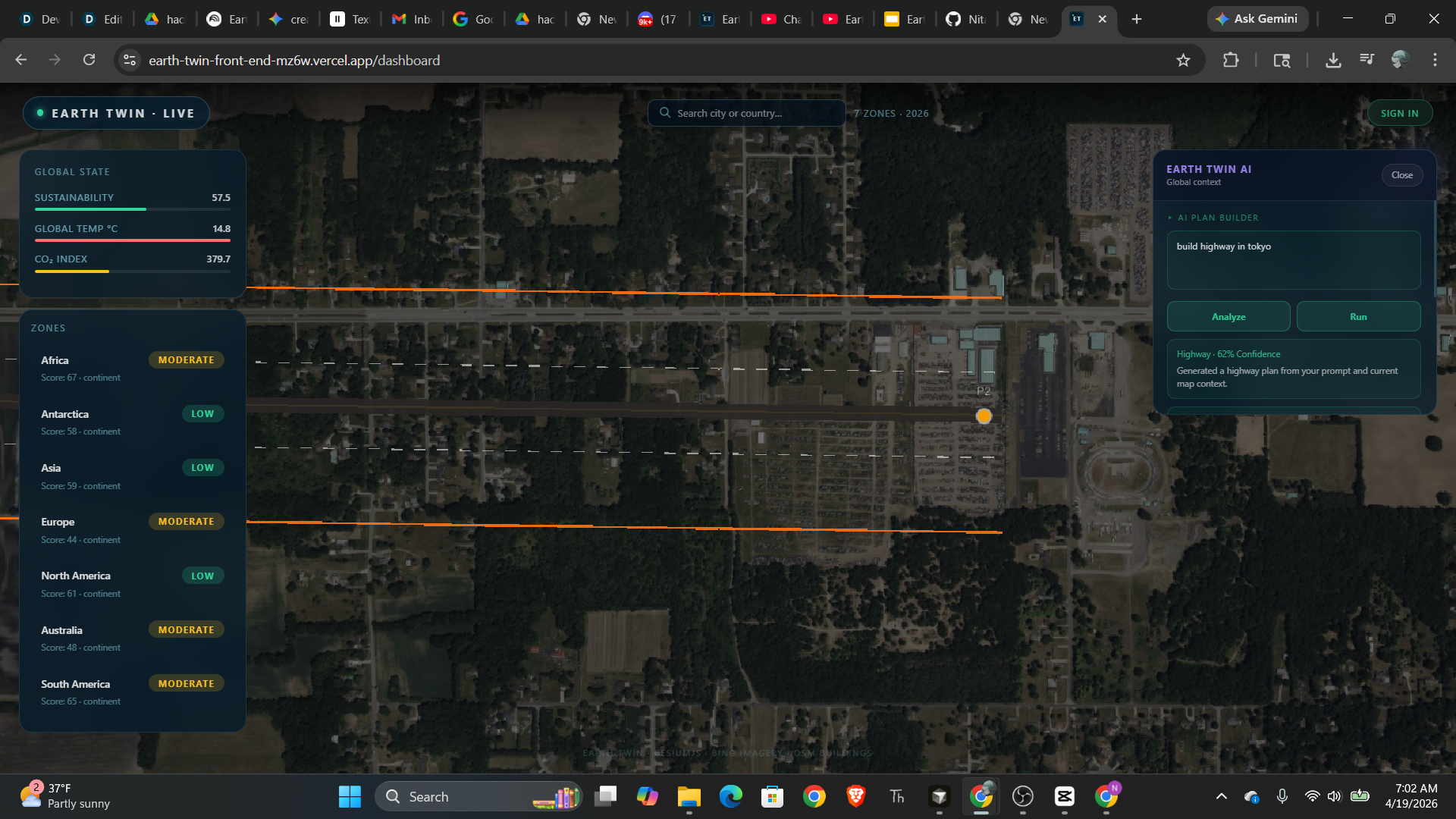
infrastructure builder example
-
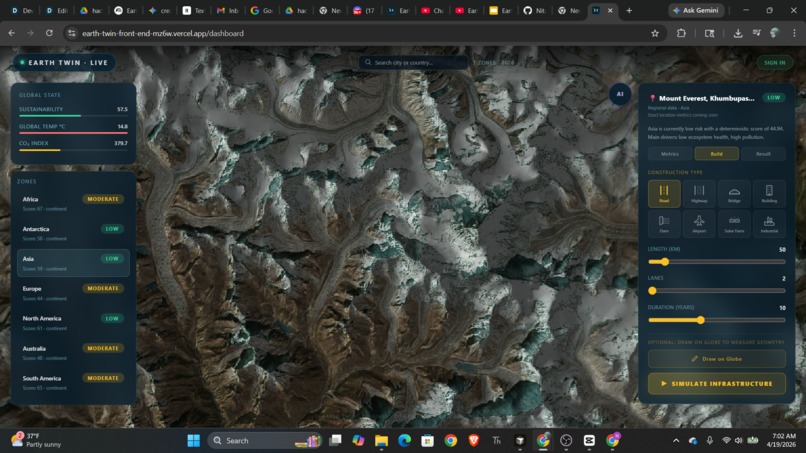
real time map indicator proof
🌍 Earth Twin — Plan Before You Build (sustainability track)
💡 Inspiration
Modern infrastructure projects often fail not because of bad intent, but because of late discovery. Environmental impact pollution, biodiversity loss, regulatory risks is usually identified after millions have already been spent.
Environmental impact assessments (EIAs) can take months to years, cost hundreds of thousands of dollars, and still come too late to prevent damage.
Our inspiration is grounded in real data. We analysed six years of EPA AQS + CASTNET ozone measurements (374,000+ rows) and found ozone rose nearly 20% between 2020 and 2025 a consistent, worsening trend directly linked to unplanned construction and industrial activity. The full data analysis behind Earth Twin is open source:
📊 HackAugie 2026 Data Challenge — Earth Twin Ozone Analysis Six years of real ozone data proving that construction without planning makes air quality measurably worse every year.
We asked a simple but powerful question:
What if you could simulate the environmental impact of a project instantly — before building anything?
That idea became Earth Twin.
🧠 What We Built
Earth Twin is an AI-powered environmental planning system that allows users to:
- Describe any infrastructure project in plain English
- Simulate its environmental impact instantly
- Compare "with planning" vs "without planning" scenarios
- Generate a professional planning report
Instead of replacing EIAs, we eliminate the blind guesswork before them.
⚙️ How We Built It
Our system combines three core components:
1. 🔎 RAG + Gemini (Structured Understanding)
We built a retrieval-augmented generation (RAG) pipeline that:
- Matches user prompts to validated infrastructure templates
- Injects domain-specific constraints (capacity, environmental rules, etc.)
- Uses Gemini to extract structured JSON (not free text)
This ensures:
Output = User Input + Domain Constraints
2. 🧮 Deterministic Simulation Engine
Unlike typical AI systems, our environmental calculations are not AI-generated.
We model impact using controlled formulas such as:
Ozone_future  = Ozone_baseline × (1 + Δ_construction)
Planned Impact = Baseline      × (1 − Δ_optimization)
Example from our dataset:
| Scenario | Ozone Change |
|---|---|
| Without planning | +8% increase |
| With Earth Twin | −5% optimized reduction |
This creates trustworthy, explainable results.
3. 🤖 Gemini as Planner + Analyst
We use Gemini in three distinct roles:
| Role | Responsibility |
|---|---|
| Interpreter | Extract structured plans from natural language |
| Planner | Decide actions based on real environmental metrics |
| Analyst | Generate grounded reports from simulation outputs |
This separation prevents hallucination and keeps AI strictly grounded in reality.
📊 What We Learned
- AI alone is not enough — combining AI with deterministic systems creates trust
- RAG is powerful when used for constraint injection, not just retrieval
- The hardest problem is not generation — it's structuring inputs and outputs correctly
- Real-world impact comes from decision support, not just predictions
⚠️ Challenges We Faced
1. Avoiding Hallucination
We solved this by:
- Restricting Gemini to structured outputs
- Feeding it only validated context
- Separating simulation from AI
2. Data Realism
Environmental modeling requires real baselines, not fake data. We integrated:
- Public environmental datasets (EPA AQS + CASTNET, 374,000+ rows)
- Real ozone trend analysis (2020–2025) — ozone up ~20% over 6 years
- Scenario-based modeling for planning decisions
3. Bridging AI + Systems
The biggest challenge was designing a system where:
- AI makes decisions
- But math validates them
This hybrid architecture was the core breakthrough.
🚀 Impact
Earth Twin transforms:
| Before | After |
|---|---|
| 2–5 year environmental reviews | Seconds |
| Expert-only tools | Plain English accessibility |
We are not replacing regulation — we are making better decisions before regulation is needed.
🔮 Future Scope
- Fully mobile-optimized platform
- Expanded infrastructure types (transport, energy, urban planning)
Earth Twin shows: *"What will happen — before you build."*
Built With
- cesium-ion
- fastapi
- google-gemini-api-(gemini-2.5-flash)
- google-genai-sdk
- nominatim-(openstreetmap-geocoding)
- open-meteo-api
- postgresql
- pydantic
- python
- rag-(custom)
- react
- render
- supabase
- vercel
- vite
- world-bank-api

Log in or sign up for Devpost to join the conversation.