-
-
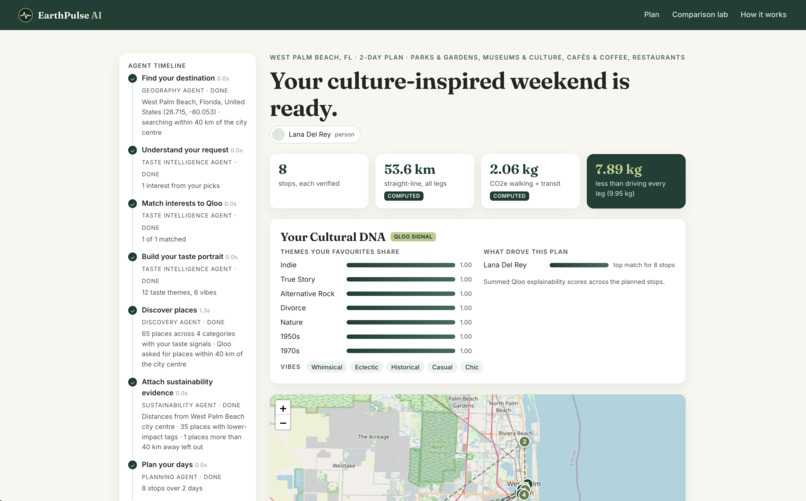
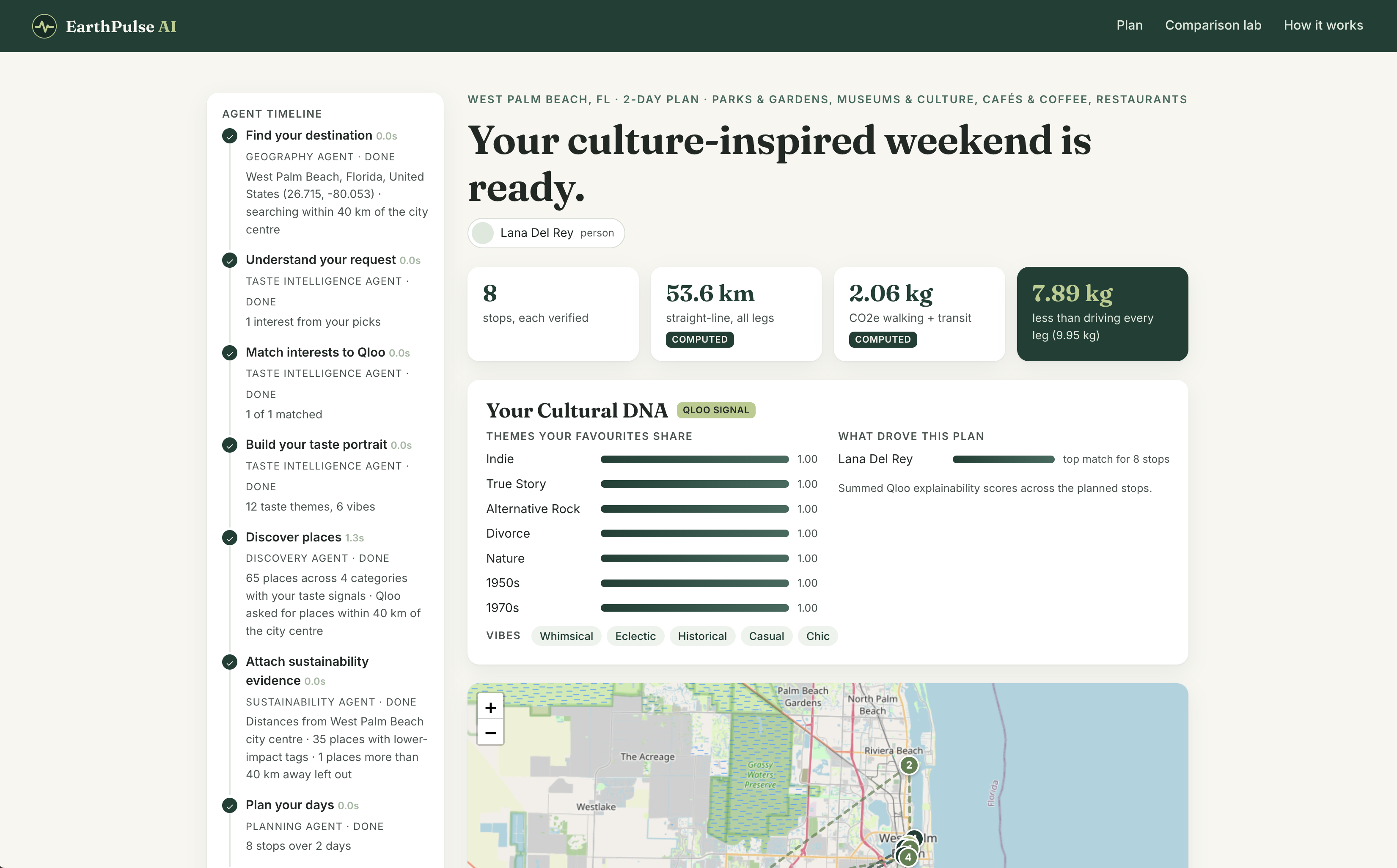
Lana Del Rey meets West Palm Beach: a personalized weekend with Qloo taste insights and estimated travel emissions.
-
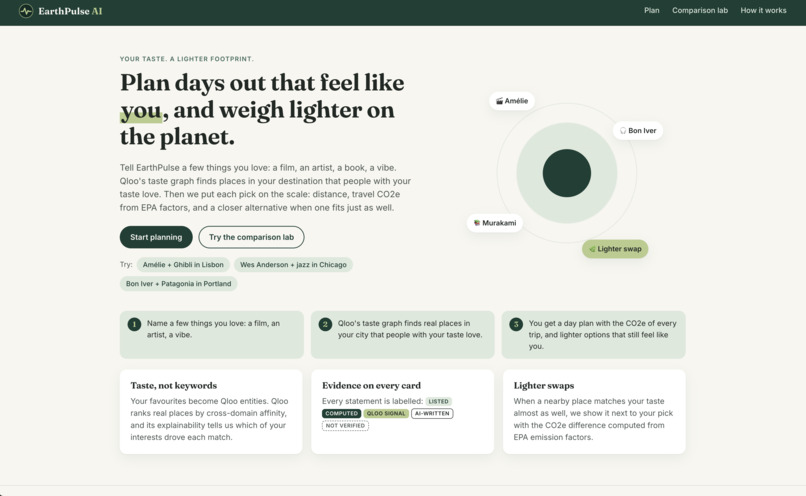
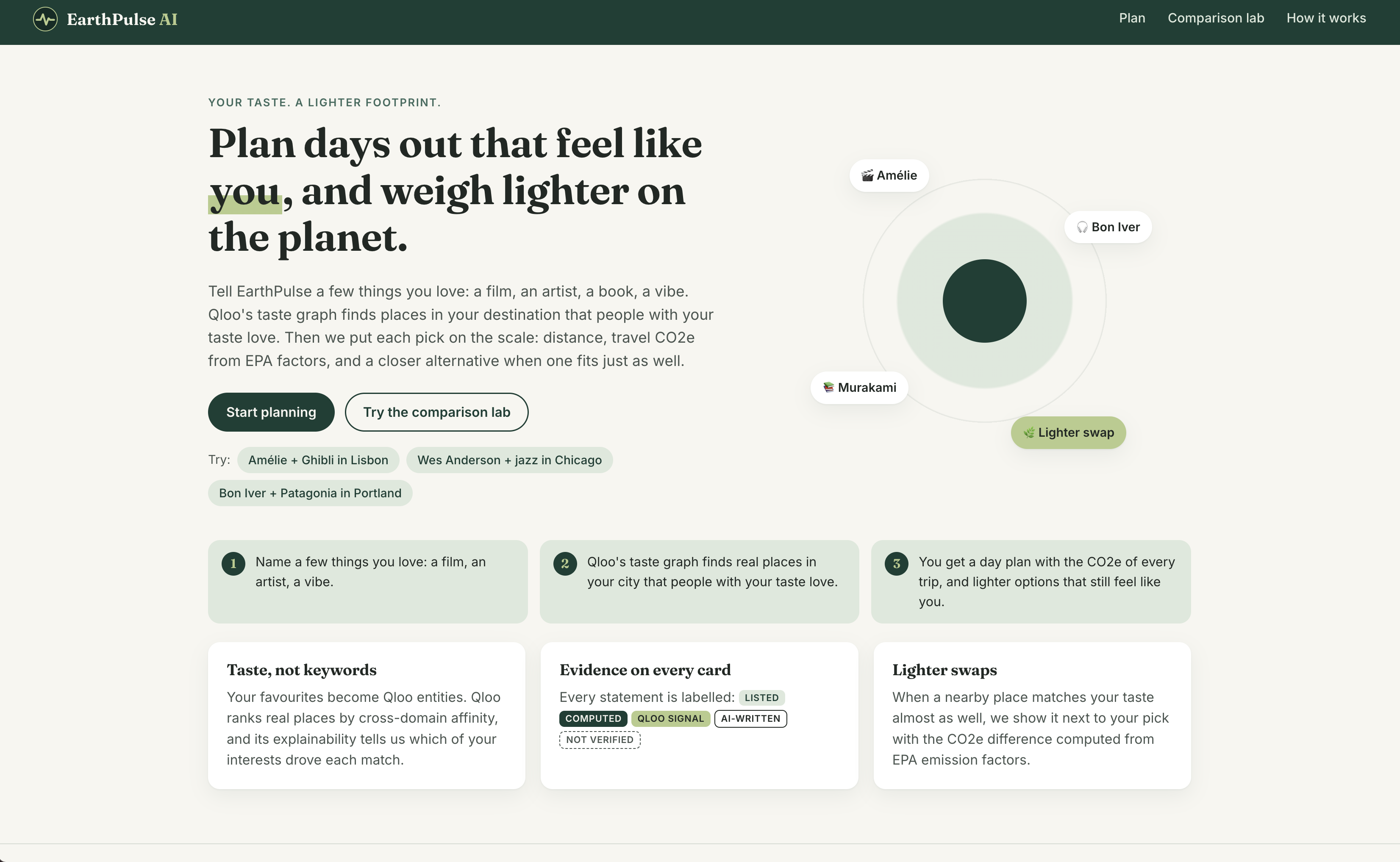
Your taste. A lighter footprint. EarthPulse turns what you love into places to explore.
Inspiration
I care deeply about conservation, but I also want exploring somewhere new to feel personal. I want to discover gardens, architecture, and cultural spaces that connect with what I love, while understanding the footprint of getting from one to the next.
EarthPulse began with a question: could a travel planner understand your taste and help you make more informed travel choices?
What it does
EarthPulse turns your interests into a personalized city itinerary using Qloo’s cultural intelligence.
Choose a destination, add interests such as Studio Ghibli, Japanese architecture, or botanical gardens, and build a plan. EarthPulse connects those interests with nearby places, organizes the itinerary, and estimates the travel emissions.
The experience includes:
- Cultural DNA: a view of how your interests connect to the recommendations.
- Mapped itineraries: see where the recommended stops are located.
- Evidence panels: distinguish Qloo signals, calculated estimates, listed information, and details that remain unverified.
- Lighter-footprint adjustments: regenerate the plan with greater emphasis on distance and review what changed.
- Blind comparisons: rate recommendation lists before revealing which used Qloo.
- Destination clarification: broad destinations such as “Florida” trigger a city-selection step.
How I built it
The planning workflow integrates destination resolution, Qloo interest matching, nearby place discovery, itinerary construction, and travel emissions estimation.
Qloo provides the cultural connections between a person’s interests and potential destinations. Geographic constraints keep discovery focused on the selected city, while the planner accounts for travel between stops.
The interface exposes planning progress and evidence so users can understand the recommendations. Travel emissions are estimates based on distance, transport assumptions, and published emission factors; they are not direct measurements.
The application is deployed on Render.
Challenges I ran into
A central challenge was balancing taste and proximity. The closest destination is not necessarily the most interesting, and a strong taste match may require more travel. I wanted that trade-off to be visible and adjustable.
Another challenge was communicating uncertainty. A recommendation signal, a calculated estimate, and a verified fact mean different things. EarthPulse separates them instead of presenting every detail with the same confidence.
Accomplishments that I’m proud of
I brought personalization, geographic planning, and environmental estimates into one coherent experience.
I’m especially proud of the comparison feature. It lets users examine what Qloo contributes by comparing taste-based recommendations with keyword- and distance-based approaches within the same city and place directory, using the same rules.
I also designed the interface to make the evidence accessible without overwhelming someone planning a weekend.
What I learned
Personalization becomes more useful when people can understand and adjust it.
I also learned that environmental information needs clear boundaries. EarthPulse estimates local travel emissions, which are only one part of a trip’s overall impact. Making those assumptions visible is part of building a trustworthy product.
What’s next for EarthPulse
I want to expand the evaluation to include more destinations and independent user ratings, improve route and transport estimates, and incorporate more locally appropriate emission factors.
The goal is to help people discover places that feel like them while making the travel trade-offs easier to understand.
Built With
- qloo
- render
