slides - live presentation link: https://docs.google.com/presentation/d/1fMtrDwj9vcG02R1ZFxgERvjKA75tooredfSfD4Yi6HQ/edit?usp=sharing
team name: Northwood KS / EarthZ
Wildfires in Southern California are becoming increasingly frequent and severe at alarming rates, devastating communities and ecosystems. In 2020, the Silverado Fire in Orange County burned over 13,000 acres, driving over 90,000 civilians into evacuation. Additionally, the 2024 Line Fire burned nearly 43,000 acres, while the Greater Los Angeles fires burned through more than 57,000 acres, forcing more than 200,000 people into evacuation and destroying over $135 billion in infrastructure. If we do not take the necessary preemptive measures, these fires will continue to grow, causing even more devastation to the already affected communities and ecosystems. These issues directly impact climate change. Our mission for our model is to use real-time data to predict high-fire-risk locations and work on SDG 13 by preventing climate change.
Furthermore, When fires ravage ecosystems, they not only destroy habitats, they displace species and disrupt food chains, often leading to many ecological imbalances. Many wildlife, especially those in high-risk areas struggle to recover, and some may even face extinction if their habitats are destroyed. With our model predicting fire risk, it can provide early alerts and allow for preemptive measures such as controlled burns or evacuations, to prevent wildfires from reaching dry, vulnerable regions. This will not only safeguard biodiversity of affected ecosystems, it will reduce the destruction of wildlife, preserve habitats, and ultimately maintain ecological balance. We aim to fix this, working towards SDG 15.
The overall effect of this ecosystem imbalance results in consequences for humans. According to the World Health Organization, Humans rely on biodiversity in their everyday lives, and human health is greatly impacted through ecosystem products: such as water, food, and fuel resources. Furthermore, albeit indirectly, changes in ecosystem services affect income, livelihoods, and local migration. Significant scientific and medical discoveries are directly made through the greater understanding of biodiversity. Due to this, ecological imbalances which affect biodiversity, leading to a loss, means that humans are losing access to potential discoveries through nature’s chemicals and genes. Climate change, which directly affects almost all human beings worldwide, is further defined through the use of biodiversity in ecosystems. Long-term changes in the climate affect the distribution of plants, animals, and humans. This correlates exactly what our model is attempting to address, both UN sustainable development goals 13, climate actions, and 15, life on land.
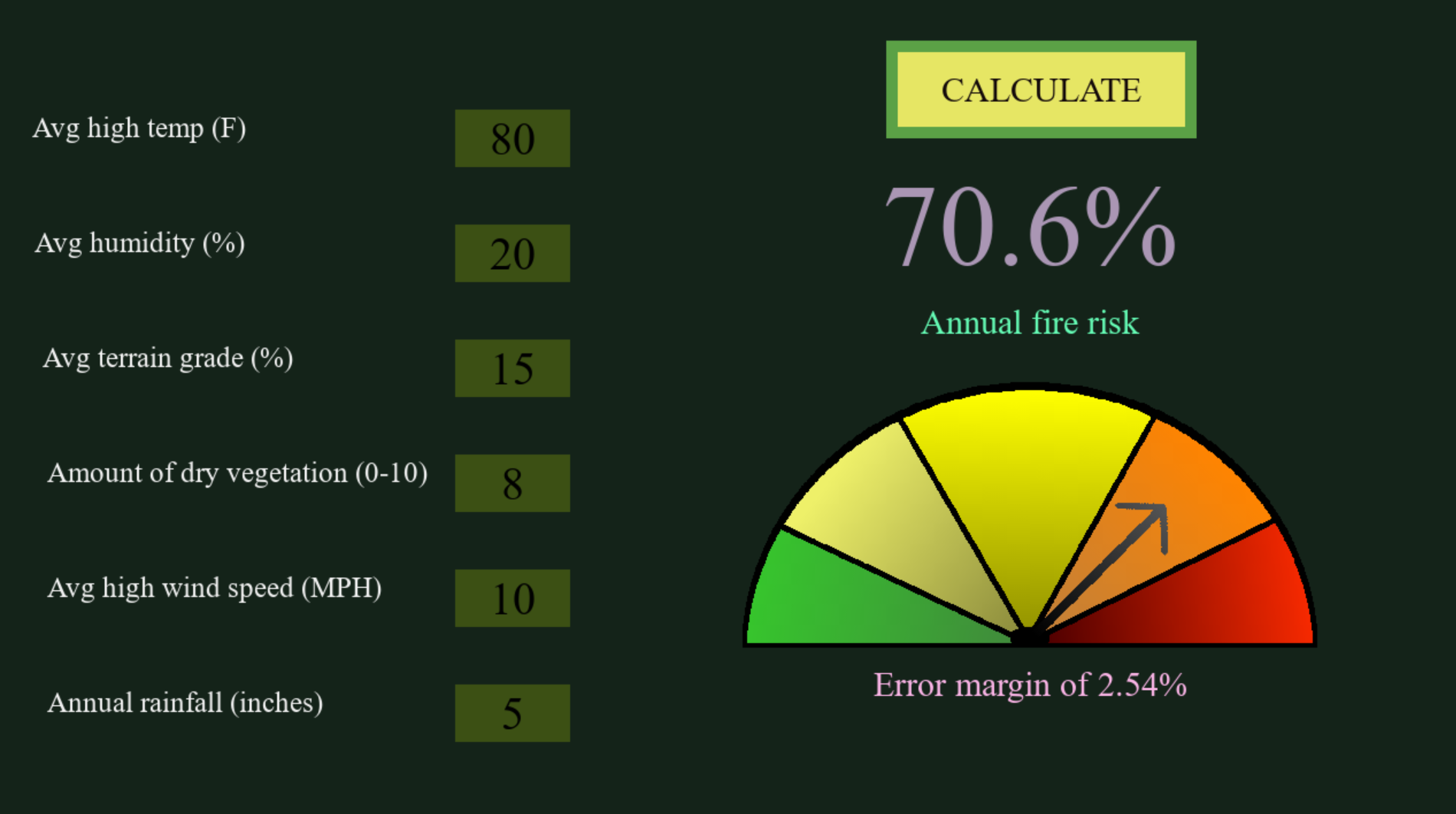
Currently, our model is extremely preliminary, with no AI integration. It uses a simple weight system to accurately predict areas of high fire risk. In the future, we plan to create an AI-Based model that uses real time data and past weather patterns to determine areas of high potential fires. To ensure that the data we collect is current and accurate, we will set up an AI based model to gather current weather conditions from various sources including weather stations and satellites to measure the climate in our area. After we train this model, it will be accessible to the public through a website in which we will alert first responders of areas that have high fire risk. We plan to start locally, as our model will be trained using local data, and we will share resources and information with local fire stations to prevent devastating outbreaks. Additionally we plan to scale this project throughout California by training the AI to adapt to the diverse regions in our state, such as the chaparral and redwood biomes. This data collected will be translated onto the website for firefighters and civilians to then use.
Our website will feature a home page with a menu, allowing the user to select the region they wish to. The AI model will then provide a risk prediction of wildfire in that area based on historical and current weather data. This streamlined method allows the general public to easily access our predictions and for emergency services to identify danger zones and take preemptive measures.
Our model allows users to see the predicted areas of which a fire is about to take place, therefore allowing preemptive measures. This would also send notifications to emergency personnel like firefighters who can help protect and save vulnerable areas or wildlife.
The California Department of Fish and Wildlife states that “Atypically large patches of high-severity fire can hinder the ability of an ecosystem to recover, potentially undermining conservation of native biodiversity by long-term or permanent loss of native vegetation, expansion of non-native, invasive species, and long-term or permanent loss of essential habitat for native fauna.”
By integrating local fire stations and making our website accessible to the public, the model’s impact will increase over time. As we continue to collect data and update the AI model, its accuracy will improve as it receives fresh data, guaranteeing long-term relevance . Ongoing investment in technology and collaboration with state agencies will ensure that our model becomes a long-term solution for mitigating wildfire damage across California’s high-risk regions.
As climate change intensifies, wildfires will become more frequent and severe, highlighting the necessity of long-term technological investment in wildfire prediction. Wildfires are an escalating crisis driven by climate change, urban expansion, and shifting weather patterns, making it crucial to develop adaptive predictive models. However, without continuous updates, these models quickly become outdated and less effective in identifying new fire risks. Our AI model addresses this issue by continuously training on both historical and real-time data, ensuring its accuracy and long-term relevance. As artificial intelligence becomes increasingly vital in modern society, leveraging its capabilities to prevent and mitigate wildfires is essential. Ongoing investment in AI technology, combined with collaboration with state agencies, will enhance wildfire prediction and provide a sustainable solution for protecting California’s high-risk regions.
The Greater Los Angeles Fires exposed a critical lack of preparedness, forcing thousands to evacuate and causing over $135 billion in damages. Our AI-driven wildfire prediction model will change that by identifying high-risk areas in real-time, allowing first responders to take proactive measures like firebreaks and controlled burns before fires spiral out of control.
With support, we can equip communities with accurate, up-to-date fire risk reports, safeguarding lives, homes, and ecosystems. Join us in building a fire-prepared future - where technology helps protect what matters most.
Works Cited
de Guzman, Chad. “Here's the Size of the L.A. Fires So Far.” Time, 10 January 2025, https://time.com/7206020/los-angeles-fires-size-acres-manhattan-football-fields/. Accessed 13 February 2025. Gopalan, Nisha. “Los Angeles Wildfires Loss Estimate Now Up to $150B as Death Toll Rises.” Investopedia, 10 January 2025, https://www.investopedia.com/los-angeles-wildfires-loss-estimate-now-up-to-usd150b-as-death-toll-rises-8772312. Accessed 13 February 2025. “Line Fire.” Wikipedia, https://en.wikipedia.org/wiki/Line_Fire. Accessed 13 February 2025. Macias, Antonio. “New Data Confirms: Forest Fires Are Getting Worse.” World Resources Institute, 13 August 2024, https://www.wri.org/insights/global-trends-forest-fires. Accessed 13 February 2025. Samborska, Veronika. “Scaling up: how increasing inputs has made artificial intelligence more capable.” Our World in Data, https://ourworldindata.org/scaling-up-ai. Accessed 13 February 2025. “Silverado Fire.” Wikipedia, https://en.wikipedia.org/wiki/Silverado_Fire. Accessed 13 February 2025. Sommer, Lauren. “Evacuation lessons to be learned from the Los Angeles fires.” NPR, 9 January 2025, https://www.npr.org/2025/01/09/nx-s1-5252742/wildfires-evacuation-lessons. Accessed 13 February 2025. Stelloh, Tim, et al. “California wildfires: What we know about L.A.-area fires, what caused them, who is affected and more.” NBC News, 30 January 2025, https://www.nbcnews.com/news/us-news/california-wildfires-what-we-know-palisades-eaton-los-angeles-rcna188239. Accessed 13 February 2025. https://www.who.int/news-room/fact-sheets/detail/biodiversity-and-health https://pmc.ncbi.nlm.nih.gov/articles/PMC3839693/

Log in or sign up for Devpost to join the conversation.