-
-
1. Project Identity
-
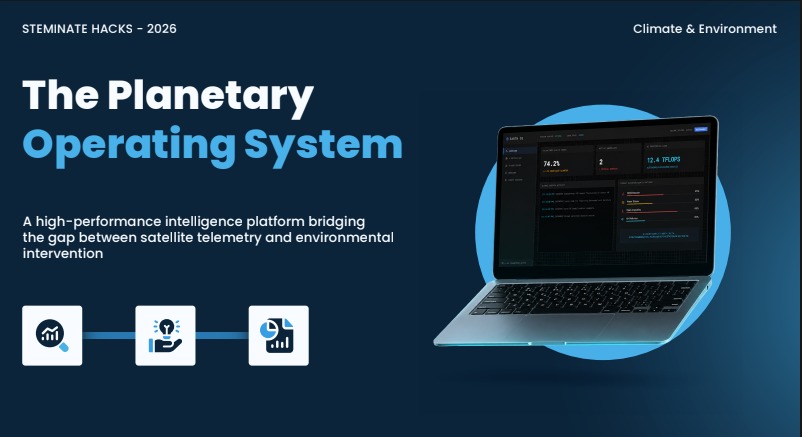
Project Identity
-
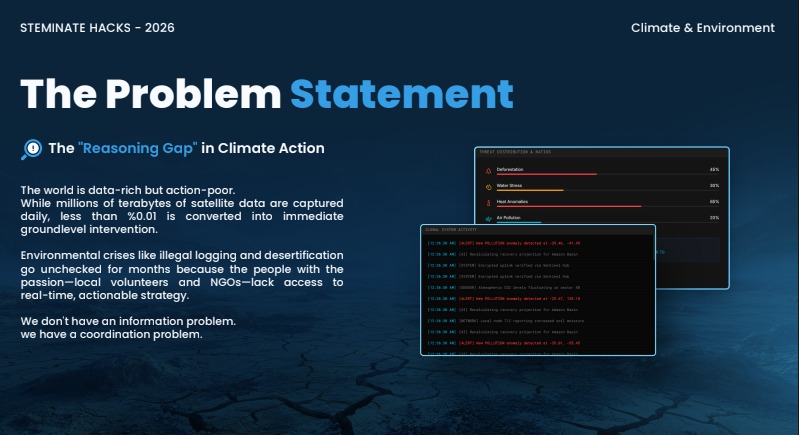
2. The Problem Statement
-
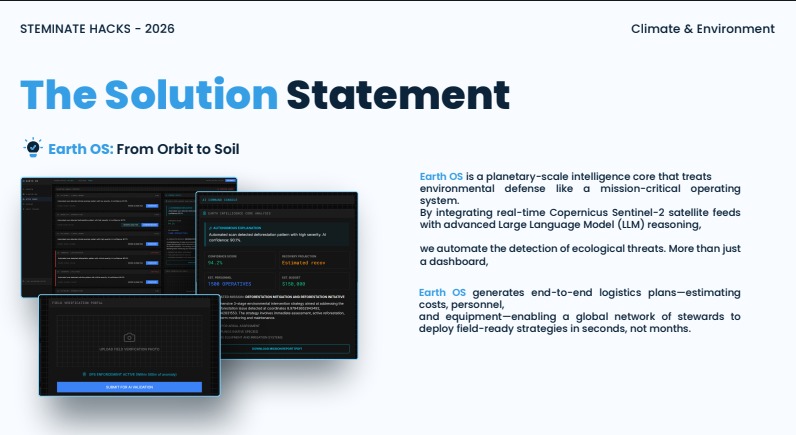
3. The Solution Statement
-
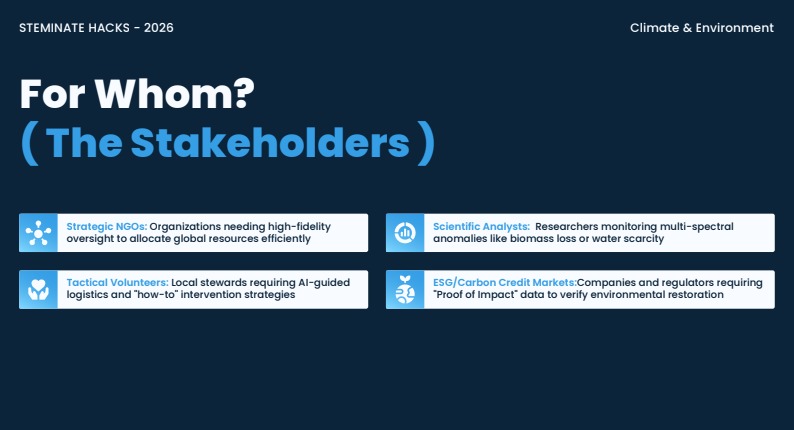
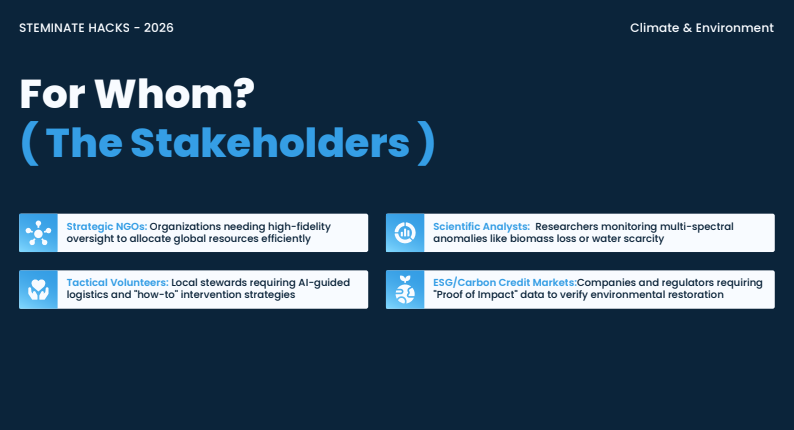
4. For Whom? (The Stakeholders)
-
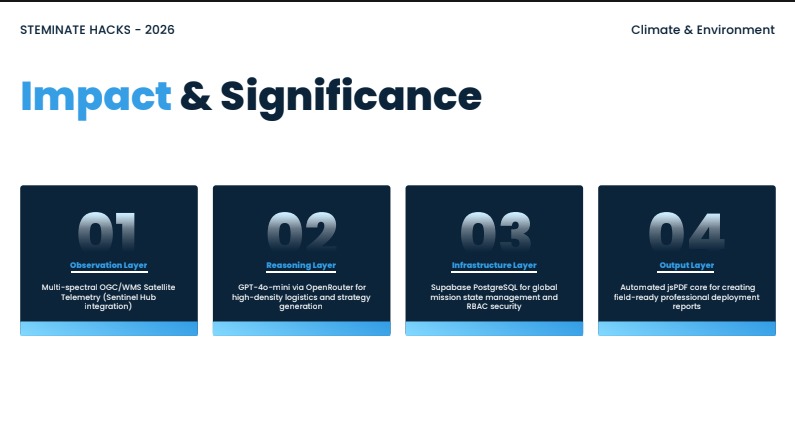
5. Impact & Significance
-
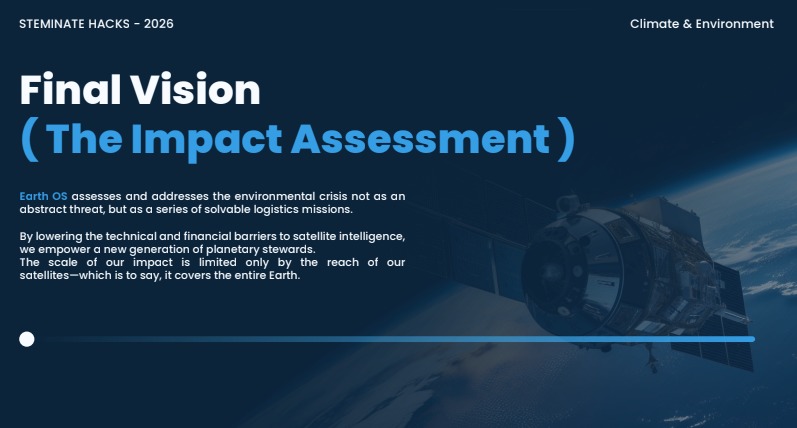
6. Final Vision (The Impact Assessment)
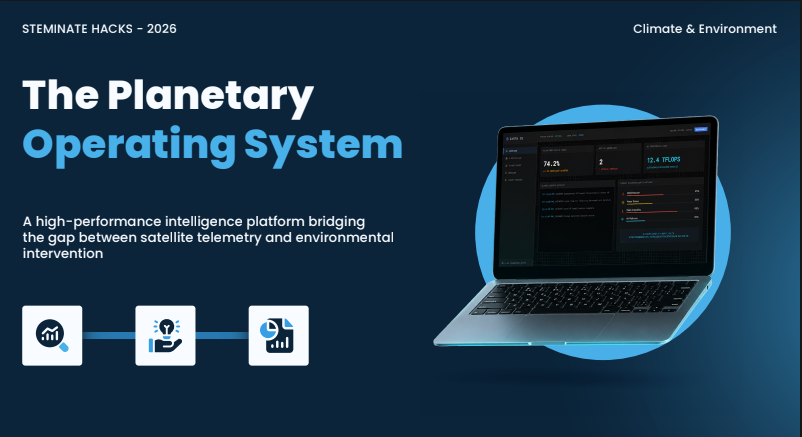
🌍 About Earth OS: The Planetary Intelligence Network
✨ Inspiration: The Planet Needs an Operating System
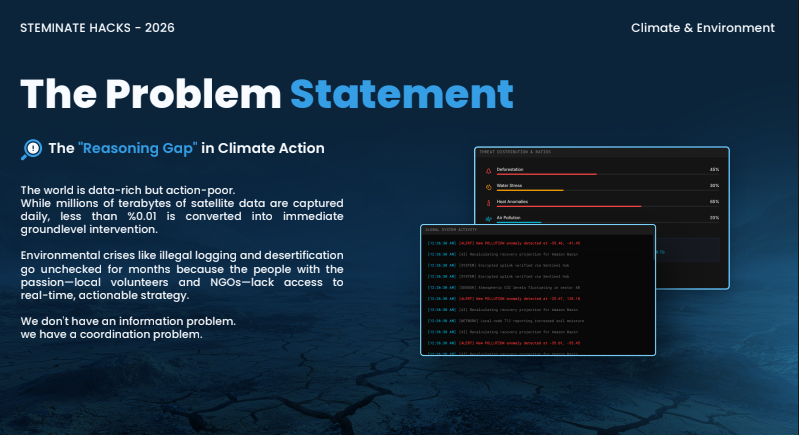
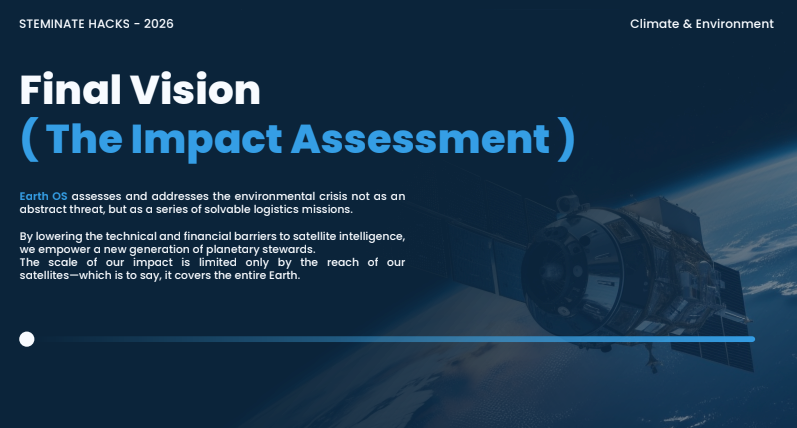
The project was born from a simple but urgent realization: we have more data about our planet than ever before—orbiting satellites, ground sensors, and weather stations—yet this data is often fragmented and inaccessible to the people who can actually take action.
Earth OS was inspired by the vision of a "Planetary Command & Control center." I wanted to build something that didn't just show problems, but solved them by bridging the gap between high-altitude telemetry and ground-level coordination. The goal was to create a tool where a satellite detecting a hotspot in the Amazon could automatically trigger a tactical recovery plan and coordinate local volunteers in real-time.
🛠️ How I Built It
The architecture was designed to be as professional and scalable as possible for a hackathon project:
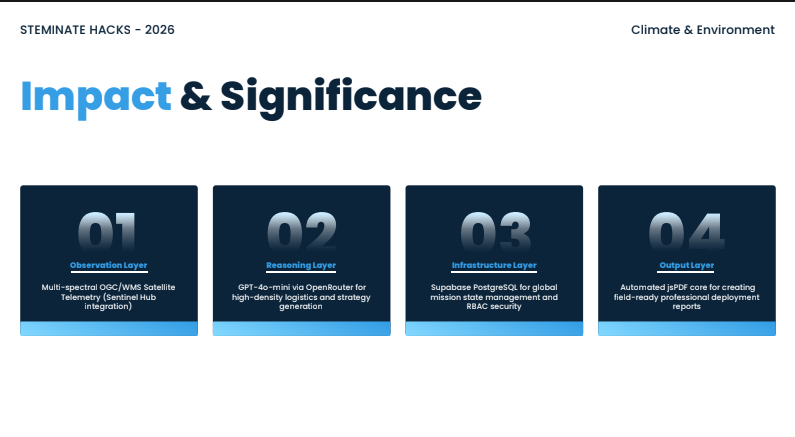
- The UI & Framework: Built with Next.js 15 (App Router) for a high-performance, modern web foundation. I used Framer Motion to create a "NASA-terminal" aesthetic, ensuring the interface felt like a mission-critical tool rather than just another dashboard.
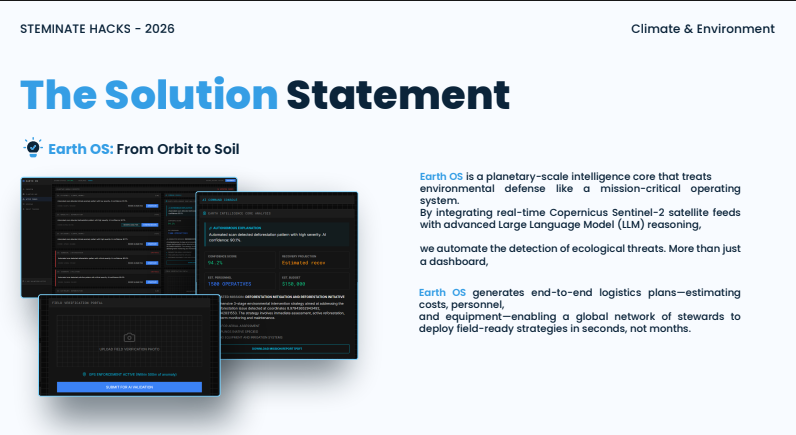
- The Intelligence Core: I integrated OpenRouter (GPT-4o-mini) to act as the "Earth Intelligence Core." Instead of hardcoding responses, the system performs live "Deep Scans," using the LLM to translate raw geographic coordinates and threat types into actionable 3-stage tactical missions.
- Planetary Visualization: The heart of the app is a mapping interface built with React-Leaflet. I integrated a live WMS (Web Map Service) uplink to the Copernicus Sentinel-2 satellite constellation, allowing users to see the actual state of the Earth within a 5-day revisit window.
- The Backend: Supabase was used for high-speed authentication and database management, handling everything from operative profiles to mission state persistence.
- Reporting: To make the missions feel "real," I implemented a PDF generation utility using jspdf, which creates professional-grade mission dossiers automatically for stakeholders.
🧠 What I Learned
Building Earth OS was a deep dive into several complex domains:
- Satellite Telemetry: I learned how to work with OGC standards and WMS protocols to fetch and display multi-spectral satellite imagery. Understanding how to overlay real-time planetary data on interactive maps was a game-changer.
- Multi-Tier Intelligence Architecture: I experimented with how to use AI not just for chat, but as a "reasoning engine" that takes structured input (coordinates, threat levels) and produces structured output (logistics, impact projections).
- Authentication Migration: I gained significant experience in migrating auth providers (Clerk to Supabase), which taught me a lot about middleware, session management, and role-based access control (RBAC).
- The "Cyber-Industrial" Aesthetic: I learned how to balance high-end digital aesthetics (dark modes, glows, terminal fonts) with actual usability, ensuring the "cool factor" didn't overshadow the technical data.
🚧 Challenges Faced
No project is built without friction, and Earth OS had its share:
- API Transitions: Mid-development, I had to transition from the Google Gemini API to OpenRouter. This required refactoring the entire AI service layer to move from SDK-based calls to a clean, fetch-based architecture while maintaining the prompt's "personality."
- Auth Refactor: Switching from Clerk to Supabase was a major technical pivot. It involved rewriting the authentication logic and restructuring the database schema to handle custom operative roles while the project was already mid-flight.
- Data Latency vs. Visuals: Integrating live satellite imagery (WMS) sometimes caused performance bottlenecks. I had to optimize the map rendering and layer management to ensure the "Digital Twin" stayed responsive even when loading high-resolution satellite tiles.
- Simulating the "Un-simulatable": Finding the balance between real satellite data (which is static) and the dynamic "anomalies" (which need to be interactive for the demo) required building a custom
AnomalySimulatorthat felt authentic to real environmental crisis patterns.
🔭 The Future
Earth OS is just the beginning. The roadmap includes integrating NASA FIRMS for real-time wildfire tracking and connecting to IoT ground sensors to create a truly closed-loop planetary intelligence system.
Built With
- cartodb
- jspdf
- leaflet.js
- nextjs
- openrouter-api
- react
- sentinel-hub
- supabase
- typescript

Log in or sign up for Devpost to join the conversation.