-
-
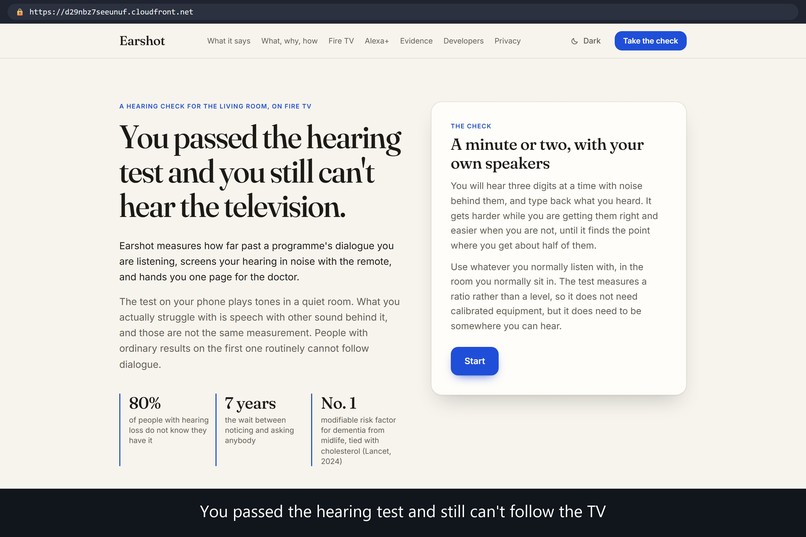
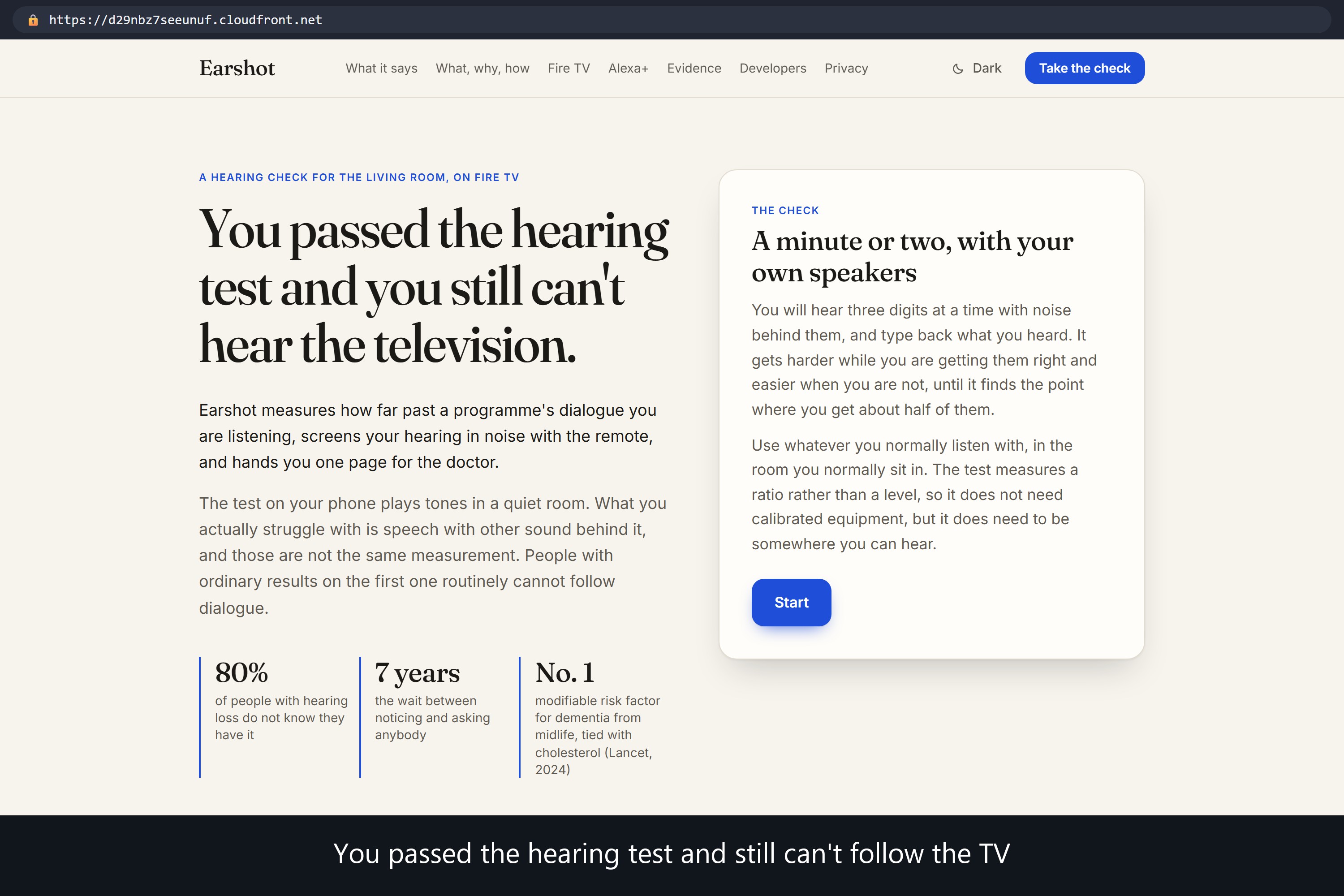
You passed the hearing test and still can't follow the TV. Earshot checks the kind of hearing a tone test misses.
-
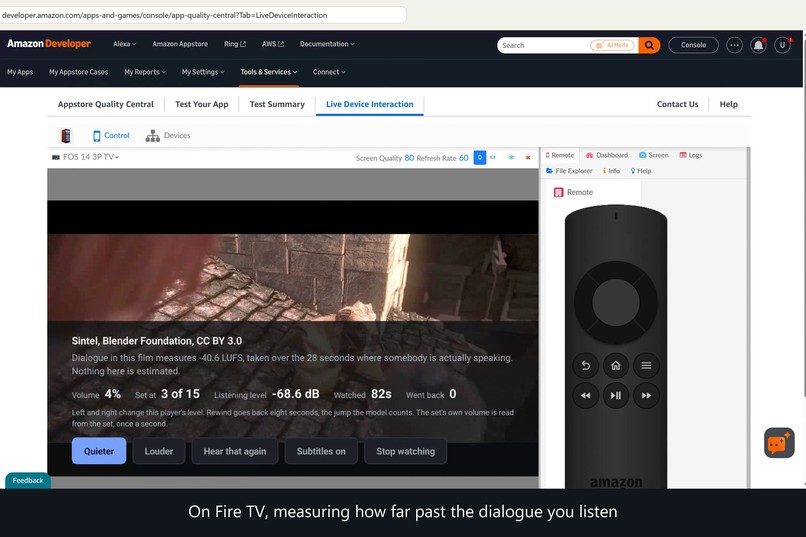
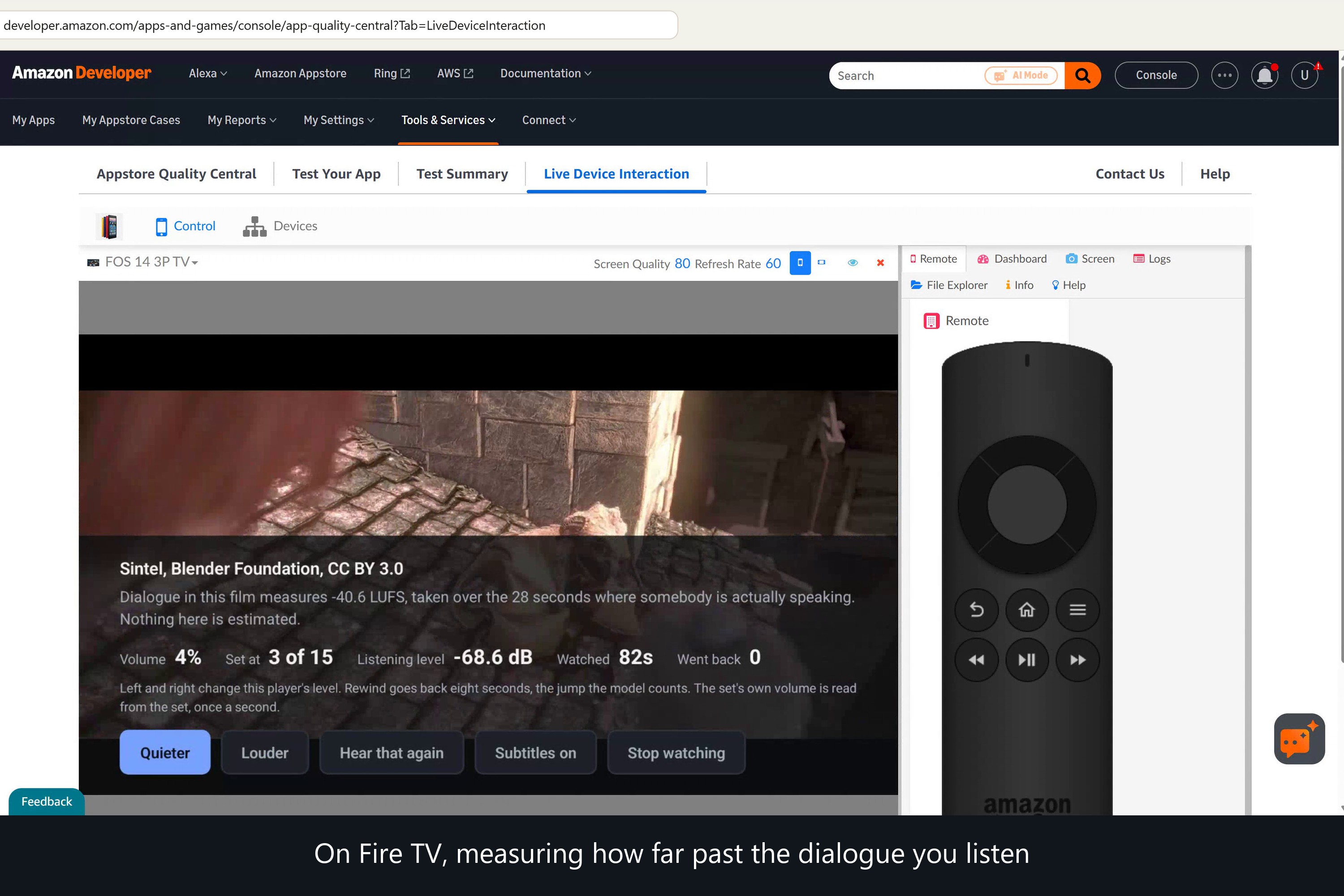
Earshot on Amazon's hosted Fire TV, playing Sintel and measuring how far above the dialogue you've set the volume.
-
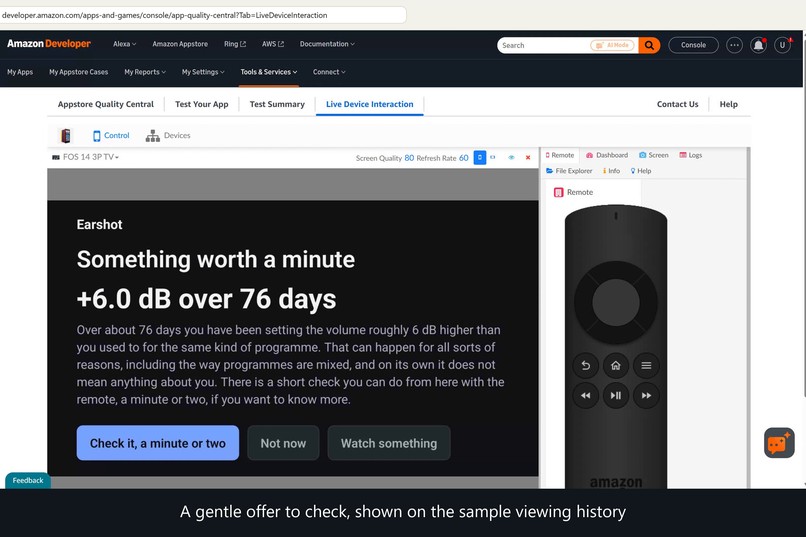
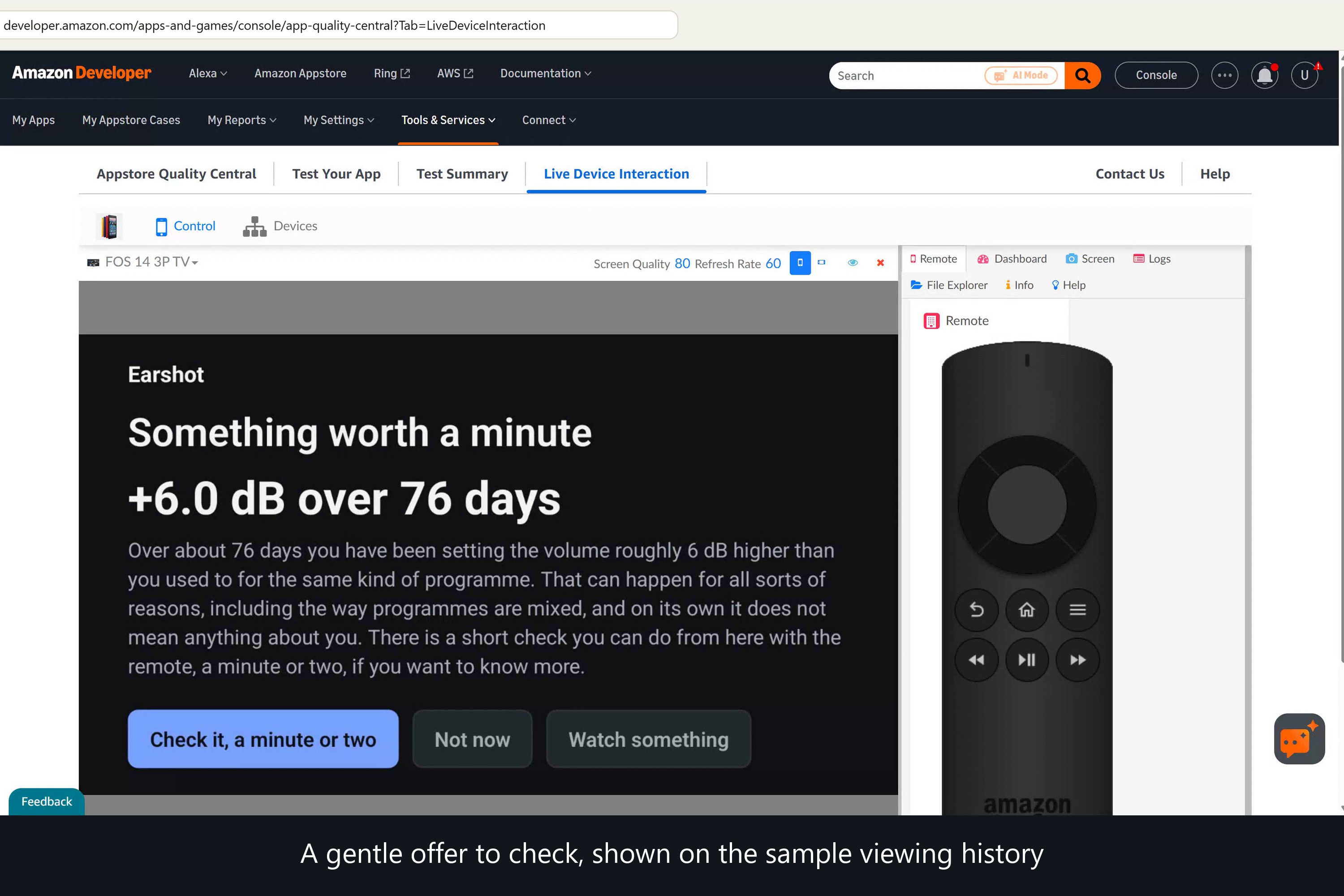
After months of watching, the TV gently offers a quick check. Shown here on sample viewing history, never mid-show.
-
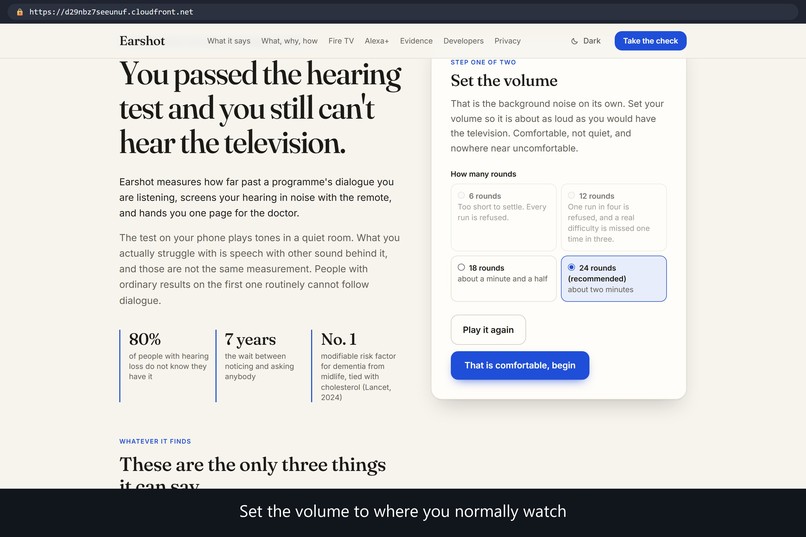
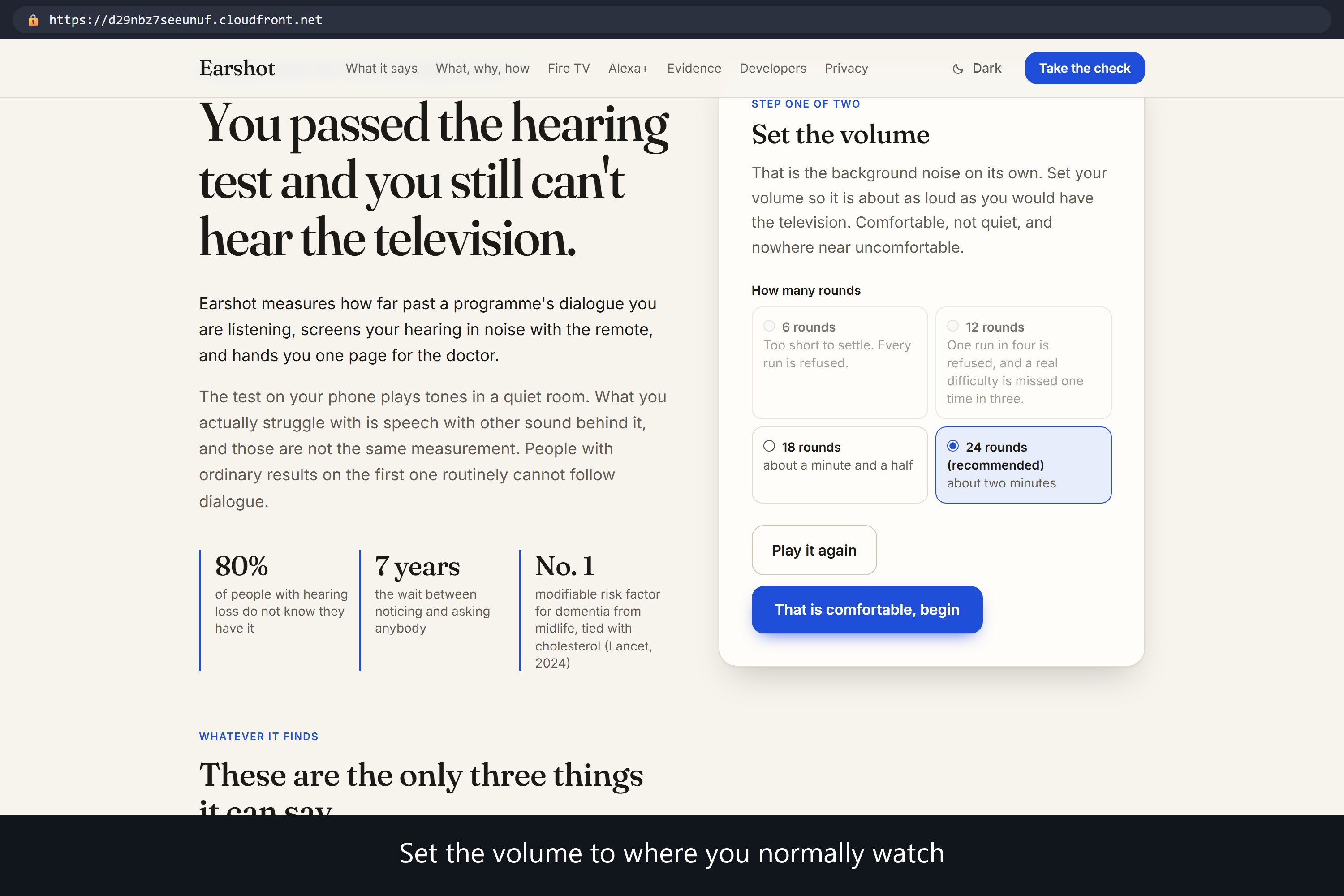
Step one: set the volume to where you normally watch. Pick a length; two minutes is the one we recommend.
-
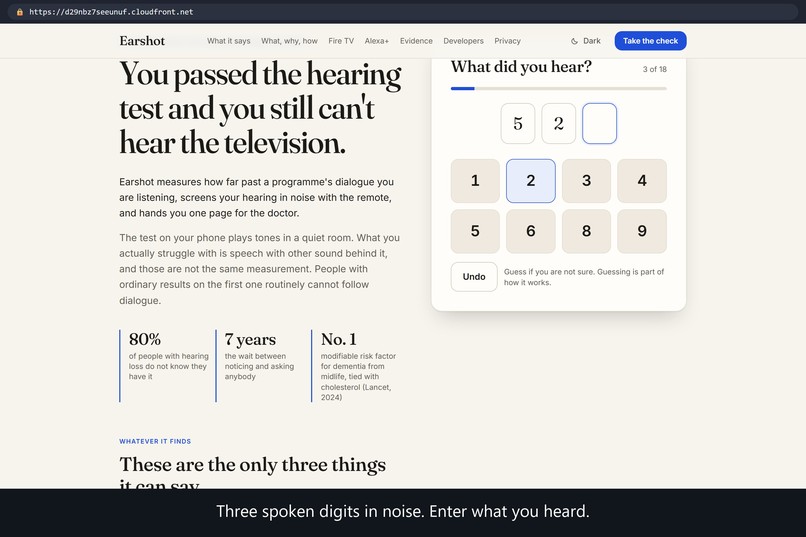
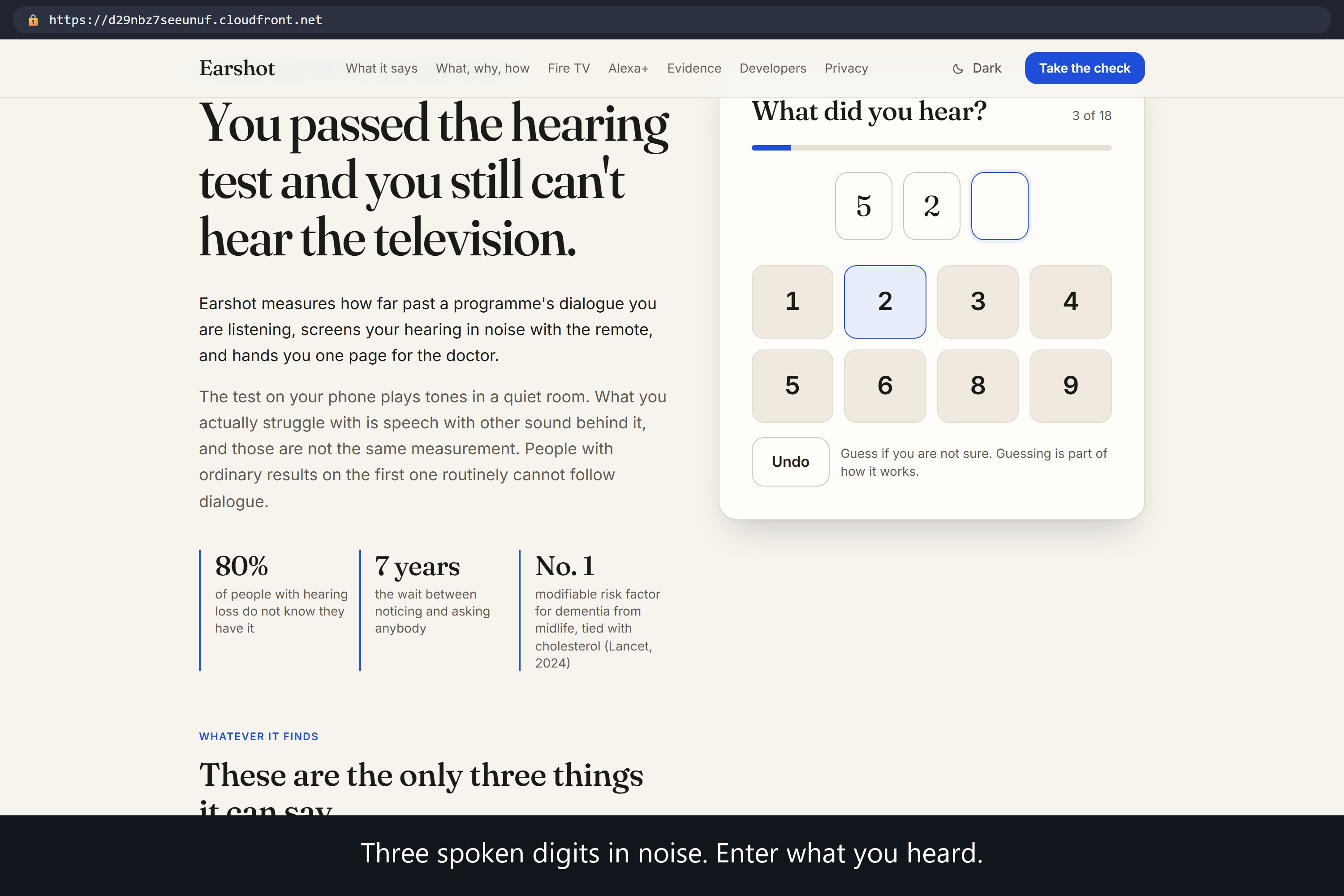
Three spoken digits, with noise behind them. Type what you heard. It gets harder when you're right, easier when you're not.
-
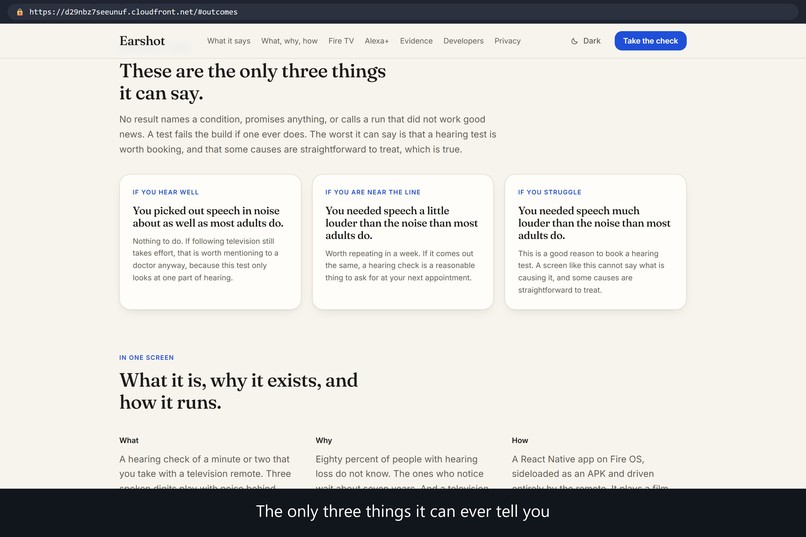
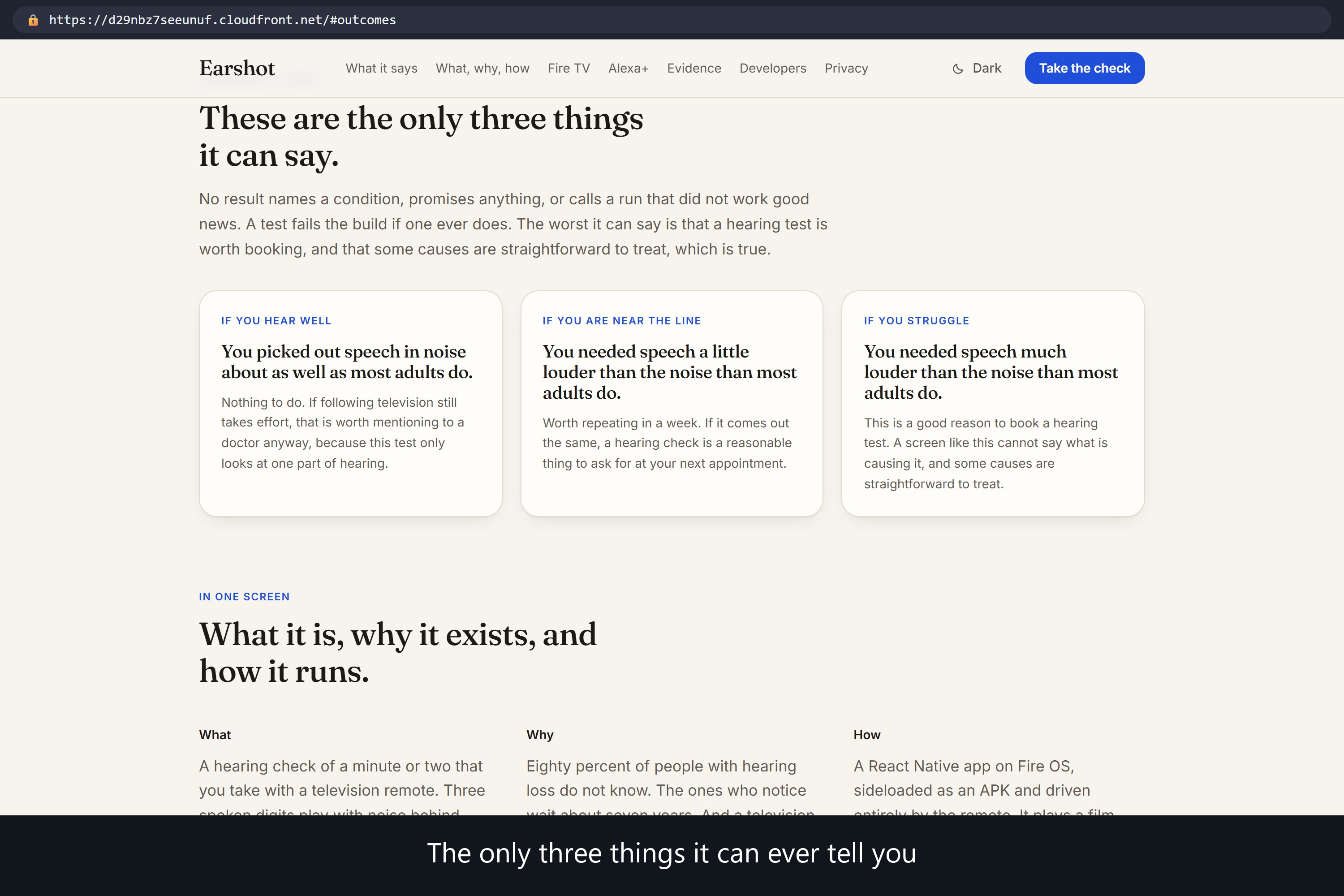
Whatever happens, it can only say one of three things. None names a condition or turns a bad run into good news.
-
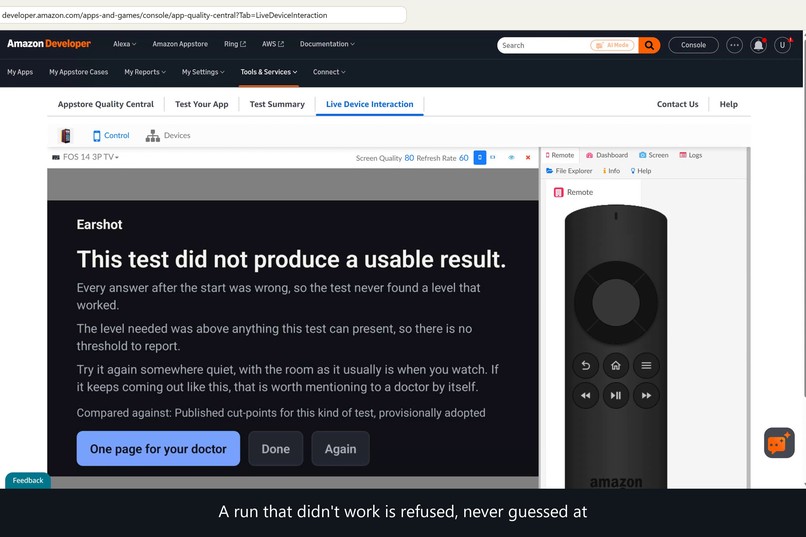
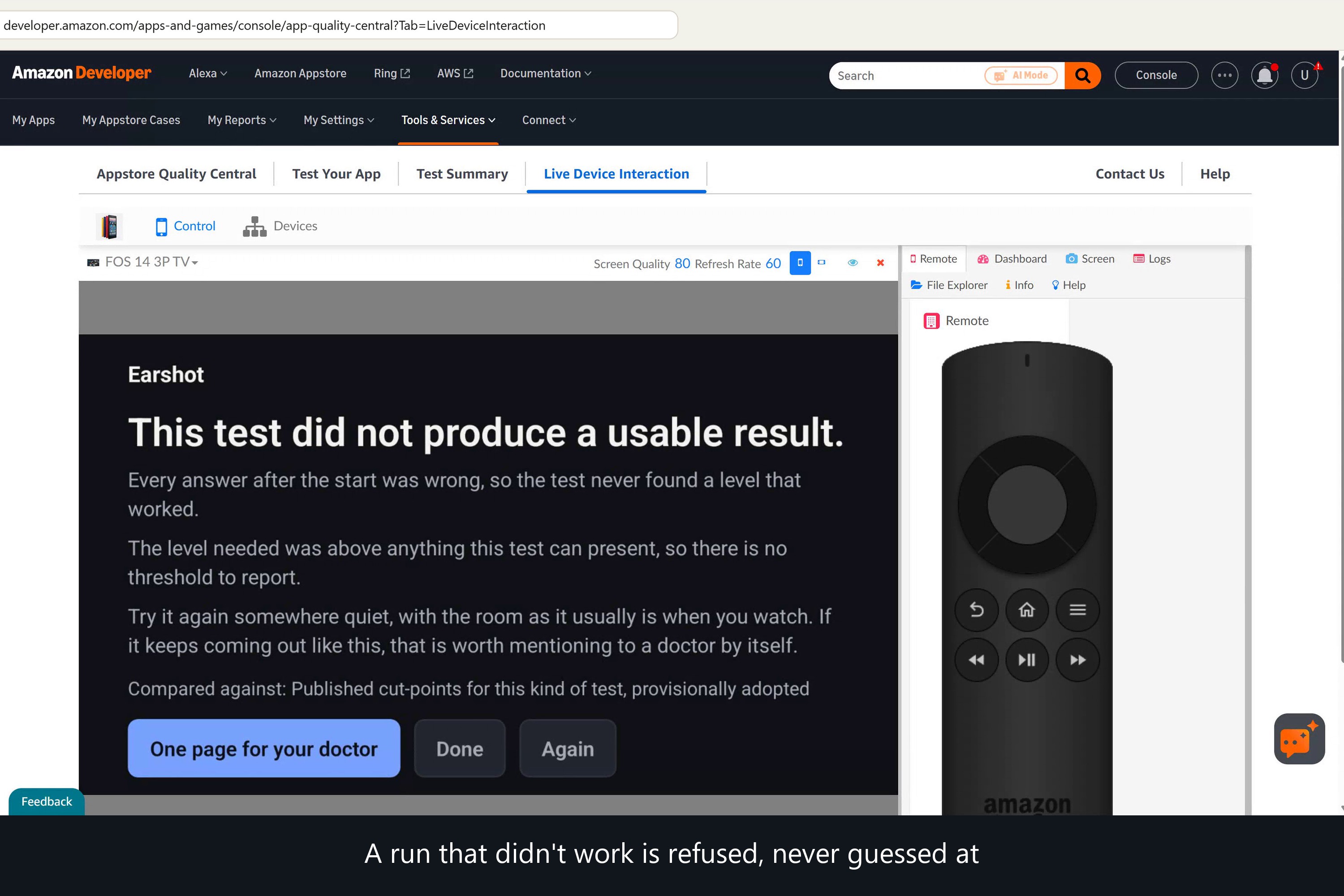
When a run doesn't work, Earshot says so and why, instead of making up a number. Better honest than tidy.
-
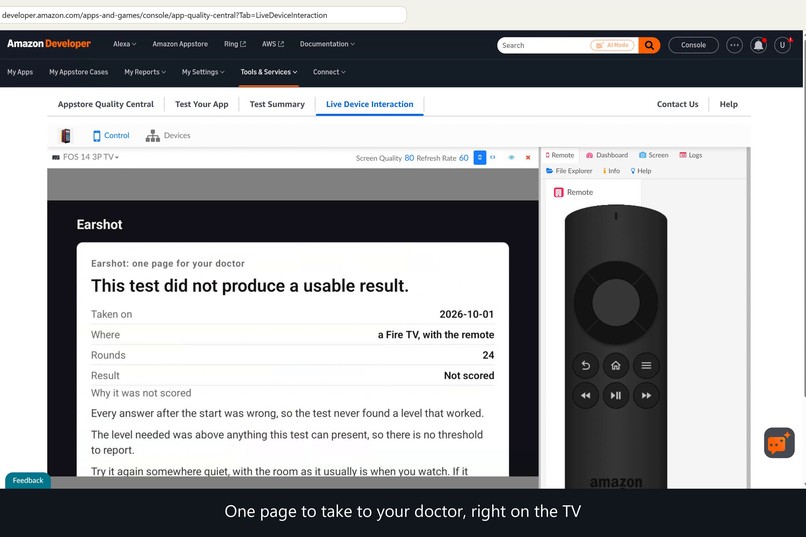
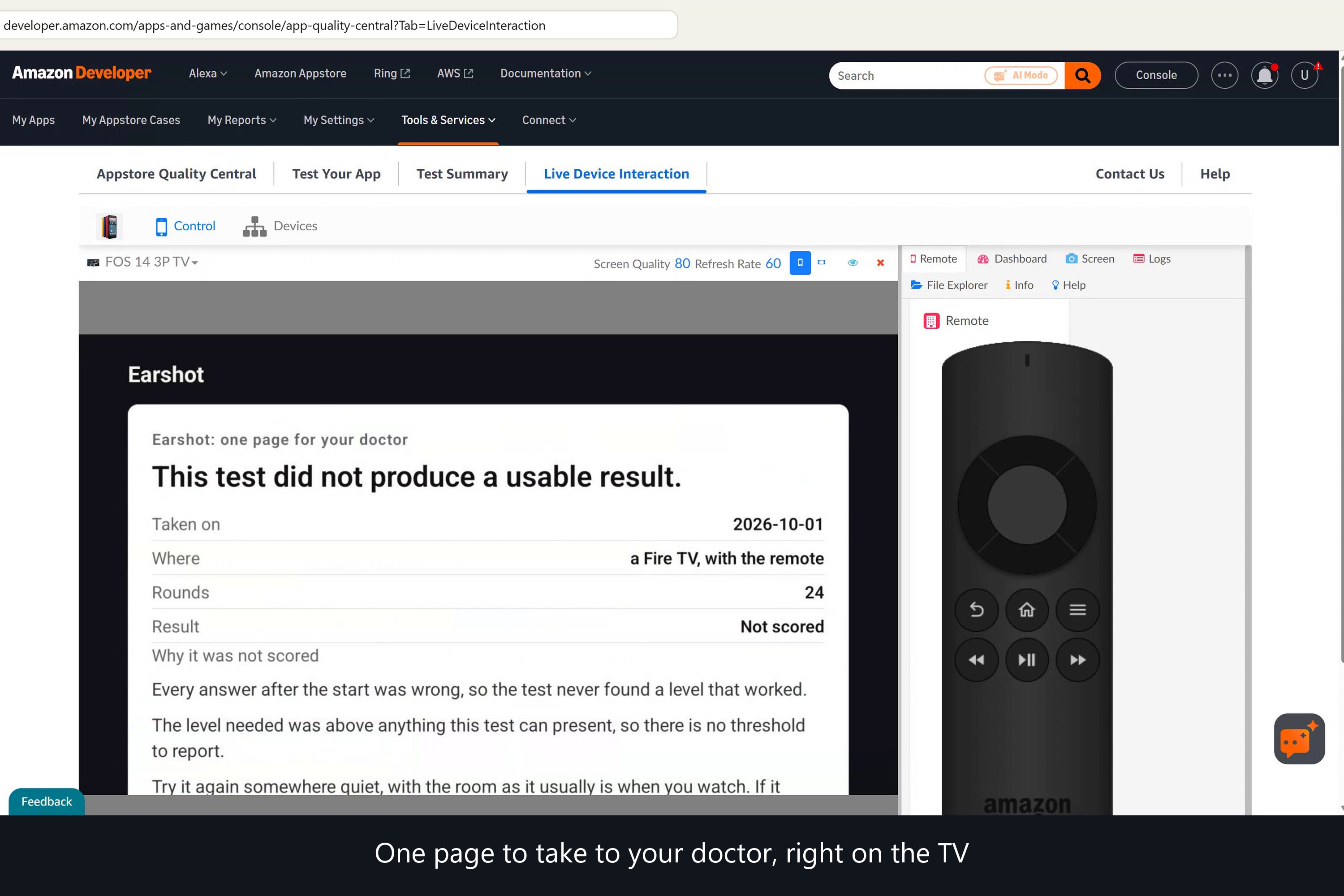
One page to take to your doctor, right there on the TV: the date, the rounds, the result and what it can't tell you.
-
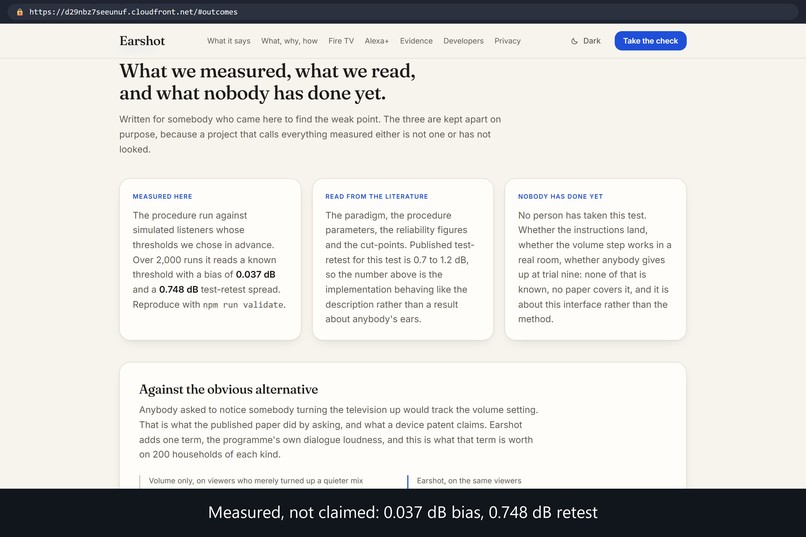
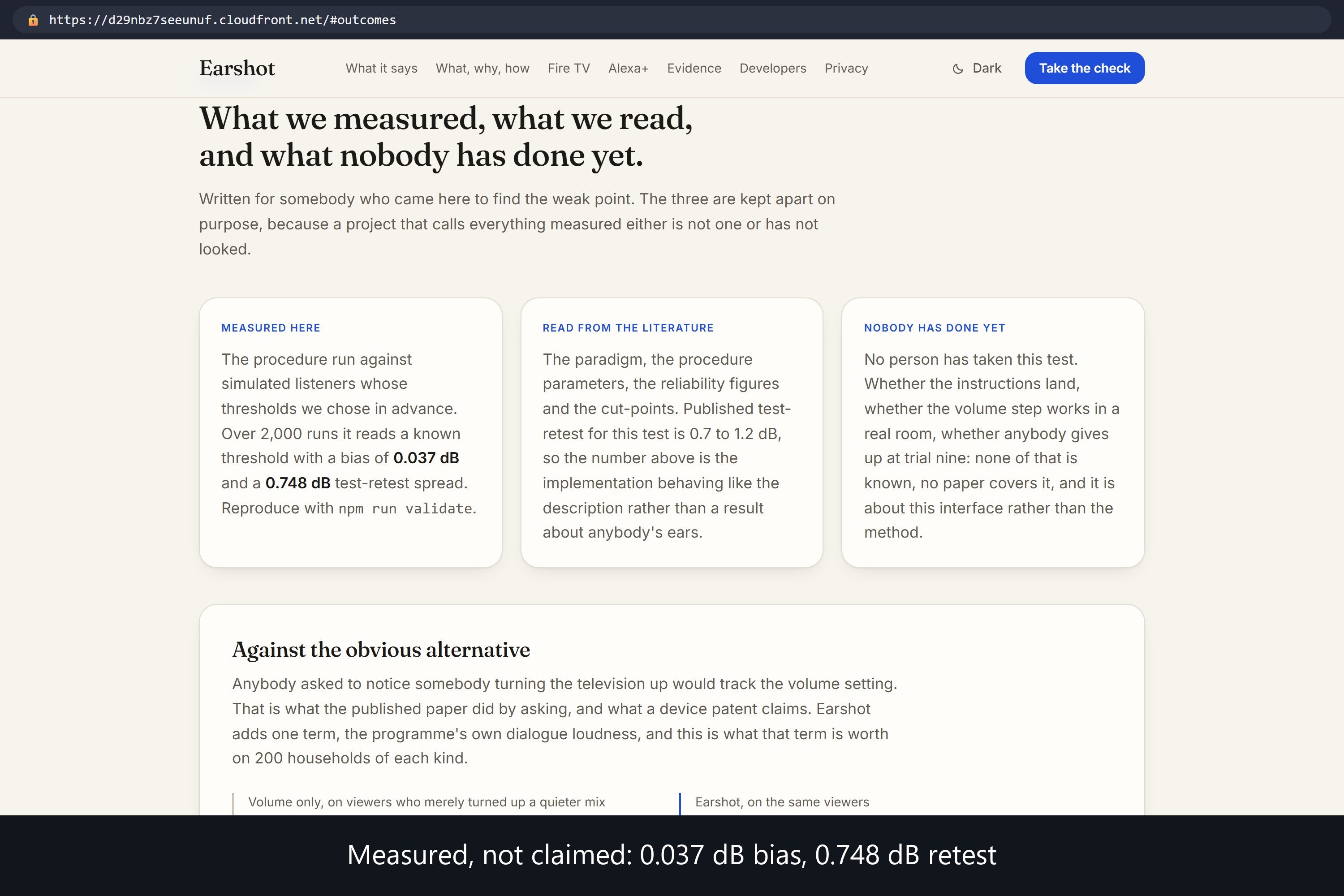
We measured the test before trusting it: 0.037 dB bias and 0.748 dB retest spread over 2,000 simulated listeners.
-
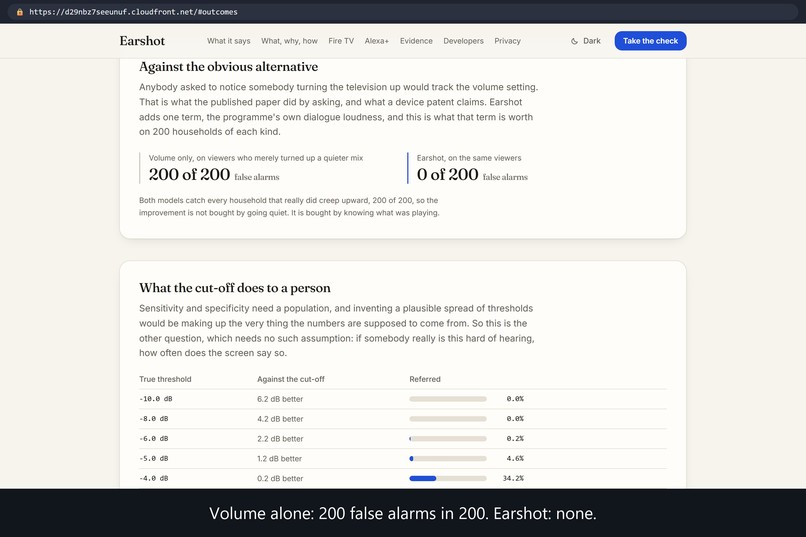
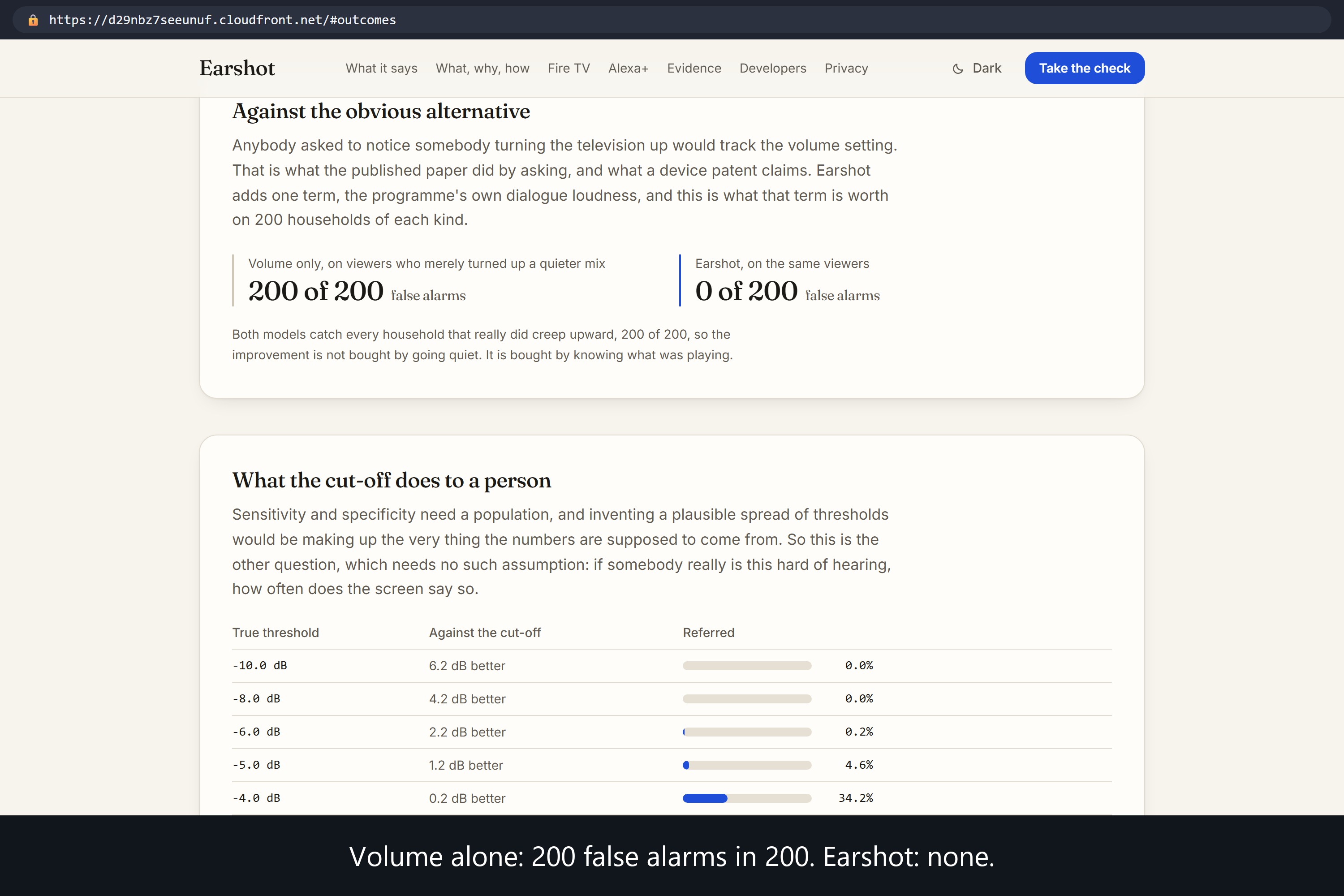
Why not just watch the volume? On 200 simulated homes, volume alone raised 200 false alarms. Earshot raised none.
-
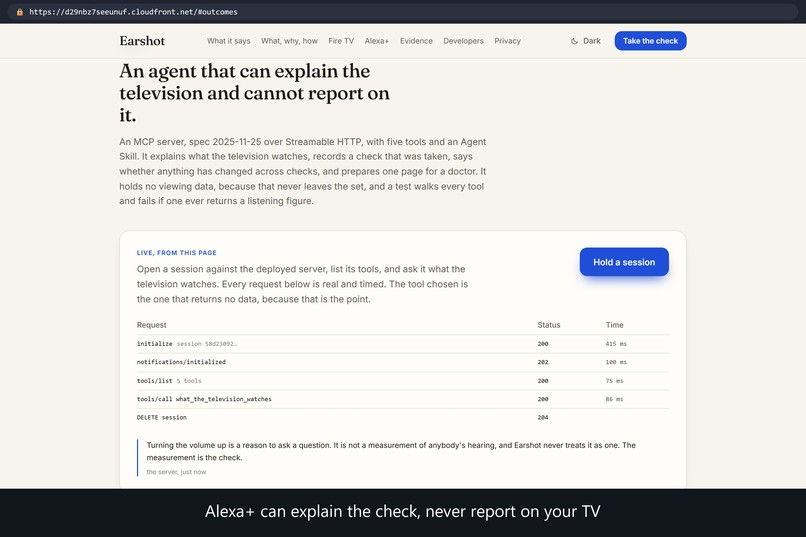
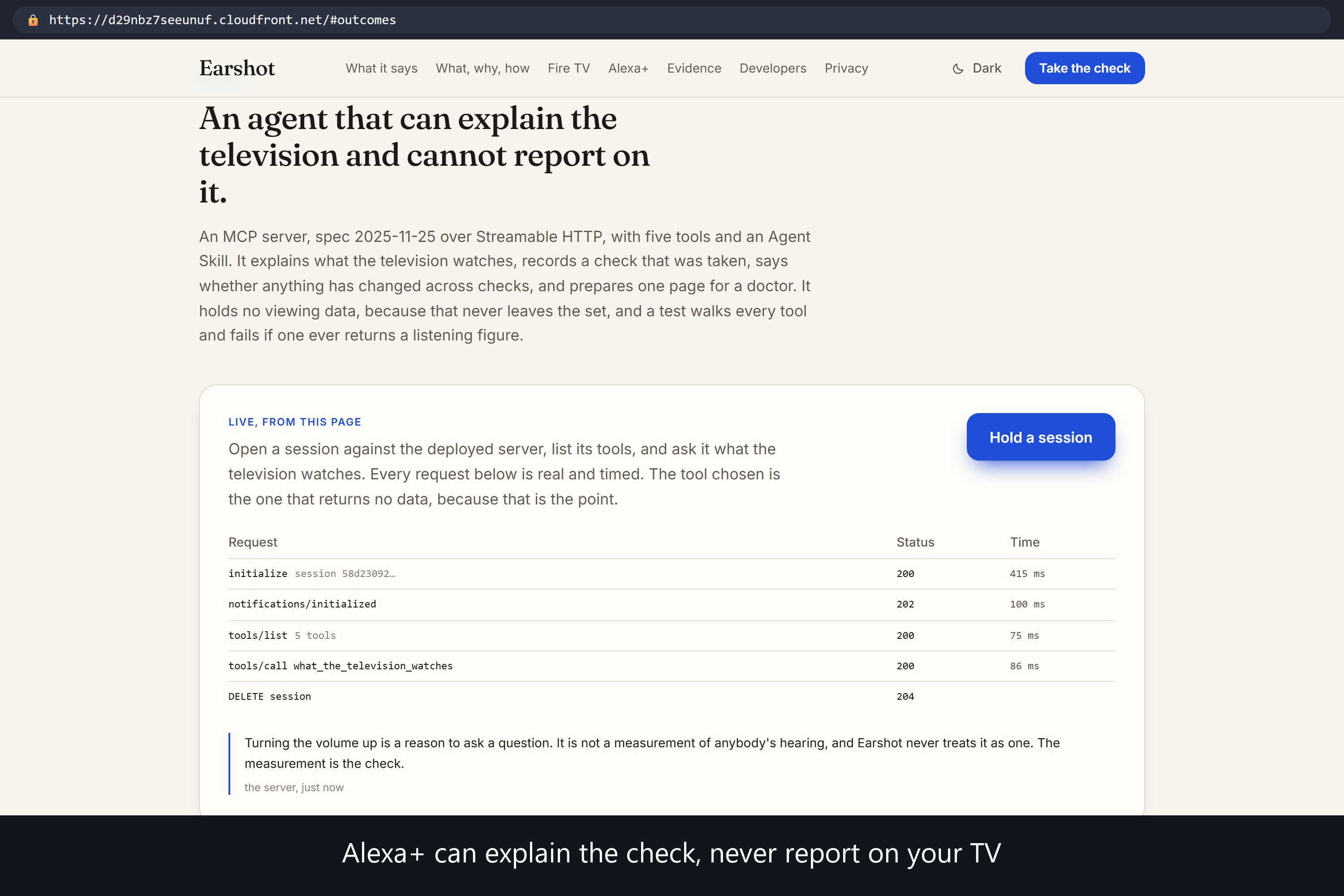
Ask Alexa+ about the check. A live session with our server shows it can explain the TV but never report what you watch.
-
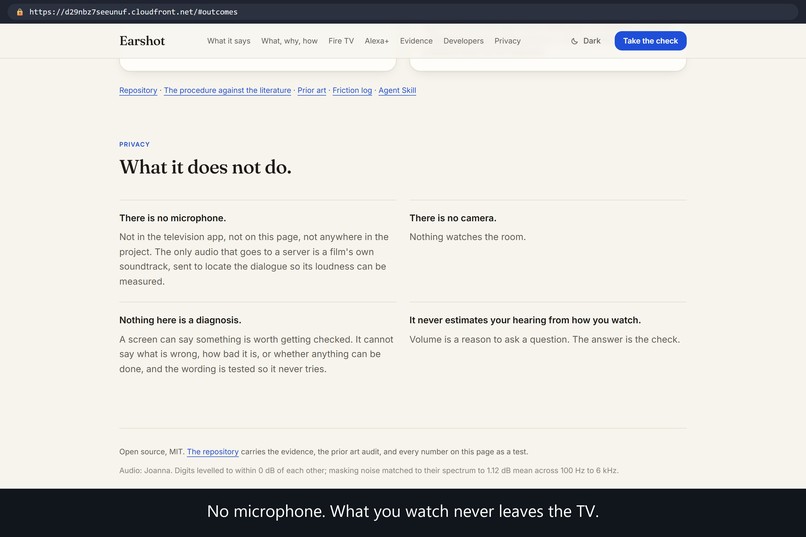
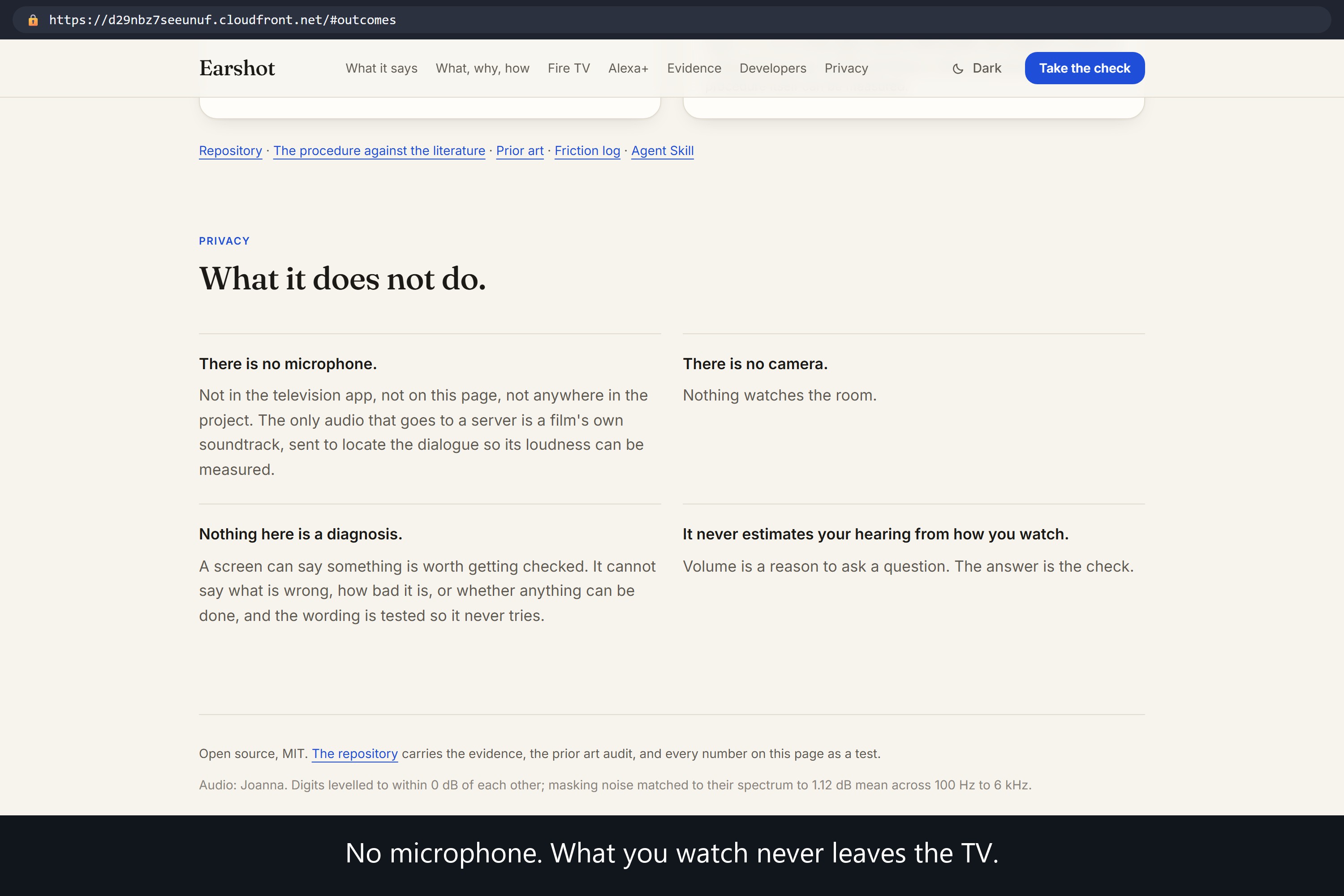
No microphone and no camera. How you watch TV stays on the TV, and nothing here is a diagnosis.
Inspiration
You passed the hearing test, and you still can't follow the television.
That is a common complaint, and there is a reason for it. The hearing test on your phone plays tones in a quiet room. What people actually struggle with is speech with other sound behind it, and those are different measurements. Normal results on a tone test alongside trouble following speech in noise is common enough to have a name [1], and finding it needs speech measured in noise [2].
Meanwhile the problem goes unnoticed for years:
- Around 80% of people with hearing loss don't know they have it, and those who notice wait about seven years before asking anyone [3].
- 22% of adults aged 65 to 74, and 55% of those over 75, have disabling hearing loss, and fewer than one in three people over 70 who need a hearing aid have ever used one [4].
- The 2024 Lancet Commission names hearing loss as one of the largest modifiable risk factors for dementia, at 7% of cases worldwide [5].
And the television already holds a clue. A clinical study found that someone who turns the TV up has a 68% chance of already having measurable hearing loss, at 81% sensitivity [6]. The researchers got that number by asking patients in a clinic. The TV knows it every night, and nobody has ever asked it.
So we built the hearing check that belongs on the television.
What it does
Earshot is a Fire TV app, a website and an Alexa+ agent around one idea: check the hearing problem people actually have, on the device where they notice it.
- Checks your hearing in noise, with the remote. Two minutes. You hear three spoken digits behind noise and enter them with the remote. The test adapts as you go and gives a speech reception threshold, the level of speech you can follow in noise. This is the digits-in-noise test, validated against clinical hearing tests [7] and the kind of test the World Health Organization put in its hearWHO app, because it measures a ratio rather than a volume and still works on hardware nobody calibrated.
- Says only three things. You hear well in noise, you're near the line, or a hearing test is worth booking. A run that doesn't settle is refused, not reported. It never names a condition and never turns a failed run into good news.
- Hands you one page for your doctor. The result, the date, what the test measures and what it doesn't, on the TV or on paper.
- Points you to the help Fire TV already has. Dialogue Boost, hearing aid pairing and streaming to cochlear implants exist today, but only for people who already know. Earshot explains where to find them.
- Asks rarely. It offers the check after months of watching, never during a programme, never twice in a season, and never again if someone says no twice.
- Answers through Alexa+. An Agent Skill and an MCP server let an assistant explain the check, record a result, say whether anything changed across checks, and prepare the doctor page. It can never report how a household watches TV, because that data never leaves the set.
What it notices, honestly. The idea that started this is the TV noticing when someone keeps turning dialogue up. The model for that is built and runs on the app's own playback: it reads the TV's real volume through a small native module and records what the viewer settled on, subtitles and rewinds. But a Fire TV app cannot see what other apps are playing, so it cannot measure your evening of TV. That needs a platform API, and it is the feature request we most want Amazon to read. Until then the app's viewing history is sample data, and the app says so on its home screen.
How well does it work?
A hearing screen gives each person one number, so there is nothing to check it against without a clinic. So we tested the procedure the way test designers do: against simulated listeners whose true threshold we chose in advance, over 2,000 runs.
- It reads a known threshold with a bias of 0.037 dB.
- Its test-retest spread is 0.748 dB. Published figures for this test sit between 0.7 and 1.2 dB [8].
- It stays accurate across the whole range, including near the cut-off, which is where a screen matters most.
We have not tested it on people, and the site says so. The next step is a pilot: patients at one audiology clinic take the check on their own TV the week before a routine appointment, and the clinic compares it with the booth test.
Try it yourself
On the live site you can:
- Take the check in your browser, the same test the TV runs.
- See the only three things it can say, before you start.
- Open a live Alexa+ session to the deployed MCP server and watch it answer.
- Get your own API key in one click, free and with no account. Paste it into any MCP client, and the households you name with it are yours alone; the page proves it by asking for the same household with no key. No key still works for everything.
The Fire TV app is a release APK. The demo video shows it running on Amazon's hosted Fire TV in Appstore Quality Central.
How we built it
- Fire TV: a React Native app for Fire OS, driven entirely by the D-pad, with a native module that reads the TV's real volume. Tested on Amazon's hosted Fire TV devices.
- Alexa+: an Agent Skill and a self-hosted MCP server (spec 2025-11-25, Streamable HTTP) with five tools.
- AWS: Amazon Polly creates the spoken digits, levelled so all eight are equally loud, with noise shaped to match the speech. Amazon Transcribe finds where people are talking in a film, so the app can measure how loud the dialogue really is. A Strands agent on Amazon Bedrock, also hosted on Amazon Bedrock AgentCore, answers "why did my TV ask?" from the MCP tools alone. Lambda, DynamoDB, S3 and CloudFront run the rest, deployed with one CDK stack.
- Open source: the test itself is a new dependency-free TypeScript library,
digits-in-noise(MIT), so it runs on a TV, in a browser and in research tools. The existing open versions are in Java and native mobile code.
Privacy
There is no microphone anywhere in Earshot: not in the TV app, not on the website, not on the server. How a household watches TV never leaves the television. A stored check holds a date, a threshold and whether the run settled. Nothing else.
Challenges we ran into
- Fire TV can't tell an app what other apps are playing. That blocks the "notice" half of the product, and we confirmed why instead of guessing: the permissions it would need are not available to third-party apps. We built and tested the model anyway and filed the API request.
- Fire TV has no way to turn Dialogue Boost on or check it. So Earshot explains where the setting is and can't confirm anyone found it.
- Health products have to know what not to say. The hardest design work was making sure no result could ever read as a diagnosis or as false reassurance, especially for the person whose run fails because their hearing is furthest outside the range.
Accomplishments that we're proud of
- A hearing check that runs on a TV with nothing but the remote.
- Accuracy we measured, not claimed, sitting inside the published range for this test.
- An assistant that can explain the TV but is built so it can never report on it.
What we learned
The most useful thing a health product can do is often to say less. Earshot's whole vocabulary is three sentences and a page for a professional.
What's next
A clinic pilot to compare Earshot's result with the booth test, a normed set of spoken digits so the referral bands can stop being provisional, and a platform API so the TV can notice dialogue struggles across everything a household watches.
Earshot is a screening aid. It does not diagnose any condition and does not replace a hearing test by a professional.
Sources
- ASHA Leader, Hidden hearing loss, article; 2025 systematic review, PMC11940875
- Speech-in-Noise Testing: An Introduction for Audiologists, PMC10872656
- ASHA, Untreated Hearing Loss in Adults, article
- NIDCD, Quick Statistics About Hearing, statistics
- Livingston et al., Lancet standing Commission on dementia, 2024, abstract
- Validation of self-reported hearing loss using television volume, Journal of Laryngology and Otology, PubMed
- Evaluating a smartphone digits-in-noise test as part of the audiometric test battery, PMC5968873
- The digits-in-noise test: Assessing auditory speech recognition abilities in noise, J. Acoust. Soc. Am., article; clinical test-retest, PMC8221724
Every claim with its source and limits: README, METHOD.md, EVAL.md
Built With
- agent-skills
- alexa-plus
- amazon-bedrock
- amazon-bedrock-agentcore
- amazon-cloudfront
- amazon-dynamodb
- amazon-polly
- amazon-transcribe
- amazon-web-services
- android
- aws-cdk
- aws-lambda
- fire-os
- fire-tv
- kotlin
- mcp
- next.js
- node.js
- react-native
- react-native-tvos
- strands-agents
- typescript

Log in or sign up for Devpost to join the conversation.