Inspiration
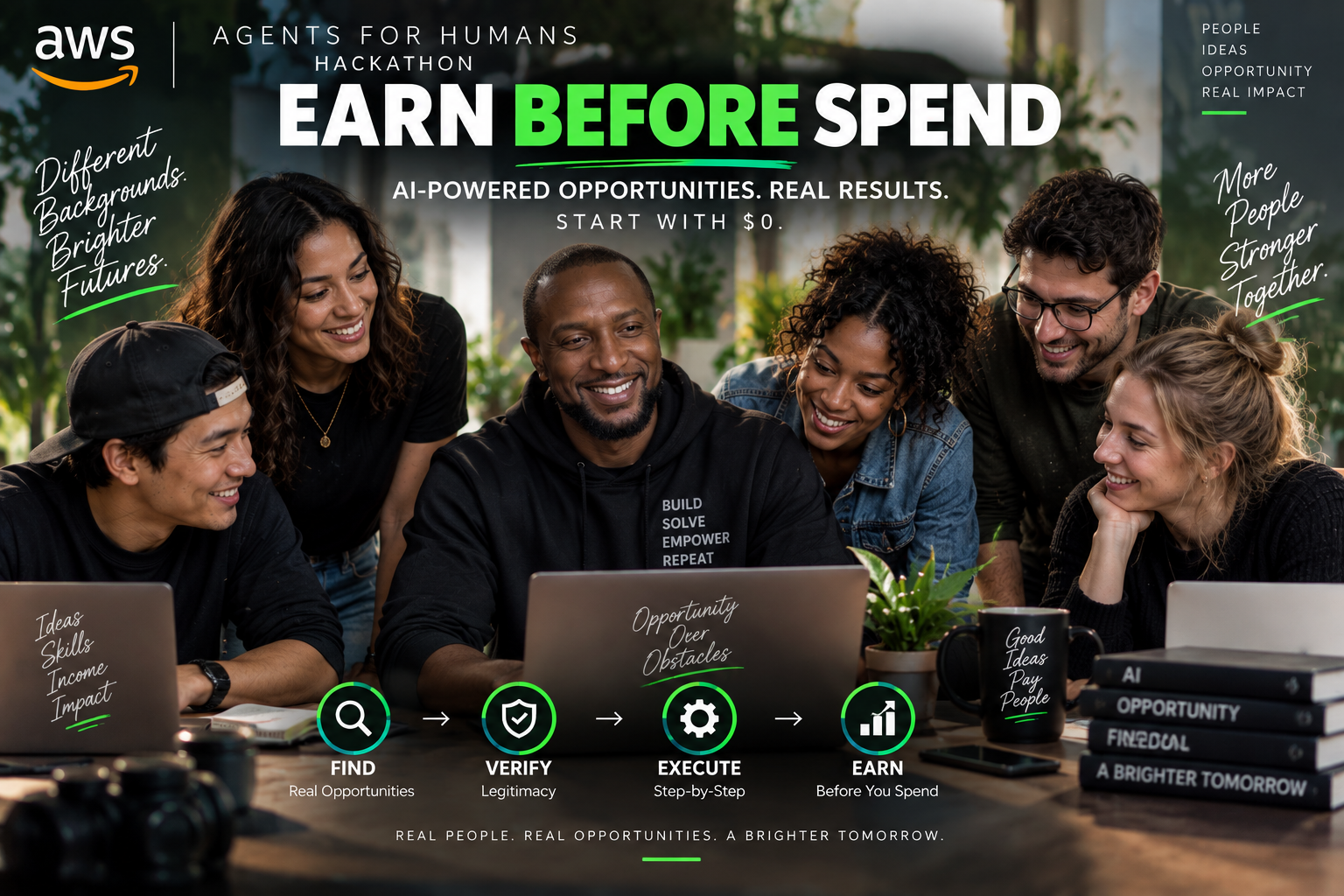
Most people trying to make money online start by spending money first: another subscription, another domain, another ad campaign, or another AI tool.
We wanted to reverse that sequence.
Earn Before Spend asks a simple question:
What is the smallest legitimate path from $0 in new seed capital to verified positive cash contribution?
The answer does not have to be "start a business." It could be a bounty, paid service, competition, license, referral commission, digital product, grant, or another legitimate earning path.
What it does
Earn Before Spend is an AI agent built with the Strands Agents SDK that evaluates and ranks earning opportunities while enforcing strict zero-capital rules.
For each opportunity, it asks:
- Does this require new money before anything is earned?
- Is the owner secretly being turned into the fulfillment worker?
- Are rights and eligibility clear?
- Is the opportunity legitimate?
- Can the payout actually be verified?
- How quickly could it produce a result?
- Does moving forward require a human to accept terms, make a legal commitment, or approve publication?
Opportunities that violate the hard rules are rejected, even if the potential payout is huge. Qualified opportunities are ranked using factors such as expected value, legitimacy, fit, urgency, and human workload.
The agent can explain the recommendation and propose the next action, but it cannot override the economic guardrails.
How we built it
We separated reasoning from authority.
The Strands Agent handles reasoning, explanation, comparison, and tool orchestration. Two deterministic Python tools enforce the hard rules:
evaluate_opportunityevaluates one opportunity against the zero-new-cash requirements.rank_opportunitiesevaluates and ranks up to three opportunities after applying the guardrails.
This means the language model can help make decisions, but it cannot simply persuade the system to ignore a rule.
The default demo runs without a model-provider call, making it possible to demonstrate the economic logic without adding new infrastructure cost. The optional Strands run requires a configured model provider; a live Amazon Bedrock deployment is not claimed here.
Challenges we ran into
The biggest challenge was avoiding AI optimism.
Language models are extremely good at making exciting possibilities sound actionable. That becomes dangerous when money is involved.
A $10,000 prize sounds amazing, but it should still be rejected if entering requires money, eligibility is unclear, the payout cannot be verified, or the real work gets pushed onto the human owner.
We also had to define what actually counts as earning money.
A possible prize is not revenue. A test payment is not revenue. An owner deposit is not revenue. Credits are not revenue.
The mission's success criterion is real external money verified and reconciled against the real costs involved. Automated payout reconciliation remains future work.
Accomplishments we're proud of
- Built an AI agent with Strands Agents SDK.
- Created deterministic economic guardrails that the model cannot override.
- Designed the system to consider multiple earning pathways instead of assuming entrepreneurship is always the answer.
- Defined explicit human approval boundaries for contracts, identity, publication, legal commitments, and spending.
- Created a zero-provider-call deterministic demo.
- Added tests for hidden costs, excessive human work, unclear rights, and unverifiable payouts.
- Built the first experiment while keeping new seed spending at $0.
Mission 001 starts with $0.00 in new seed capital, $0.00 in new cash spent, and $0.00 in verified earnings. Existing tools or credits are not the same as new cash spending, and we do not claim the project has earned money yet.
What we learned
Autonomous agents work better when their authority is narrow and transparent.
Instead of telling an agent to simply "make money," we learned to break the problem into:
Discover → Verify → Rank → Act → Reconcile → Learn
The model is strongest at reasoning and context. Deterministic software is better at enforcing rules that should never be negotiable.
What's next
The next major layer is trusted payout reconciliation. We want Earn Before Spend to verify actual earning events, subtract fees, refunds, reserves, taxes, and attributable costs, and then report the true net result.
Future versions can also include:
- automated opportunity discovery
- event-driven monitoring
- a dashboard showing starting capital and verified earnings
- owner-time tracking
- pathway performance history
- repeatability scoring
- learning from successful and failed experiments
An autonomous agent should prove value before asking its owner for more money.
Development disclosure
AI coding assistance was used during development. This public project is a standalone implementation; no private Bonita/BLVX source code, private prompts, customer data, or proprietary datasets are included.

Log in or sign up for Devpost to join the conversation.