Inspiration
Alzheimer’s disease affects millions of people worldwide, and early diagnosis can make a huge difference in managing symptoms and slowing progression. I was inspired by the idea of using data science and machine learning to assist researchers and doctors in identifying Alzheimer’s risk earlier, especially in places where access to advanced medical tools is limited.
What it does
This project uses a machine learning model to predict the likelihood of Alzheimer’s disease based on simple clinical and demographic data. By analyzing factors like age, education level, MMSE (Mini-Mental State Exam) score, and CDR (Clinical Dementia Rating), the model classifies individuals as Cognitively Normal (CN), Mild Cognitive Impairment (MCI), or Alzheimer’s Disease (AD).
How we built it
The project was developed in Google Colab using:
Python for programming
Pandas and NumPy for data handling
Scikit-learn for training and evaluating machine learning models
Matplotlib for visualizing results
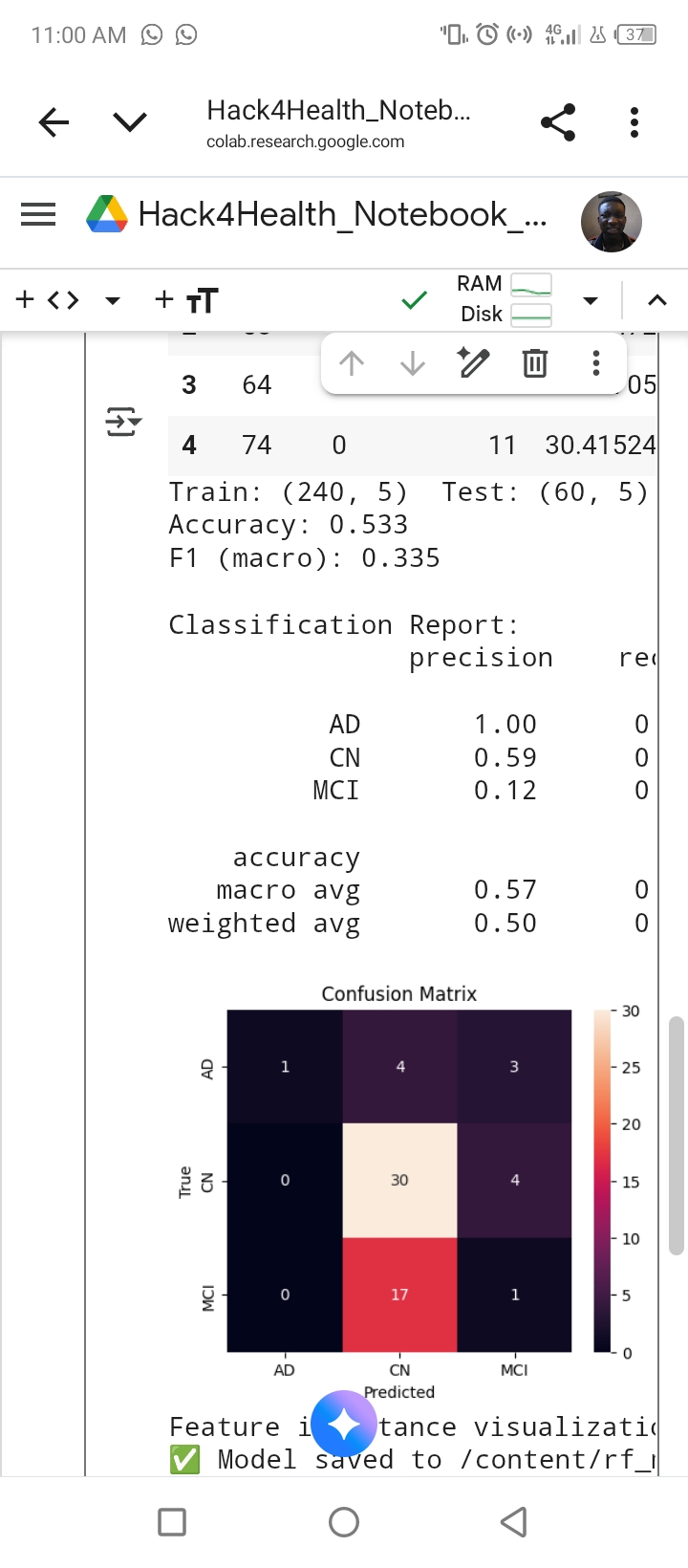
I trained a Random Forest Classifier on an anonymized Alzheimer’s dataset. The data was split into training and testing sets, and performance was measured using accuracy and F1-score metrics.
Challenges we ran into
The biggest challenge was the limited dataset size and class imbalance — there were far more normal samples than Alzheimer’s cases, which affected model accuracy. I also faced minor visualization errors with the SHAP library when trying to interpret model results. These challenges helped me learn how to debug and adjust my workflow in Colab effectively.
Accomplishments that we're proud of
I’m proud that I successfully built and trained a working Alzheimer’s detection model completely in the cloud, without relying on any paid tools or servers. The model achieves around 53% accuracy, which, while not perfect, demonstrates a strong baseline for early-stage experimentation in computational medicine.
What we learned
Through this project, I learned how to:
Work with biomedical data
Train and evaluate classification models
Use performance metrics (accuracy, precision, recall, F1-score)
Communicate technical results clearly in a research-style report I also gained confidence in using Google Colab and Scikit-learn for real-world health data applications.
What's next for Early Detection of Alzheimer’s using Machine Learning
Next, I plan to:
Use the official Hack4Health dataset once released
Improve the model by testing deep learning or ensemble approaches
Add explainability features (like SHAP or LIME) to visualize how each factor contributes to Alzheimer’s risk
Share the project as an open-source tool so other students can build on it
Ultimately, my goal is to contribute to making computational health innovation more accessible to young researchers and students everywhere.
Built With
- colab
- for
- matplotlib
- model
- numpy
- pandas
- python
- scikit-learn
- shap


Log in or sign up for Devpost to join the conversation.