Inspiration
Lina had been folding dumplings since she was eight, standing on a stool in her grandmother's kitchen. Twenty years later the whole block knew her by them: Friday orders over text, a cooler at the farmers market every Saturday, a line that sold out by noon.
When she finally had $90,000 saved (eleven years of double shifts and skipped vacations), she went looking for a storefront. She found one with big windows, a good corner and fair rent. The broker said it would be "perfect for food." She toured six other spaces first and paid for an inspection on two of them. By the time she signed, four months had passed.
Three weeks into the build-out, the plumber told her the building had no grease interceptor. Installing one would cost $28,000. The hood system needed upgrades too. By opening day, half her savings was gone before she'd sold a single dumpling, and the cushion that was supposed to carry her through the slow first year no longer existed.
Lina is a composite. Every number around her is real:
- A straightforward retail location takes 3–6 months from first search to signed lease (GrowthFactor). Complex builds take 12–18 months (Aquila Commercial).
- An unbiased commercial building inspector costs $5,000–$7,000 (Developco). A pre-feasibility study costs $3,000–$10,000, and a full feasibility study $15,000–$50,000 (SimpleFeasibility). A Phase I environmental assessment, often required by lenders, starts at $1,800–$2,500 (CREtelligent).
- Installing an in-ground grease interceptor for a commercial kitchen typically runs $10,000–$30,000 (24/7 Restaurant Equipment). Reusing an existing compliant trap can save $15,000–$30,000, and a new hood system can run more than $30,000 (Jack in the Box Franchising).
- The tenant's broker is usually paid out of the landlord's commission, so nobody in the deal is financially motivated to protect the founder's savings (Donahue Advisors).
Professional expansion teams evaluate 30–50 candidate sites for every location they open (GrowthFactor). Even at the cheapest end, doing that the traditional way would cost:
$$ C_{\text{search}} = n \cdot (c_{\text{inspect}} + c_{\text{pre-feas}}) \geq 30 \cdot (5000 + 3000) = 240000 \text{ USD} $$
That's more than most small businesses have to open with. So founders like Lina don't filter. They guess. Big chains have site-selection teams; Lina had a broker working for the other side.
We built EagleEye so the person betting their life savings sees what the experts see, and finds the missing grease interceptor before signing the lease, not three weeks after.
What it does
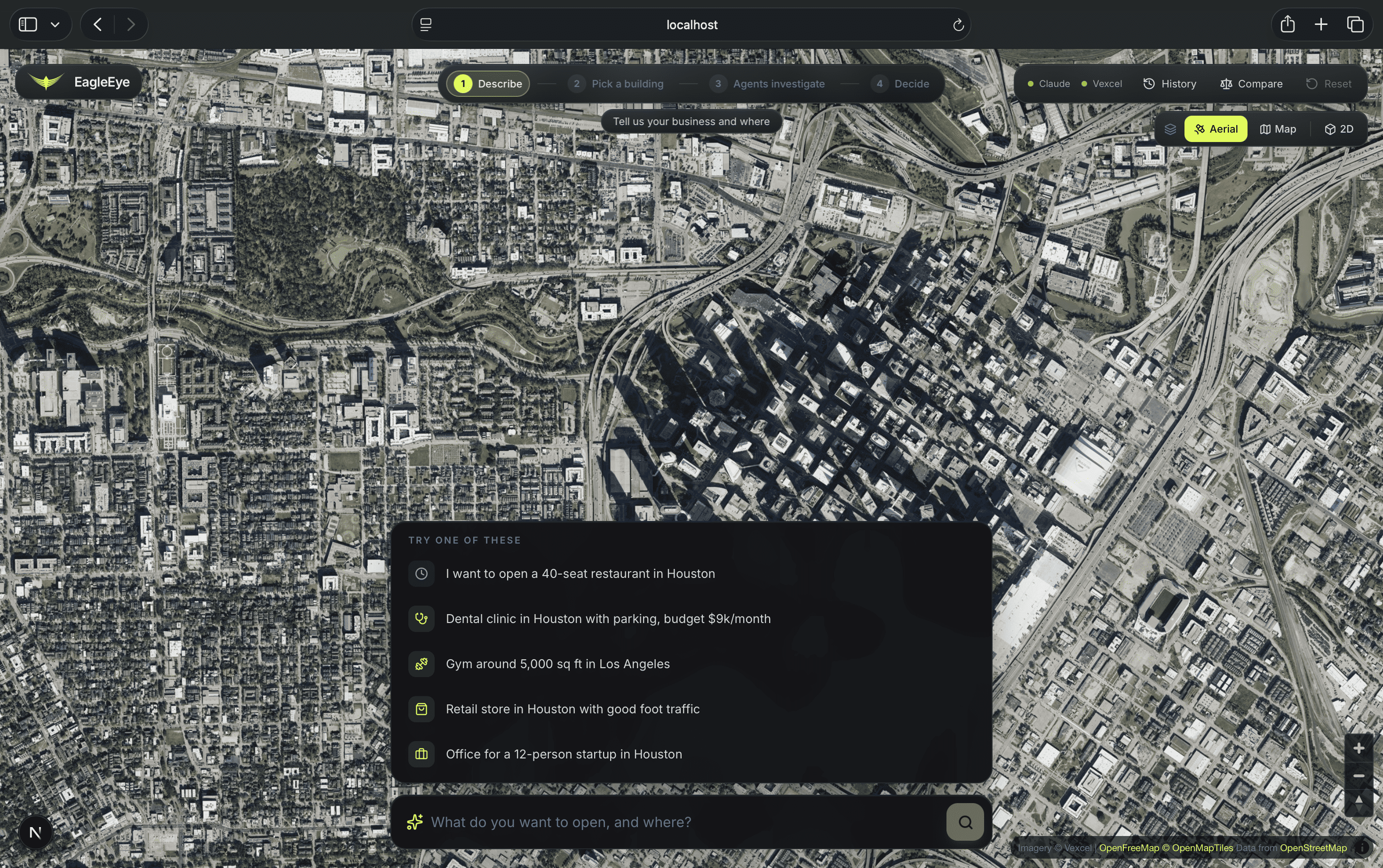
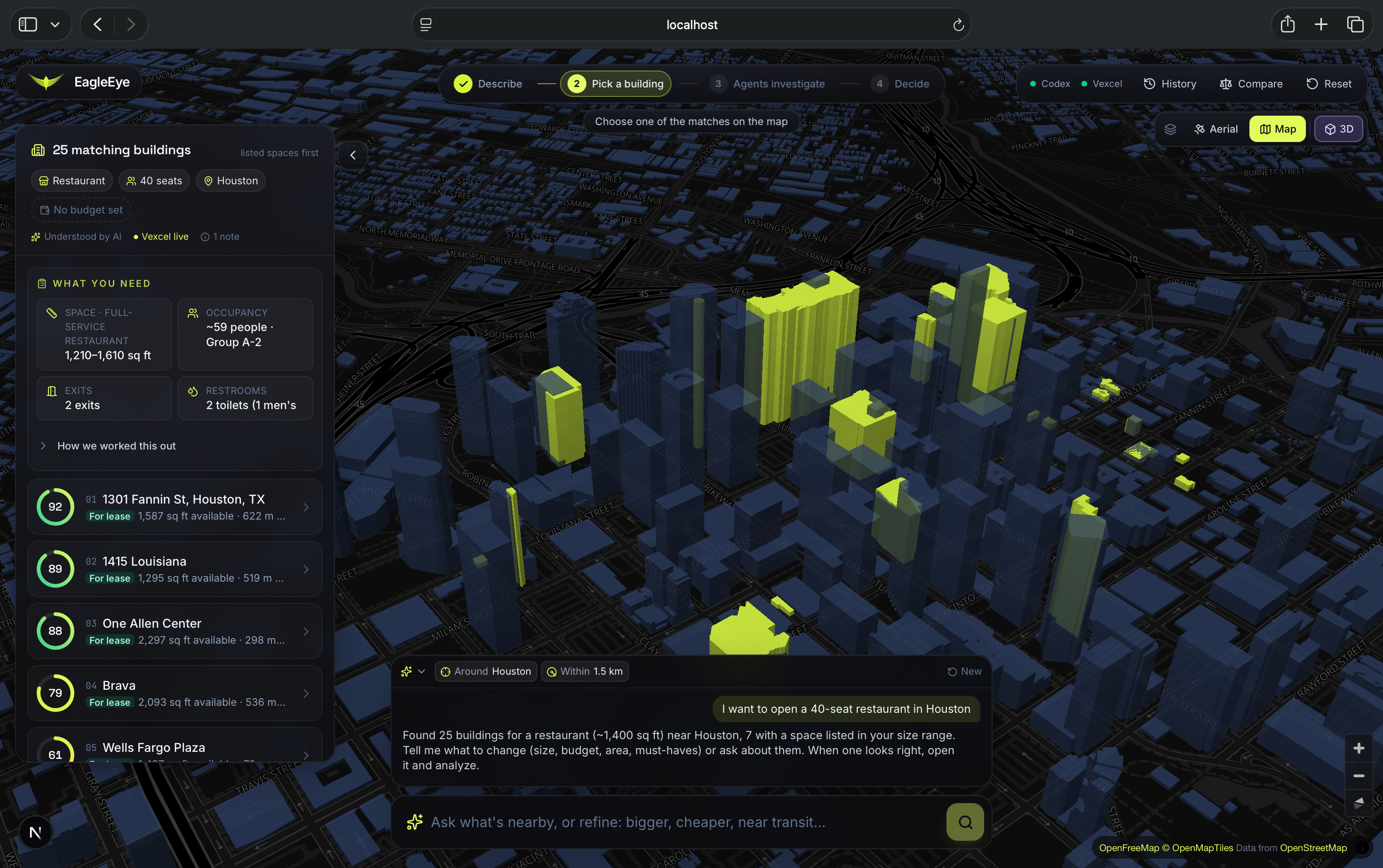
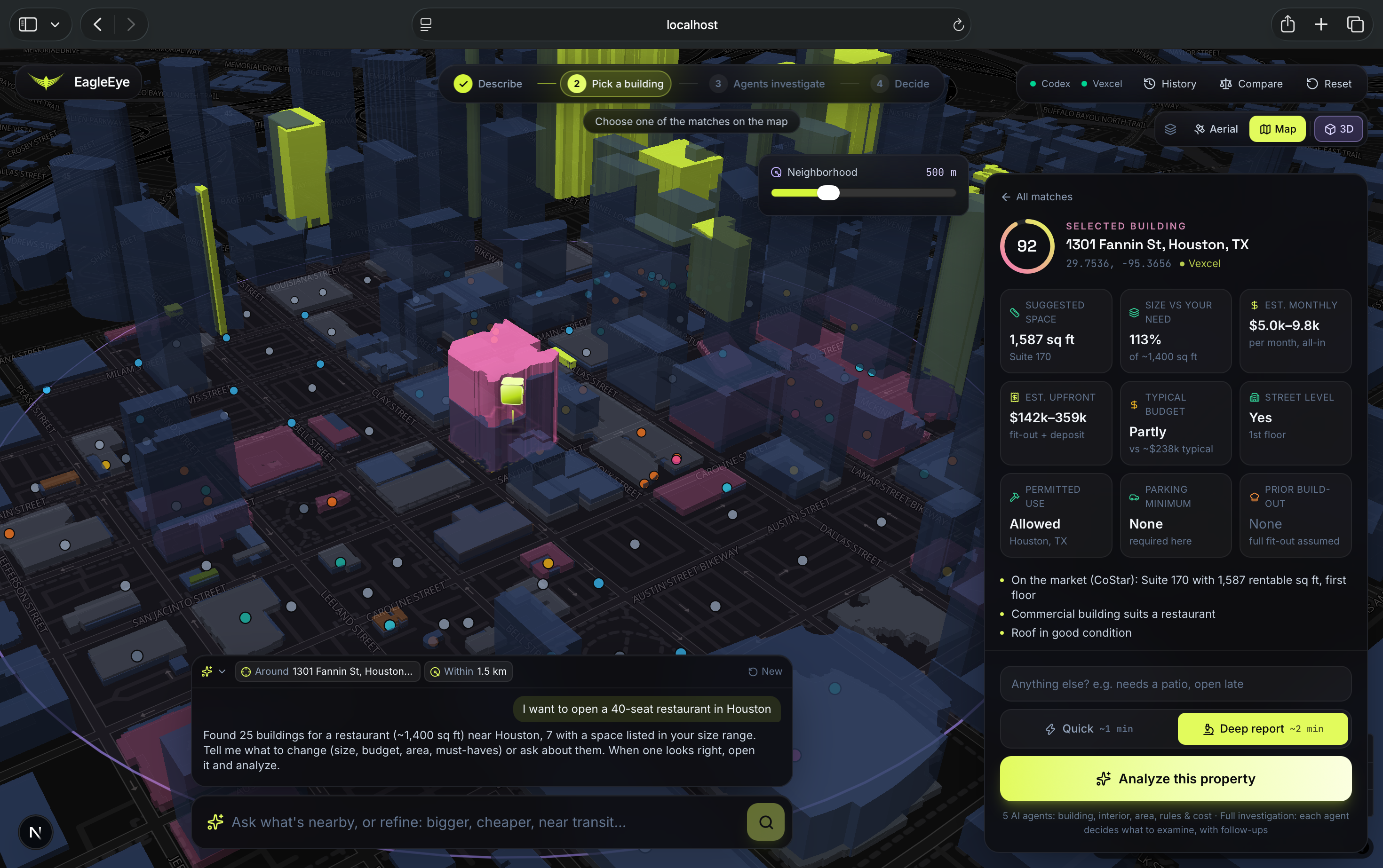
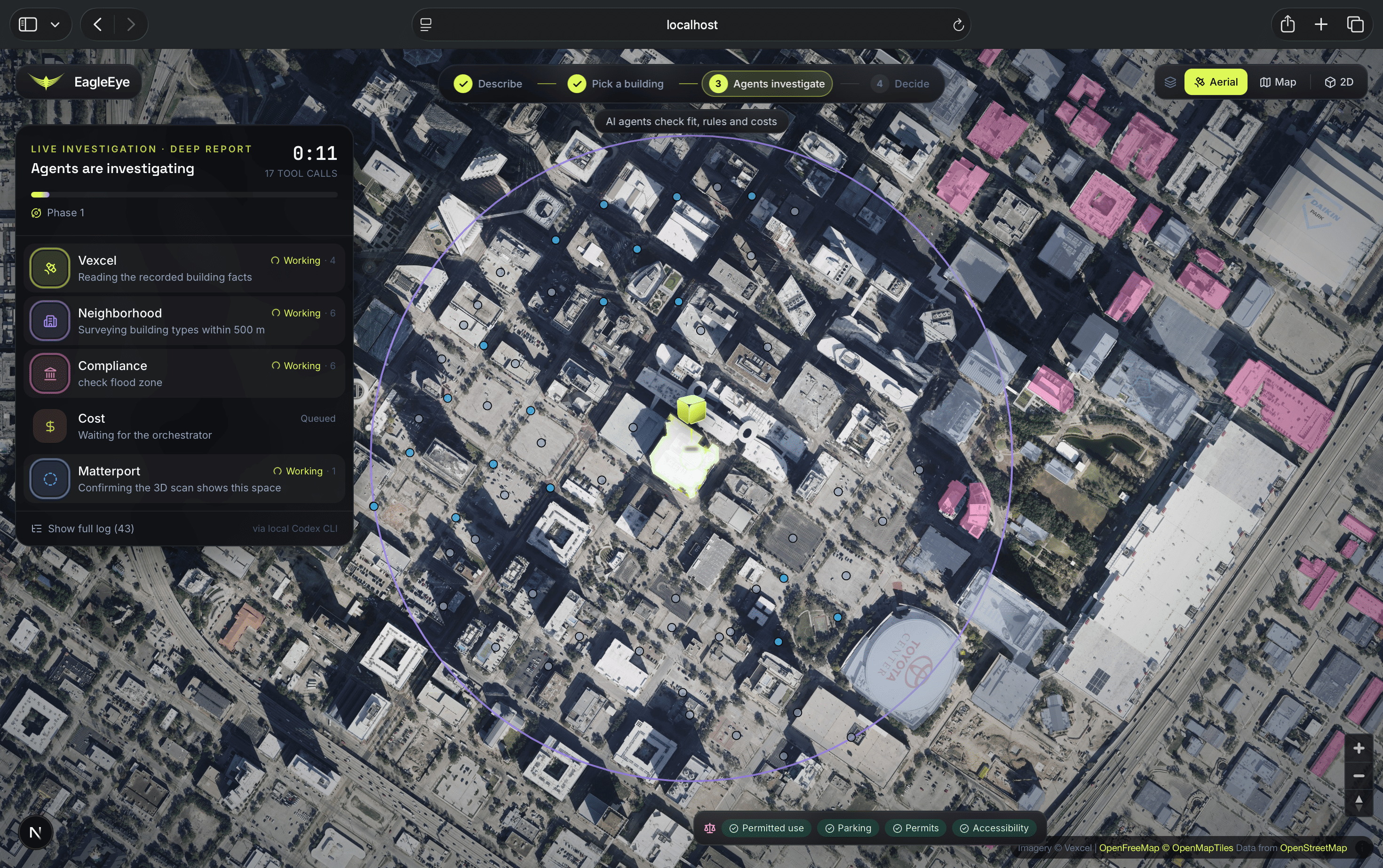
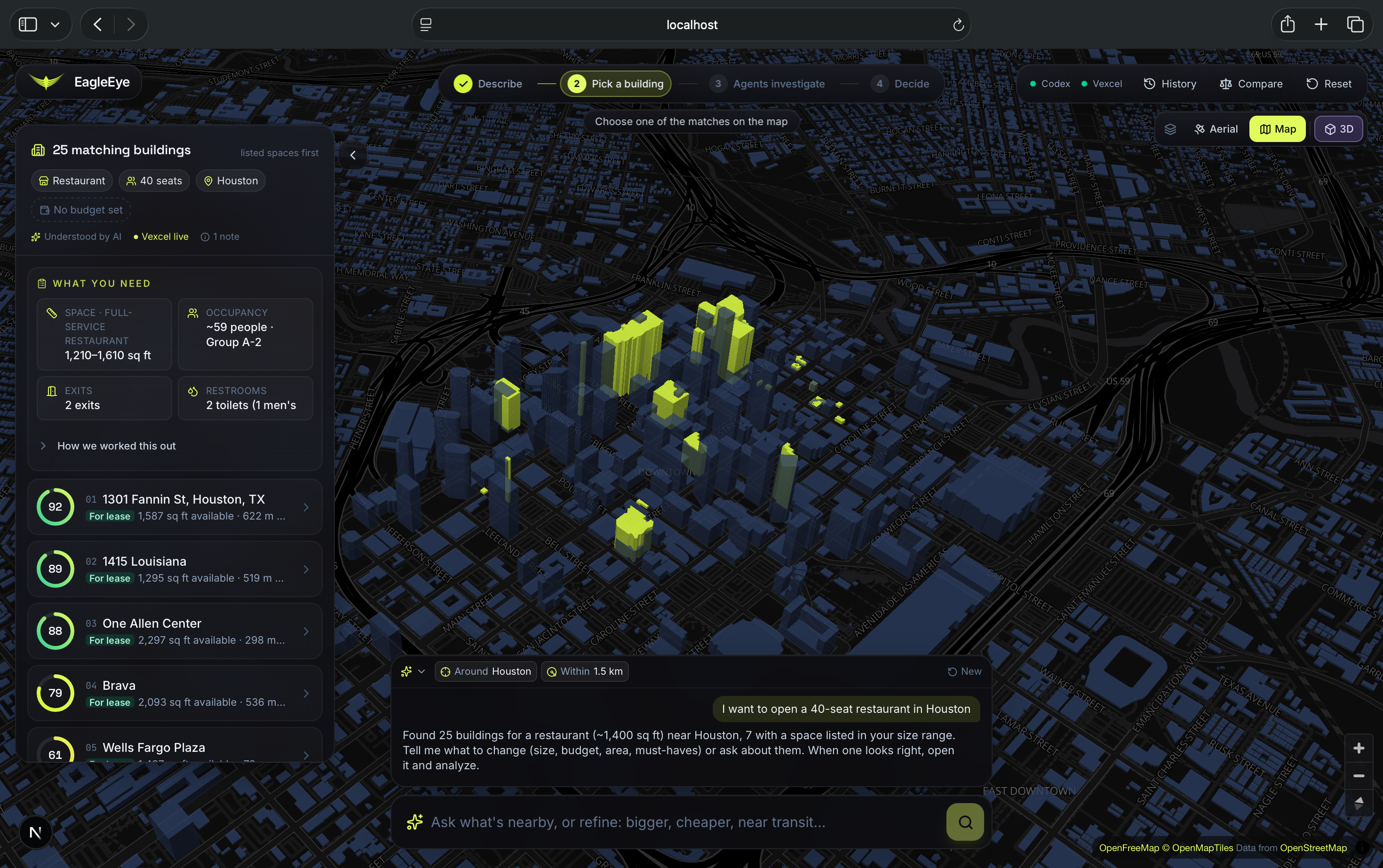
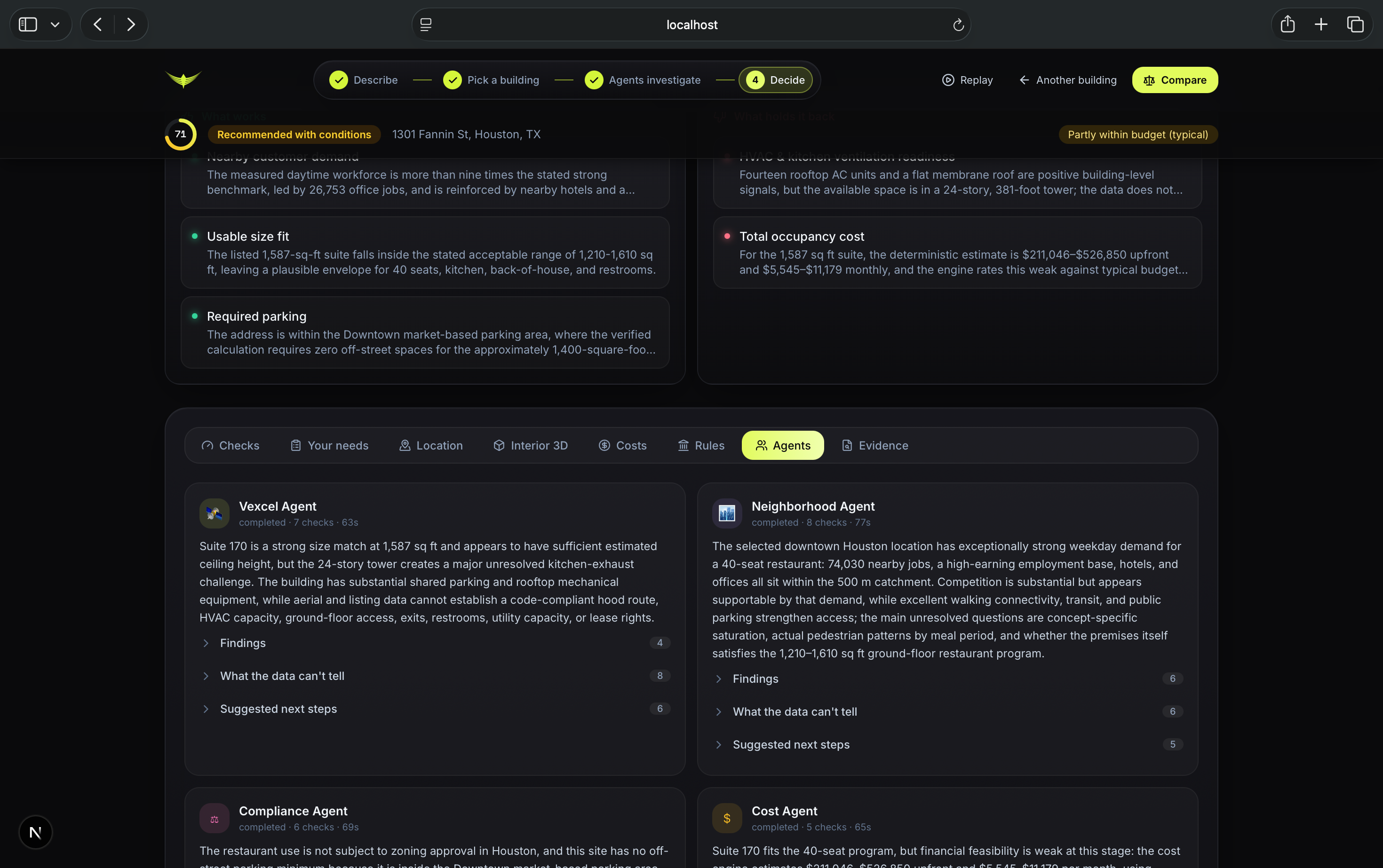
You describe your business in plain English, like "dumpling shop, 30 seats, needs a kitchen." EagleEye shows candidate buildings on a live aerial map. Pick one, and a team of AI agents investigates it:
- 🛰️ Vexcel agent: reads roof condition, rooftop HVAC, footprint and paving from aerial AI data, and states what imagery can't see.
- 🏘️ Neighborhood agent: demand, competition and transit from OpenStreetMap and US Census data.
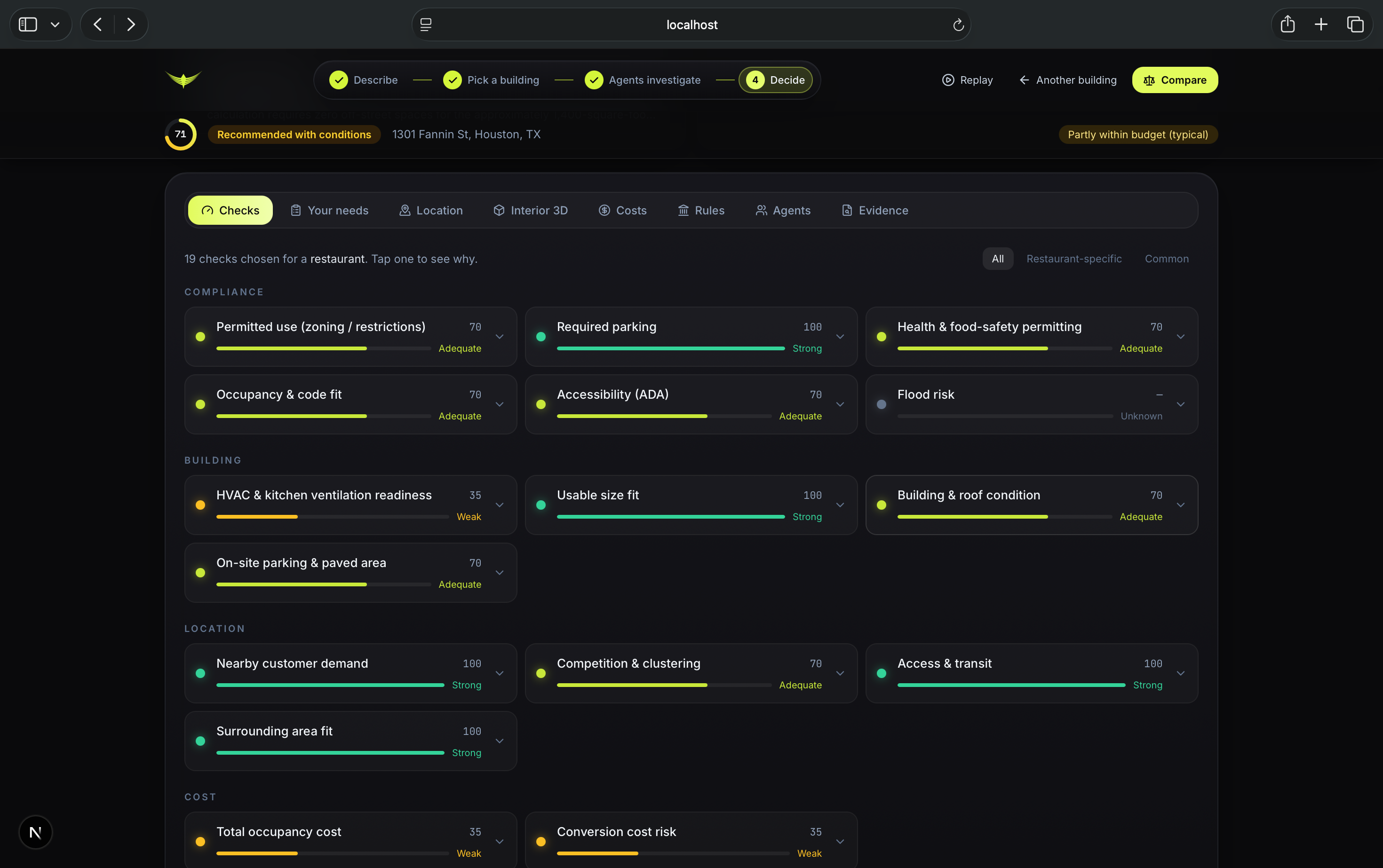
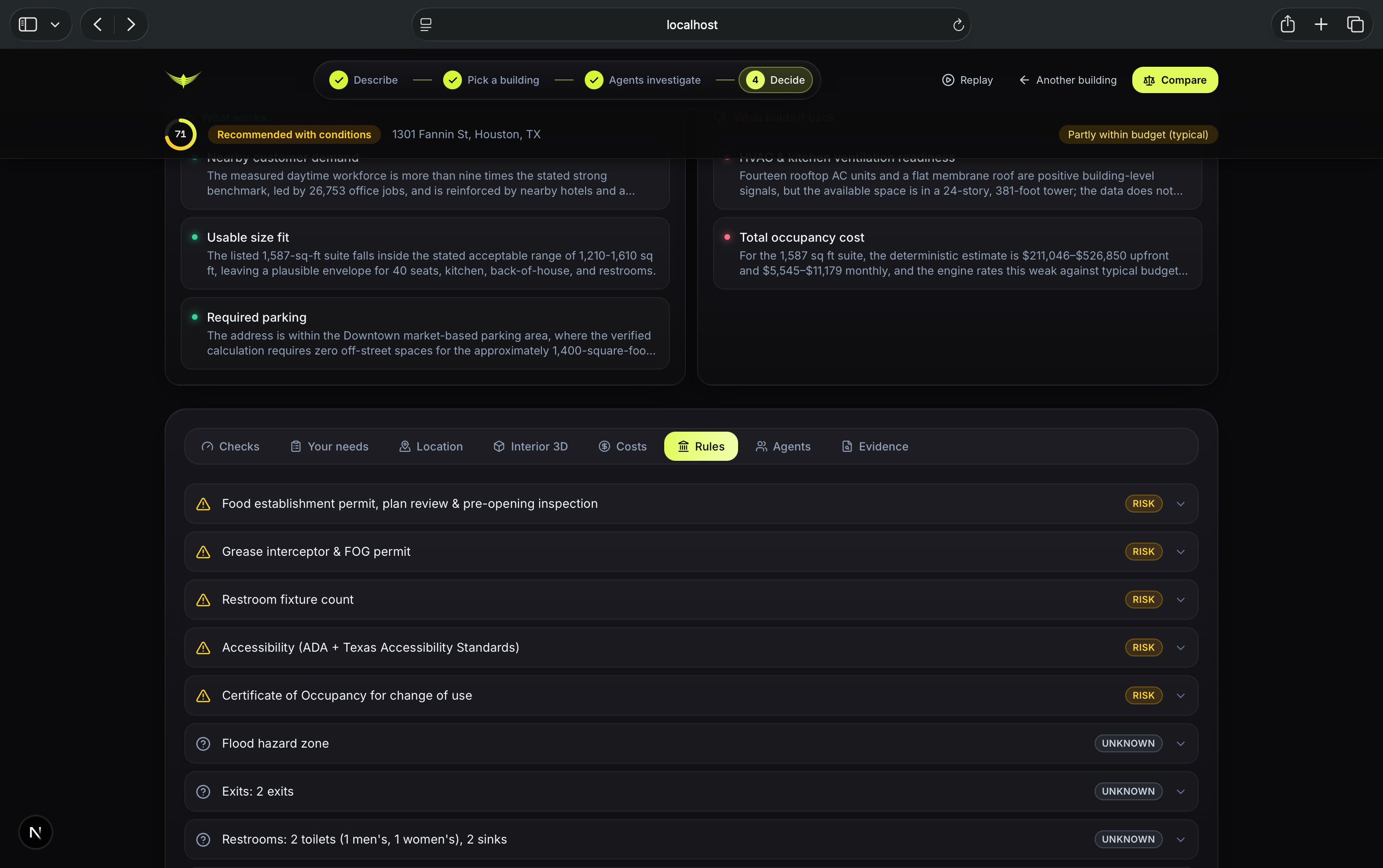
- 📜 Compliance agent: permitted use, parking minimums, health rules (including grease interceptors) and ADA, from a verified rule set with citations.
- 💰 Cost agent: uses the other agents' findings to estimate what it will actually cost to open.
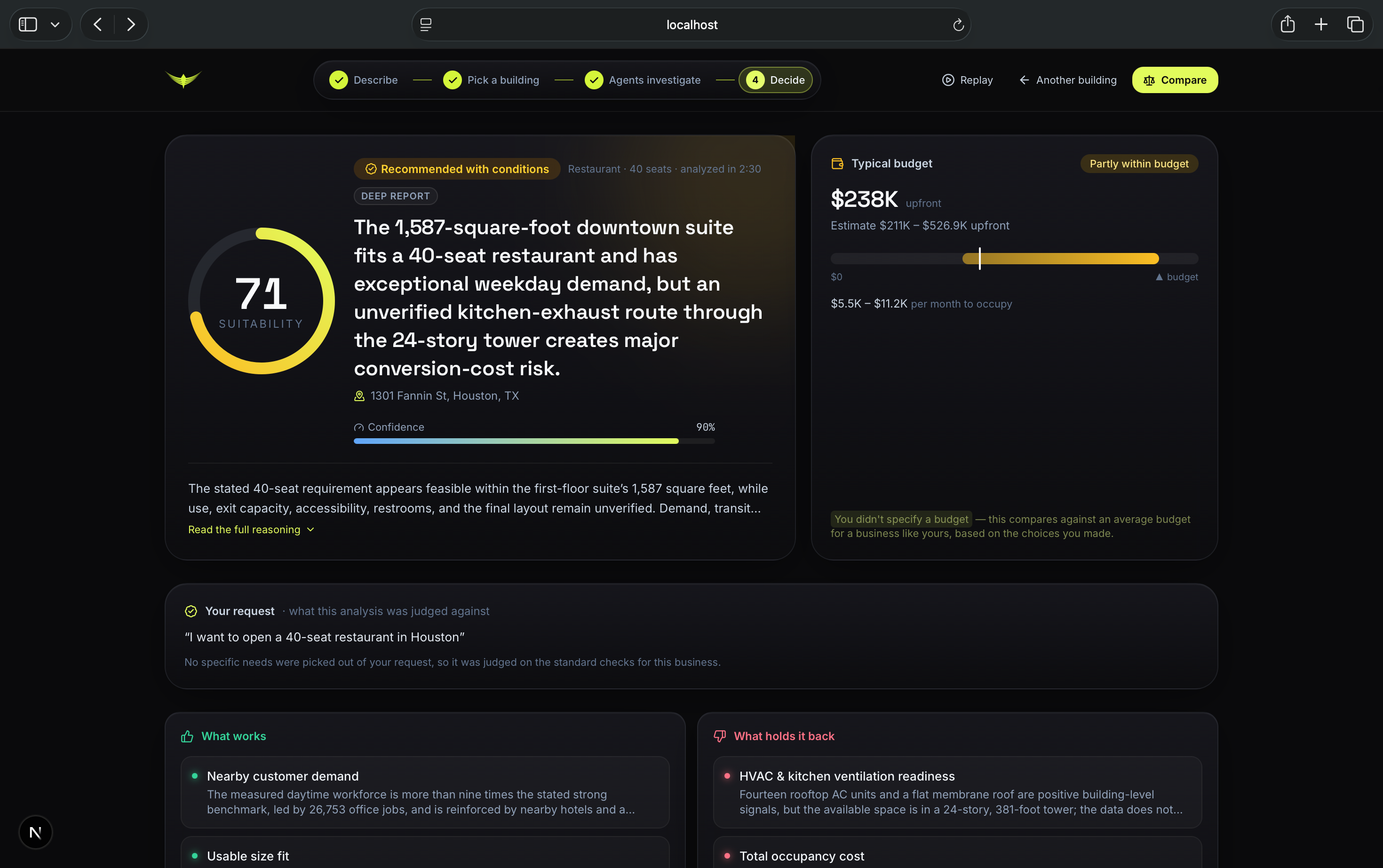
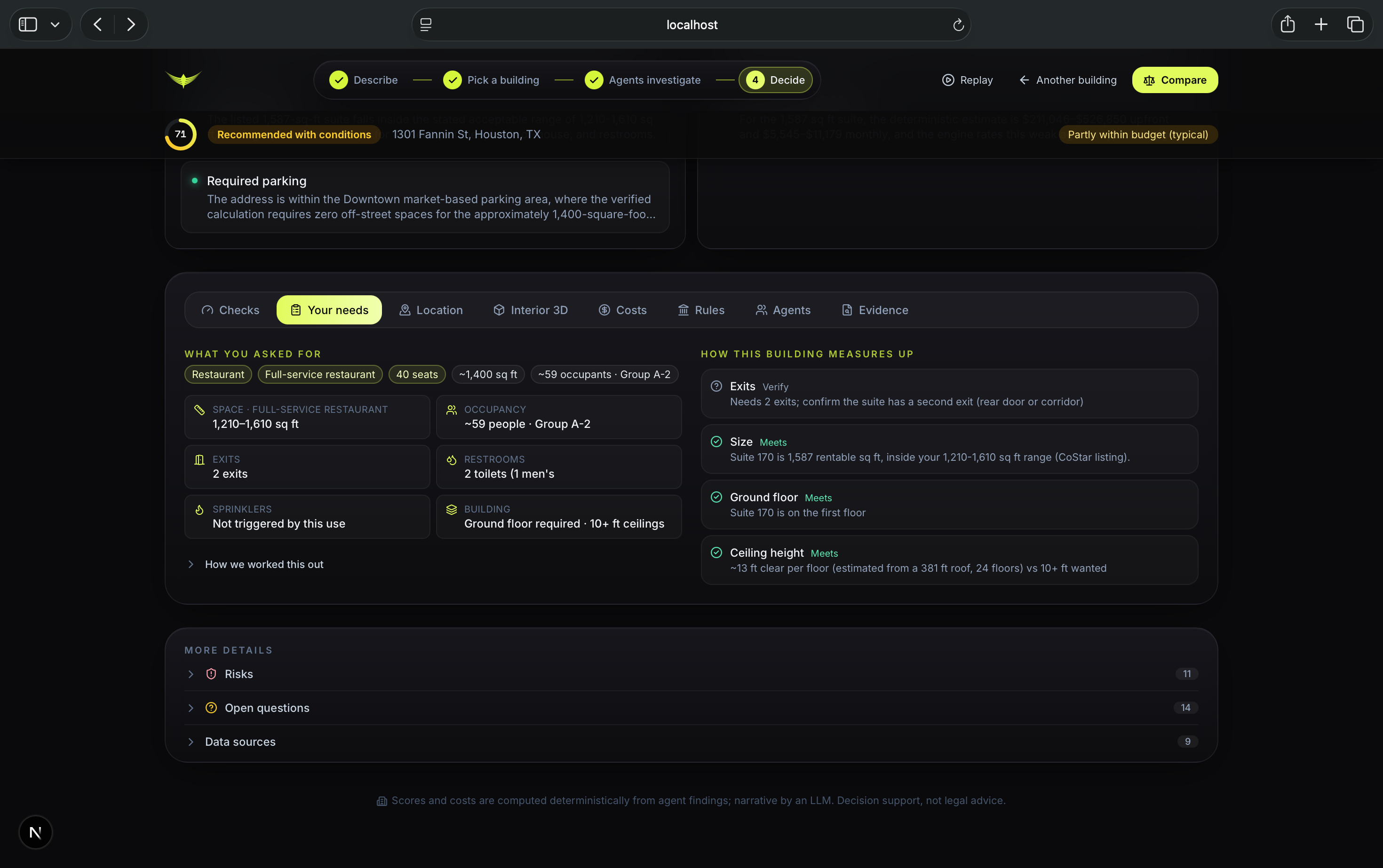
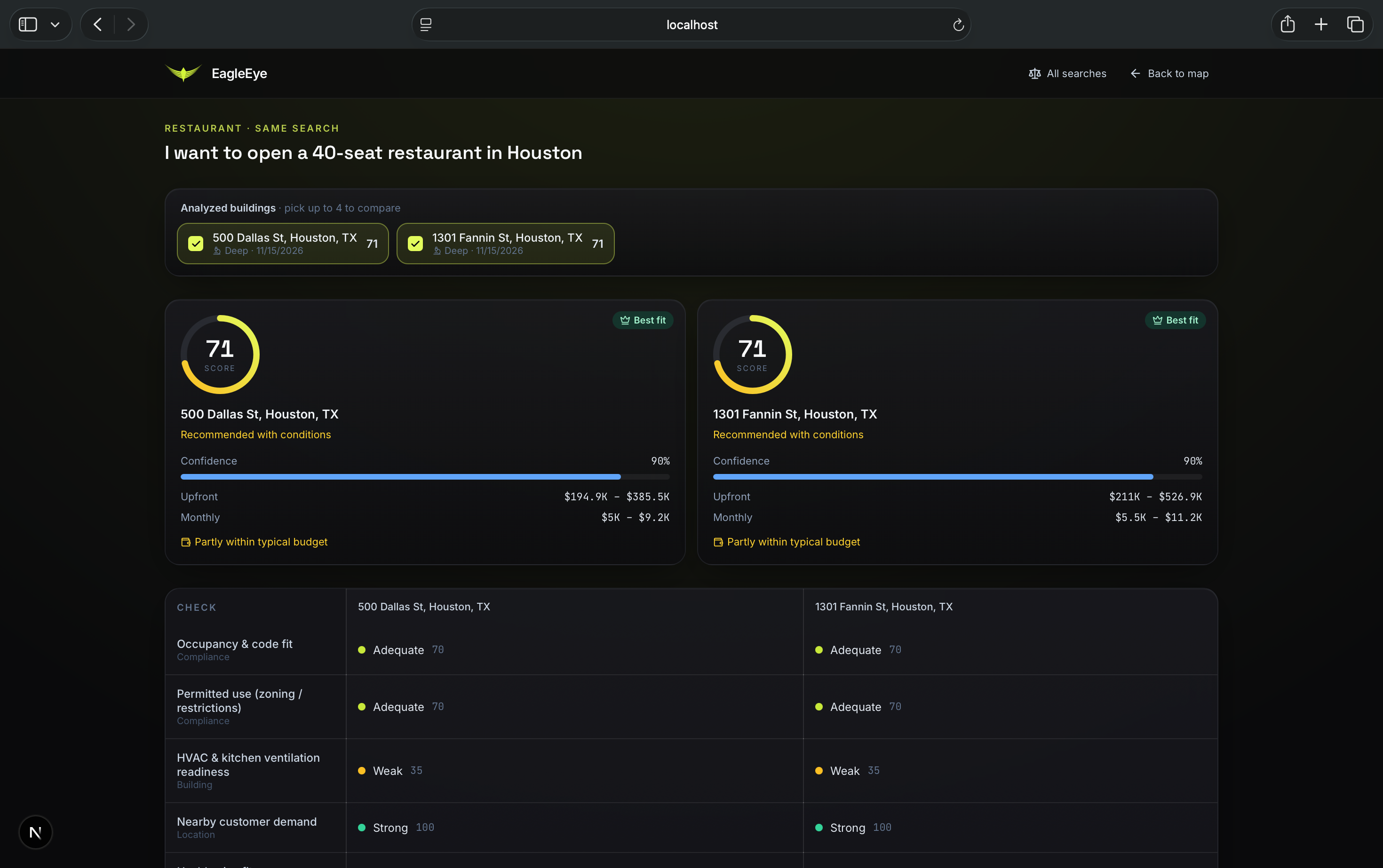
You get a verdict, a score, a confidence level, evidence behind every claim, cost ranges and a list of questions for the landlord, and you can compare buildings side by side.
How we built it
- Frontend: Next.js 15, React 19, TypeScript, Tailwind CSS and MapLibre. Vexcel map tiles go through our backend, so API keys never reach the browser.
- Backend: Python, FastAPI and Pydantic, with SQLite for jobs, the live event log and caching.
- Agents: LangChain Deep Agents on LangGraph. Each agent sees only its own domain tools, and every tool result is registered as citable evidence (E1, E2, …).
- LLM fallback chain: Codex CLI → Claude Code CLI → Ollama (qwen3:8b, local). If one provider hits a usage limit, the next takes over mid-analysis.
- Data: Vexcel property extraction and ortho imagery, OpenStreetMap (Nominatim and Overpass), the US Census geocoder and ACS, and hand-verified city-code rules.
- Config over code: metrics, business types, weights, jurisdictions and cost bands all live in YAML. Adding a new business type is a config edit.
Our core rule: AI investigates, math decides. Agents assign each metric a status with evidence, and plain Python turns that into numbers. Each status earns points p (strong 100, adequate 70, weak 35, blocker 0). A claim without valid evidence gets pulled toward neutral:
$$ s_m = p_m \quad \text{(claim cites valid evidence)} $$
$$ s_m = 0.6 p_m + 20 \quad \text{(no valid evidence)} $$
The overall score is a weighted average using business-specific weights, and confidence is the share of that weight backed by real evidence:
$$ \text{Score} = \frac{\sum_{m \in K} w_m s_m}{\sum_{m \in K} w_m} $$
$$ \text{Confidence} = 100 \cdot \frac{\sum_{m \in E} w_m}{\sum_{m} w_m} $$
Here K is the set of metrics with a known status and E is the set of metrics with cited evidence. A hard blocker (for example, a prohibited use) means Not recommended. Confidence below 40 means Insufficient evidence, not a guess. Before any scoring runs, a validator removes citations to evidence that doesn't exist, lets verified rules override agent opinions, and downgrades any blocker that has no evidence behind it.
Challenges we ran into
- Vexcel has no listings and no text search. We checked its OpenAPI spec, and there's no way to ask for "storefronts near X." We rebuilt discovery from scratch: geocode the area, pull the Vexcel parcels around it, and pre-screen them by building type, size and roof.
- Our API key was geofenced to two cities. Outside them, EagleEye falls back to OpenStreetMap footprints and says so in the UI.
- LLMs make things up with confidence. Early agents marked uses as "permitted" with nothing behind them. That led to the evidence-ID system and the validator: no citation, no credit.
- Aerial data is easy to misread. "0 AC units detected" is not the same as "no HVAC," because units can be hidden or out of frame. Our tools now return detection limits along with the numbers, so agents reason about what's missing instead of treating it as a finding.
- City code is hard. Verifying parking ratios, health rules and deed restrictions with citations was slow, careful work. Where we couldn't verify a rule, EagleEye says "unknown" and points to where to check instead of guessing.
- Agents fail. Timeouts and usage limits hit us during testing. Now a failed agent never sinks the analysis: its metrics become "unknown" and confidence drops, so the user still gets an honest answer.
Accomplishments that we're proud of
- We were able to pull this off together as a team
- Implemented a multi-agent system to address an existing, real-world problem
- Modularized agents so they can always be improved without affecting other parts of the code
- Implemented fallback chains
- Clean UI, fun to use.
What we learned
- Agentic system is more than LLM wrapper. They involve structured agents, each assigned a specific task, working together to solve a bigger problem.
- Modularity of the code base
- Parallel Agents
- There are many more factors to consider before buying a property, and rent is just a small part.
What's next for EagleEye
- Expansion in to more field-specific domains
- AI systems that is more robust and provides answers that are much relevant to the user's need
- Stronger task-specific agents
- Optimize agents and response latency
Built With
- langchain
- nextjs
- python
- vexcel