-
-
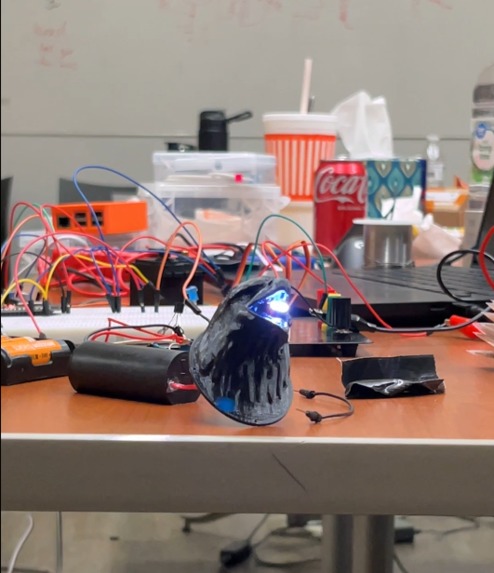
The spark mechanism in the eagle's mouth
-
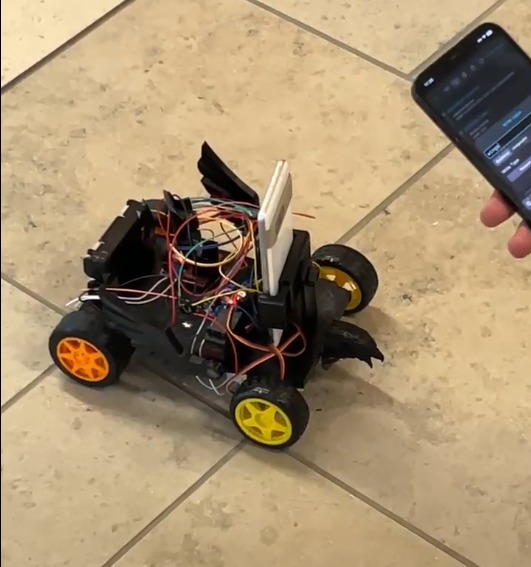
Full car
-
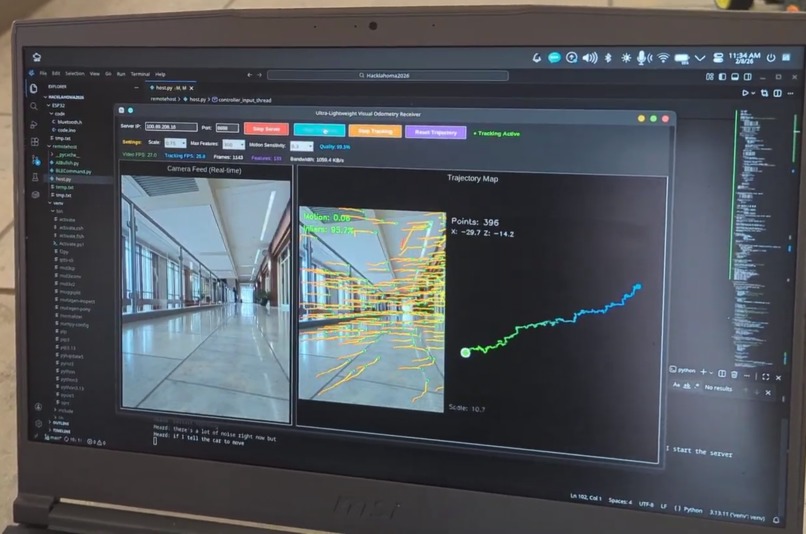
Remote computer connection to car for real time mapping
-
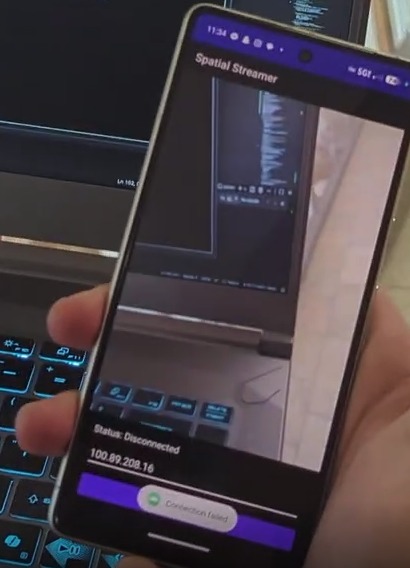


Inspiration
Eagle Eye was inspired by the idea that spatial awareness shouldn’t require heavyweight SLAM systems, expensive sensors, or specialized hardware. We wanted to see how far we could push pure computer vision and lightweight signal processing to give a live camera feed an understanding of motion, position, and intent. The goal was to build something fast, accessible, and responsive — something that could “see” and react in real time on consumer hardware.
What it does
Eagle Eye is a real-time spatial awareness and control system that receives a live camera stream and tracks motion through space using lightweight visual odometry. It builds a live trajectory map showing where the camera has moved, while overlaying motion vectors and feature tracking on the video feed.
The system also supports hands-free interaction, allowing users to control the application using:
Voice commands (start/stop camera, tracking, reset trajectory)
Clap detection for activation
Game controller input for movement and interaction visualization
All of this runs in real time with high frame rates, even on CPU-only systems.
How we built it
We built Eagle Eye entirely in Python with a focus on efficiency and modularity:
OpenCV for sparse optical flow and feature tracking (Lucas–Kanade)
Essential matrix + pose recovery for motion estimation without full SLAM
Tkinter for a custom real-time GUI
Sockets for low-latency video streaming
Multithreading to separate video reception, tracking, UI updates, and input handling
Speech recognition, clap detection, and controller input for multimodal control
Instead of relying on heavy SLAM frameworks, we implemented our own adaptive scaling, motion damping, and drift control, keeping the system fast and stable.
Challenges we ran into
Maintaining stable motion estimates without depth sensors or full SLAM
Preventing drift and sudden jumps when feature tracking quality dropped
Balancing tracking accuracy with real-time performance
Synchronizing multiple threads (video, tracking, UI, audio, input) safely
Making voice and audio input reliable in noisy environments
A lot of iteration went into tuning thresholds, damping factors, and feature selection to keep tracking smooth.
Accomplishments that we're proud of
Achieving real-time visual odometry at 40–60 FPS on CPU
Building a full spatial tracking system without SLAM libraries
Creating a clean, intuitive GUI that visualizes both motion and trajectory
Successfully integrating vision, audio, voice, and controller input into one system
Designing a system that is modular and extensible for future features
What we learned
Lightweight approaches can go surprisingly far with the right constraints
Visual odometry doesn’t have to be complex to be useful
Multithreaded real-time systems live or die by careful synchronization
User interaction improves dramatically when multiple input modes are available
Debugging real-time systems is as much about visualization as it is about code
What's next for Eagle Eye
Next, we want to:
Add loop closure or drift correction techniques
Integrate depth estimation or stereo input
Export trajectories for robotics or AR applications
Improve robustness in low-texture environments
Experiment with AI-assisted feature selection and tracking
Ultimately, Eagle Eye could evolve into a lightweight spatial perception module for robotics, drones, AR/VR, or assistive navigation systems.

Log in or sign up for Devpost to join the conversation.