-
-
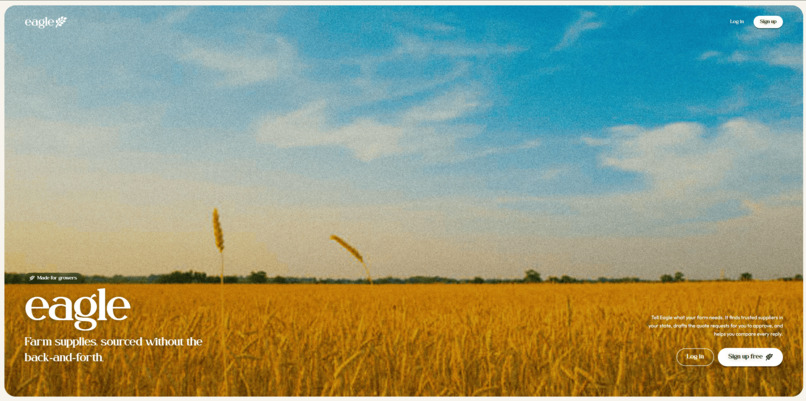
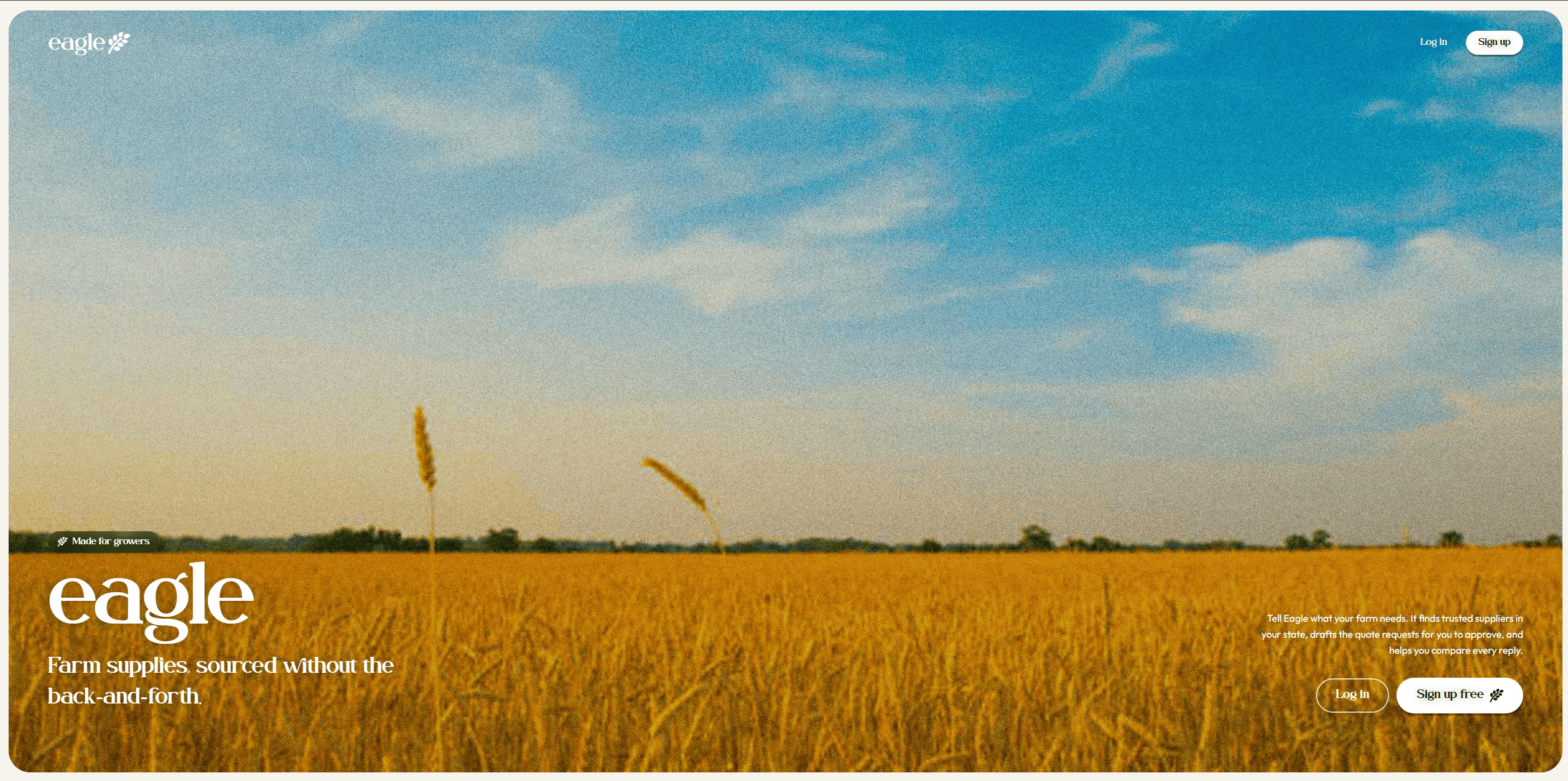
The landing page, where you may sign up for or log in to an account.
-
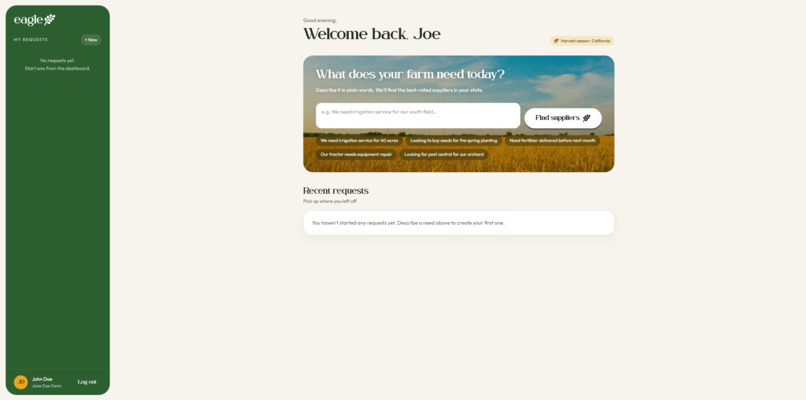
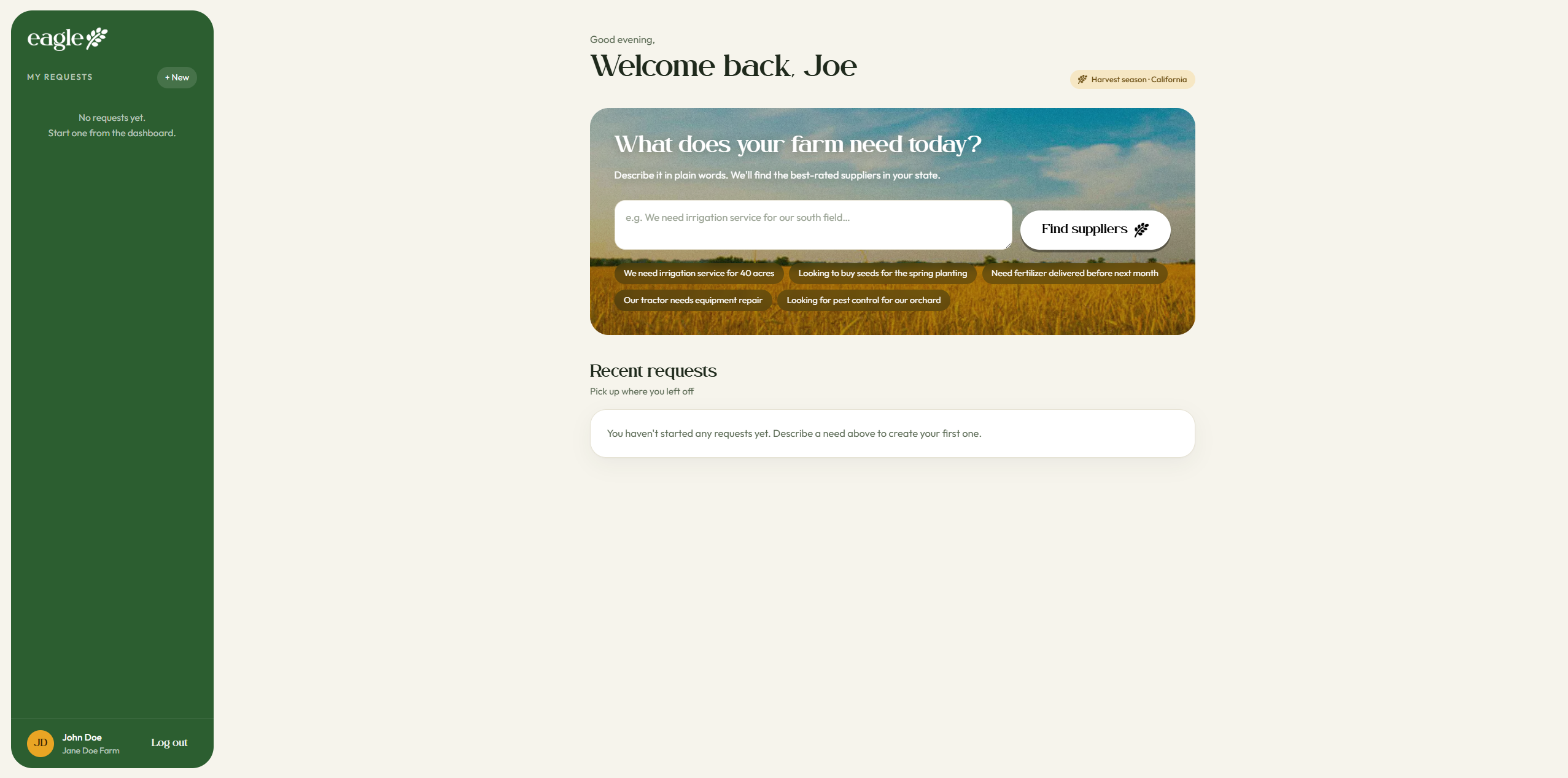
The main dashboard, prompting you to create a request or view active requests.
-
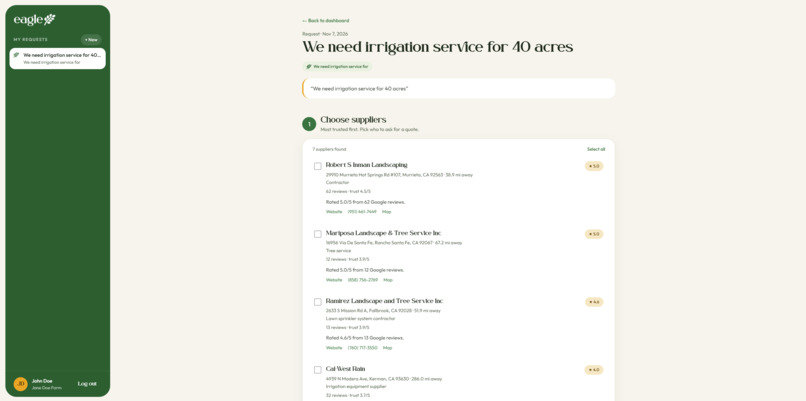
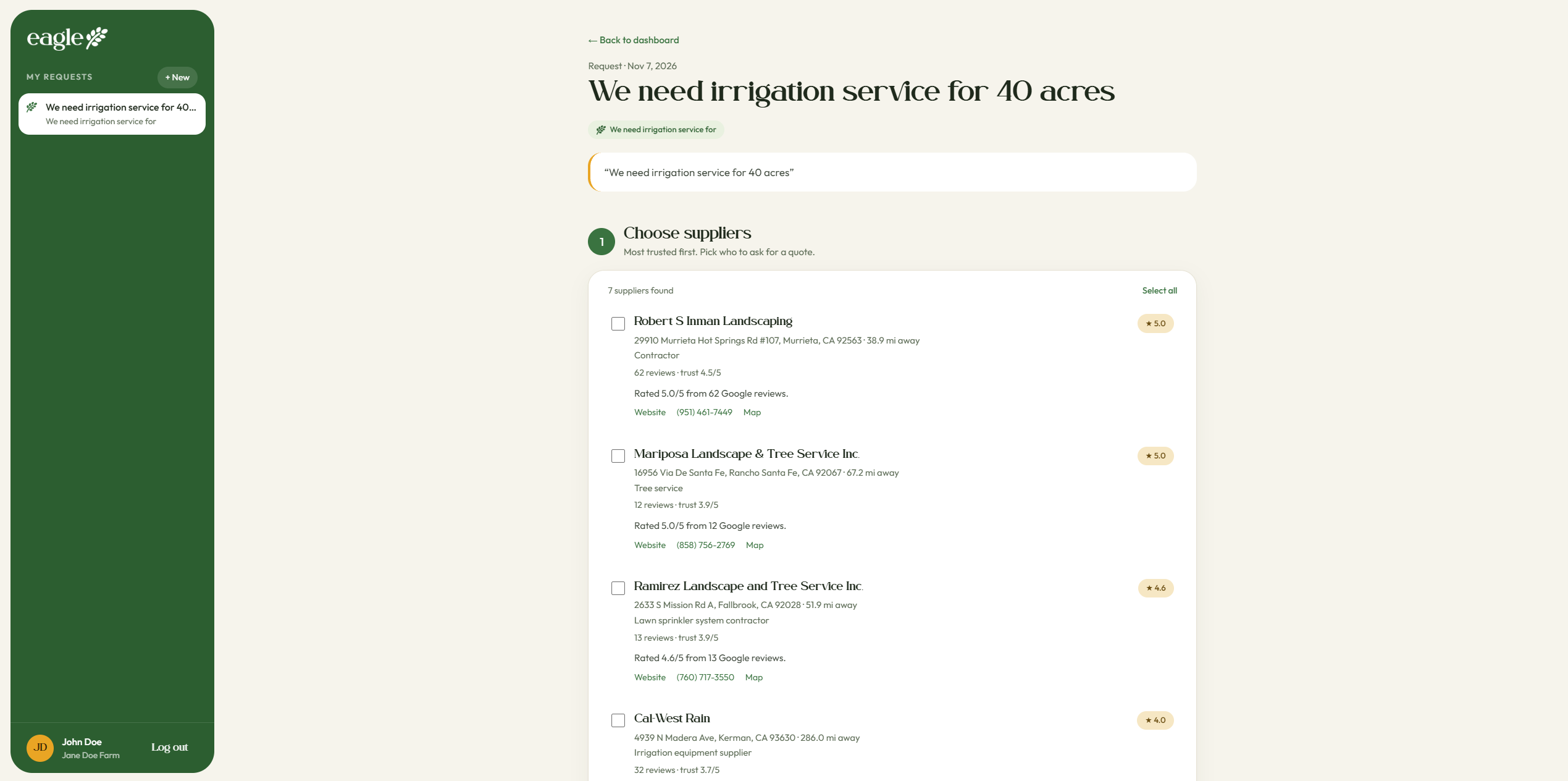
An example request asking for irrigation support; Eagle pulls up the highest-rated businesses for your query.
-
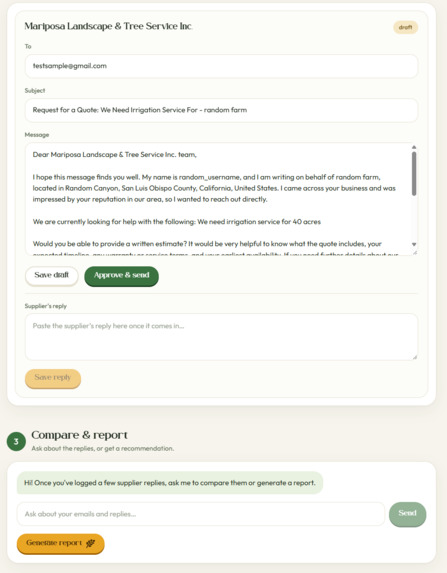
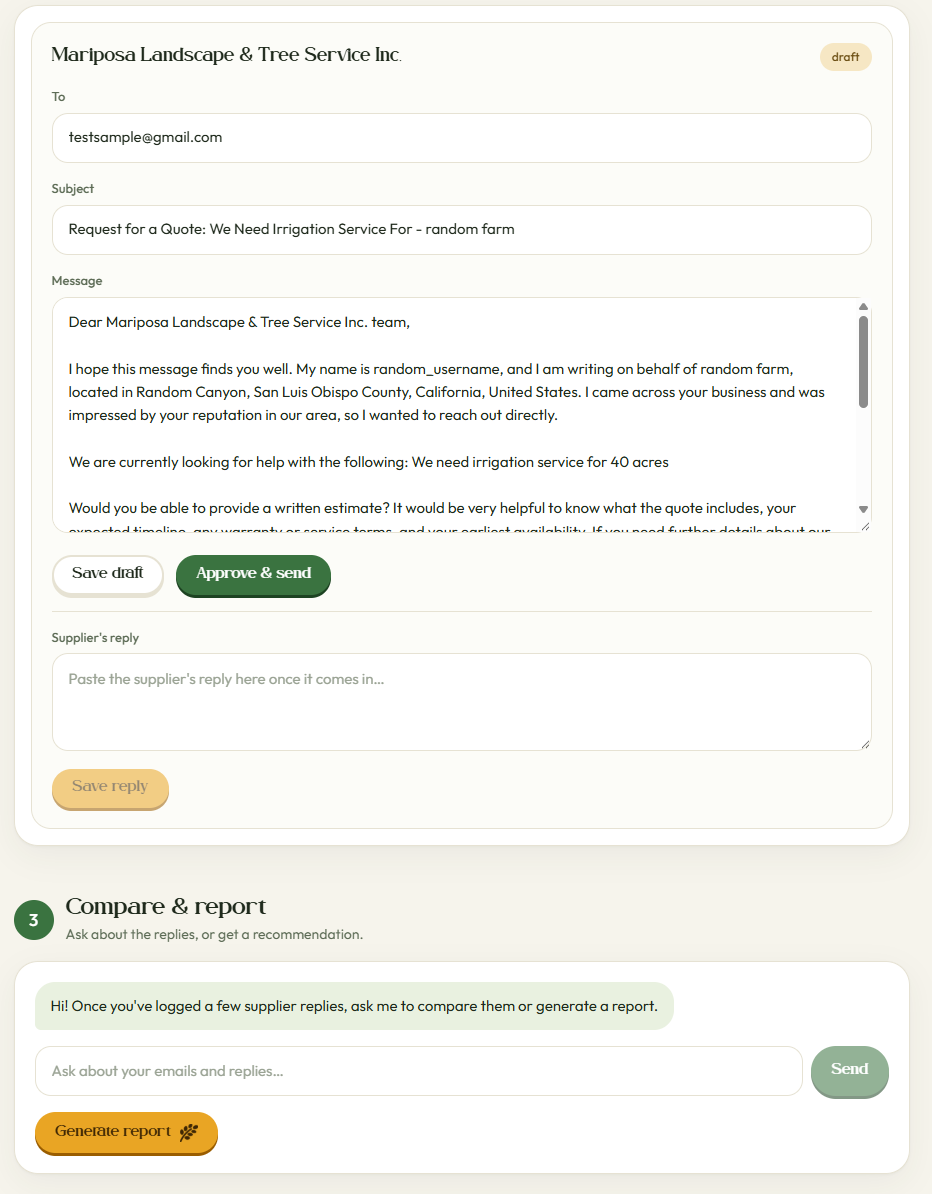
An example email to be sent to a business, optionally customizable.
-
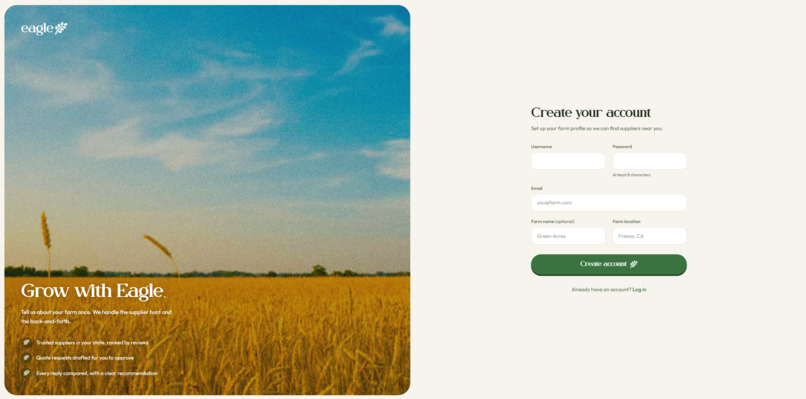
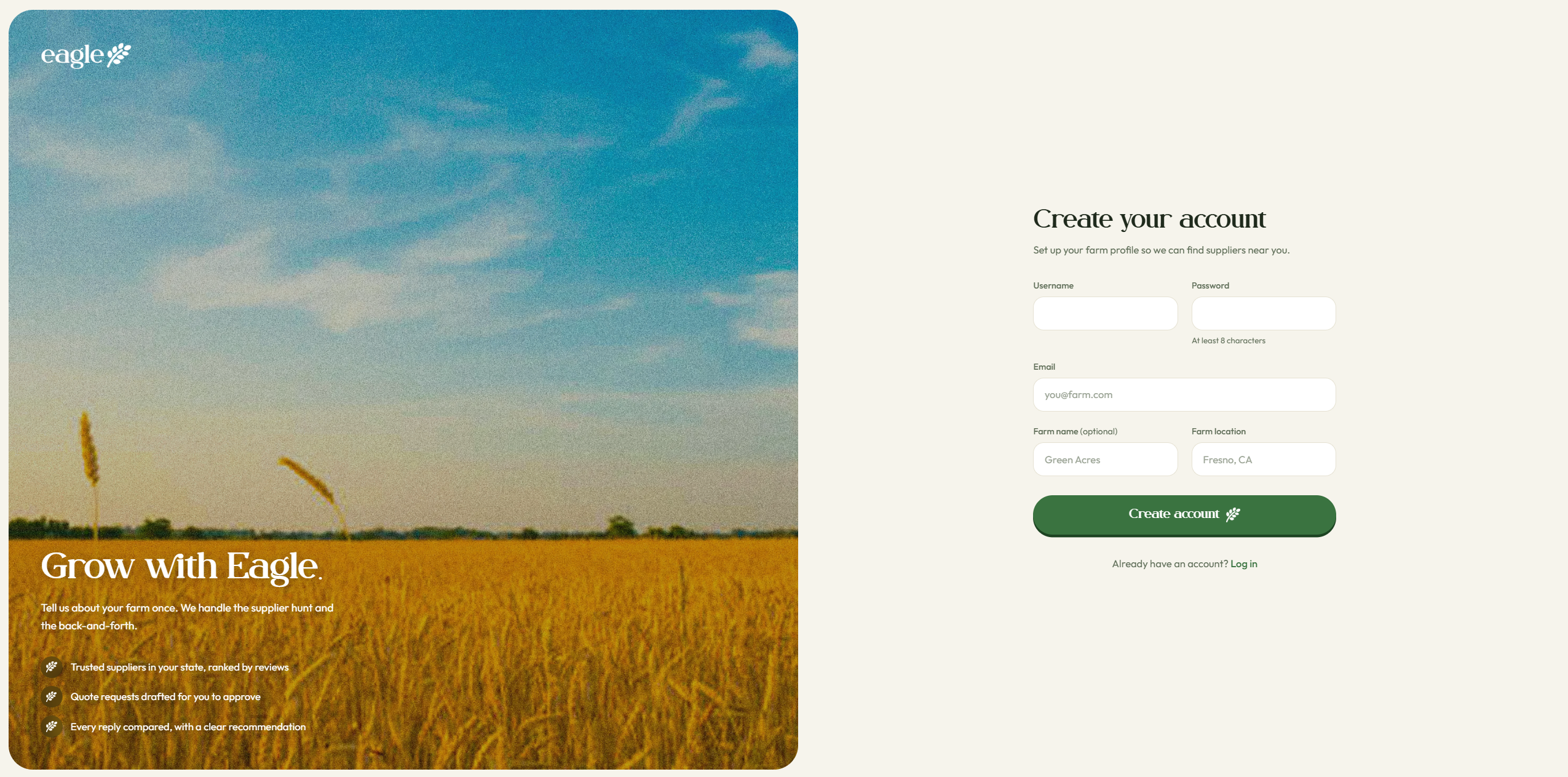
The sign up page where you may create an account.
The Problem: Many small farming businesses lack the time and effort to fully optimize their operations and supply chain. Eagle brings this directly to their computers, allowing them to run and manage everything from home, with agentic AI.
Features
Eagle offers a variety of features:
Farm accounts that save your farm name and location. Plain-language service requests (e.g. "we need irrigation repair") mapped to a service category by Claude on AWS Bedrock. Service providers pulled from MongoDB and ranked by rating. AI-drafted outreach emails that you can edit and approve before anything is sent. Email sending over SMTP, or simulated sending when SMTP isn't configured. Reply tracking, plus a chat and report generator built on your email history.
- more!
How It Works
Register / log in. Your farm name and location are saved to your account. Describe what you need. Claude maps your request to a service, and matching companies are listed by rating. Reach out. Pick companies, let Claude draft the emails, then edit, approve, and send. Follow up. Log company replies, then chat with or generate a report from the full email history. Build
Caution
In order to build and/or run this project, you will need Docker installed! You will also need a .env file at the top level with your MongoDB Atlas and AWS Bedrock settings. This project runs as a single Docker container holding both the API and the front-end. Docker may require WSL (Windows Subsystem for Linux) installed on your machine if you are running a Windows device.
Create your environment file, then fill in MONGO_URL and the AWS settings.
cp .env.example .env
docker compose up --build docker compose down Running Without Docker
Install all the project's requirements
pip install -r requirements.txt
Run the app with all the fields passed directly.
MONGO_URL="mongodb+srv://..." AWS_REGION=us-east-1 USE_BEDROCK=1 \ CLAUDE_MODEL=anthropic.claude-3-5-haiku-20241022-v1:0 \ uvicorn app.main:app --reload Architecture
This project is made of 3 main pieces which each handle their own respective tasks.
Frontend (HTML, CSS & JavaScript)
This piece is responsible for the interface that users see when launching the webapp. The whole front-end lives in app/static/index.html and is served by the backend.
- Provides account registration and login for farms.
- Walks users through requesting a service, choosing companies, and reviewing email drafts.
- Makes RESTful API calls to the backend to send and retrieve data.
- Backend (Python w/ FastAPI)
This piece is responsible for making everything work together. It lives in app/main.py and mainly provides these key features:
- Connects to MongoDB Atlas for persistence.
- Stores farm accounts, workflows, companies, emails, and replies.
- Seeds a starter set of service companies.
- Exposes API endpoints for the frontend to access. (e.g. /api/workflows, /api/emails/{id}/send, /api/companies)
- Sends approved emails over SMTP, or simulates sending when SMTP isn't configured.
- AI (Claude on AWS Bedrock)
This piece is responsible for all of the AI-related tasks, called from the backend through the Anthropic SDK.
Maps plain-language requests to a service category. Drafts tailored outreach emails for each selected company. Answers questions about and generates reports from a workflow's email history.
What we learned from this project:
Building with AWS requires choosing wisely which resources you will use to make the most out of the tokens given to you. Making a strong product means choosing a reliable model and fine-tuning if needed. Additionally, we found that the most effective feedback loop is one where the agent handles the core aspects, but the human still acts as the final decision-maker.
What is next
We plan to scale Eagle's features to include but not limit to the following:
- Significantly expand our security systems for every user
- Add the ability to merge several workflows into one if they align well with each other, bringing together each agent instance.
Built With
- amazon-ec2
- amazon-web-services
- bedrock
- docker
- fastapi
- mongodb
- next.js
- tailwindcss
