-
-
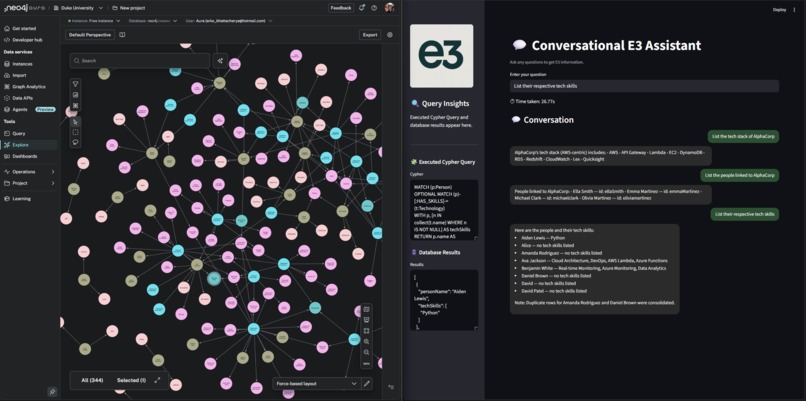
LLM generated Knowledge Graph + Web App
Inspiration
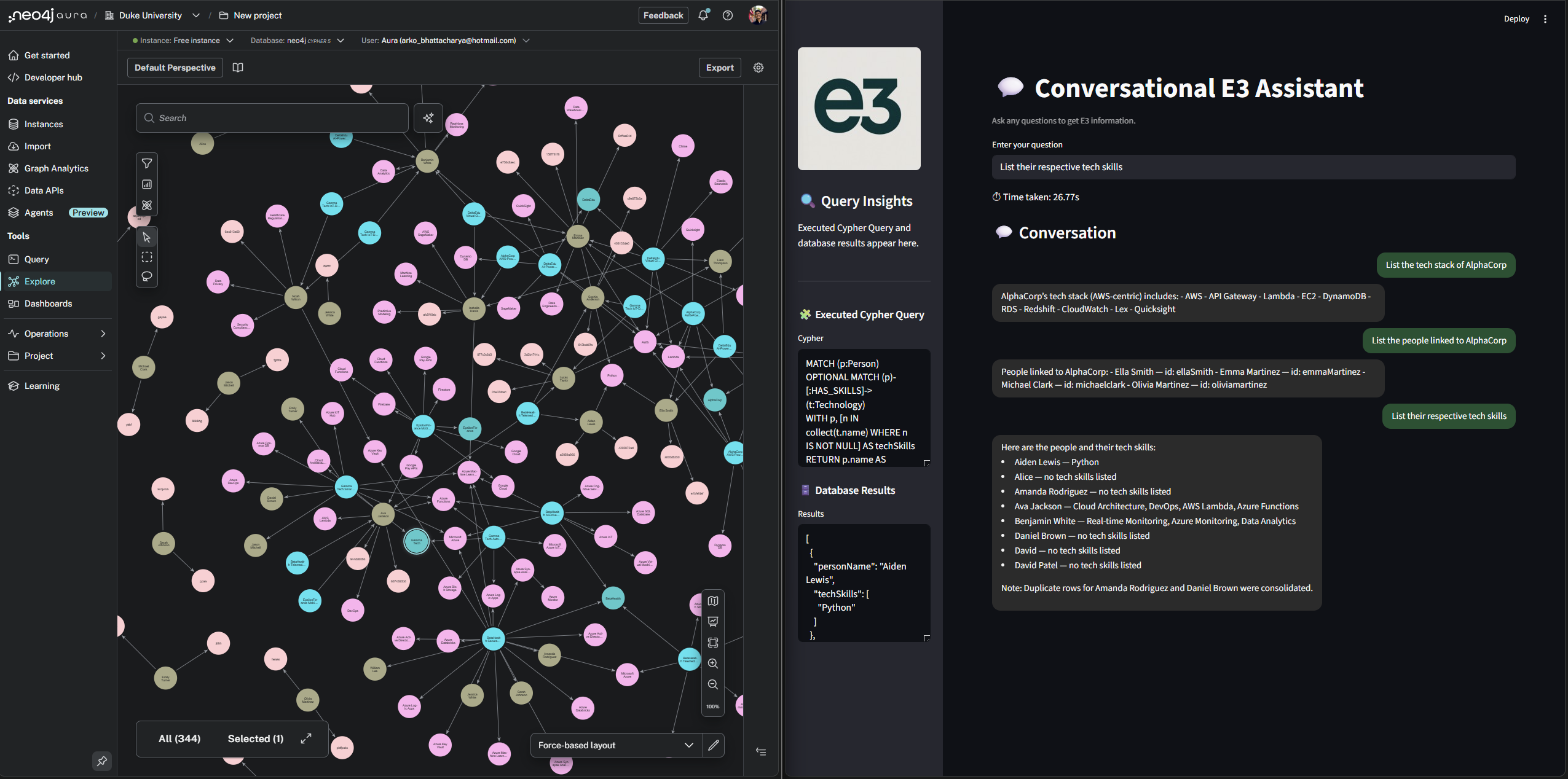
Enterprises generate enormous volumes of unstructured information ... reports, project briefs, and technical documents ... that are nearly impossible to navigate cohesively. I wanted to connect the dots across this scattered knowledge. E³ was inspired by that challenge: to create an intelligent system that could read, reason, and expand an organization’s knowledge base in real time, while remaining explainable and transparent.
What it does
E³ transforms plain text into a dynamic Neo4j knowledge graph through LLM-powered entity extraction and relation expansion.
It allows users to: Ask natural-language questions about people, projects, clients, or technologies. Automatically convert these questions into Cypher queries using an LLM. Receive human-readable explanations of graph results — not just raw data.
Expand the graph continuously by discovering new entities and links, assigning each a confidence score and rationale for explainability.
How I built it
LLM Entity Extractor – I used GPT-based (gpt4o for entity resolution and expansion, gpt-5 for web-app and cypher generation) models to identify entities and relationships from raw text. Graph Construction – Each entity type (e.g., Project, Client, Technology) was structured and linked inside Neo4j using Cypher scripts. Entity Expansion Logic – The model enriches the graph by linking semantically similar entities. Conversational Interface – A Streamlit frontend interacts with LangChain’s GraphCypherQAChain to turn user queries into Cypher, execute them, and summarize results dynamically. Transparency Layer – Every executed Cypher query and database result is displayed in the sidebar, ensuring the reasoning process remains visible.
Challenges I ran into
Handling schema drift between dynamically generated Cypher and live Neo4j structures. Ensuring LLMs produce safe, deterministic queries without over-generation or syntax errors. Designing a real-time interface that refreshes both conversation and insights on the first query execution. Balancing speed and interpretability when summarizing complex graph results.
Accomplishments that I'm proud of
Built a fully functional conversational graph assistant that can query, reason, and explain. Successfully implemented entity expansion using LLMs, linking previously disconnected concepts. Designed a transparent user experience where users can see exactly which Cypher queries are executed. Created a scalable architecture that can easily plug into other enterprise systems (e.g., Snowflake, BigQuery).
What I learned
Large language models can act as semantic reasoning agents when paired with structured databases. Explainability requires not just results, but rationale ... every edge in the graph should have contextual evidence. Integrating LLMs into real data systems (like Neo4j) demands robust prompt design and fallback logic for reliability. Visual and conversational interfaces dramatically improve trust and usability for complex data tools.
What's next for e3-enterprise entity expansion
Add Conformal Prediction to assign statistically rigorous confidence intervals to each inferred relationship. Integrate Snowflake Cortex and BigQuery MCP connectors for large-scale ingestion. Enable graph visualizations and subgraph summaries directly within the chat interface. Build a reinforcement learning feedback loop where user corrections fine-tune future entity linking.

Log in or sign up for Devpost to join the conversation.