-
-
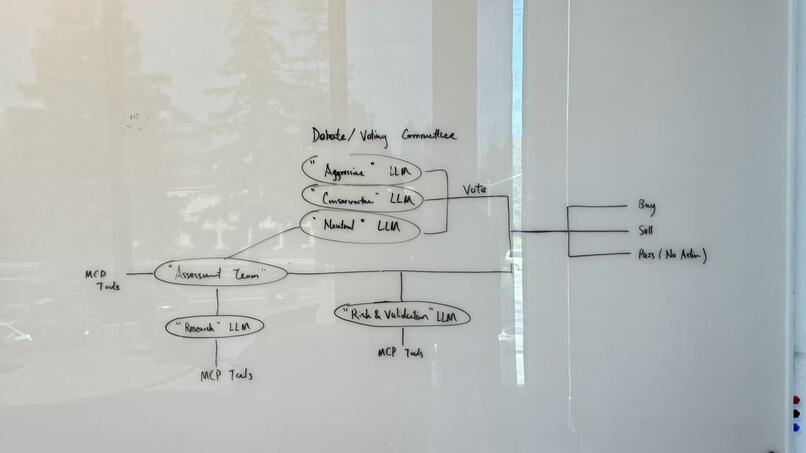
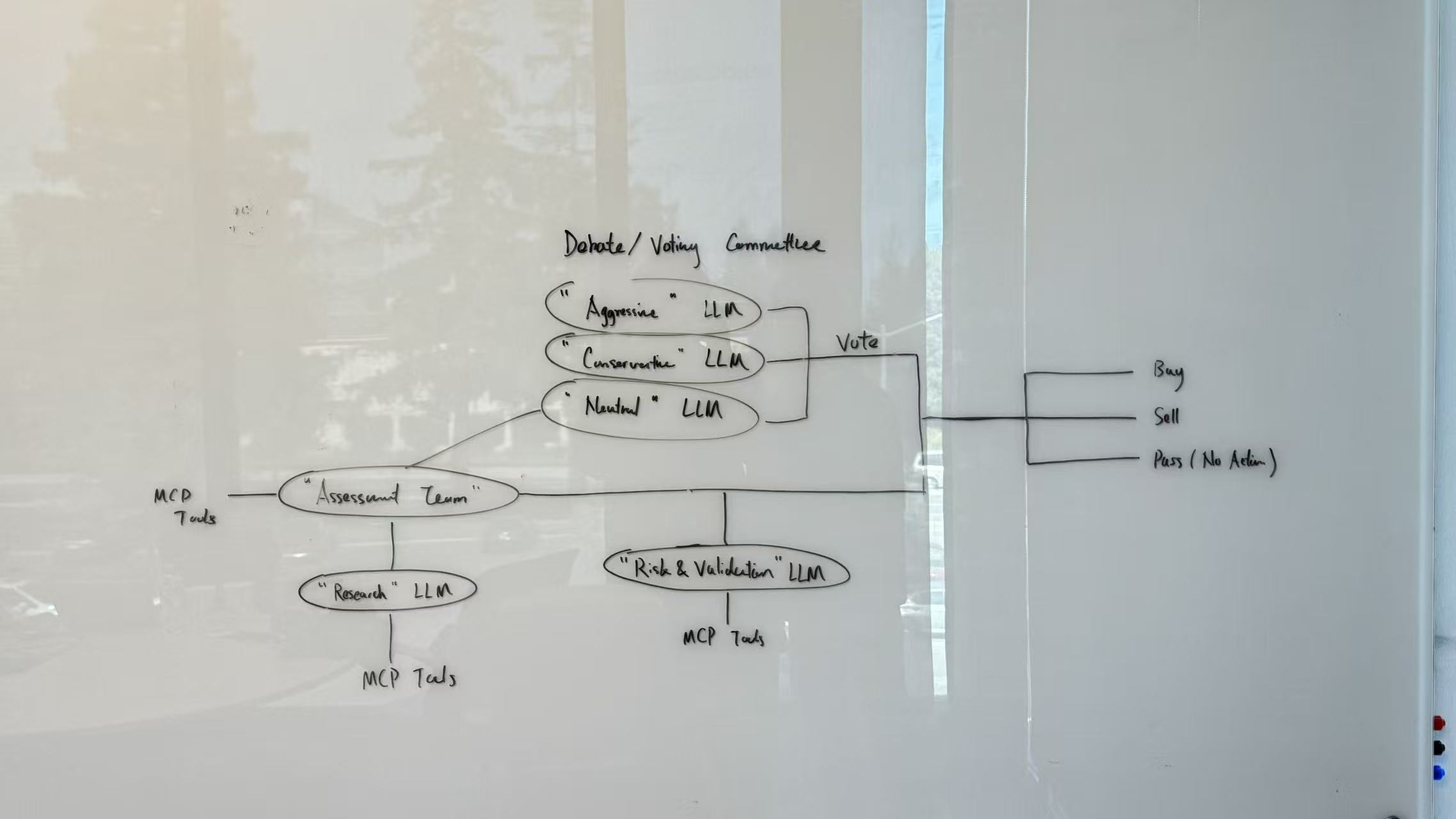
Basic Structure
-
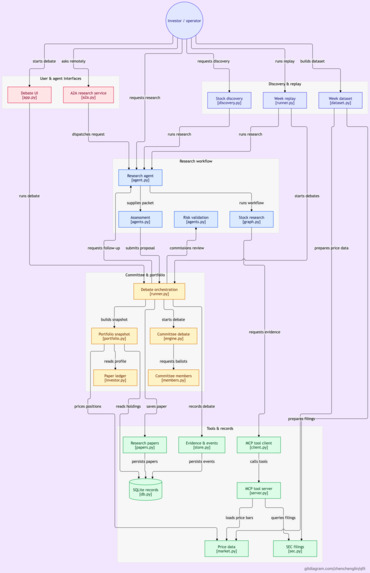
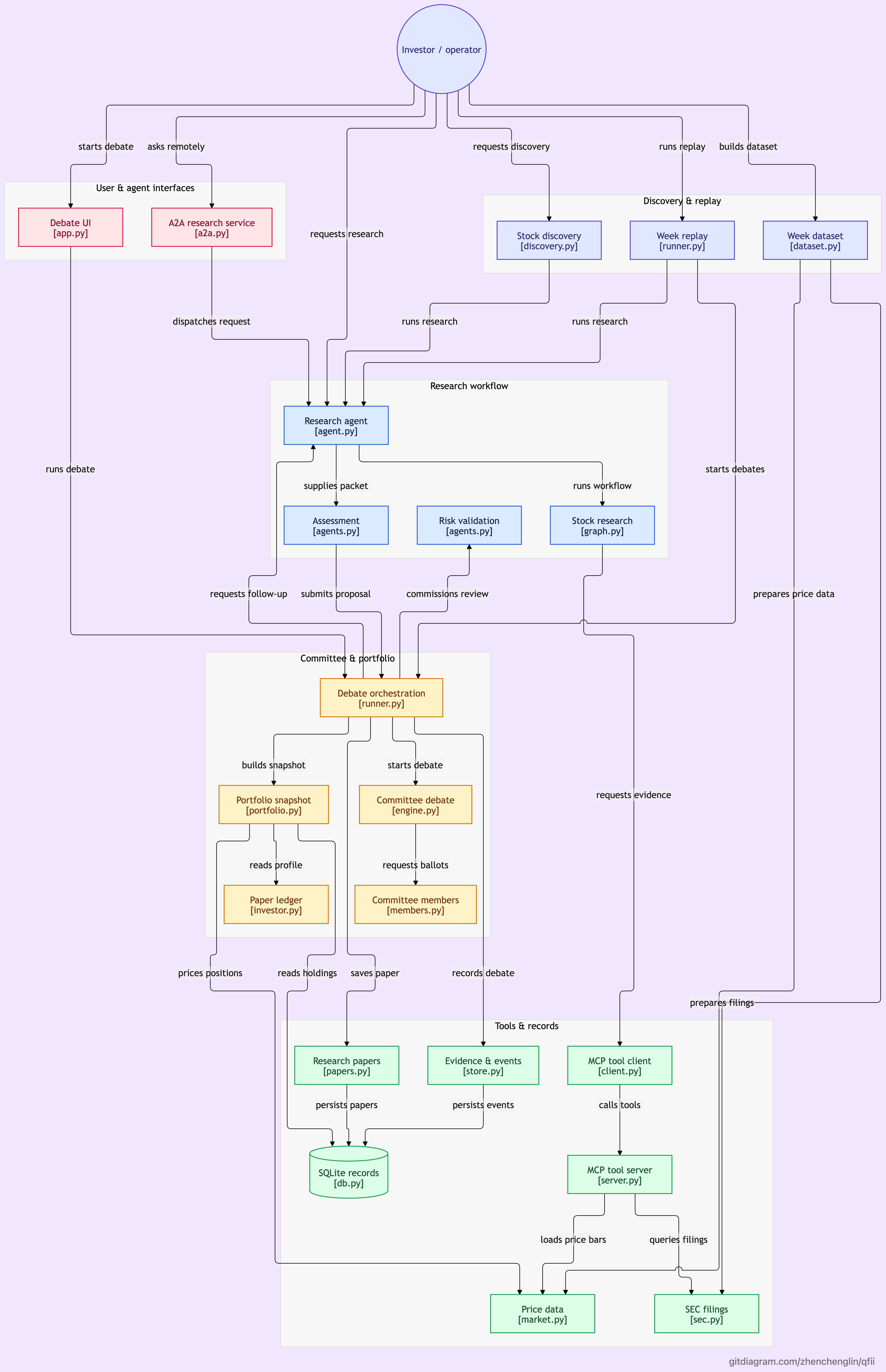
Github Diagram
E.T.F. — (E)xtremely (T)alkative (F)und
Inspiration
Retail investors often struggle to make informed investment decisions, not only because they lack access to reliable financial information, but also because they lack the time, resources, and expertise to interpret it effectively. Meanwhile, institutional investors benefit from specialized research teams, risk analysts, and investment committees that evaluate opportunities from multiple perspectives before committing capital.
We wanted to bridge this gap by giving retail investors access to an AI-powered investment team that resembles the organizational structure and decision-making process of an institutional investment fund.
Our vision was simple: What if individual investors could have an entire investment committee working for them, rather than relying on a single AI-generated stock recommendation?
What it does
E.T.F. is a multi-agent investment research and portfolio management system designed to simulate the organizational structure of a real-world investment fund. Instead of relying on a single predictive model or a predetermined trading algorithm, E.T.F. assigns specialized LLM agents to different departments, each with distinct responsibilities, analytical perspectives, and decision-making objectives.
The system separates financial research, investment assessment, risk validation, and portfolio allocation into independent but collaborative teams. Research agents gather quantitative and qualitative market information, while assessment agents critically evaluate potential investment opportunities before presenting them to an investment committee.
The committee consists of three agents representing aggressive, conservative, and neutral investment philosophies. Rather than accepting recommendations automatically, these agents debate their disagreements, challenge assumptions, request additional evidence, and negotiate investment terms through a structured voting system.
This approach allows E.T.F. to evaluate investment decisions through multiple competing perspectives, while maintaining deterministic safeguards for portfolio constraints and simulated trade execution.
How we built it
We built E.T.F. using a multi-agent architecture incorporating Cisco Outshift's AGNTCY ecosystem, Agent-to-Agent (A2A) communication, Model Context Protocol (MCP), and LangGraph to coordinate specialized LLM agents and financial data tools.
Our workflow begins with a Research team that collects and processes financial information across three analytical areas:
- Fundamental analysis: SEC financial filings, XBRL financial statements, financial ratios, earnings announcements, and qualitative disclosures using EdgarTools and filing-parsing tools.
- Technical analysis: Historical price data, market trends, momentum, volatility, and statistical indicators calculated using Python-based tools.
- Macroeconomic analysis: Economic indicators retrieved through FRED to provide broader market context.
The Research team converts these findings into structured, source-referenced reports. An Assessment agent then evaluates the investment thesis, identifies counterarguments, and determines whether an opportunity deserves the committee's attention. Opportunities requiring additional evidence can be returned to Research for further investigation.
Promising proposals advance to a three-member investment committee. Each agent independently evaluates the proposal according to its assigned investment philosophy and participates in multiple rounds of debate. Members can vote to invest, reject an opportunity, request further research or independent risk validation, or propose amendments to investment terms such as position size, holding period, and risk controls.
We use schema-validated JSON and shared evidence references to preserve information accuracy between agents. Financial calculations and portfolio constraints are handled through deterministic tools rather than relying on LLM-generated arithmetic. The system also supports point-in-time data handling, persistent agent memory, and a paper-trading environment for evaluating decisions without risking real capital.
Challenges we ran into
Our greatest challenge was not simply connecting multiple LLMs, but designing an organizational structure in which their collaboration actually improves investment decisions.
Throughout development, we repeatedly reconsidered the responsibilities and relationships between agents. One major debate involved choosing between a top-down research approach, where decision-makers request analysis of specific stocks, and a bottom-up approach, where research agents continuously screen investment opportunities while minimizing computational costs.
Another challenge was designing a voting system that encouraged meaningful disagreement without creating endless debates. We experimented with different committee structures, voting thresholds, information requests, and mechanisms for resolving disagreements while preserving each agent's independent judgment.
We also encountered technical challenges involving data integrity, information loss between agents, computational efficiency, and the possibility of LLMs inventing unsupported financial conclusions. Addressing these issues required separating numerical computation from qualitative reasoning and developing structured communication protocols with explicit evidence validation.
Ultimately, we learned that giving agents different personalities was not enough. They needed distinct objectives, shared evidence, meaningful disagreements, and clear rules for reaching decisions.
Accomplishments that we're proud of
Our proudest accomplishment is developing a functioning multi-agent investment committee that goes beyond simply aggregating independent AI recommendations.
We created a system in which specialized agents can challenge one another, reconsider their positions, commission additional research, and negotiate amended investment proposals. Rather than forcing consensus, the system also recognizes that declining an investment can be a legitimate outcome.
We tested the committee across 11 stocks and examined how different voting rules affected its ability to reach decisions. These experiments revealed recurring voting deadlocks and allowed us to evaluate alternative resolution mechanisms without changing previously settled investment decisions.
Equally important was our team's ability to resolve significant architectural disagreements within a short development window. Through continuous discussion and rapid iteration, we transformed a broad conceptual idea into a structured system with specialized research workflows, independent analytical agents, and a working debate mechanism.
Despite numerous changes to our implementation, our original philosophy remained unchanged: Investment decisions should emerge from evidence, critical evaluation, and constructive disagreement rather than unquestioned acceptance of a single recommendation.
What we learned
This project taught us that successful multi-agent systems require much more than assigning different prompts to multiple LLMs.
We learned how to translate real-world institutional decision-making processes into agent responsibilities, communication protocols, and computational workflows. More importantly, we discovered the importance of balancing agent autonomy with structured constraints to maintain reliability, accountability, and efficiency.
Our experiments also demonstrated that more discussion does not necessarily lead to better decisions. Effective collaboration requires agents to recognize meaningful new evidence, respond to opposing arguments, and know when additional debate provides little value.
Beyond the technical lessons, the hackathon was an invaluable experience in interdisciplinary teamwork. We combined financial reasoning, software engineering, and AI orchestration while learning how to communicate across different areas of expertise, challenge one another's assumptions, and rapidly reach practical solutions.
What's next for (E)xtremely (T)alkative (F)und
Our next priority is improving E.T.F.'s computational efficiency, reliability, and practical usability.
Our current hackathon deployment uses Cisco-provided GPT-6 models to power the agents. However, many tasks, particularly routine data extraction, preliminary screening, and information summarization, do not require the same reasoning capabilities as investment assessment or portfolio allocation. We plan to introduce tiered model deployment, assigning smaller, more energy-efficient models to routine tasks while reserving stronger reasoning models for complex financial decisions.
We also plan to expand our evaluation framework through historical market simulations, benchmark comparisons, and more extensive testing of committee decision-making. These experiments will help us determine whether structured multi-agent deliberation produces more consistent, defensible, or risk-aware investment decisions than simpler alternatives.
In the longer term, we envision a more accessible platform where users can inspect the evidence behind investment proposals, observe agent disagreements, and understand how the committee arrives at its conclusions.
Our ultimate goal remains the same: To make institutional-style investment research and decision-making accessible to everyday investors, one extremely talkative committee at a time.

Log in or sign up for Devpost to join the conversation.