Inspiration
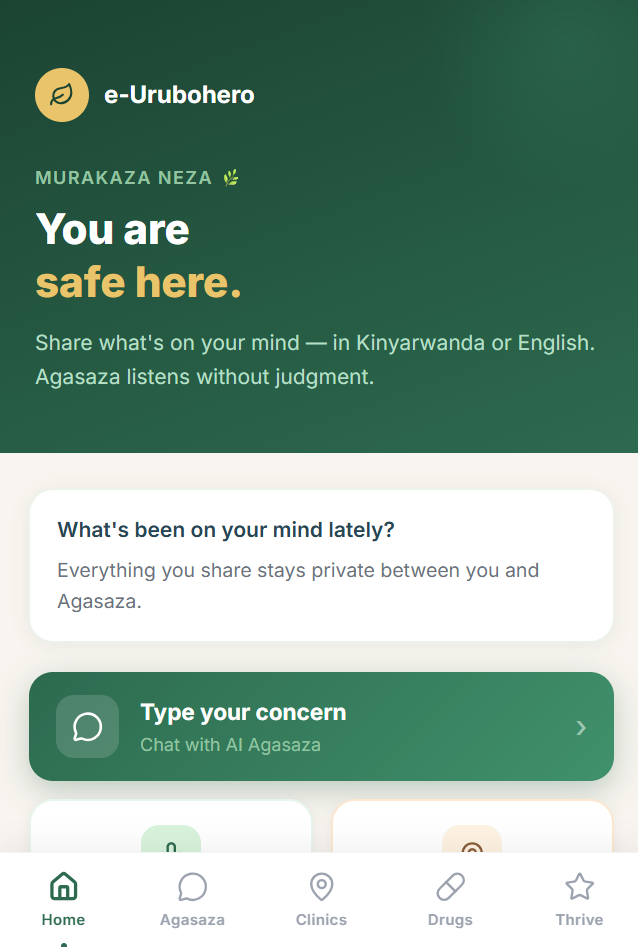
Youth in Rwanda face a profound "trust gap" when seeking mental health and Sexual and Reproductive Health (SRH) support. Traditional clinical settings can feel intimidating, and many existing digital solutions exclude youth with disabilities (PWD), particularly those with visual or literacy impairments. We were inspired by the traditional Rwandan concept of "Urubohero"—a culturally sacred, safe space for peer mentorship and learning. We wanted to digitize this heritage, using AI to create a barrier-free, non-judgmental entry point for youth to access vital health information and find the right care.
What it does
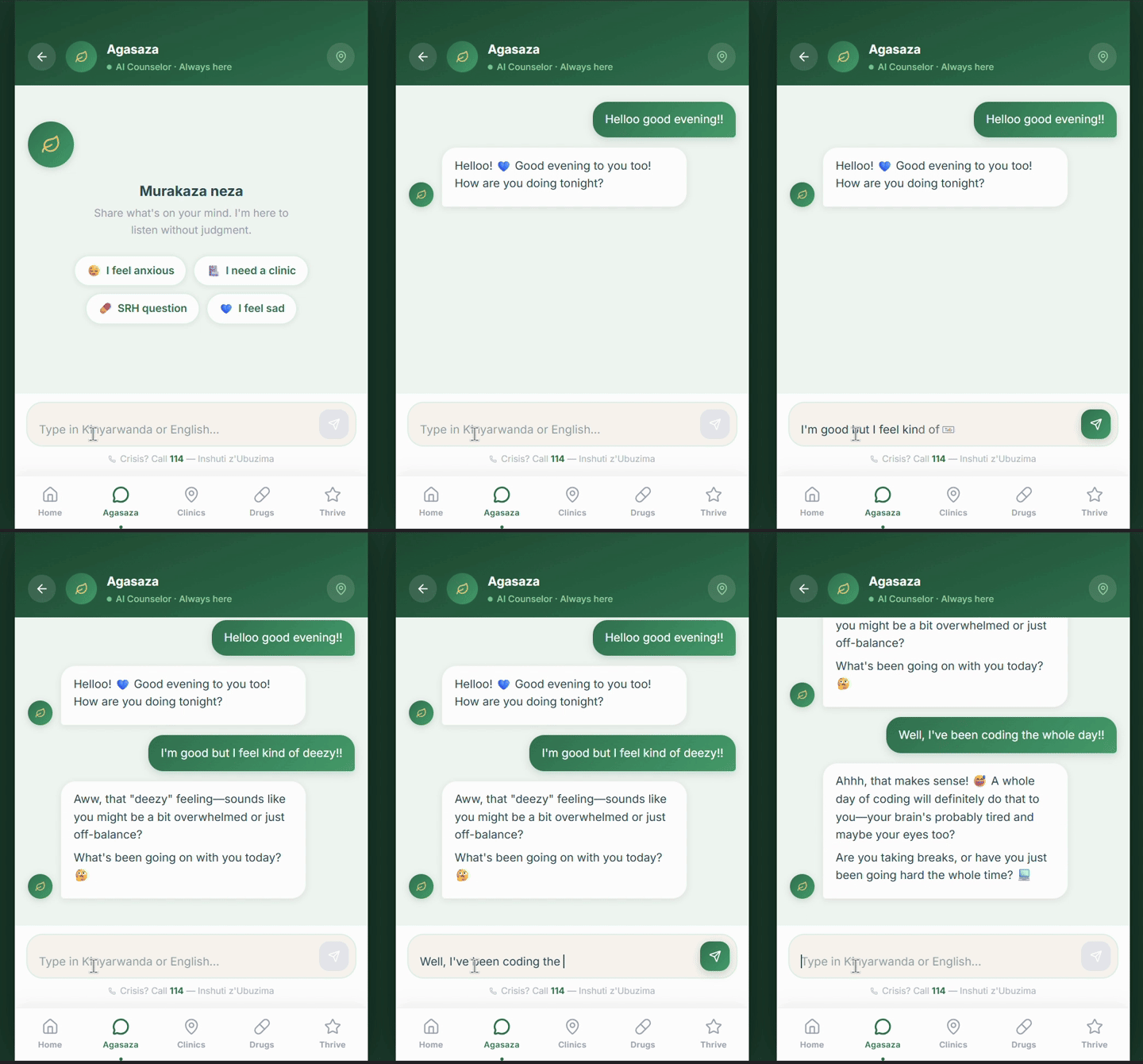
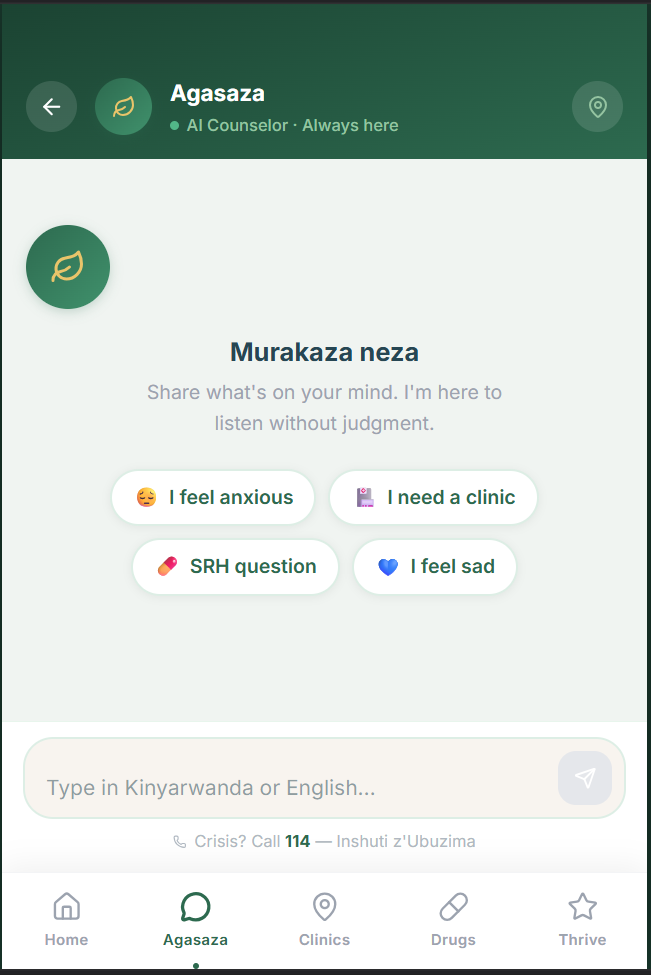
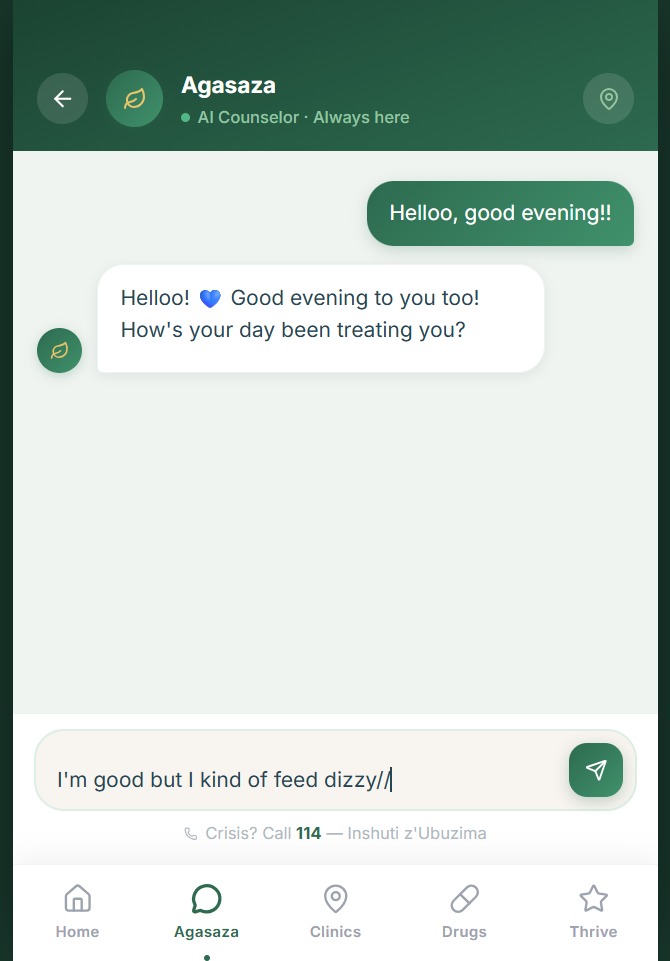
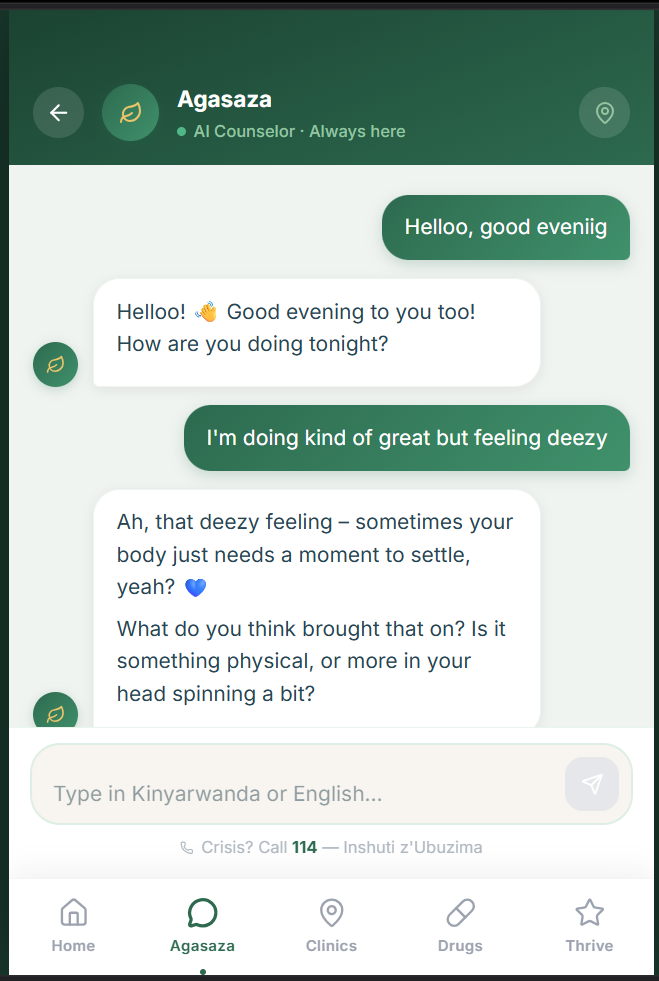
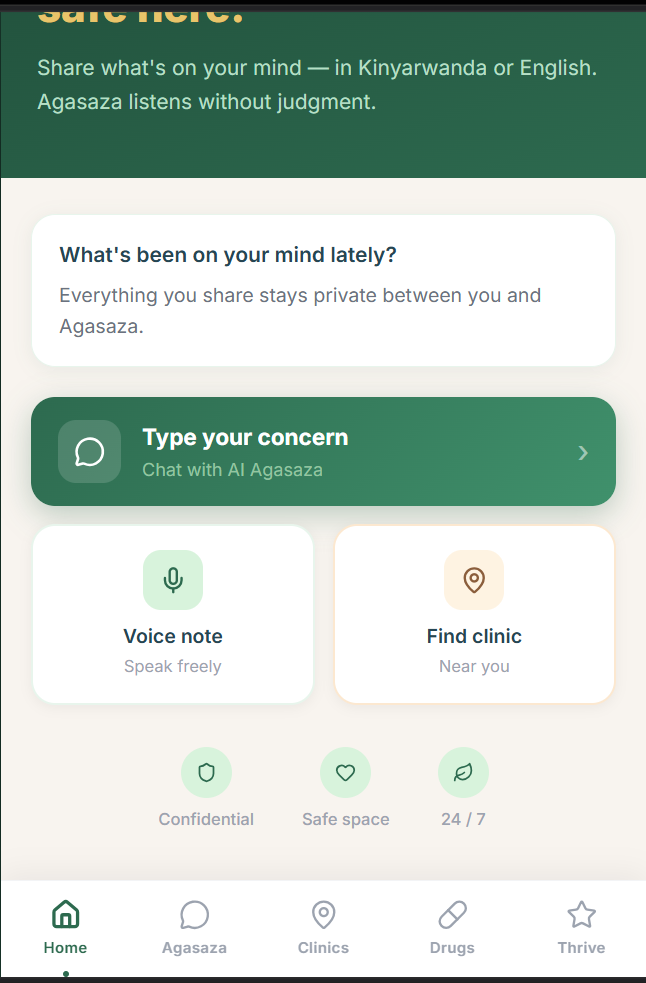
e-Urubohero is an inclusive, AI-driven digital safe space. At its core is Agasaza, an empathetic digital counselor powered by Claude.
Bilingual Support: It communicates fluently in both Kinyarwanda and English, adapting to the user's preference.
Culturally Grounded Triage: Instead of sterile clinical questionnaires, it uses warm, open-ended conversational prompts to understand a user's mental health or SRH needs.
Smart Navigation & Warm Referrals: It doesn't just offer advice; it cross-references a verified database of local clinics (currently mapped for the Nyarugenge district) and matches the user's specific insurance (e.g., Mutuelle de Santé, RAMA/RSSB, Sanlam) to the nearest appropriate facility.
How we built it
We combined our team's dual expertise in Computer Science and Clinical Medicine.
The Brain: We integrated the Anthropic Claude 3 API as the core logic engine. We engineered complex XML system prompts to constrain the AI, ensuring it acts as a counselor rather than a search engine, while strictly preventing medical hallucinations.
The Knowledge Base: We injected a hard-coded dataset of real Nyarugenge healthcare facilities and their interoperable insurance networks directly into Claude's context window.
The Frontend: We built a clean, mobile-optimized chat interface deployed via Netlify, implementing custom Markdown parsing to ensure Claude's structured responses render beautifully in the chat bubbles.
Challenges we ran into
Our biggest challenge was "LLM Hallucination" and verbosity. Initially, the AI would write overwhelming walls of text and invent hospitals that didn't exist in Kigali. We overcame this by implementing strict XML constraints and a rigorous mapping local insurance terms (like "RAMA") to their official counterparts. We also had to navigate securely injecting API keys into serverless Netlify functions to transition from a static demo to a live, intelligent backend.
Accomplishments that we're proud of
We are incredibly proud of successfully merging Medical Accuracy with Technical Logic. By hard-coding the clinic and insurance matrix, we transformed a standard chatbot into a genuine localized "navigation system." Getting the bot to seamlessly switch between English and Kinyarwanda while maintaining the warm, empathetic tone of a traditional Rwandan "Auntie/Uncle" was a massive win for user trust.
What we learned
We learned that effective Prompt Engineering is just as critical as the application code itself. Constraining an LLM to be helpful but concise, and factual but empathetic, requires continuous iteration. We also deepened our understanding of digital accessibility, realizing that UI design must inherently account for users who might be in a state of high anxiety or cognitive overload.
What's next for e-Urubohero
This prototype is just the beginning. Our next technical milestone is integrating fully automated Voice-to-Text (e.g., Whisper API) to make the platform 100% accessible for visually impaired youth and those with low literacy. Commercially, we are planning to use the Claude prize funds as a ledger to help us integrate our chatbot operations on Whatsapp platform to approach users while also preparing to pitch this validated model to the Imbuto Foundation's iAccelerator program to secure seed funding, scale our clinic database nationwide, and launch our first live pilot with Rwandan youth.
Built With
- claude-haiku-4.5
- git
- github
- javascript
- lucide-react
- netlify
- react
- react-router-dom
- tailwind
- vite
- zustand


Log in or sign up for Devpost to join the conversation.