-
-
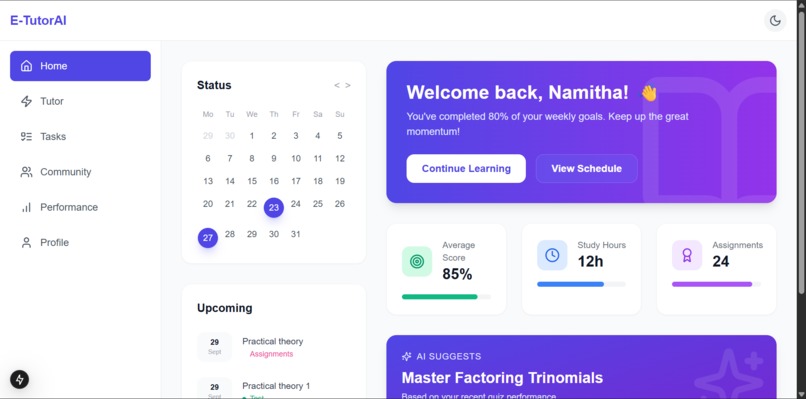
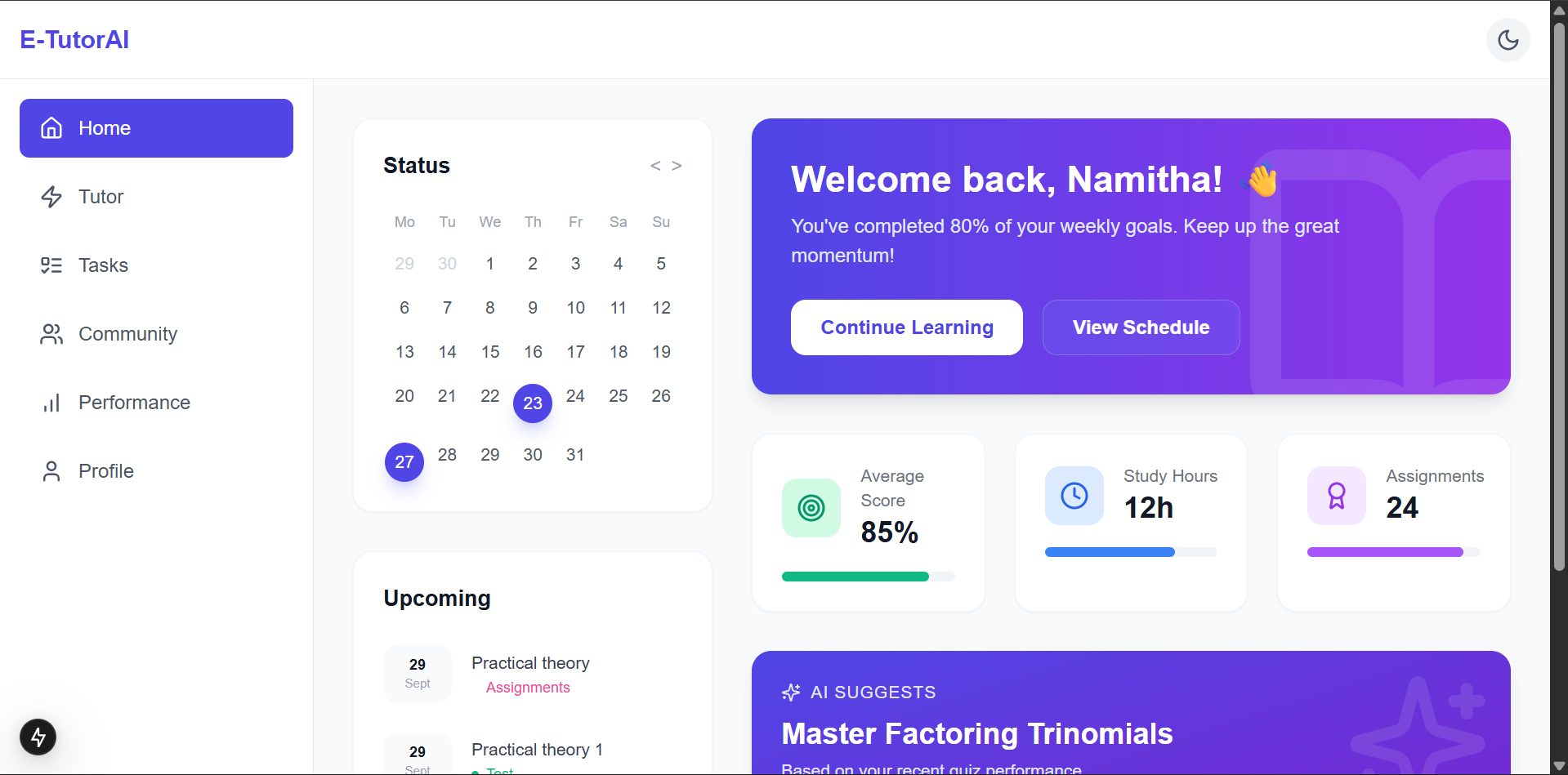
Student Dashboard
-
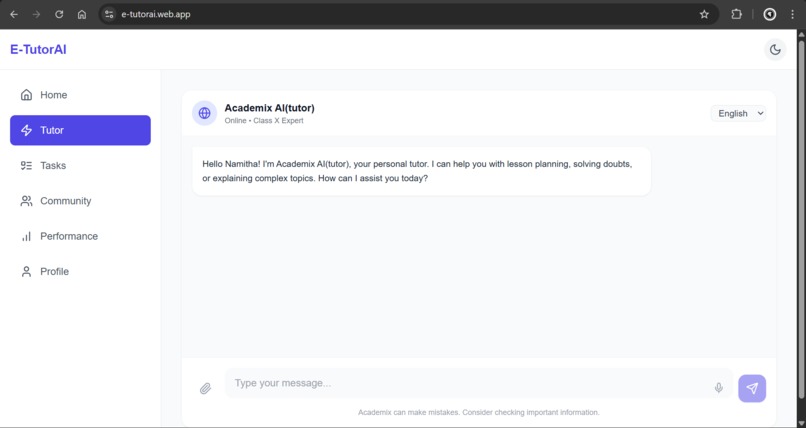
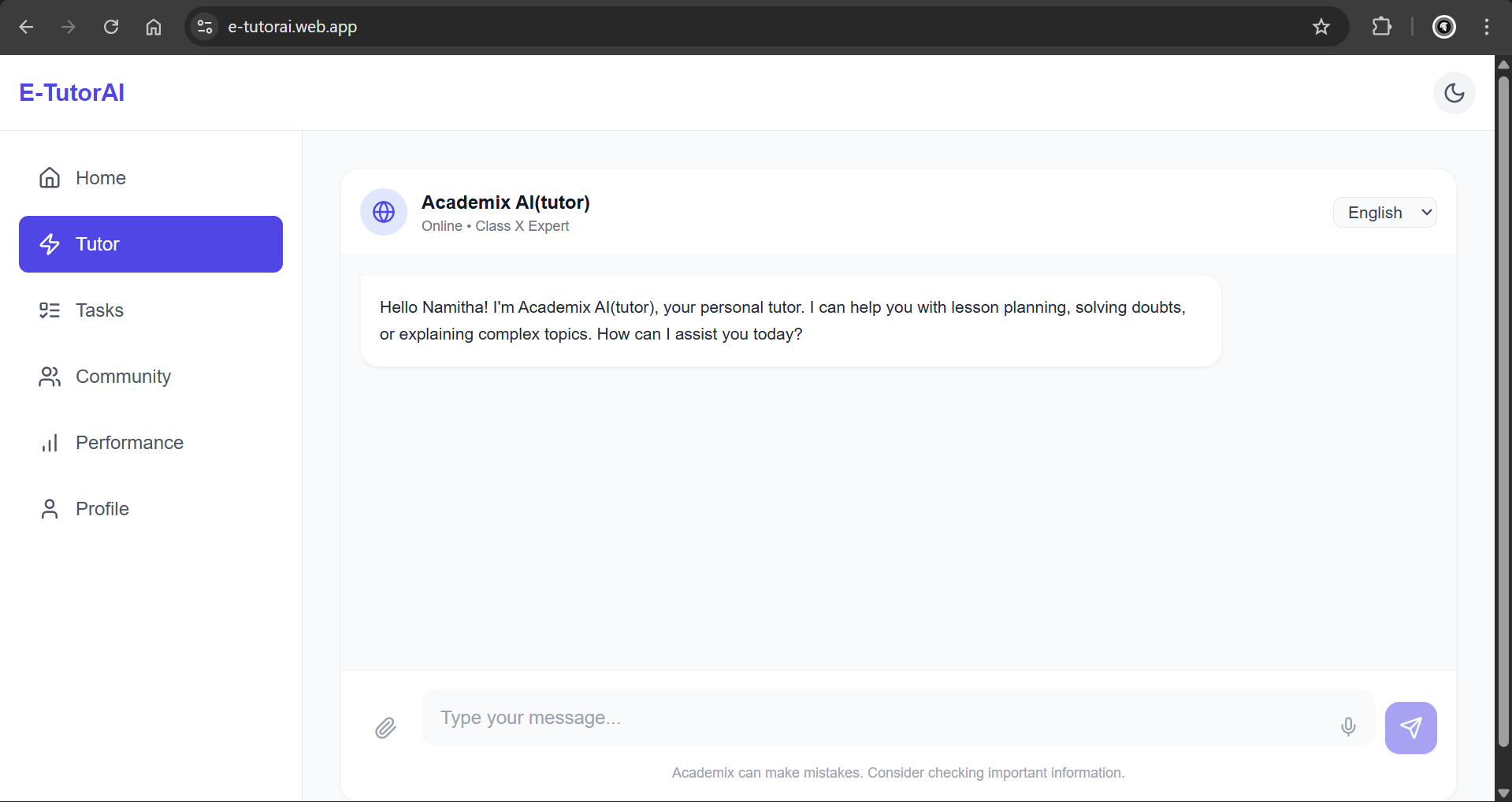
Personalised AI tutor
-
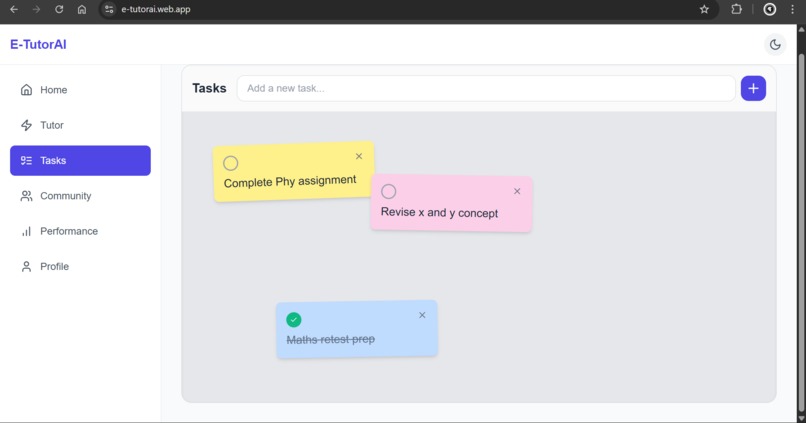
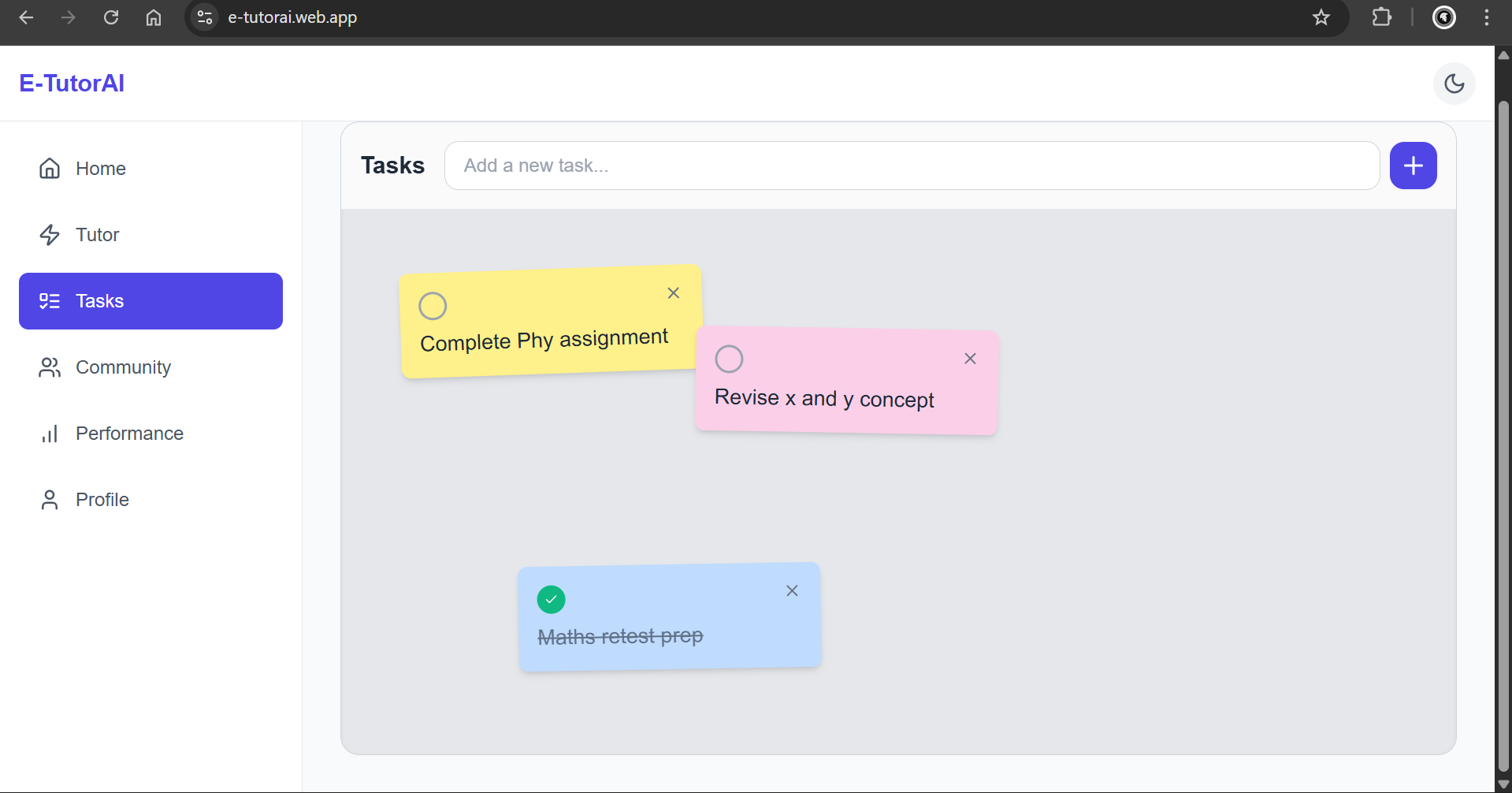
Interactive Task Manager
-
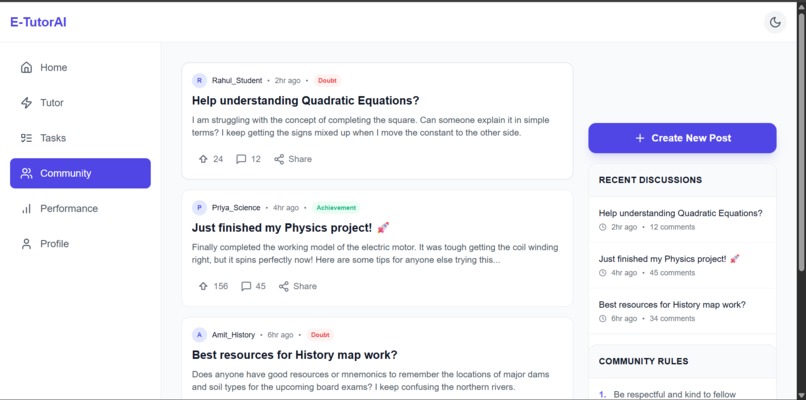
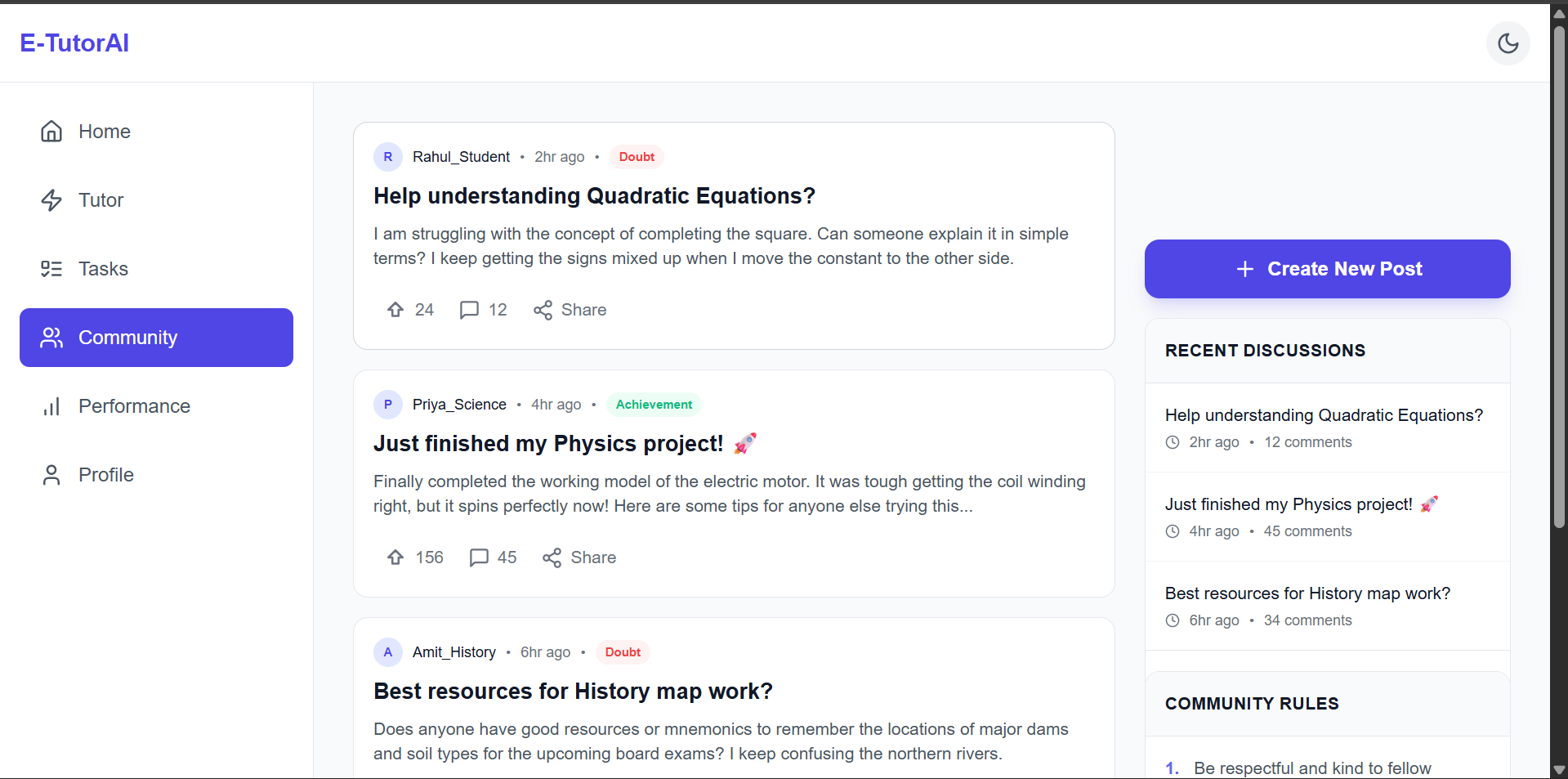
Student + Teacher Community for Collaborative Learning
-
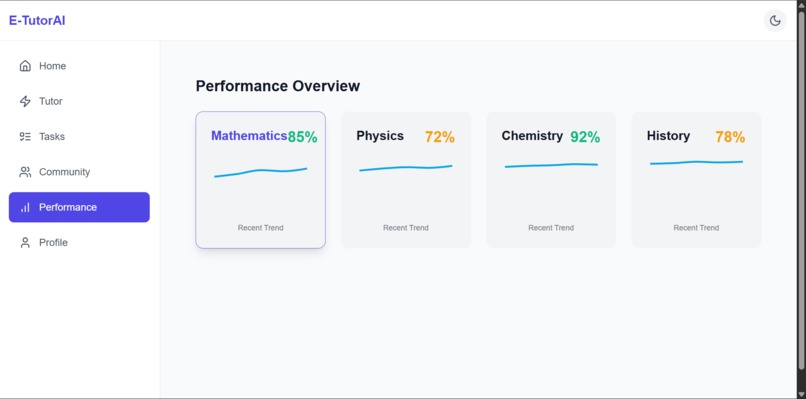
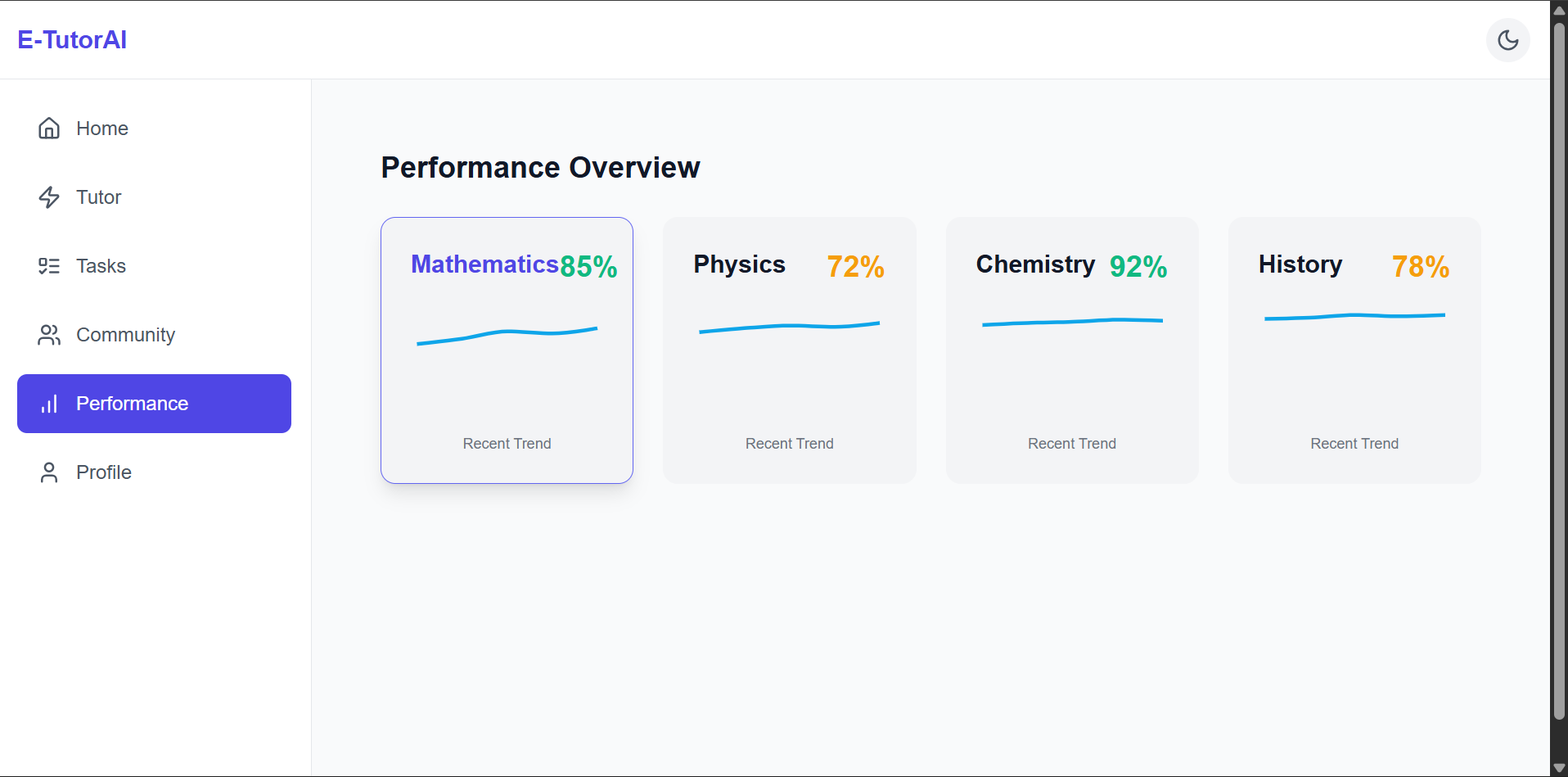
Personalised Performance Tracker with AI based Insights
-
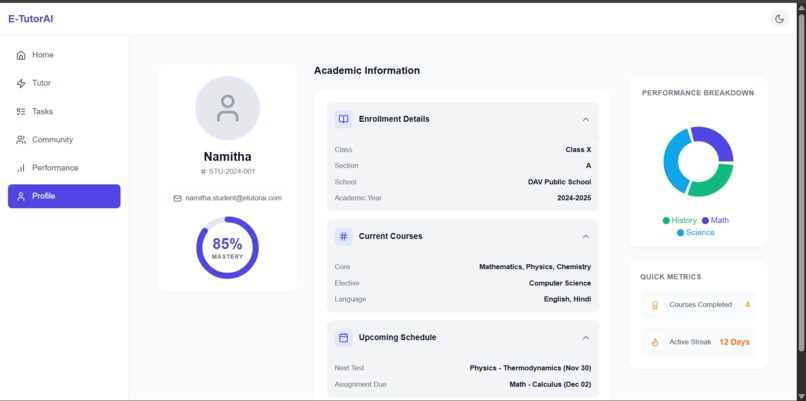
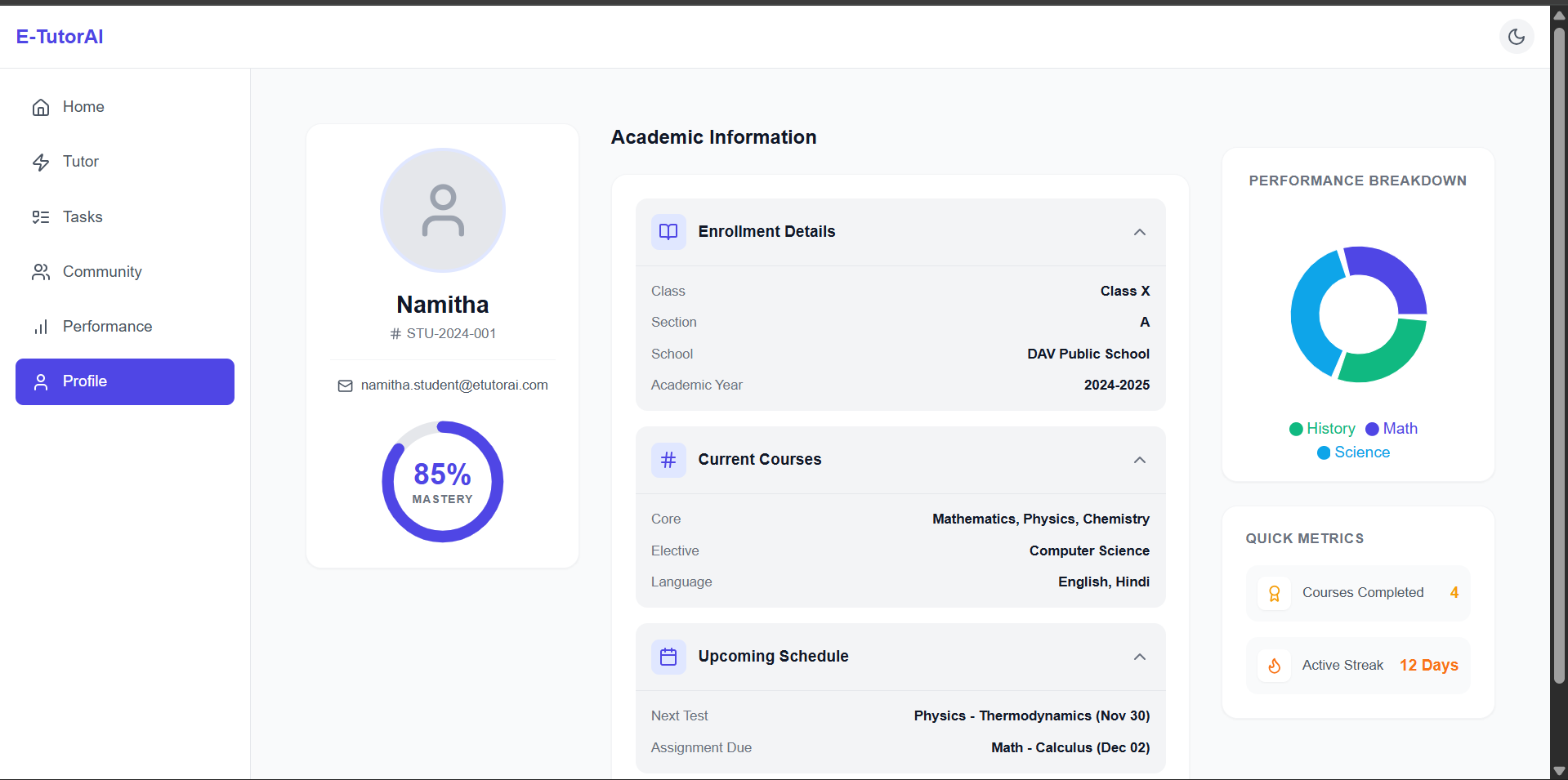
User Profile
E-TutorAI: The Future of Personalized Learning Inspiration Our inspiration stems directly from the global challenge of educational inequality and teacher shortages. In schools with limited access to subject-matter experts, students often lack the personalized, one-on-one attention necessary for mastery. We were driven to create a scalable, accessible solution that acts as a perpetual teaching assistant. The goal was to pivot from generic chatbots to an adaptive platform that doesn't just answer questions, but actively diagnoses weak areas and generates remediation before the student falls behind, fundamentally supplementing traditional teaching resources.
What it does E-TutorAI acts as a multimodal, personalized academic companion delivered through a responsive web application. It performs four critical functions:
Socratic Tutoring: Provides homework and doubt resolution using a Socratic method, forcing students to work toward the answer rather than receiving it directly.
Weakness Diagnosis: Analyzes mock test scores and chat history, using AI logic to pinpoint the student’s weakest concepts (e.g., "Linear Equations") and generates immediate, actionable feedback.
Personalized Curriculum: Uses the identified weakness and the student’s profile data to dynamically generate structured, personalized lesson plans.
Collaborative Environment: Features a Reddit-style Community Forum for peer-to-peer discussion and a Sticky Note Task Manager to promote organization and productivity.
How we built it We focused on a clean, dynamic, and state-driven architecture to rapidly prototype this feature-rich MVP. The frontend is built using React with Tailwind CSS for a responsive, light-dominant UI/UX. The intelligence layer is powered by the Gemini 2.5 Flash model, which handles the complex tasks of Socratic dialogue, multilingual chat, and performance analysis. Crucially, the deployment uses Next.js SSR (Server-Side Rendering) via Firebase App Hosting (leveraging the Blaze plan) to securely proxy the API key, ensuring all dynamic AI features run securely without exposing credentials on the client side. We utilized internal client-side state management for the entire application, simulating a single-page app with full routing (/tutor, /tasks, /performance).
Challenges we ran into The primary challenge was managing the conflicting version requirements in the dependency ecosystem. Integrating third-party components that did not yet fully support the bleeding-edge React 19 Release Candidate used by Next.js caused persistent build errors (ERESOLVE errors related to libraries like Recharts). This forced us to shift development time from adding features to implementing dependency workaround strategies, ultimately requiring the removal of incompatible components and relying on resilient native techniques. Furthermore, correctly configuring Firebase App Hosting to deploy the dynamic Next.js server logic proved tricky, necessitating the switch from static export to the SSR model for secure API key management.
Accomplishments that we're proud of We are most proud of:
AI Integration and Security: Successfully implementing a robust, secure server-side proxy for the AI calls, completely shielding the API key while maintaining high performance.
Unified Experience: Designing and implementing complex UI features like the drag-and-drop Sticky Note Manager and the Reddit-style Community Feed—all within a cohesive, single-file application architecture.
Core Value Delivery: The Performance Analysis page successfully converts abstract mock data (test scores/weak spots) into actionable, personalized directives, delivering the core value proposition of an adaptive tutor system.
What we learned We learned that when building full-stack dynamic applications for modern frameworks:
Dependency Stability is Paramount: Relying on the absolute latest features (like React RCs) introduces severe build overhead, and developers must be ready to implement advanced dependency resolution (like npm overrides) or switch to more stable libraries.
Security Requires Server-Side Logic: Client-side-only deployments are fundamentally insecure for API keys, confirming that SSR/Serverless Functions are essential for any production-ready AI feature, regardless of the API's free tier status.
Figma/Design-First Focus Pays Off: The early commitment to a strict color palette and responsive layout simplified the Tailwind CSS development phase tremendously, allowing for extremely fast implementation of complex UI features.
What's next for E-TutorAI: The Future of Personalized Learning The next steps focus on connecting the prototype to real data and adding administrative features:
Live Teacher Dashboard: Building out the /admin view with live charts and data from mock student usage patterns (tracking common search topics, time spent, and overall engagement).
Curriculum Grounding Integration: Fully integrating the RAG Uploader feature by creating a Cloud Function endpoint that would simulate chunking and vectorizing teacher-uploaded documents, enabling the AI to answer questions specific to the school's curriculum.
Gamification: Implementing visual reward systems, mastery badges (visible on the /profile page), and leaderboards to further increase student motivation and sustained engagement.

Log in or sign up for Devpost to join the conversation.