Inspiration
The inspiration behind Symptom Searcher stemmed from a common dilemma: navigating health symptoms online often leads to overwhelming or generic search results that can be difficult to process during a moment of health concern. With the rising popularity and usefulness of Artificial Intelligence (AI), I chose to implement that technology as a core part of the program; I envisioned an intelligent companion alongside a summarizing engine that computes real-time probabilities and pathways right alongside the conversation.
What it does
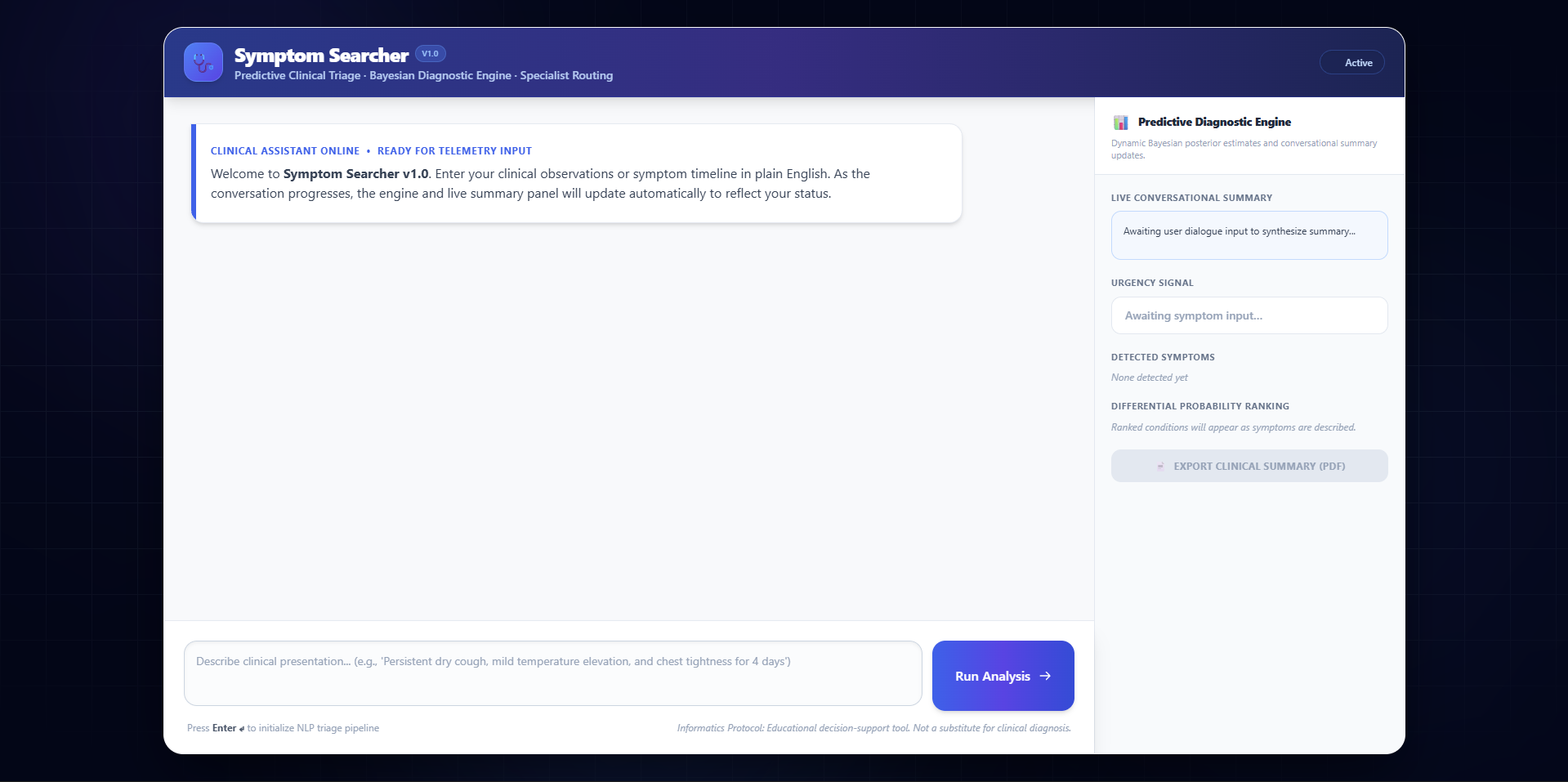
Symptom Searcher is an Clinical AI Navigator and predictive platform.
- Interactive Conversational Triage: It acts as a professional medical navigation assistant that asks targeted follow-up questions, evaluates symptoms, and recommends medical specialties. It does not serve as a replacement for a professional diagnosis, rather, an aid before you get a professional diagnosis.,
- Dynamic Bayesian Diagnostic Engine: Running concurrently with the chat, a dedicated informatics layer processes inputs, isolates symptoms using a clinical lexicon, and computes symptom likelihood percentages across a differential of conditions.
- Live Conversational Summary: The engine maintains and dynamically updates a real-time summary sidebar that tracks the patient's symptoms as dialogue evolves.
- Visual PDF Clinical Report Export: Users can instantly generate and save a comprehensive PDF summary containing the live summary, urgency assessment, detected symptom matrix, condition ranking bars, and the AI's final clinical recommendations.
How I built it
I built Symptom Searcher using a clean, modern web architecture with the help of AI:
- Frontend Layer: Styled with Tailwind CSS, featuring custom animations, a split-pane diagnostic dashboard, and a print-optimized PDF reporting template.
- Informatics Core (
engine.js): A custom JavaScript Bayesian decision-support engine. It categorizes conditions into Tier 1 (literature-backed likelihood ratios from published clinical prediction rules like Centor/McIsaac and CPSS) and Tier 2 (CDC/NIH-backed base rates with heuristic updates). - AI Integration: Integrated via a secure backend endpoint with strict system prompts, dual symptom extraction parsing (scanning both user input and AI replies), and a system-message context injection loop that passes the engine's real-time differential to the language model. The program was specifically integrated with OpenRouter. In addition, AI played a big role in the construction of this project as a useful tool to help support a programming beginner.
Challenges I ran into
- Synchronizing AI & Engine State: Ensuring that symptoms confirmed by the AI during conversation (not just those typed by the user) were automatically captured and factored into the engine required building a bilingual extraction pipeline.
- Print Layout & PDF Generation: Achieving a clean PDF export without relying on heavy external libraries meant designing a hidden print-ready DOM template styled with inline CSS and browser media queries for flawless output.
- Scope Guardrails: Crafting strict system instructions to keep the AI rigidly focused on medical symptom assessment while rejecting prompt injections and out-of-scope queries.
Accomplishments that I'm proud of
- Successfully bridging the gap between probabilistic clinical computing (Bayesian inference) and natural language generation.
- Designing a polished, production-ready interface complete with live probability bars, color-coded urgency signals, and a useful PDF export template.
What I learned
- Transparency Builds Trust: In health tech, exposing why a condition is ranked high (via cited likelihood ratios and tier badges) makes decision-support tools vastly more credible and educational.
- AI is the Future: With how useful AI has been for this project, I've realized that it has so many more opportunities for growth and massive scalability.
What's next for Symptom Searcher
- Expanded Medical Lexicon: Scaling up the condition library to cover a broader amount of pediatric, dermatological, and orthopedic presentations. Right now, time is pretty limited so I can't train the model on a large amount of information; I'd love to grow its library in the future.
- Electronic Health Record (EHR) Interoperability: Enhancing the export pipeline to generate fully compliant FHIR (Fast Healthcare Interoperability Resources) PDF reports for clinical use. Right now, the reports are pretty strong, but I'd love to polish and include more detail.
- Multilingual Support: Translating triage pathways and symptom dictionaries to serve diverse patient populations globally.
Built With
- ai
- antigravity
- claude
- gemini

Log in or sign up for Devpost to join the conversation.