Inspiration
All of us drive cars to and from class, and to get groceries/coffee in the morning. We wanted to develop an app that users can implement to get information about their carbon emissions as well as their driving habits. Having this data easily accessible by users will allow people to be more conscious about driving habits and hopefully work to reduce driving emissions.
What it does
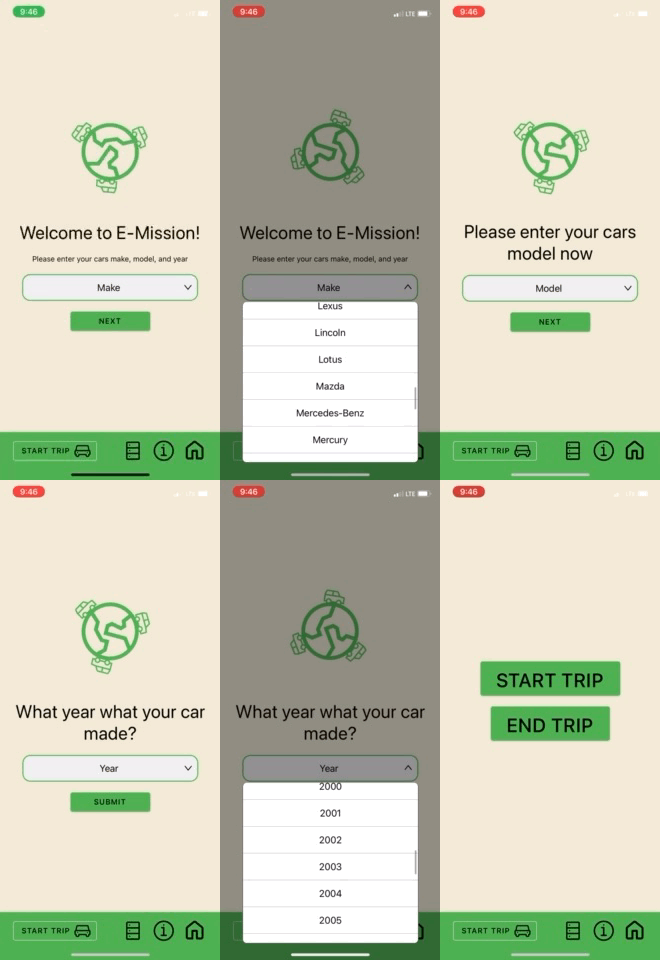
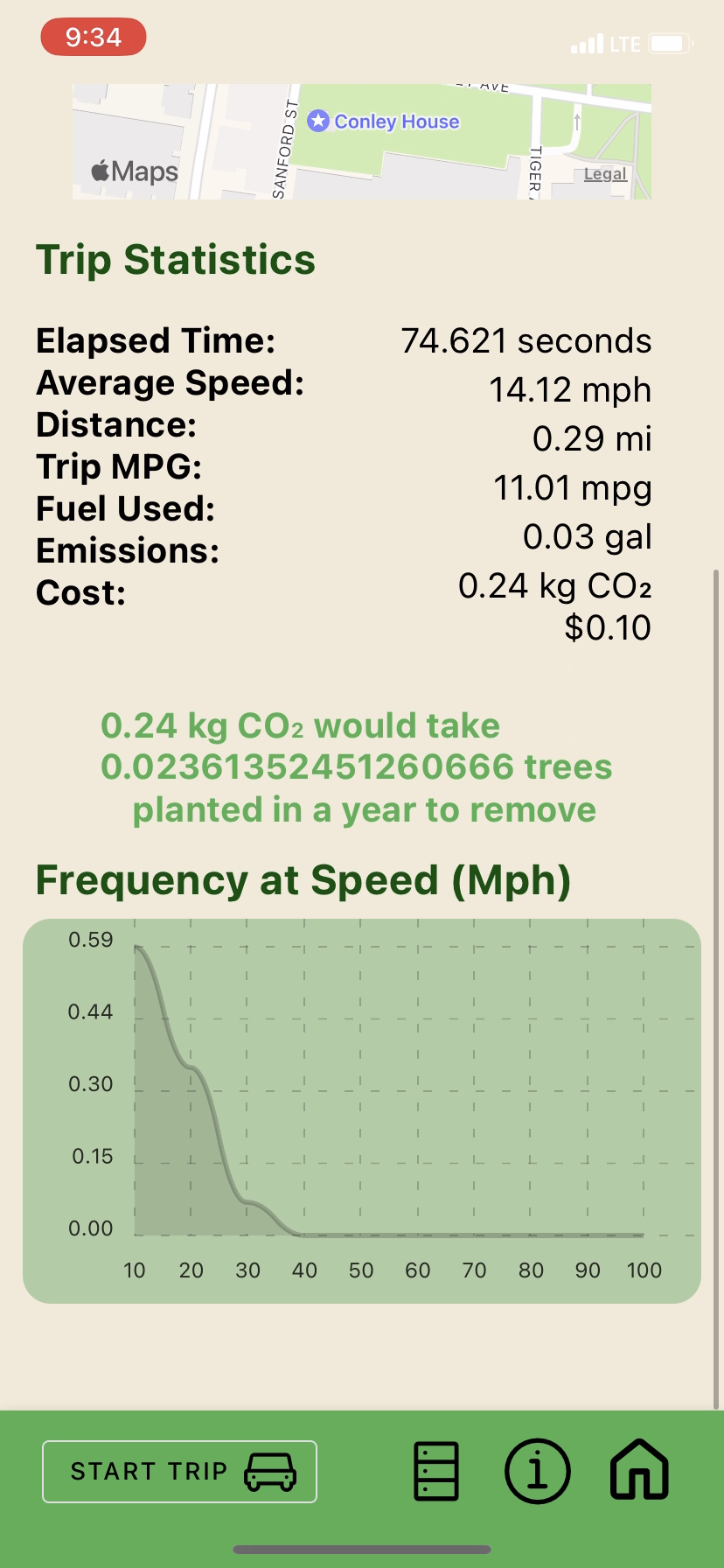
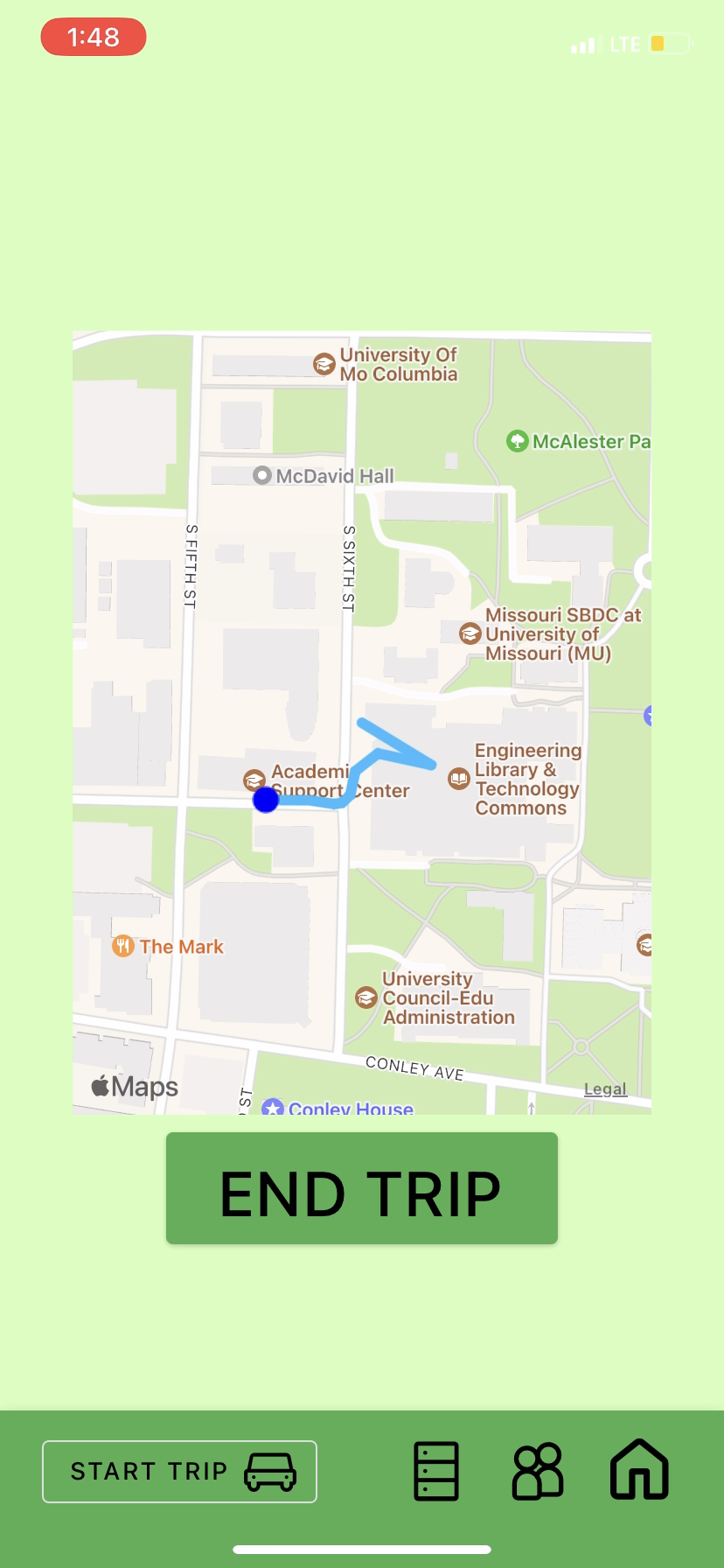
The app first allows you to enter their car’s make, model, and year. By querying the EPA’s car database this provides the app with the car’s average mpg and other important statistics like fuel type and economy. Once you have entered your car’s information the app will redirect you to a screen that allows you to start and stop a trip. After clicking start the app will begin tracking your current speed, location, and acceleration. Once you have arrived at your final destination, click stop and the app will automatically calculate and display important statistics about the drive. These statistics vary on the driving habits of the driver during the trip, and calculate a specific mpg for each trip. One of these being a measure of how many trees you would need to plant to offset the trips CO2 emissions. After this you can navigate to the trip logs screen which stores and updates a live feed of all your trips that you have completed and their length, average mpg, and CO2 emitted.
How we built it
We used a react native front-end and a python tornado server hosting a mySQL server. In the python tornado server we were able to create our own API endpoints that call upon the EPA’s database endpoint to retrieve car information, as well as custom endpoints that allow us to create and store car and trip data. In the frontend we utilized a number of react-native libraries for user location tracking, frontend components, and data visualization. We include data on gas consumption based on driving speeds to get a more accurate emission calculation.
Challenges we ran into
One of the challenges we ran into was learning how to use Expo and React Native to develop our project. We had previous experience with Flask but decided the tools that come with Expo are better suited to our needs. During development there was also a number of hiccups including implementation barriers and the scope of the project which we could accomplish in the given time frame.
Accomplishments that we're proud of
Overall we are very proud of this project as a whole. Our team’s ability to create a full-stack iOS react application that has the ability to track user’s speed, location, and acceleration all while using these data points to calculate some important and impactful statistics was a real accomplishment. Our goal to drive change through raising awareness on personal vehicle emissions can be accomplished by this app which provides a user friendly, and informative experience. In the end we learned a ton about our abilities as well as our passions while making this app this past weekend.
What we learned
Throughout the development of E-Missions, we learned about how our driving patterns affect our amount of fuel use, as well as the carbon emissions released. Going into the idea we knew that things like gas mileage/car wear and tear was higher when driving in a city setting, but we had no idea that carbon emissions on shorter trips were so high. From a technical standpoint we each had our specialities but found ways to learn new components, frameworks, and how to develop as a team in a short period of time. TigerHacks taught us how to balance fun, focus, and friendship to produce an app we are all proud of and excited about.
What's next for E-Mission
One of the next steps for E-Mission is to include a social aspect to the app that will allow users to compete in decreasing carbon emissions against others. We believe that the social aspect will give people another incentive to spend more time learning about their emission usage. By implementing user trends over periods of times such as weeks/months/years we hope to give people the ability to see their impact and change over time. We also plan on expanding the project to include adaptive learning tips based on driving habits during a trip to educate people on how to create fewer carbon emissions while driving.


Log in or sign up for Devpost to join the conversation.