-
-

Logo
-
High-Level Overview

Inspiration
Climate change is one of the biggest existential threats to humanity. We believe that blockchain technology allows us to provide transparency, accountability and incentives in order to mitigate the effects of climate change and undo much of the damage that has been done.
The E-Chain Staking Process
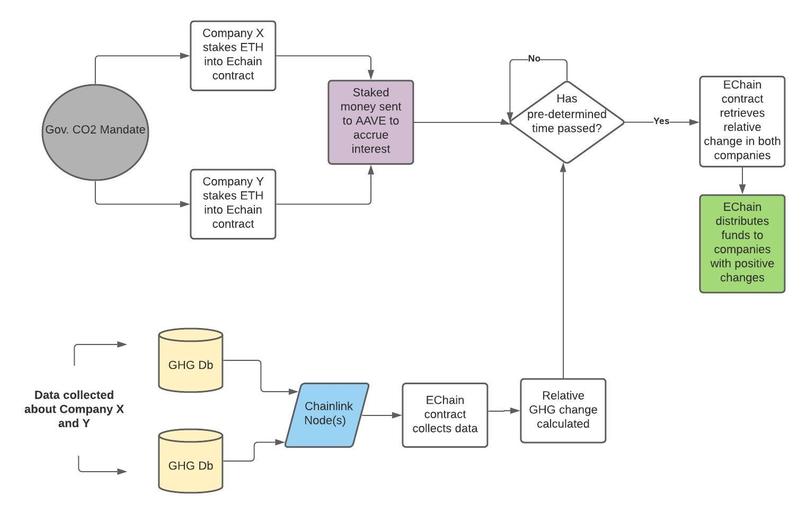
- Companies of a certain category decided by a local government, stake coins at the beginning of the Fiscal year within the E-Chain smart contract aka E-Chain GHG Pool.
- During the fiscal year, E-Chain collects air quality data from each company through sensors that gather data and loaded to the blockchain via Chainlink.
- Threshold of variables greenhouse gas emissions are set by the local municipality.
- Throughout the year, the coins staked are rewarded to or penalized from the company based on how well the company does in relation to the threshold values and in comparison with the other companies in the GHG Pool.
How we built it
We used the scaffold-eth ethereum dev stack for fast prototyping and implementation.
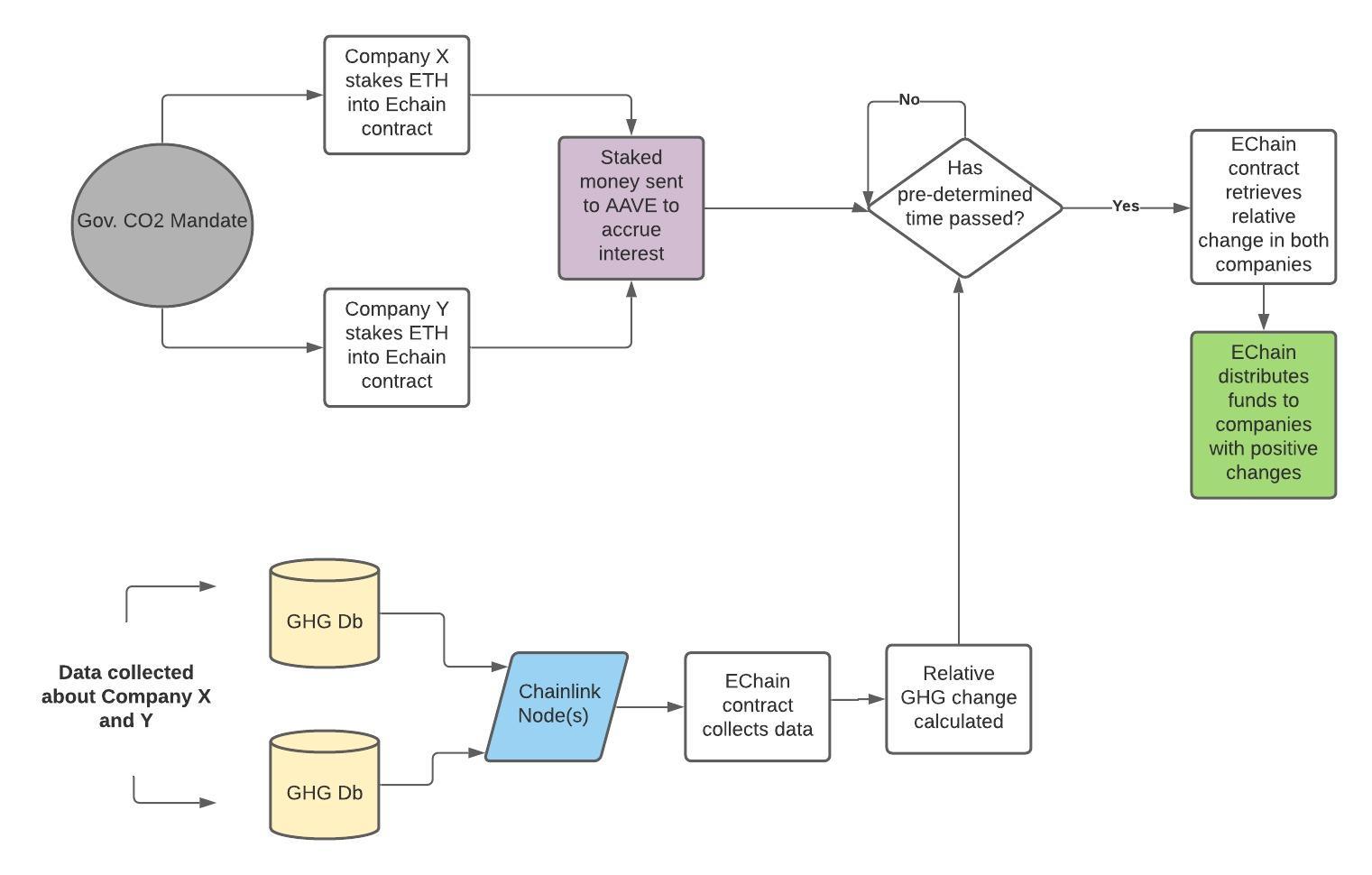
One smart contract was programmed which makes companies able to stake ETH and deposits it into Aave to mint aWETH which is send back to the smart contract. After that the smart contract can start collecting data from the companies that staked by requesting data with their external API via a chainlink node. Following that the relative change of the data was calculated. Next the average of the relative change data was taken to determine a threshold which companies are rewarded or penalized. The aWETH stakes of the penalized companies are taken and withdrawn from Aave into ETH and split between the rewarded companies.
Challenges we ran into
- Trying to find time to meet since we’re in 3 different timezones all over the world.
- Finding ways to get data for proof of concept since we didn’t have enough time to get sensors hooked up
- Overall implementation bugs in the code.
Accomplishments that we're proud of
We made something that works! And met cool people!
What we learned
-Time is of the essence! Start early, and do not leave things for the last minute. -Communicate with your team, and get on the same page. -Keep the implementation within the time scope, there are many ideas, but not enough time to implement. -Schedule meeting times and incorporate everyone, even if in differing time zones. -Ask questions to the devs and community! -If you are stuck on what idea to implement, try to reach a compromise. Implement what you can, and note your future plans!
What's next for E-Chain
Here are some of our future plans: To begin with, we want to finish up the front end implementation with React Js to make the UI a more enjoyable and simpler experience. This is key for removing the technical aspects from the UX.
Dynamic NFTS: E-Chain plans on implementing dynamic NFTs. Each organization could have a public reputation based on their carbon emissions. These NFTs would change according to the data received on chain from a Chainlink oracle. Their NFTs would indicate their emissions status, for example, "positive," "neutral," and "negative." Several studies cite three primary drivers for change in a business those are: legislative, economic, and public pressures. The NFTs would focus on the last pressure.
Governance: Afterall, because the air we breathe is a collective issue, it would make sense to allow for the collective to distribute funds obtained from a tax on what we release into the air. In order to make it fair, maintain confidentiality, and secure, ZKPs paired with Kleros PoH registry could be used to allow for verified citizens of a municipality to distribute their funds obtained from the smart contract + chainlink system. For example, if the city of Reno decides to make it their goal to reduce emissions, enable transparency, and allow for the public to decide what to do with a newly added tax, they could incorporate this idea to make it a reality. This means that the money obtained from emissions fees would be distributed by the citizens of Reno! (Those with a crypto wallet and internet connection!)
Sensor Deployment: A network of trusted sensors will need to be implemented either through E-Chain or a reputable supplier. Data tampering a bottleneck in all systems, thus having more deployments, the more distribution there is. The more reliable sensor deployments there are, the reduced the odds are of data tampering before it is sent on chain!
Built With
- aave
- chainlink
- kovan
- openweatherapi
- solidity


Log in or sign up for Devpost to join the conversation.