-
-
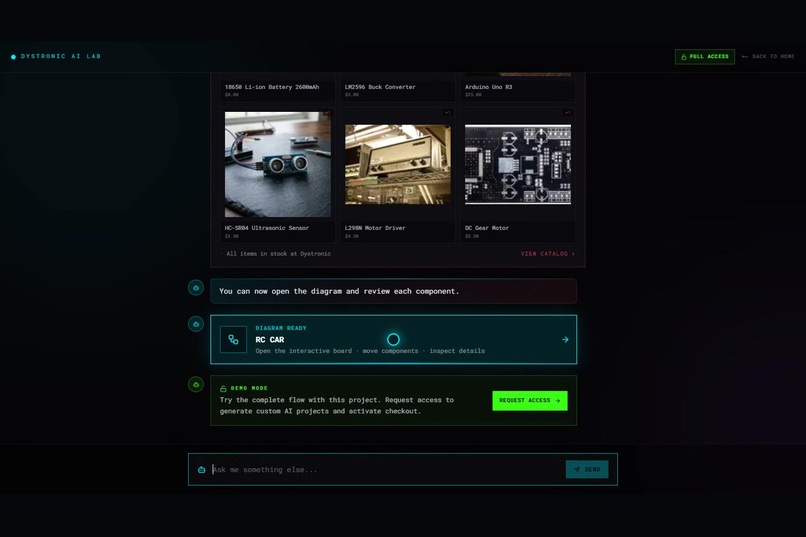
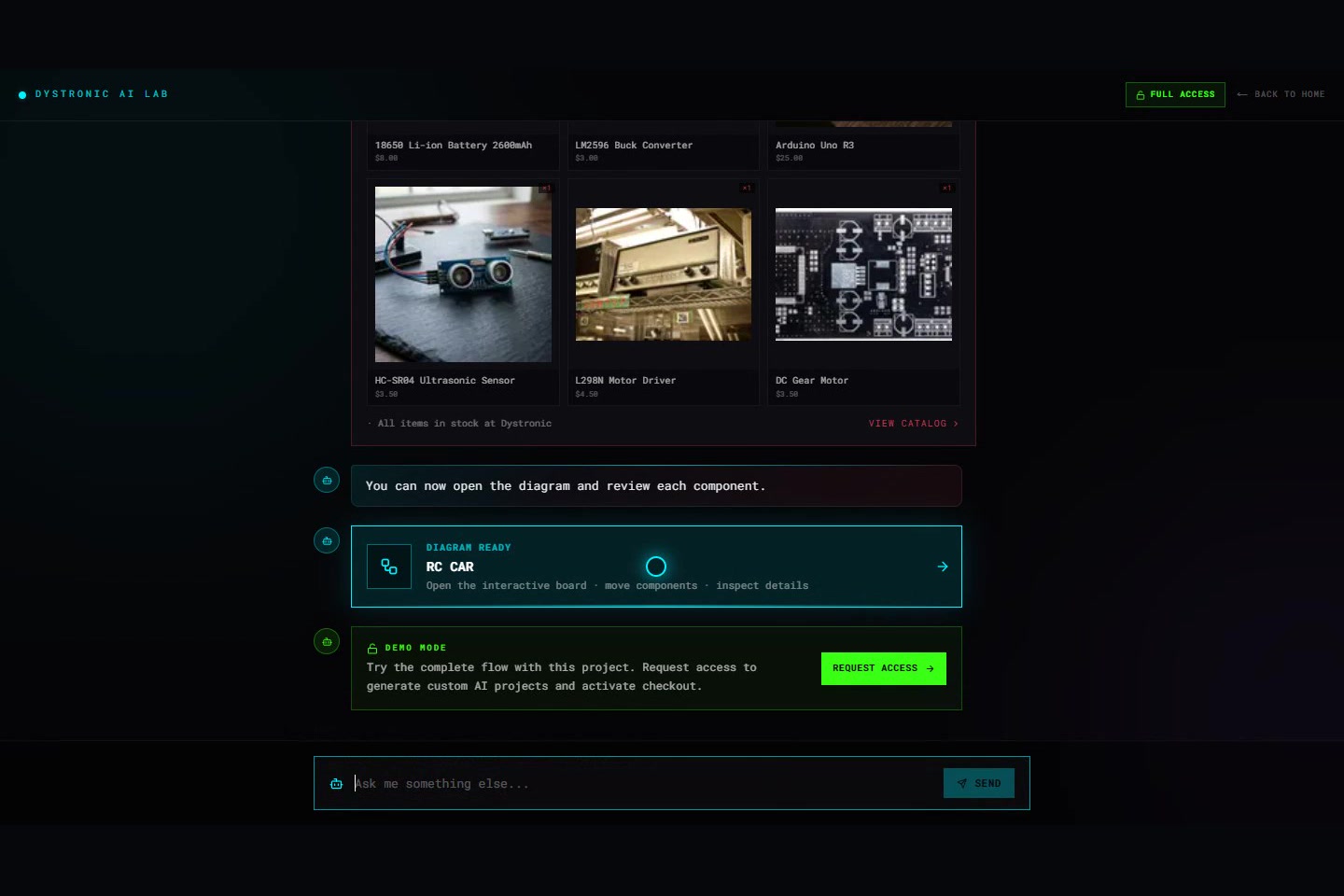
Demo Access. The public demo includes a direct path to request full AI generation, purchasing, and checkout access.
-
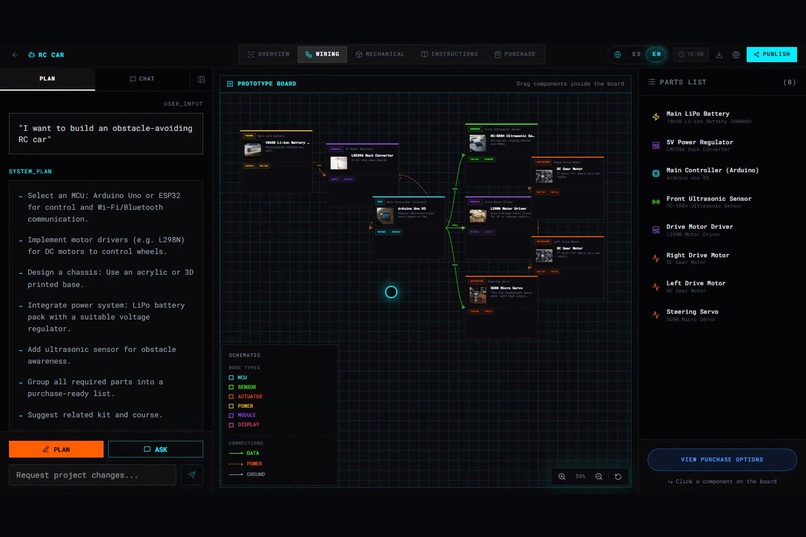
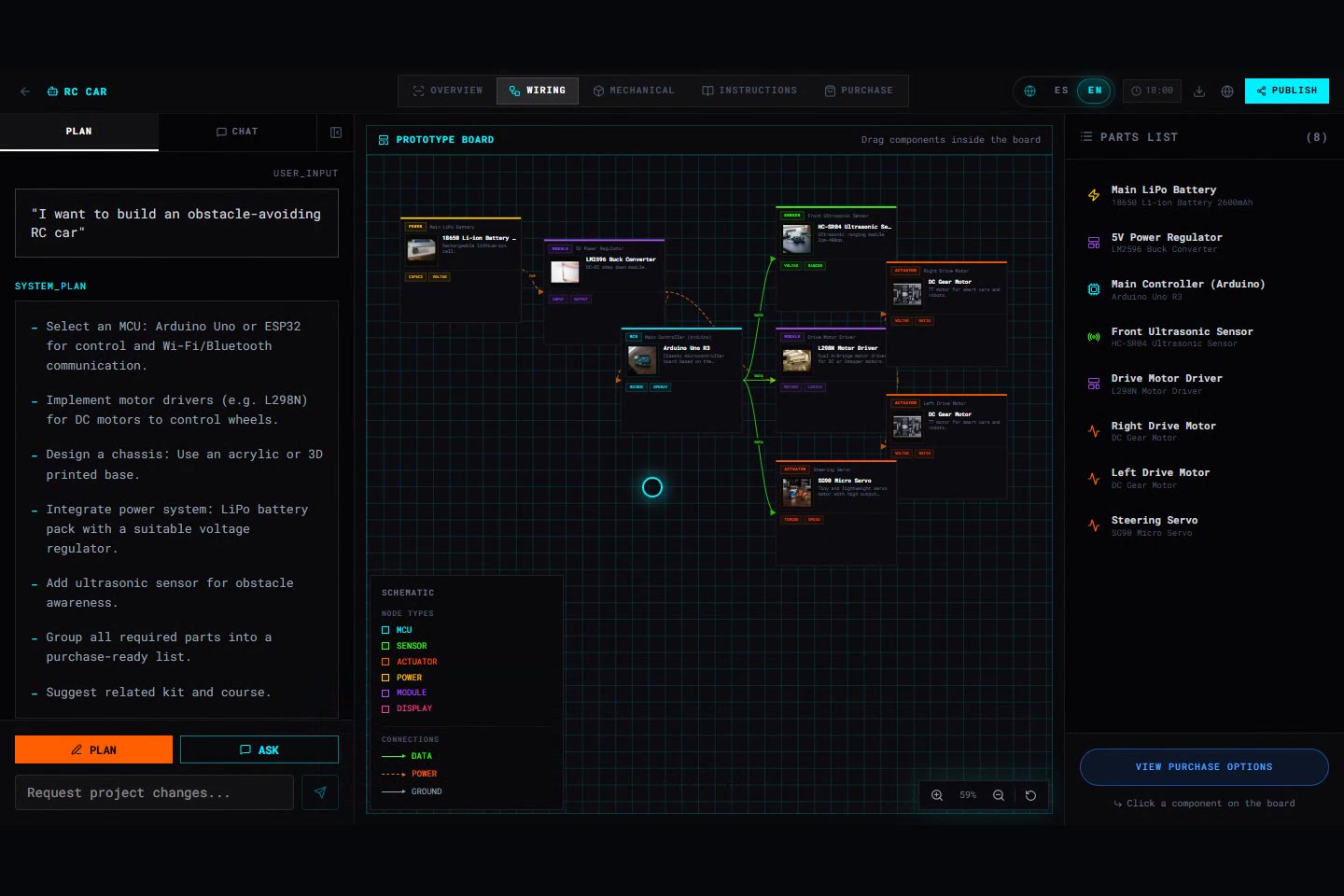
Interactive Wiring View. The interactive wiring view maps power and data connections between real catalog components.
-
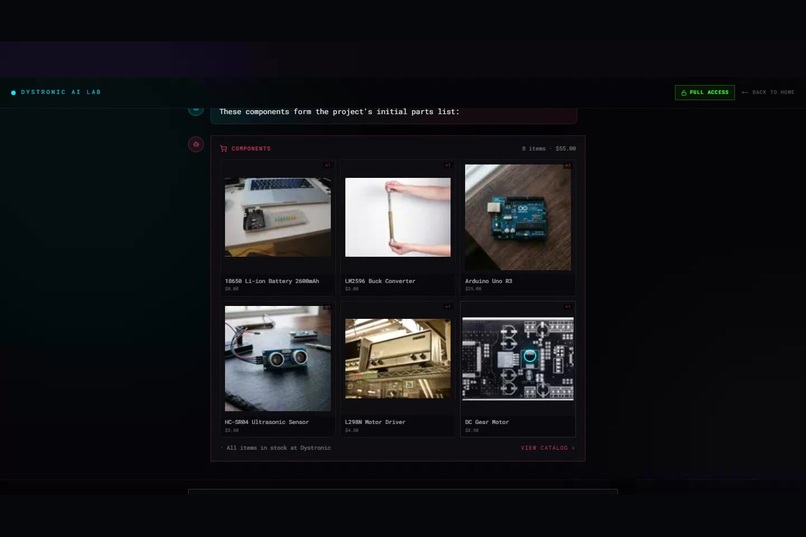
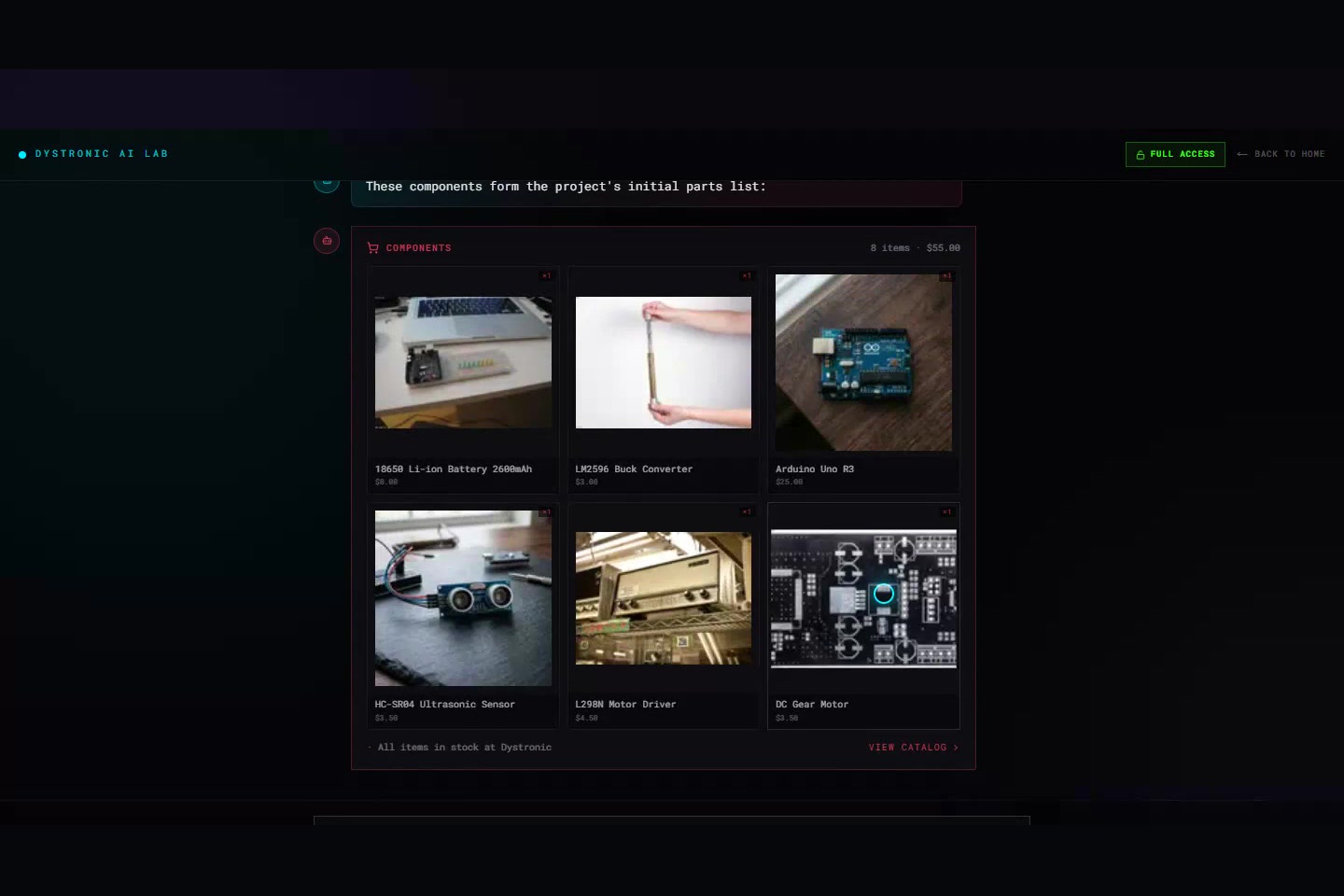
The AI Builder transforms a project idea into a structured plan with matched components, estimated cost, and an interactive prototype board.
-
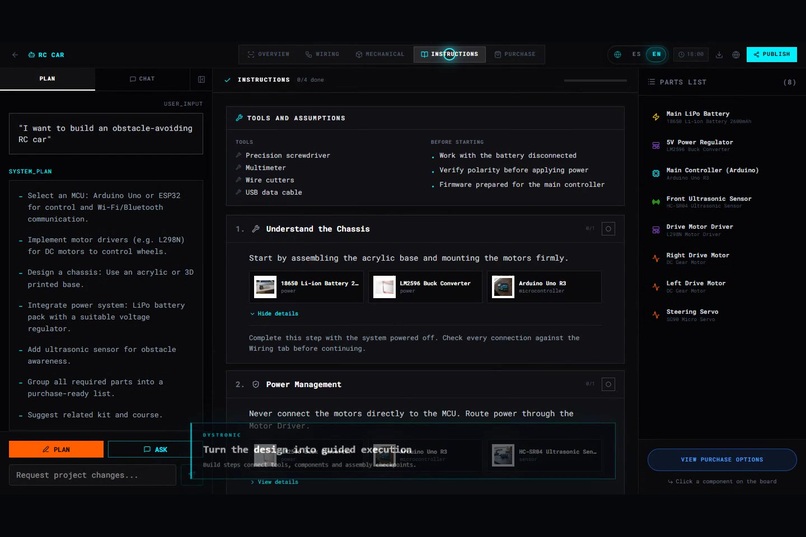
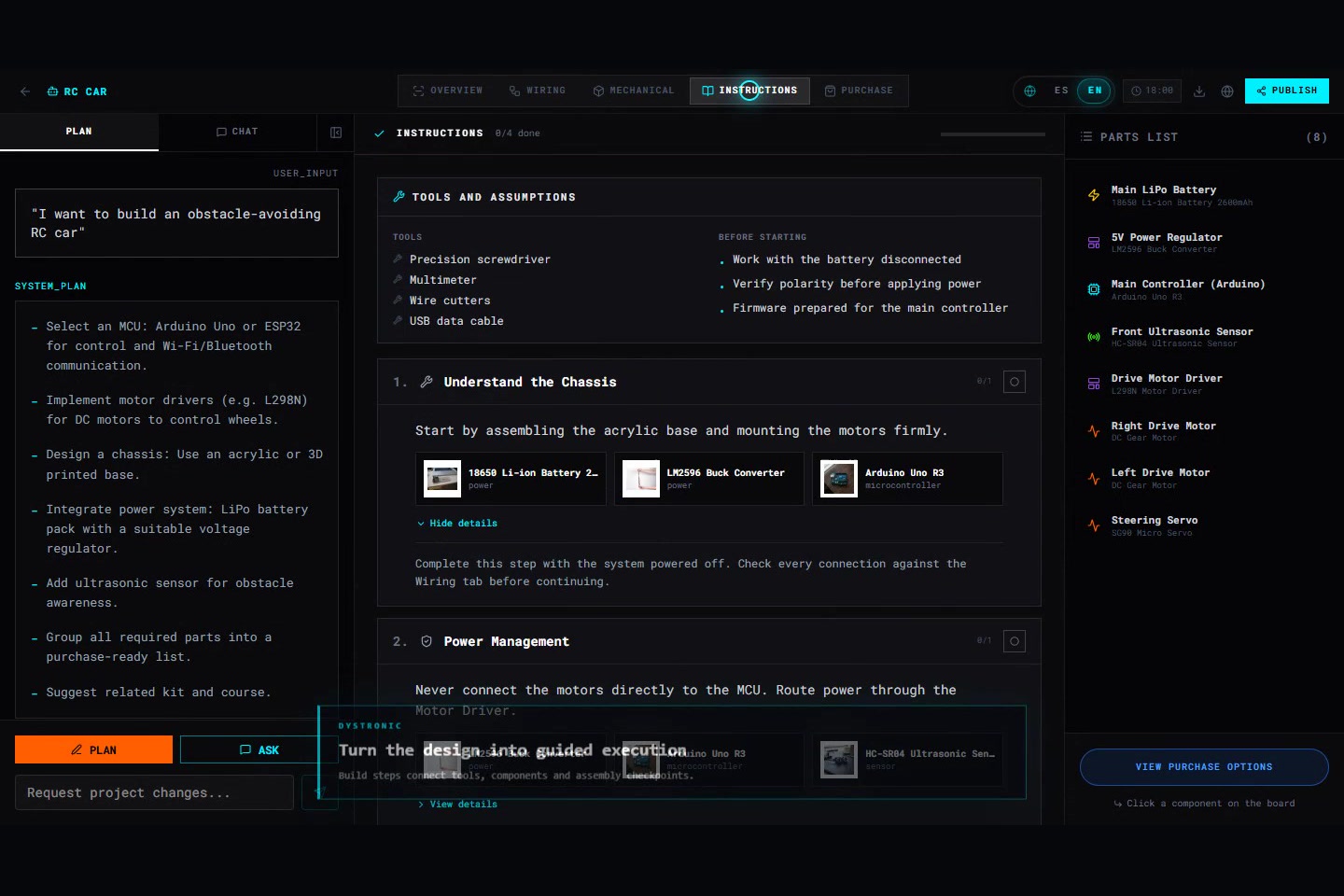
Guided Build InstructionsGuided instructions connect every build step with the required tools, safety checks, and electronic components.
-
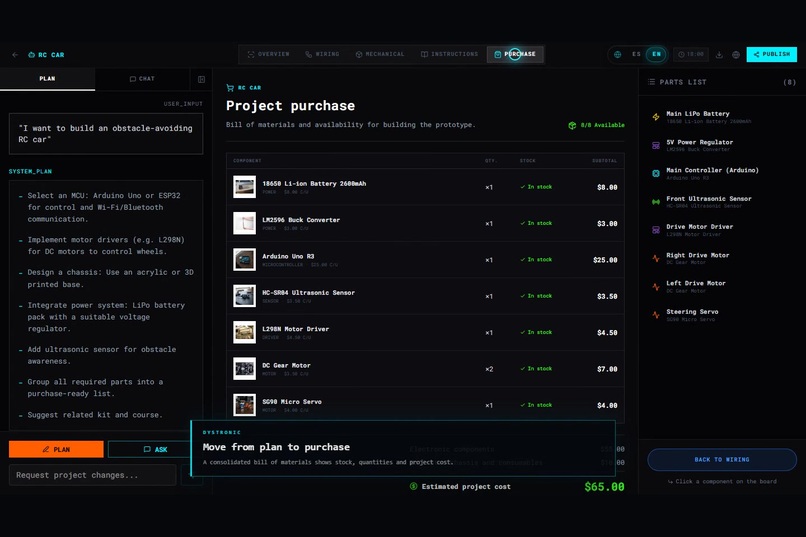
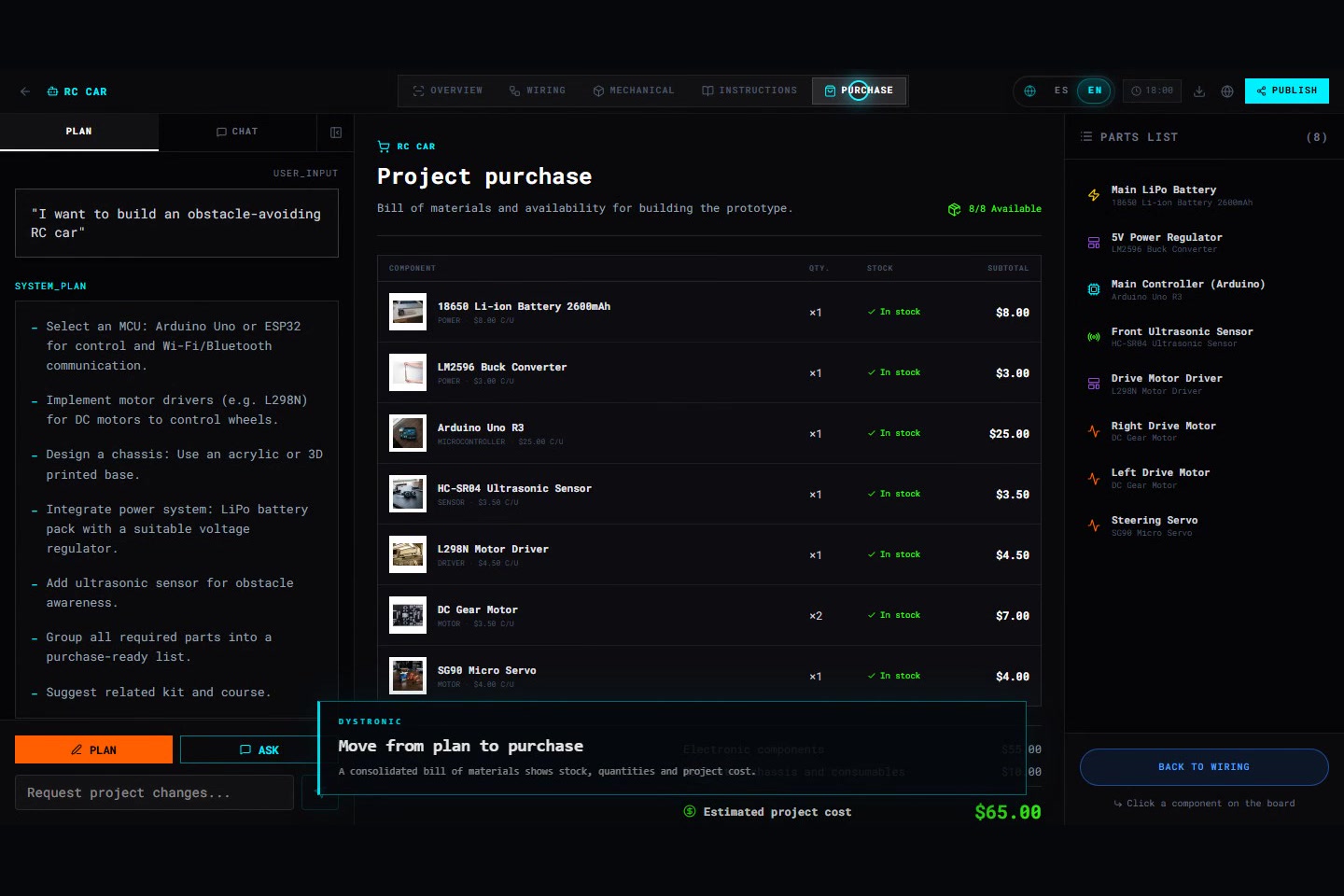
Bill of MaterialsA consolidated bill of materials shows quantities, availability, individual prices, and the estimated total project cost.
-
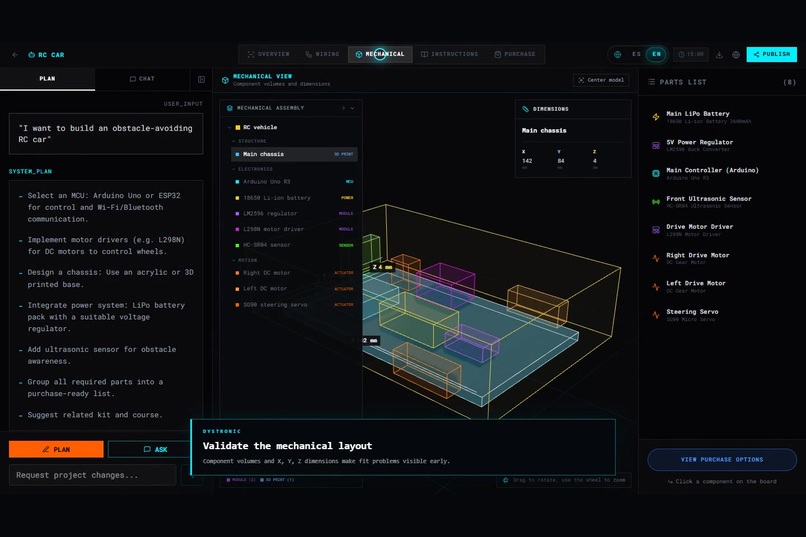
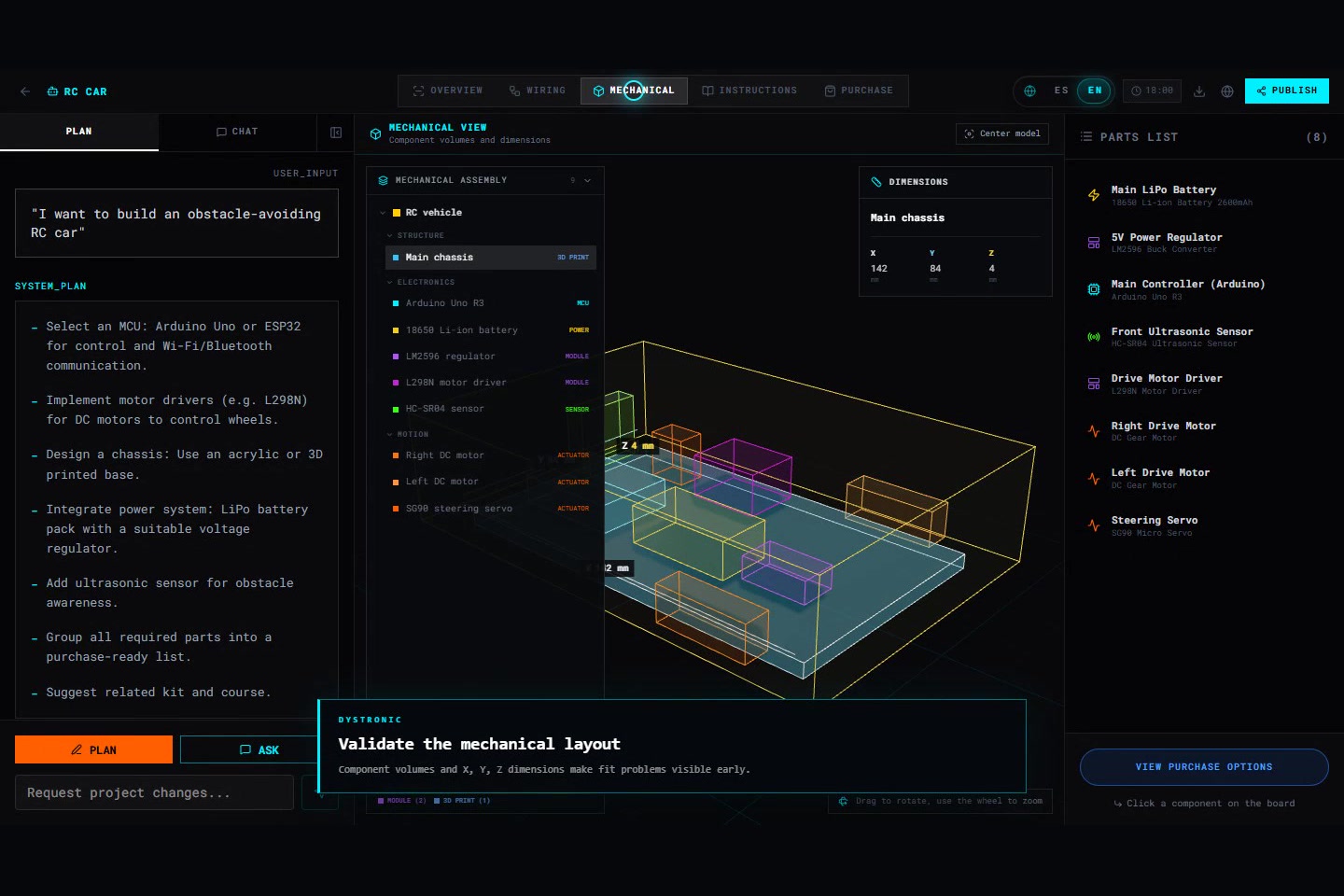
Mechanical Workspace. The mechanical workspace visualizes component placement and X, Y, and Z dimensions before physical assembly.
-
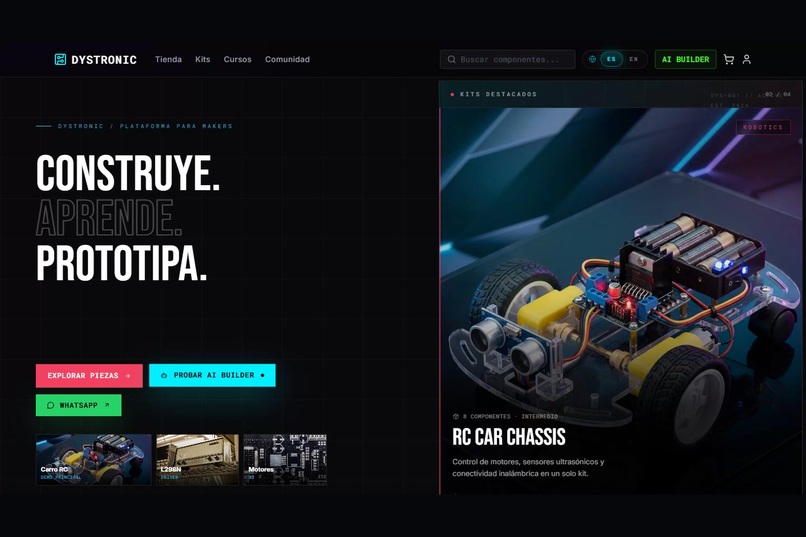
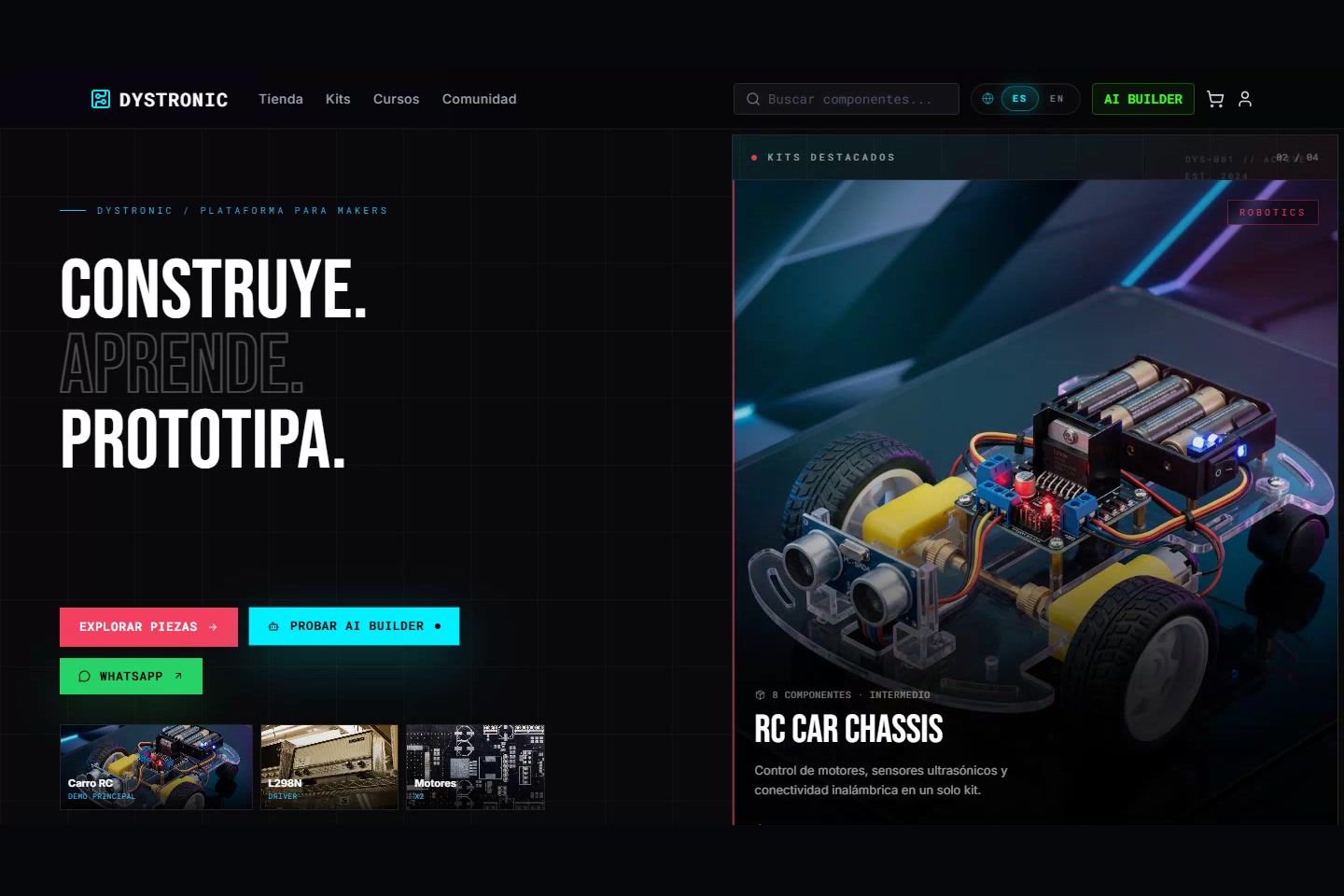
Dystronic brings electronics shopping, guided learning, and AI-assisted project planning into one maker-focused platform.
Inspiration
In the Dominican Republic, technology projects do not always stop because of a lack of talent, creativity, or ambition. Sometimes, a promising prototype is delayed by a component worth only a few dollars that cannot be found at the right time.
Students, makers, teachers, laboratories, and small engineering teams often have to search across physical stores, WhatsApp groups, informal resellers, international marketplaces, couriers, and multiple suppliers just to complete one project. Even when the components are available, users may not know whether they are compatible, whether they are paying a fair price, or how everything should be connected and programmed.
What should be a creative engineering process becomes a fragmented and uncertain journey.
Dystronic was inspired by this reality. We asked a simple question:
What if a person could describe what they want to build and receive everything needed to turn that idea into a real, build-ready project?
Although Dystronic begins with a problem we experience directly in the Dominican Republic, fragmented hardware sourcing and limited technical guidance affect students, makers, educators, and innovators across emerging markets worldwide.
What it does
Dystronic is an AI-powered platform that transforms hardware ideas into structured, build-ready projects.
A user can describe an idea in natural language, such as:
- “I want to build an automatic irrigation system.”
- “I need a robotic arm for a university project.”
- “I want to create an ESP32 access-control system.”
- “Help me build a small autonomous vehicle.”
Dystronic analyzes the request and creates a complete project workspace containing:
- A clear project architecture and development route.
- AI-generated wiring and connection diagrams.
- A bill of materials with compatible components.
- Estimated costs and alternative component options.
- Local and international sourcing links.
- Suggested kits based on the complete project.
- Embedded software and example code.
- Explanations of how the generated code works.
- AI-generated 3D models or mechanical design guidance.
- Step-by-step assembly and testing instructions.
- Safety considerations and troubleshooting guidance.
- Courses, tutorials, or workshops related to the project.
- Options to purchase, request, donate, or resell components.
Instead of returning only a chatbot response, Dystronic converts the conversation into an organized project that users can save, review, modify, and eventually build.
The experience can begin through a familiar channel such as WhatsApp and continue inside the web platform, where the user can access diagrams, costs, code, component availability, kits, project history, and assembly instructions.
Dystronic connects four elements that are normally separated:
Artificial intelligence + hardware sourcing + practical education + maker community.
A traditional electronics store sells individual parts. Dystronic helps people understand what they need, why they need it, where to obtain it, and how to transform those components into a working solution.
How we built it
We approached Dystronic as a project-generation system rather than a generic AI chatbot.
The user begins by describing a hardware idea, available budget, experience level, preferred controller, required functions, and any components they already own. The platform then turns that unstructured request into a structured project specification.
Using OpenAI models, Dystronic separates the generation process into specialized stages:
- Understanding the user's objective and technical constraints.
- Dividing the idea into electronic, software, mechanical, and power subsystems.
- Selecting compatible components.
- Creating the bill of materials.
- Generating the wiring structure and connection instructions.
- Producing embedded code and configuration guidance.
- Creating the assembly, testing, and troubleshooting sequence.
- Matching the project with sourcing options, kits, and learning resources.
Codex helped us accelerate the development process, structure features, generate and improve code, debug the project flow, and iterate more quickly on the user experience.
We designed Dystronic as a web-first platform because complex outputs such as diagrams, bills of materials, code, sourcing links, 3D assets, and project history require an organized workspace. WhatsApp is designed as an accessible entry point, especially for users in the Dominican Republic, while the web platform becomes the main environment for completing and managing the project.
The hackathon prototype focuses on demonstrating the complete journey:
Idea → technical plan → diagram → bill of materials → sourcing → code → assembly instructions → build-ready project.
Challenges we ran into
One of our biggest challenges was converting a vague human idea into a technically consistent hardware project.
Users do not always know the correct names of components, voltage requirements, communication protocols, mechanical limitations, or programming concepts. The platform must ask the right questions without overwhelming beginners.
Another major challenge was component compatibility. A bill of materials is not useful if the selected controller, sensors, motors, drivers, batteries, and power supplies cannot work together. Hardware recommendations require more structure and validation than a normal conversational response.
Generating trustworthy diagrams, code, and assembly instructions also requires controlling hallucinations and clearly communicating assumptions, limitations, and safety warnings.
Sourcing was another difficult problem. In the Dominican Republic, inventory is distributed across stores, informal sellers, social networks, importers, couriers, and international suppliers. Many sources do not provide standardized APIs or reliable real-time availability.
We also had to balance two goals:
- Solving a very real and specific problem in the Dominican Republic.
- Designing a platform that can scale to hardware communities worldwide.
Finally, Build Week gave us a limited development window, so we had to prioritize the core experience that best demonstrates Dystronic's value.
Accomplishments that we're proud of
We are proud of transforming Dystronic from the concept of an electronics store into a broader AI-powered ecosystem for building technology.
The strongest accomplishment is the end-to-end project flow. A user does not need to begin by searching for individual components. They can begin with an intention, and Dystronic organizes the technical route around that intention.
We are also proud of connecting AI-generated technical guidance with real-world execution. Diagrams, bills of materials, code, 3D assets, sourcing options, kits, courses, and assembly instructions are presented as parts of the same project rather than disconnected tools.
Another important accomplishment is preserving the local origin of the problem without limiting the product's global potential. Dystronic begins by helping Dominican students and makers, but the same system can support builders throughout Latin America, the Caribbean, and other emerging technology communities.
We also designed the platform to support circularity. Components left over from previous projects can eventually be donated or resold, helping reduce waste and making hardware more accessible to new builders.
What we learned
We learned that users rarely need only a component or only an AI answer. They need a clear path from uncertainty to execution.
We also learned that successful AI assistance for hardware must be structured. A long conversational response is not enough. Users need organized requirements, diagrams, compatible parts, estimated costs, code, testing steps, and actionable decisions.
Another lesson was that sourcing is part of the engineering problem. A technically perfect design has limited value when the user cannot obtain the required components locally or within their budget.
We learned that accessibility is not only about simplifying technical language. It also means adapting the experience to local purchasing behavior, communication channels, available inventory, shipping conditions, and economic constraints.
Most importantly, we learned that a problem discovered locally can reveal a much larger global opportunity.
What's next for Dystronic
Our next step is to validate Dystronic with technical university students, makers, teachers, laboratories, and engineering teams in Santo Domingo, beginning with the INTEC community.
We plan to expand the platform with:
- A larger verified component database.
- Live local and international inventory.
- Automatic compatibility checks.
- Electrical-rule and power-consumption validation.
- Circuit simulation.
- Improved wiring-diagram generation.
- More advanced embedded-code generation and testing.
- Editable 3D and mechanical models.
- Collaborative projects and team workspaces.
- Version control for hardware designs.
- Direct WhatsApp integration.
- Personalized kits and courses.
- A moderated marketplace for resale and donation.
- Supplier and university partnerships.
- Support for Spanish and additional languages.
Our long-term vision is to make Dystronic the operating system for turning hardware ideas into real projects.
We are starting in the Dominican Republic, but we are building for every student, maker, teacher, entrepreneur, and engineering team that has ever had a great idea stopped by missing parts, fragmented information, or a lack of technical guidance.
A small missing component should never be the reason a great idea is not built.

Log in or sign up for Devpost to join the conversation.