-
-
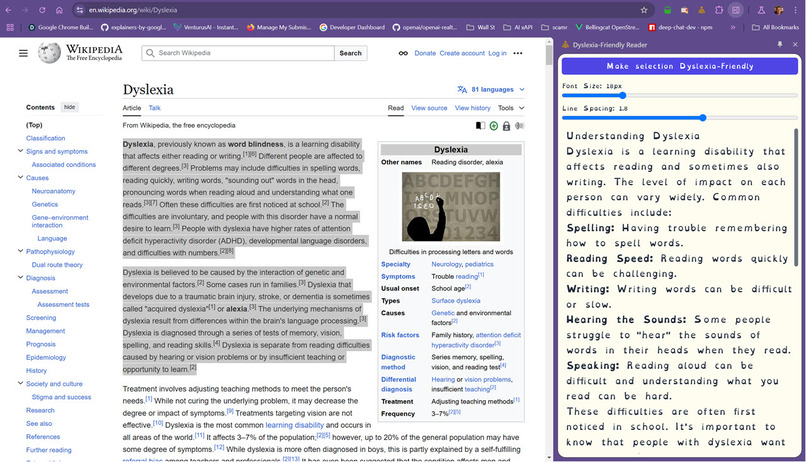
Dyslexic Friendly Reader in Action
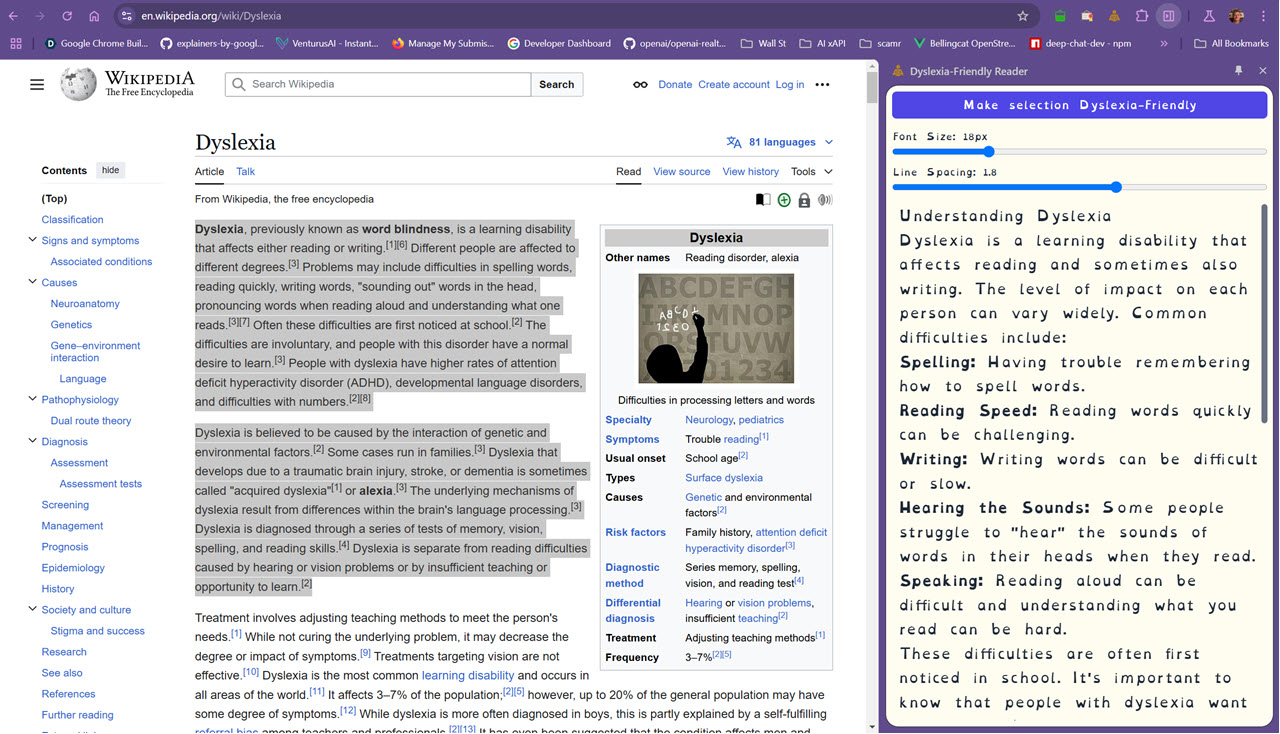
Project Story
## Inspiration
The inspiration for Dyslexic Friendly Reader came from recognizing the challenges dyslexic individuals face when reading dense or poorly formatted online content. Text-heavy websites often lack accessibility, making it harder for users to focus and comprehend. As someone passionate about inclusivity and technology, I wanted to leverage AI to make the internet a more accessible space for everyone, particularly those with dyslexia.
## What it does
Dyslexic Friendly Reader is a Chrome extension that uses AI to transform selected web text into a more dyslexia-friendly format. It simplifies sentence structures, organizes content with clear headings and bullet points, and applies dyslexia-friendly fonts and spacing. The result is a cleaner, more accessible reading experience that reduces visual stress and improves focus.
## How we built it
- Technology Stack:
- Chrome extension APIs to interact with user-selected text.
- AI model integration using Gemini Nano built into Chrome to process and transform the text based on pre-defined readability guidelines.
- Vite, Vue, JavaScript, HTML, and CSS for the extension's functionality and user interface.
- Design Process:
- Researched best practices for dyslexia-friendly formatting.
- Designed a seamless workflow to allow users to transform text with just a few clicks.
- Focused on simplicity and efficiency to ensure usability across various websites.
## Challenges we ran into
- Technical Challenges:
- Ensuring the extension works consistently across different types of web pages and dynamic content (e.g., single-page applications).
- Optimizing the AI prompt to handle a wide range of text complexities while keeping the output user-friendly.
- User Experience:
- Balancing customizability with simplicity in the settings.
- Making the transformation process intuitive for non-technical users.
- Performance:
- Maintaining fast response times despite the computational overhead of AI text processing.
## Accomplishments that we're proud of
- Successfully integrating AI to transform text in real-time within a browser environment.
- Creating a tool that directly addresses a real-world accessibility challenge and makes a meaningful impact for dyslexic readers.
- Designing a user-friendly interface that simplifies the process of improving text readability with minimal clicks.
## What we learned
- The importance of user-centered design when building accessibility tools.
- How to effectively harness the Chrome AI API to address niche accessibility needs, such as formatting text for dyslexic readers.
- The value of iterative testing and feedback in refining both the extension's functionality and its impact.
## What's next for Dyslexic Friendly Reader
- Adding support for more user preferences (like colors) and accommodating diverse grammatical structures.
- Enhancing the AI’s capabilities to include content summarization or real-time audio narration for an even broader audience.
- Partnering with educators, accessibility advocates, and developers to promote the extension and improve accessibility awareness.
- Exploring mobile browser compatibility to extend the tool's reach beyond desktops.
Built With
- javascript
- tailwind
- vite
- vue


Log in or sign up for Devpost to join the conversation.