-
Bubblesort
Inspiration The idea for Dynamic List Sorter came from the need to simplify and understand the mechanics of sorting algorithms, which are fundamental to computer science and essential in solving real-world data management problems. Our goal was to create a tool that serves as both an educational resource and a practical solution for sorting tasks.
What it does Description: The Dynamic List Sorter is a program designed to sort lists of data using various algorithms, such as Bubble Sort, Quick Sort, and Merge Sort. It allows users to understand, visualize, and implement different sorting techniques while offering flexibility for use in learning, debugging, or practical applications.
Code Block
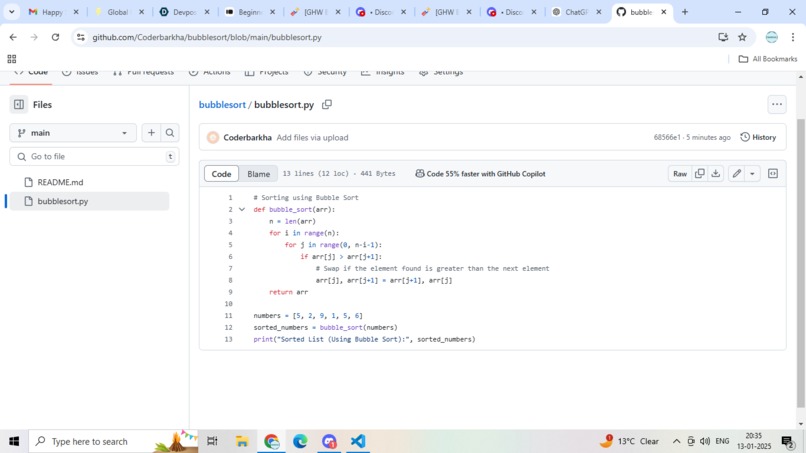
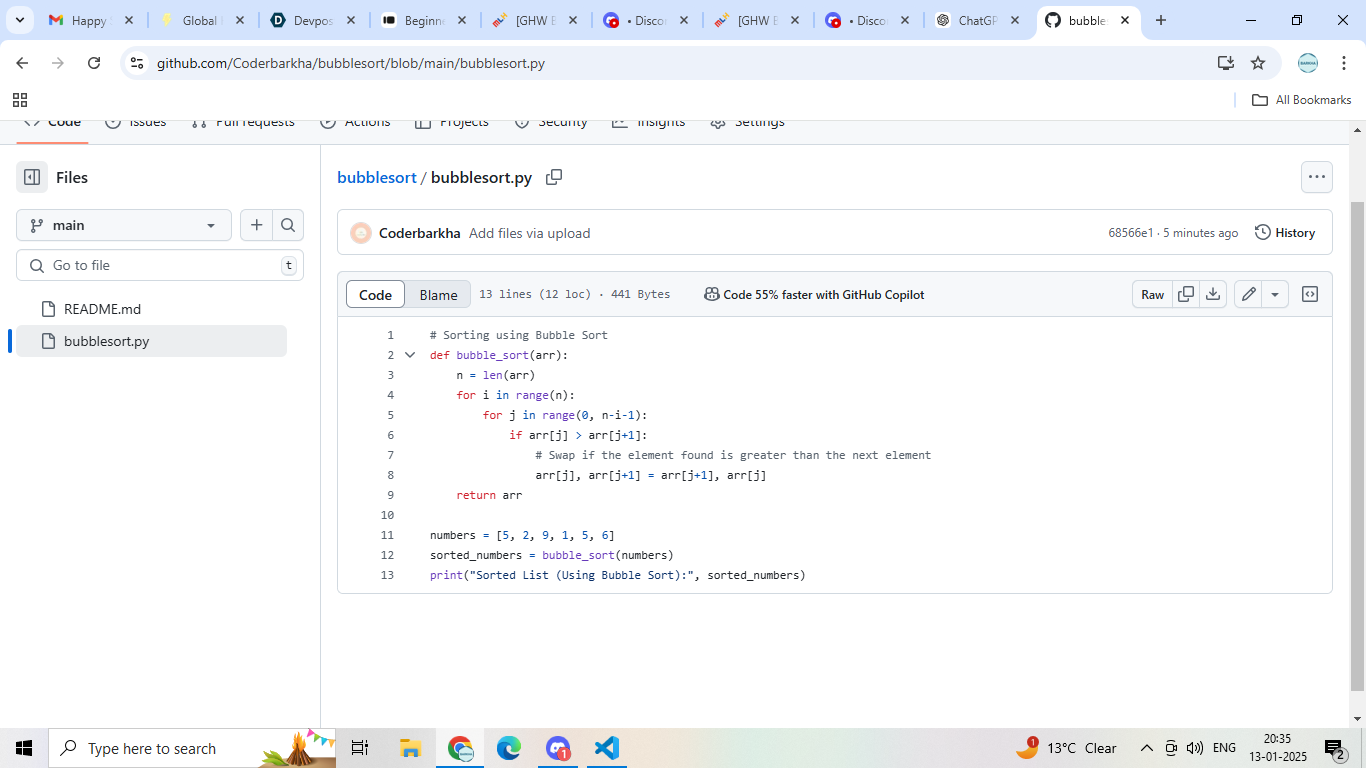
Sorting using Bubble Sort
def bubble_sort(arr): n = len(arr) for i in range(n): for j in range(0, n-i-1): if arr[j] > arr[j+1]: # Swap if the element found is greater than the next element arr[j], arr[j+1] = arr[j+1], arr[j] return arr
numbers = [5, 2, 9, 1, 5, 6] sorted_numbers = bubble_sort(numbers) print("Sorted List (Using Bubble Sort):", sorted_numbers)
How we built it Technical Specifications: Input: Accepts numerical or string-based lists. Example Input: [5, 3, 8, 1, 4] Output: Returns a sorted list in ascending or descending order. Example Output: [1, 3, 4, 5, 8] Algorithms Used: Bubble Sort: Simple, beginner-friendly, but inefficient for large datasets. Quick Sort: Efficient for large datasets with a divide-and-conquer approach. Merge Sort: Stable and reliable for large data, using a recursive technique.
Challenges we ran into
Algorithm Optimization: Balancing readability and efficiency in implementing complex algorithms like Quick Sort and Merge Sort.
User Interface Design: Making the tool intuitive for users unfamiliar with sorting algorithms while maintaining functionality.
Time Complexity Display: Accurately calculating and presenting execution time for each algorithm.
Edge Cases: Handling edge cases like empty lists, duplicate values, and extremely large datasets without errors.
Accomplishments that we're proud of 1.Successfully implementing multiple sorting algorithms with clear and concise code. 2.Creating a feature to visualize the sorting process, making it easier for users to learn. 3.Designing a flexible interface that allows users to input custom lists and choose their preferred algorithm. 4.Ensuring the program handles edge cases gracefully, enhancing its reliability. 5.Offering an insightful comparison of sorting algorithms, including their time complexities and performance metrics.
What we learned
Algorithm Design: Deepened our understanding of the logic, strengths, and weaknesses of sorting algorithms.
Problem-Solving: Tackling challenges such as optimizing efficiency and ensuring compatibility with diverse datasets.
User-Centered Design: The importance of building intuitive and educational tools for a broad audience.
Performance Metrics: Learned how to calculate and display algorithm performance dynamically.
Testing and Debugging: Improved our debugging skills to handle various edge cases effectively.
What's next for Dynamic List Sorter
1.Algorithm Expansion: Add support for more advanced algorithms like Heap Sort and Radix Sort. 2.Visualization Enhancements: Introduce animations and graphical representations for a better learning experience. 3.Web Integration: Develop a web-based version to make the tool accessible online. 4.Real-Time Data Sorting: Enable sorting for real-time datasets such as financial transactions or IoT data. 5.Open-Source Contribution: Publish the project on GitHub to invite community contributions and improvements.
Built With
- bubblesort
- python
- visualstudiocode

Log in or sign up for Devpost to join the conversation.