The delay happened. The plan kept moving.
A truck misses its dock slot. The driver has one version of the new arrival. The warehouse has another. Dispatch starts calling, copying times into notes, and negotiating without a reliable record of what anyone actually approved.
DwellGuard turns that messy exception into one bounded coordination run.
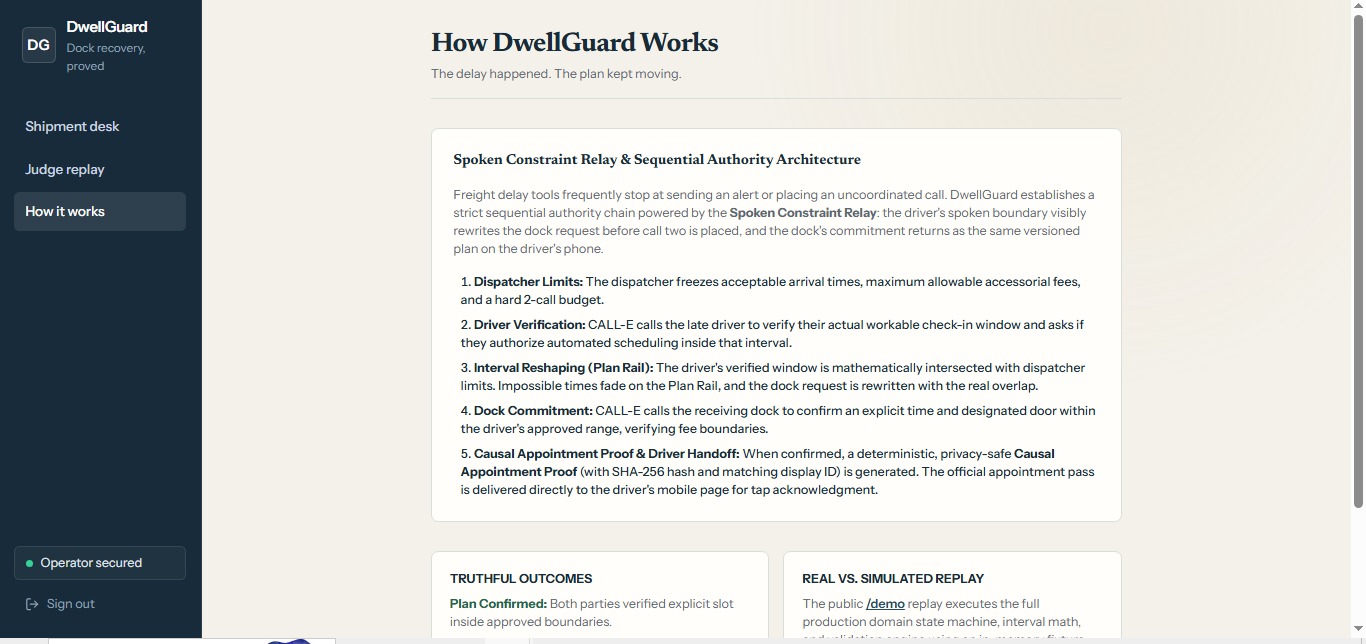
The dispatcher freezes the rules first: the acceptable arrival window, the maximum authorized fee, and the point where a person must take over. DwellGuard then uses CALL-E to speak with the driver, capture a structured workable interval, and carry only that verified context into a second call with the dock. A revised appointment is issued only when the dock's commitment fits the driver's window and the operator's authority.
If the evidence does not line up, DwellGuard stops. It does not turn an uncertain answer into a green status.
Why this is worth building
Late freight is not mainly an alerting problem. Everyone already knows the truck is late. The expensive part is the phone work that follows: reaching the right people, preserving what each person said, avoiding unauthorized fees, and returning one plan that the driver can actually follow.
DwellGuard is designed around that gap. It is not a generic voice bot or a dashboard that summarizes fictional activity. It is a narrow execution layer for a real operational exception.
How it works
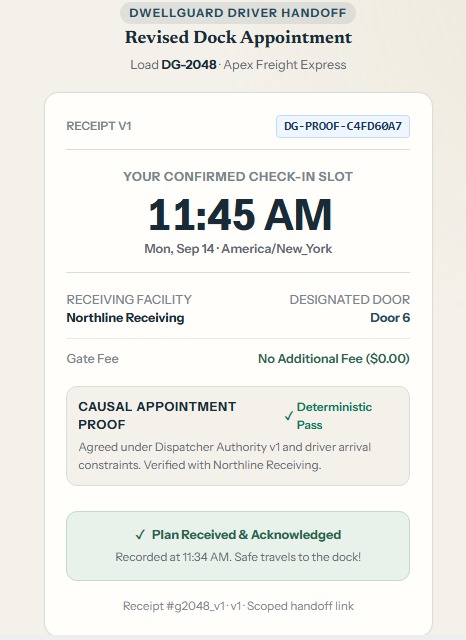
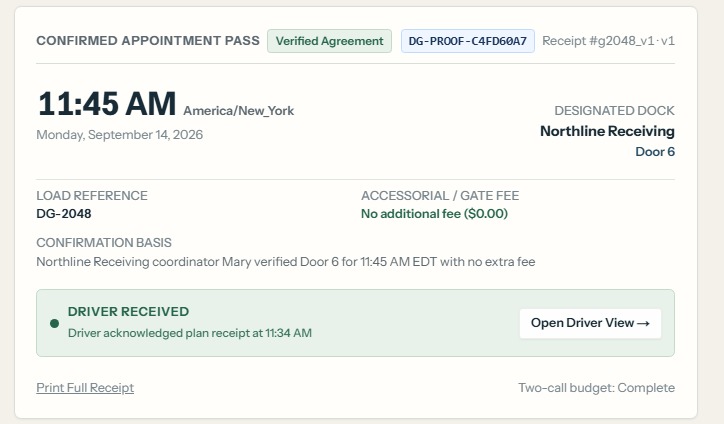
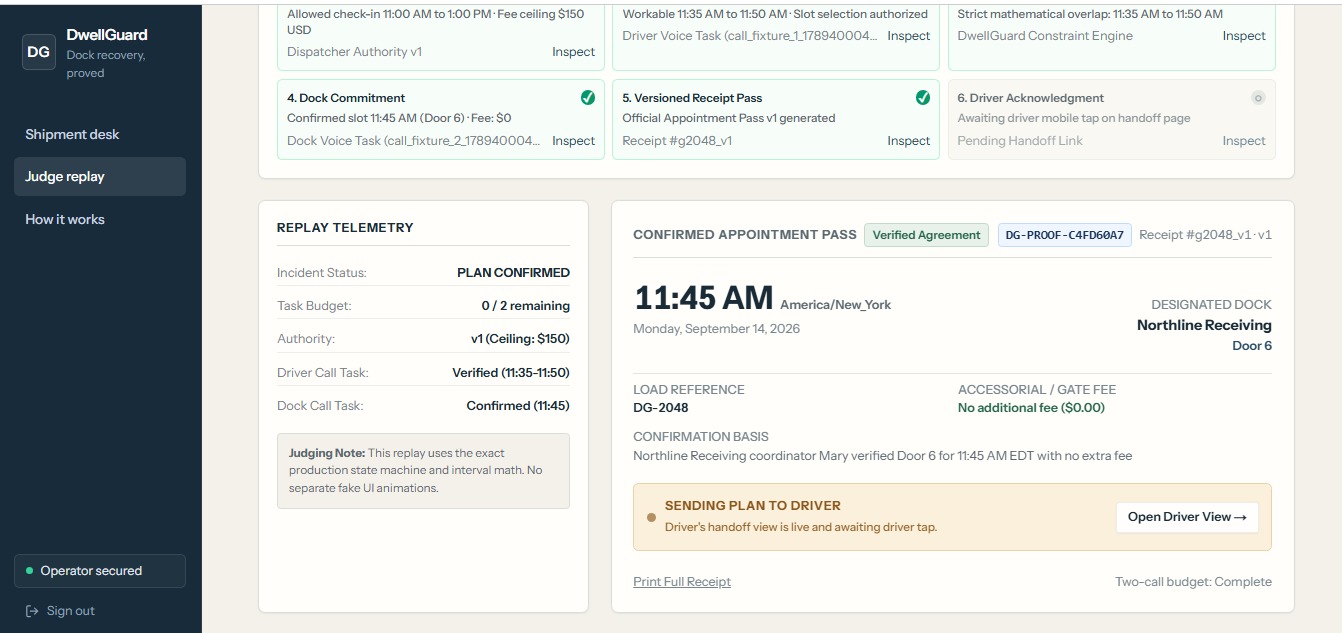
Authority is frozen before the first call. The dispatcher defines the time and fee boundaries. The calling workflow cannot silently expand them. CALL-E contacts the driver. The live app invokes the official @call-e/calle SDK and requests a structured result containing the earliest and latest workable arrival, explicit permission to select within that interval, and supporting evidence phrases. The driver's answer changes the next action. Only a valid driver result enables the dock task. CALL-E contacts the dock. DwellGuard asks for a concrete appointment, door, fee, and conditions within the already-approved envelope. Code checks the commitment. The app compares the dock result with the driver interval and fee ceiling. Unsupported or incomplete results route to a dispatcher. One handoff closes the loop. A valid plan becomes a signed driver-ready appointment pass that can be opened and acknowledged on a phone.
What makes the implementation non-trivial
CALL-E is imported and invoked at runtime through the official TypeScript SDK. Separate structured result schemas are sent for the driver and dock tasks. A deterministic policy layer—not the language model—decides whether the workflow may advance. Stable intent and reconciliation keys reduce duplicate effects when callbacks or status checks repeat. The workflow has a maximum of two outbound tasks per incident and no hidden redial loop. Credentials stay server-side; phone numbers are entered only at runtime. The public replay is isolated from live state, so judges can test the complete product without placing a call.
Safety and honest limits
DwellGuard only calls numbers controlled by or explicitly authorized by the operator. An unresolved CALL-E result stays unresolved. A connected call is not automatically treated as a valid answer. The app does not claim to cancel an in-flight provider call, and it does not make financial or contractual decisions outside the operator's frozen limits.
For example, if a dock requests a $350 fee while the dispatcher authorized no more than $150, the workflow stops and produces a clear dispatcher-needed outcome with the evidence that caused it.
Built during the hackathon
DwellGuard was newly created for CALL-E: Your Code Is Calling. During the build period we implemented the live CALL-E gateway, structured evidence contracts, two-stage coordination state machine, operator authentication, signed driver handoff, Supabase-backed persistence, deterministic judge replay, responsive product UI, and automated tests for the critical call and policy paths.
Try it
The public /demo route provides a credential-free replay of both the successful coordination path and the fee-refusal path. The recorded demo walks through that judge-safe replay, including the final Appointment Pass and the policy stop. The same production app also contains an operator-authorized live CALL-E workflow for team-controlled phone numbers.
Built With
- call-e
- next.js
- react
- supabase
- tailwind-css
- typescript
- vitest
- zod

Log in or sign up for Devpost to join the conversation.