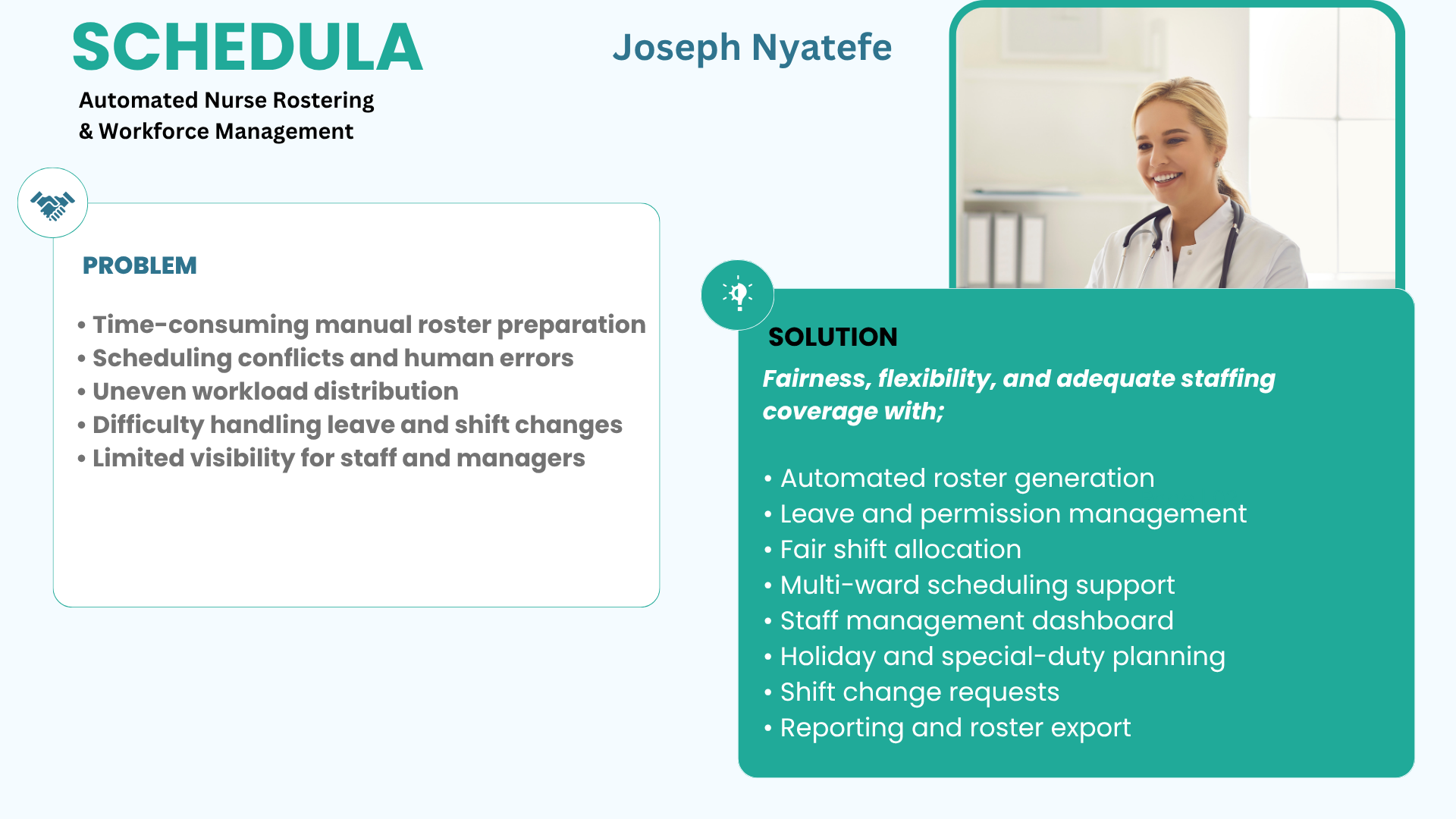
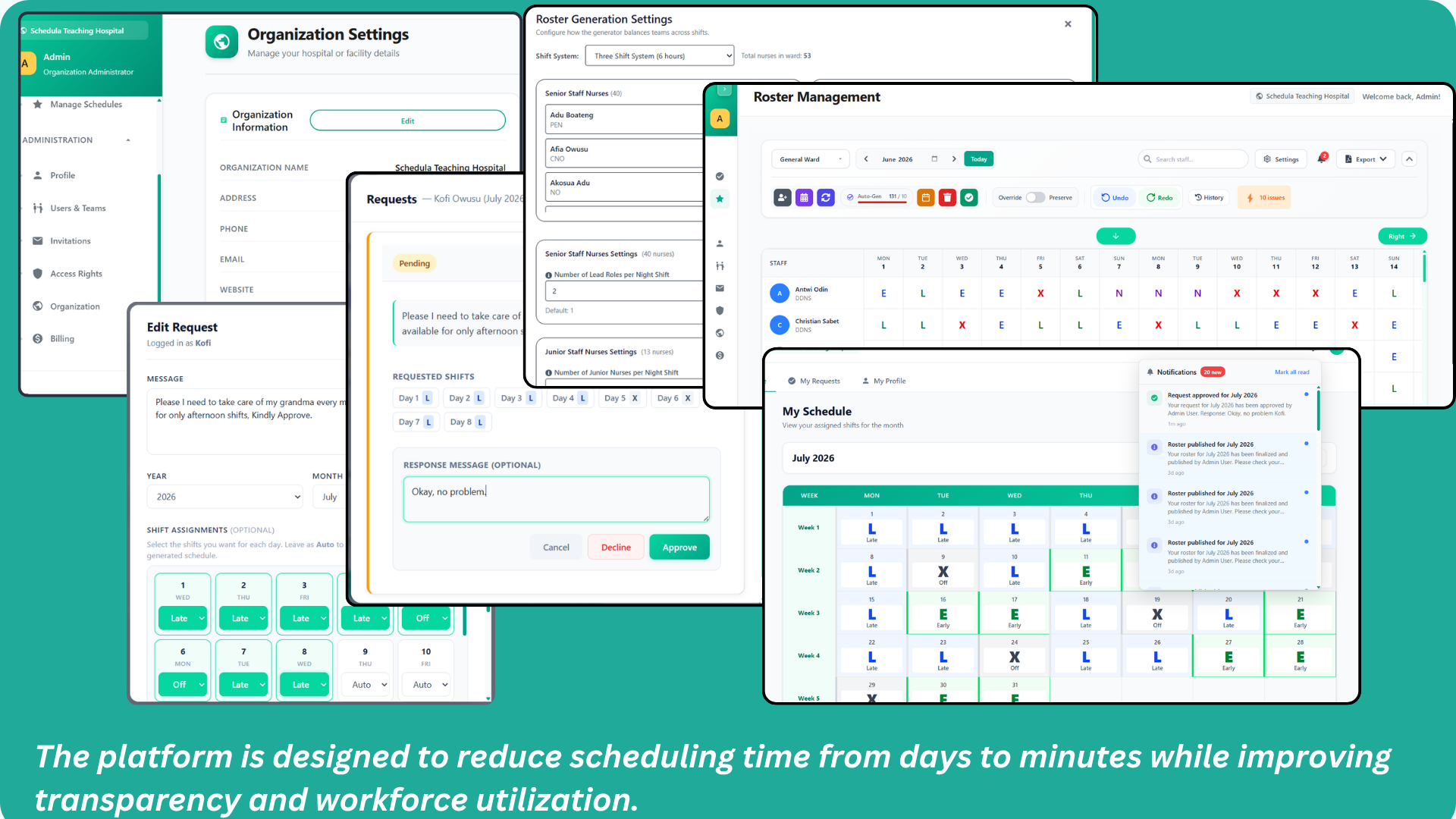
DutySchedula was inspired by my exposure to healthcare workflows and my interest in using software to automate repetitive operational processes. Creating healthcare duty rosters can require managers to manually coordinate staff availability, leave, permissions, shift patterns, coverage requirements and changes. A small change can require several other assignments to be reconsidered. I saw an opportunity to turn this repetitive coordination process into a structured software workflow. Instead of treating a duty roster as just a timetable, I wanted to build a system that understands the workforce and the constraints behind the timetable. DutySchedula is an automated healthcare workforce scheduling and attendance platform. It helps healthcare organizations:
- Organize staff by departments and wards
- Manage staff availability, leave and permissions
- Configure different shift patterns
- Generate duty rosters automatically
- Give staff access to their personal schedules
- Manage scheduling through role-based access
- Track attendance using QR-based workflows The goal is to reduce repetitive manual coordination while keeping managers in control of the final roster.
The broader vision is to connect scheduling and attendance into one structured workforce-management system. I built DutySchedula as a full-stack application. The backend was developed with - Python and Django REST Framework, with PostgreSQL used for data management.
The frontend was built with - React, Vite and Tailwind CSS.
The development process involved translating real-world healthcare scheduling requirements into software rules and workflows.
I designed the system around organizational structures such as departments and wards, different user access levels, staff scheduling requirements, leave and permissions, roster generation and attendance.
A major focus was making the system practical rather than simply creating a calendar interface. The software needed to represent the relationships and constraints that exist in real workforce scheduling.
The biggest challenge was translating a process that people normally handle through experience and manual checking into rules that software can understand.
Healthcare scheduling involves multiple interacting constraints. Changing one staff assignment can affect other shifts, availability and coverage requirements.
Another challenge was balancing automation with human judgment.
A roster should not become a black box where managers simply accept whatever the system produces. DutySchedula therefore follows a human-in-the-loop approach: automation assists with generating the roster, while the responsible manager can review and adjust it.
Building the different organizational, scheduling and attendance workflows into one coherent system was also an important engineering challenge.
The biggest accomplishment is turning the idea into a working product rather than leaving it as a concept.
I built a functioning healthcare workforce-management prototype that brings together:
- Automated roster generation
- Staff and organizational management
- Leave and permissions
- Multiple shift configurations
- Personal schedules
- Role-based access
- QR-based attendance
I am particularly proud of the fact that the project connects several parts of the workforce workflow instead of solving scheduling in isolation.
The prototype also gave me an opportunity to translate a real operational problem into a software system and continuously refine the product based on the workflow I was trying to solve.
The biggest lesson was that effective automation starts with understanding the problem deeply.
At first, it is tempting to think of rostering as simply assigning people to dates and shifts. Building DutySchedula showed me that the real challenge is managing the constraints and relationships behind those assignments.
I also learned that automation does not necessarily mean removing people from a process.
In healthcare, human oversight is important. The better approach is to automate repetitive coordination while allowing the person responsible for the operation to review, adjust and make the final decision.
From an engineering perspective, the project also taught me how important data modeling, clear workflows and modular system design are when building software around complex real-world processes.
What's next for DutySchedula
The next step is to move from prototype validation toward real-world testing.
I want to pilot DutySchedula with a healthcare department or ward, measure how the system performs against the existing manual workflow, collect feedback from managers and staff, and use those findings to improve the product.
Future development will include:
- Improved scheduling optimization
- Shift-swapping workflows
- Expanded attendance management
- Workforce analytics
- Staffing and workload insights
- Support for additional healthcare professions
- Multi-department and multi-facility management
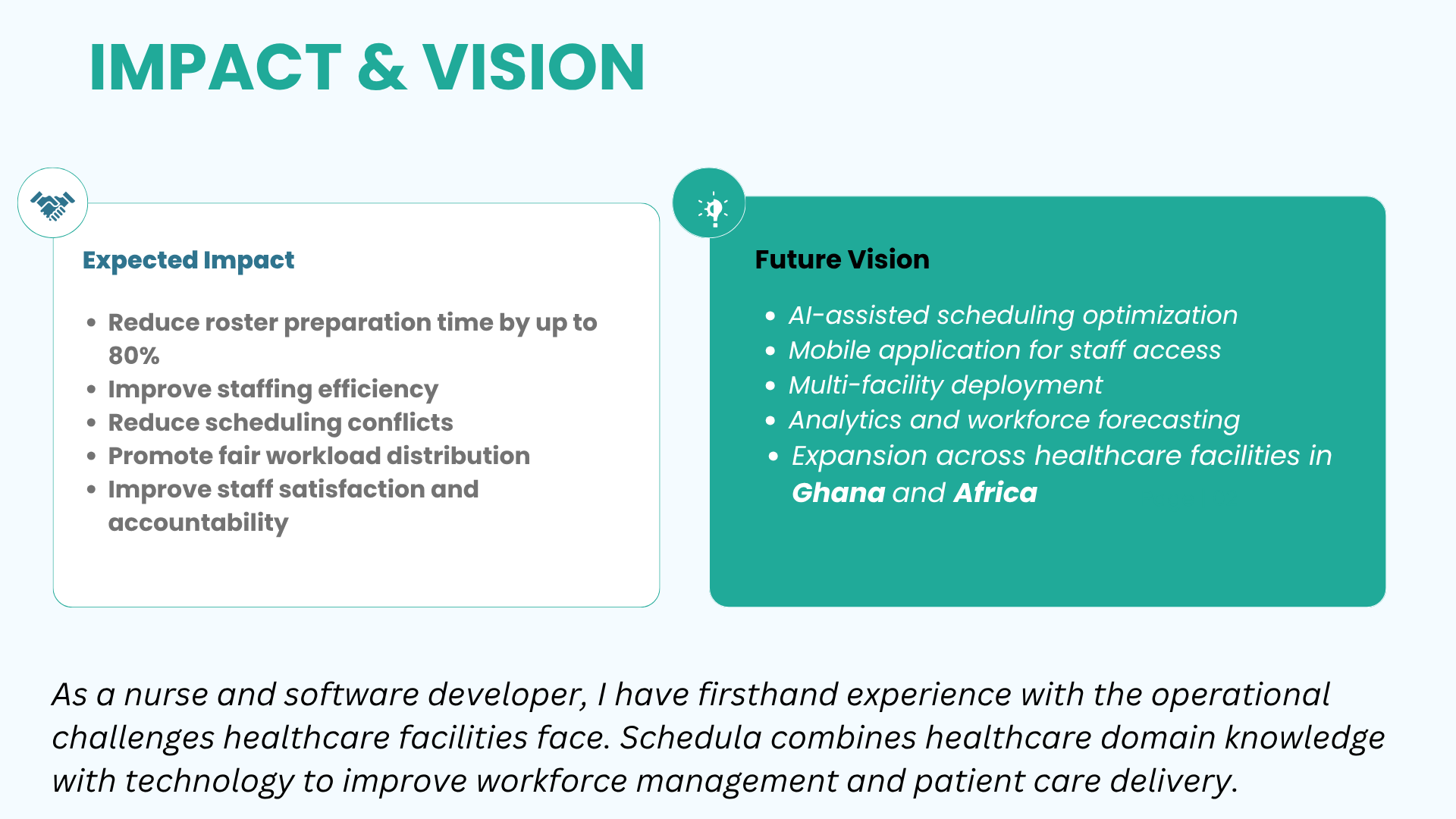
The long-term vision is to evolve DutySchedula from a roster-generation tool into a broader healthcare workforce-management platform.
The starting question is:
Who is on duty?"
The long-term goal is to help healthcare organizations answer:
How are we organizing and utilizing our workforce?"
Built With
- django
- javascript
- python
- react.js

Log in or sign up for Devpost to join the conversation.