-
-
1
-
2
Inspiration
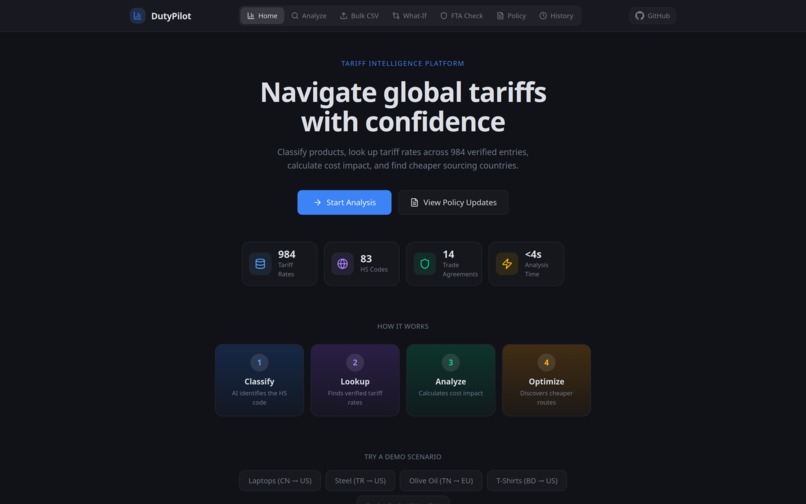
Every time a business ships goods across borders, they face a maze of tariffs, trade agreements, and constantly changing policies.
In 2025, the average US tariff rate reached 16.8% — the highest since 1935. Yet most small and medium-sized businesses have no way to track these changes in real time. They either overpay duties or get blindsided by sudden increases.
We wanted to build something that makes tariff intelligence accessible to everyone — not just large corporations with dedicated compliance teams.
What it does
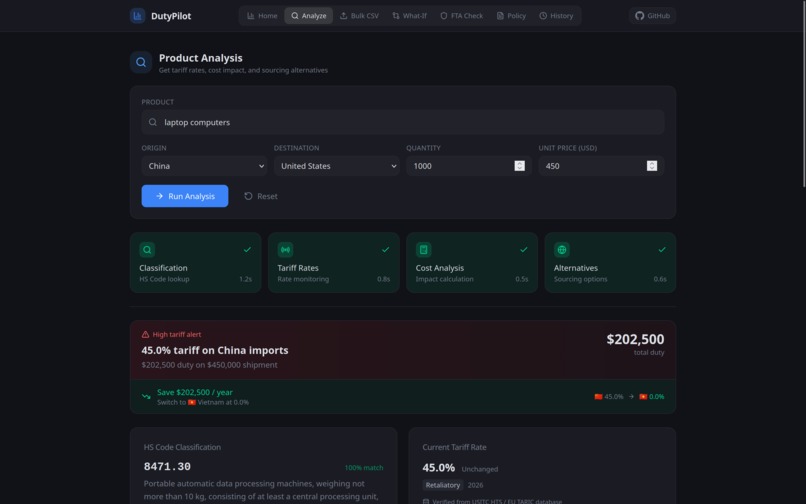
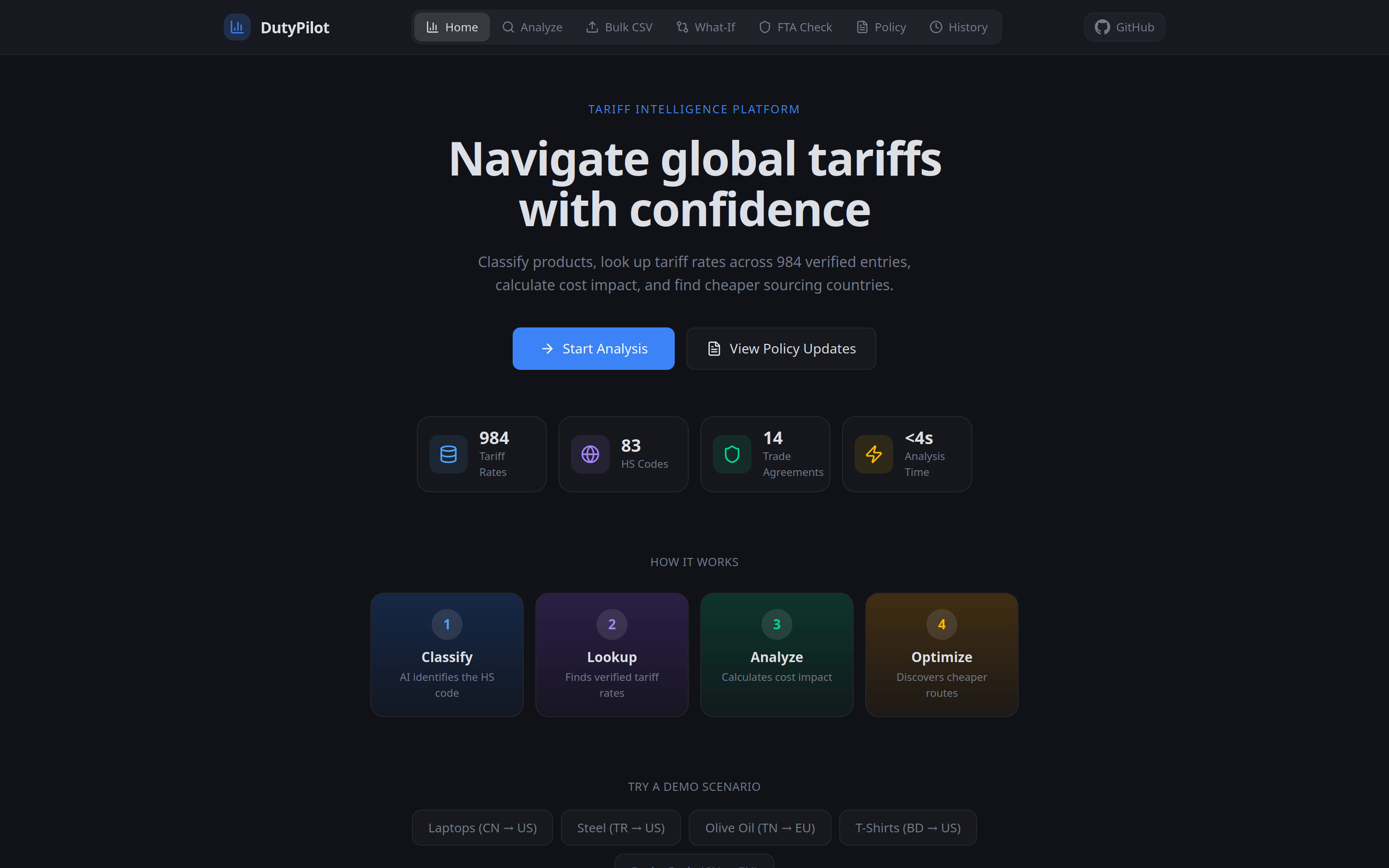
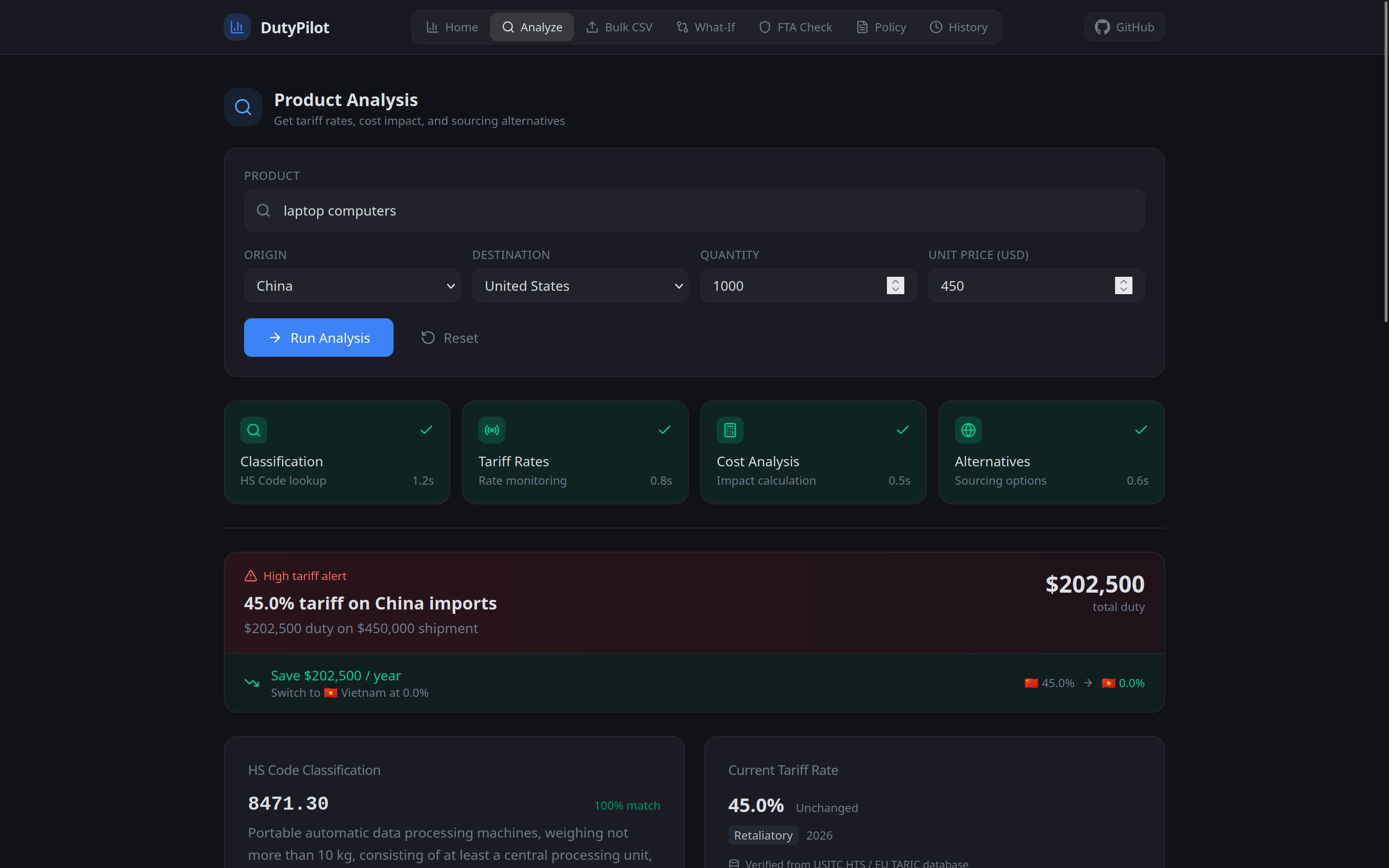
DutyPilot is an AI-powered platform that analyzes tariffs, calculates real costs, and suggests smarter sourcing strategies in seconds.
It uses four specialized AI agents working together:
- Classifier — Identifies the correct HS code from plain-language product descriptions
- Monitor — Retrieves current tariff rates and scans recent trade policy updates
- Analyst — Calculates duty costs, landed costs, and year-over-year impact
- Scout — Suggests alternative sourcing countries with lower tariffs and estimates savings
Key features:
- What-if scenario modeling for tariff changes
- Bulk CSV product classification
- FTA (Free Trade Agreement) qualification checker
- Real-time policy tracking via news monitoring
- Exportable PDF reports for decision-making
How we built it
- Frontend: React + TypeScript + Tailwind CSS + shadcn/ui, bundled with Vite
- Backend: Python FastAPI with async processing and SSE streaming
- AI: Groq API (Llama 3.3 70B) + LangGraph for multi-agent orchestration
- Data: SQLite (USITC HTS + EU TARIC), UN Comtrade, NewsAPI
The architecture follows a pipeline:
Input → HS Classification → Tariff Lookup → Cost Analysis → Alternative Sourcing → Real-time streaming to frontend.
Challenges we faced
- Tariff data is highly inconsistent across sources (USITC, EU TARIC, WITS), requiring heavy normalization into a unified schema
- Coordinating multiple AI agents while maintaining context and streaming outputs in real time
- Handling cases where tariff data is missing — we added confidence scoring for AI-estimated results
- Implementing stable SSE streaming with React, including reconnection and error handling
What we learned
- International trade systems are far more complex than expected (HS codes, MFN rates, FTAs, anti-dumping duties)
- Multi-agent AI pipelines require careful orchestration and state management
- Real-time streaming (SSE) significantly improves UX but adds complexity
- The gap between a working prototype and a production-ready system is substantial
What's next
- Real-time synchronization with official government tariff APIs
- SaaS model targeting freight forwarders and procurement teams
- ERP integrations (SAP, Oracle)
- Expansion to more countries and trade agreements
Built With
- fastapi
- groq
- langgraph
- llama-3
- python
- react
- recharts
- server-sent
- shadcn/ui
- sqlite
- tailwind-css
- typescript
- vite

Log in or sign up for Devpost to join the conversation.