-
-
Blank
-
Teach
-
Test
Inspiration
Modern artificial intelligence has achieved incredible results, but most AI systems today learn by adjusting billions of numerical weights. While this is powerful, it makes the reasoning process difficult to understand, explain, or directly modify. The inspiration for Dusk - Eccentric Model came from the question: what if intelligence could be built from explicit knowledge and logical relationships instead of hidden parameters?
I wanted to explore an AI architecture where knowledge is not buried inside weights, but stored in a clear structure that can be inspected, expanded, and reasoned over. This led to the idea of the Eccentric Model, a theory based on knowledge units, relationships, memory, reasoning, and continual expansion.
What it does
Dusk - Eccentric Model is a proposed computational framework for general intelligence. Instead of using neural networks, it represents knowledge using small indivisible units called Zetons. A Zeton is the smallest piece of knowledge in the system. These Zetons are connected through Catenates, which represent explicit relationships between pieces of knowledge.
The model begins with Foundations. Absolute Foundations represent accepted truths or rules within a domain, while Observed Foundations represent information gathered from experience, input, or observation. As knowledge grows, Zetons and Catenates form larger Zetonic Structures, which represent concepts.
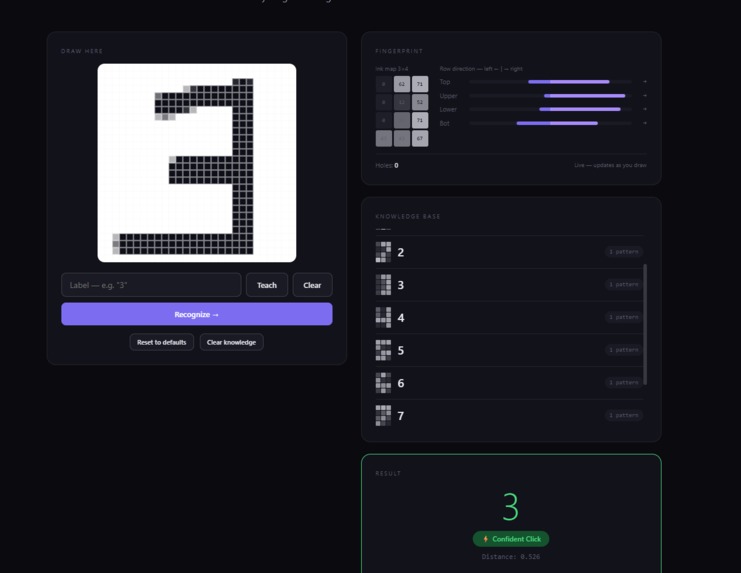
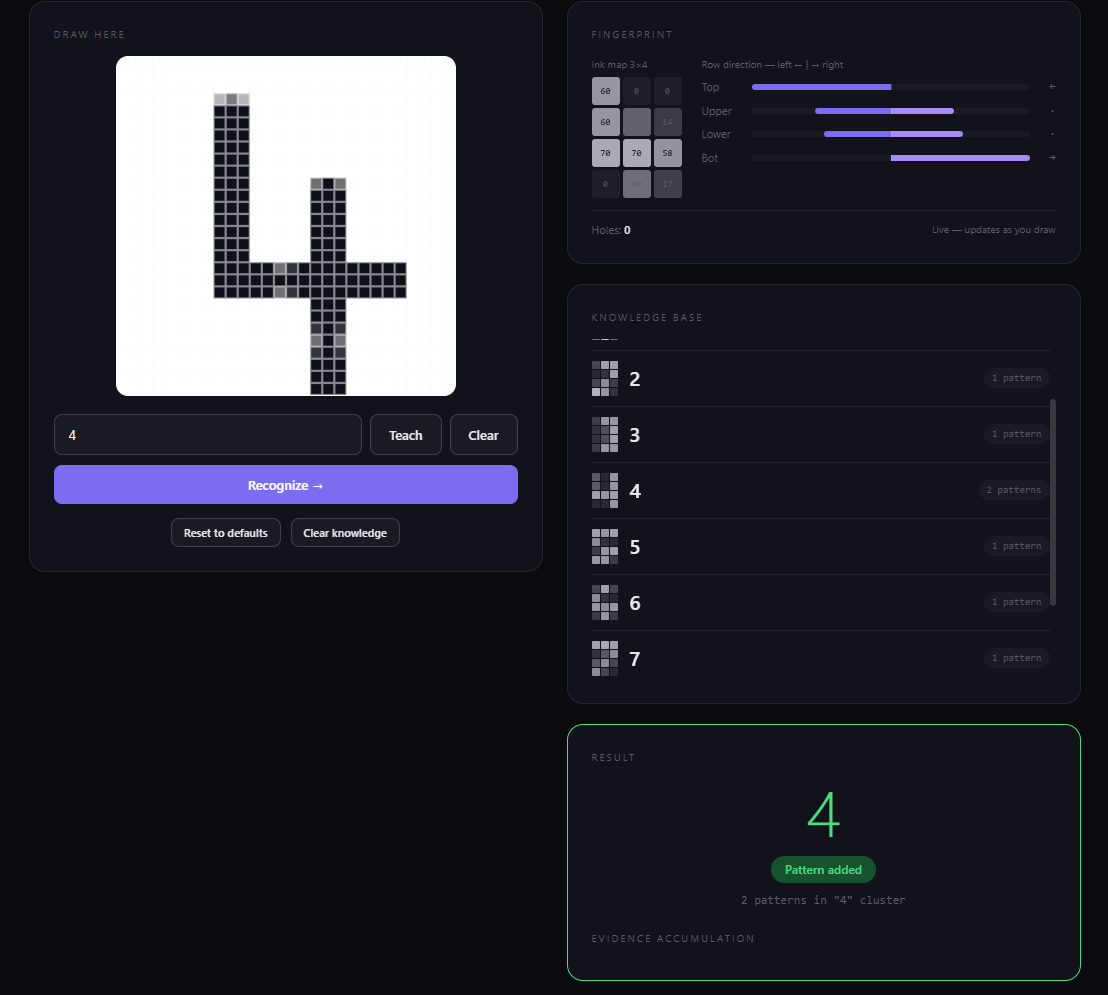
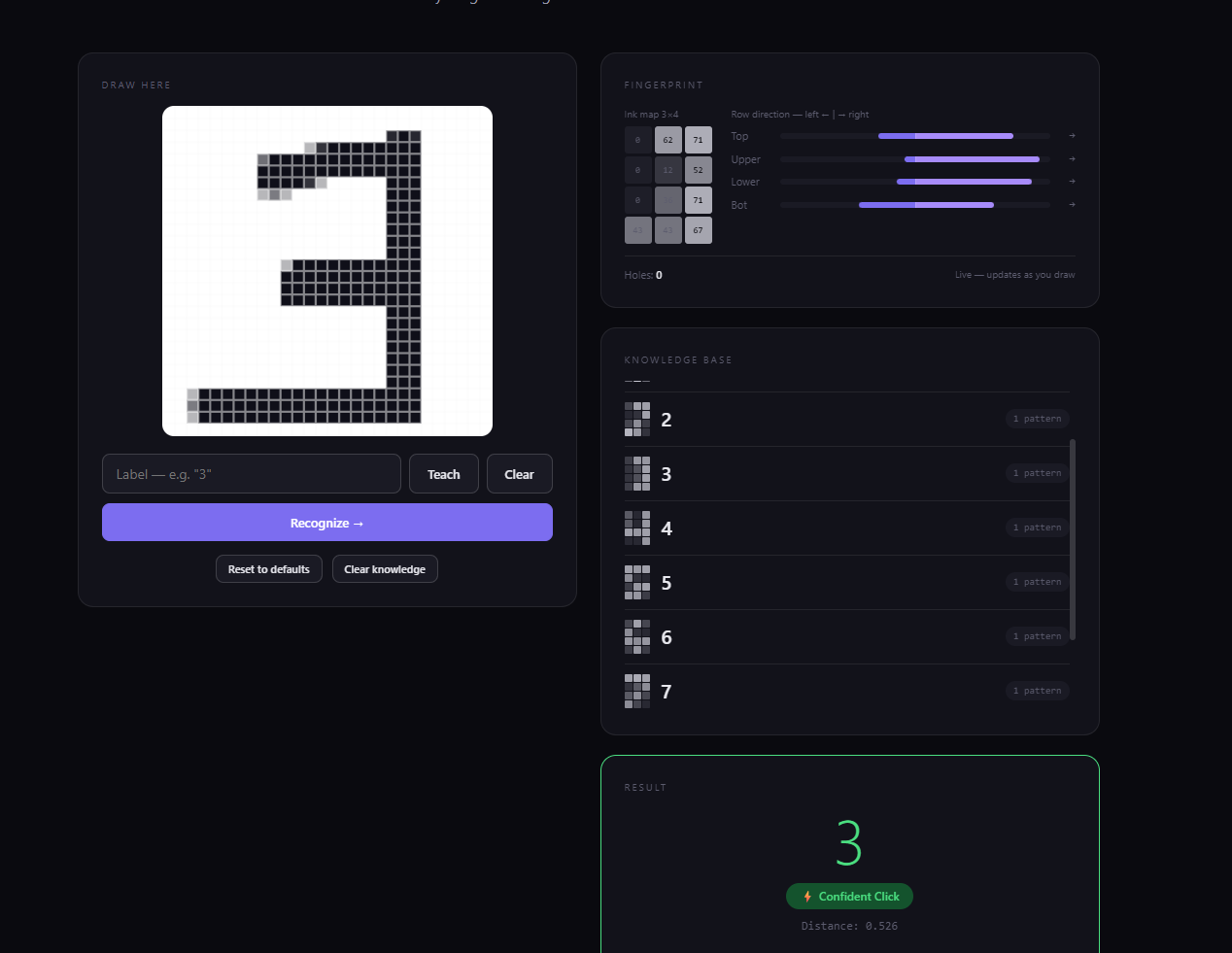
When Dusk tries to solve a task, it does not search the entire knowledge base. Instead, the Execution Model activates only the relevant knowledge, compares possible explanations, and accumulates evidence until one concept becomes strong enough to be recognized. This recognition moment is called the Click Event. The goal is for every decision to be explainable through the exact Zetons and Catenates that produced it.
How I built it
I built the project by first developing the theory instead of jumping directly into code. I started by defining the main parts of the architecture: Foundations, Zetons, Catenates, Zetonic Structures, the Knowledge Model, the Memory Model, the Execution Model, and the Click Event.
The Knowledge Model stores long-term knowledge. The Memory Model handles temporary information such as the current task, active observations, and intermediate reasoning. The Execution Model is responsible for using the stored knowledge to reason, recognize patterns, and make predictions.
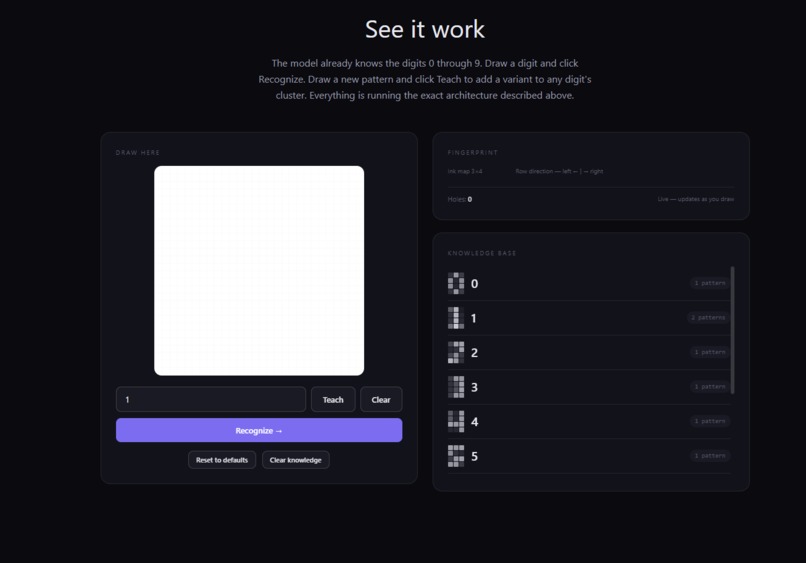
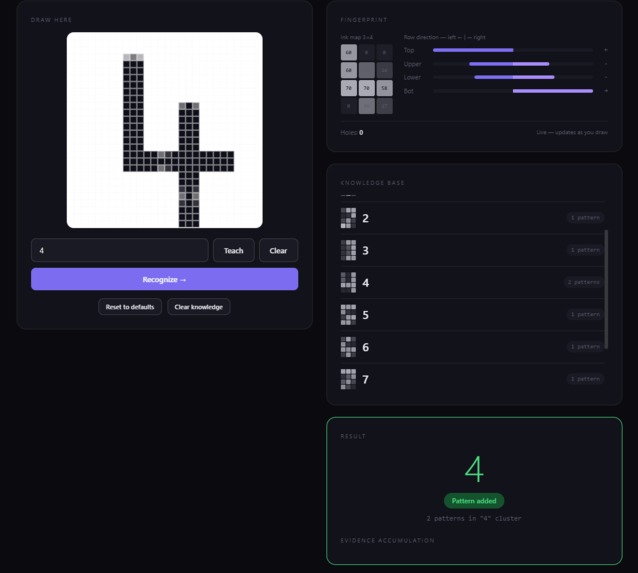
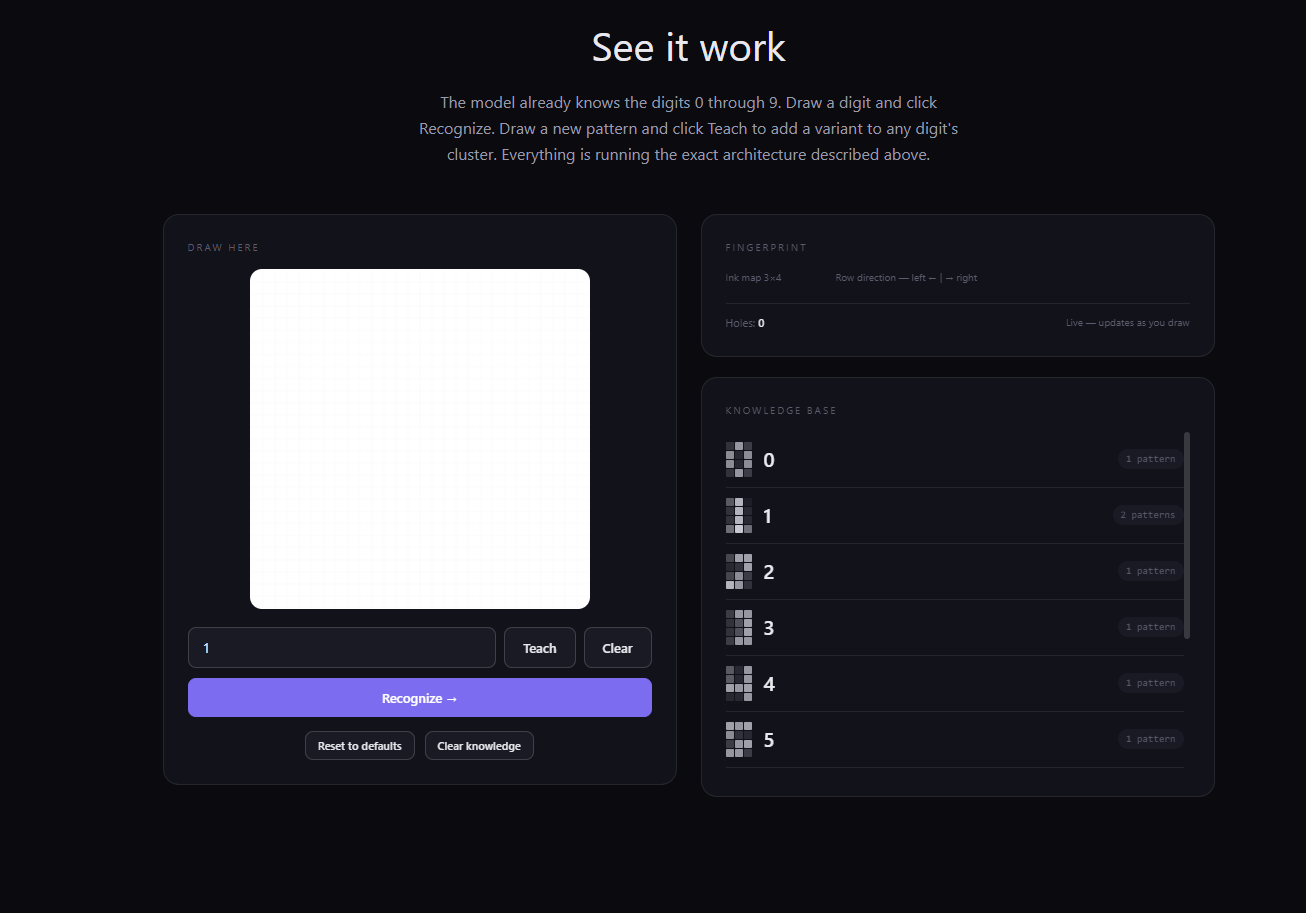
I also began testing the idea with a handwritten digit recognition prototype. The goal of the prototype was not to use a neural network, but to recognize numbers through structural features such as loops, curves, endpoints, intersections, and relationships between them. This helped show both the potential and the difficulty of building intelligence through explicit structure.
Challenges I ran into
One of the biggest challenges was figuring out how to recognize patterns without using neural networks. Neural networks are very good at handling messy real-world data, so building a different approach required thinking carefully about what a concept actually is and what makes one structure different from another.
Another challenge was avoiding hardcoding. I did not want the system to simply contain fixed rules for every number or object. The goal is for the system to learn structures, reuse knowledge, and improve over time. This made the problem much harder, especially when trying to distinguish similar shapes like 2, 3, 5, and 7.
A major theoretical challenge was also separating knowledge storage from execution. I realized that storing knowledge is not the same as thinking. Because of that, the model needed separate systems for long-term knowledge, temporary memory, and active reasoning.
Accomplishments that I'm proud of
I am proud that the project became more than just an idea for an AI app. It developed into a full theoretical architecture with its own vocabulary and structure. Concepts like Zetons, Catenates, Zetonic Structures, and the Click Event gave the model a clear identity and made it possible to describe intelligence in a different way.
I am also proud that the first prototype was able to begin recognizing digits without using neural networks. Even though it is not perfect yet, it helped prove that structural reasoning can produce real results and revealed what needs to be improved next.
Most importantly, I am proud that the model focuses on explainability. Every prediction should eventually be traceable back to the knowledge that caused it, which is one of the main reasons I wanted to build this architecture in the first place.
What I learned
I learned that building a new AI model is not only a coding problem. It is also a mathematical and philosophical problem. Before building the system, I need to clearly define what knowledge is, what reasoning is, how memory works, and how concepts form.
I also learned that neural networks are powerful for a reason. They are extremely good at perception, compression, and pattern recognition. If the Eccentric Model is going to compete with them, it needs strong mathematical foundations, efficient memory organization, and a fast execution model.
Most importantly, I learned that original research is difficult because there is no tutorial to follow. Every definition has to be tested, every assumption has to be questioned, and every part of the theory needs to become more precise over time.
What's next for Dusk - Eccentric Model
The next step is to formalize the Eccentric Model mathematically. I want to define Zetons, Catenates, Knowledge Networks, reasoning, memory, and the Click Event using clear mathematical notation and rules.
After that, I want to improve the digit recognition prototype by moving from global features to true structural graphs. Instead of only counting loops or endpoints, the system should understand how curves, lines, intersections, and regions connect to form a concept.
Long term, Dusk - Eccentric Model is meant to become the foundation for a family of AI models, including Dusk FG, Dusk FL, and Dusk FX. The goal is to build an AI architecture that can learn continuously, explain its reasoning, reuse knowledge across domains, and eventually perform general tasks without relying on hidden neural-network weights.

Log in or sign up for Devpost to join the conversation.