Inspiration
I'm a Designated School Official (DSO). For fifteen years, my job has been keeping international students legally in status in the United States.
Just this morning (as I write, July 17th, 2026) the rules changed significantly. For decades, most F-1 students were admitted for Duration of Status (D/S), allowing them to remain in the U.S. as long as they continued their academic program. Beginning September 15, 2026, that system will be replaced with fixed periods of admission, up to four years—making immigration timelines far more rigid, as well as highly dependent on a grouping of specific details about each student's individual circumstances.
Here's what I know after fifteen years of on this job: many students don't yet grasp details, and won't for weeks. Immigration news can reach international students secondhand, in slow waves — a WhatsApp group, a roommate, a panicked post in a subreddit. These rules govern how and whether they can stay in the country, but have lives: jobs, kids, exams, hobbies. And let's face it and administrative rule change is not the most headlines grabbing thing coming out of DHS these days. So, by the time the wave reaches them, some of the deadlines the new rule creates will be upon them. Two summer months is not a lot of runway. And this one is hard for even career pros to readily grasp.
So, my inbox is quiet today. But I know exactly what it looks like in early September: the same question, in a thousand variations: "Am I okay?"
The honest answer, for most students, is a decision tree with a dozen branches: i-20 program end date, I-94, visa stamp, travel plans, pending work authorization applications. I can walk one student through it in a 30-minute advising appointment. I can't do it 200 times. Neither can the thousands of other DSOs around the country.
So, I'm building the decision tree now, before the wave hits.
What it does
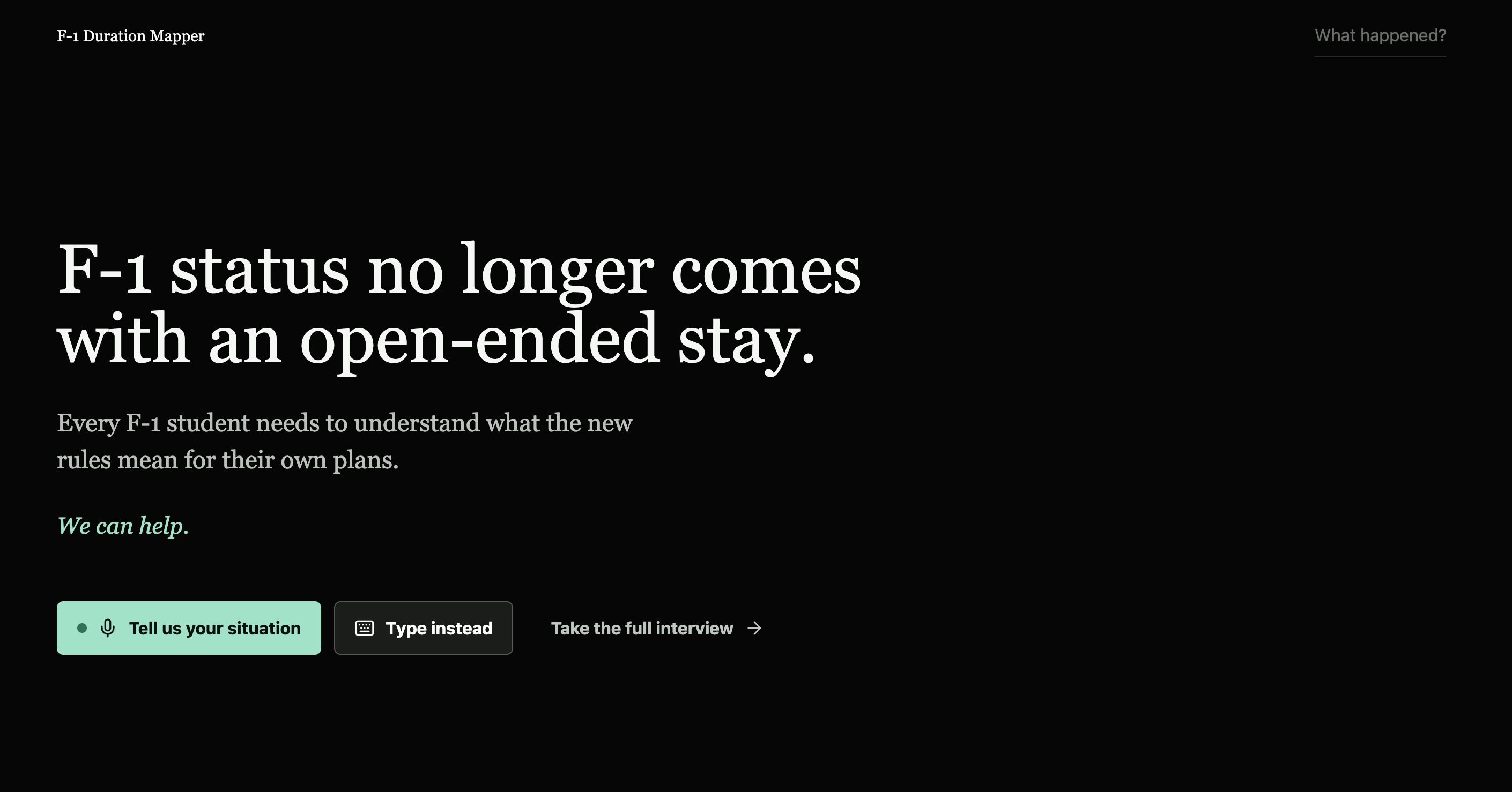
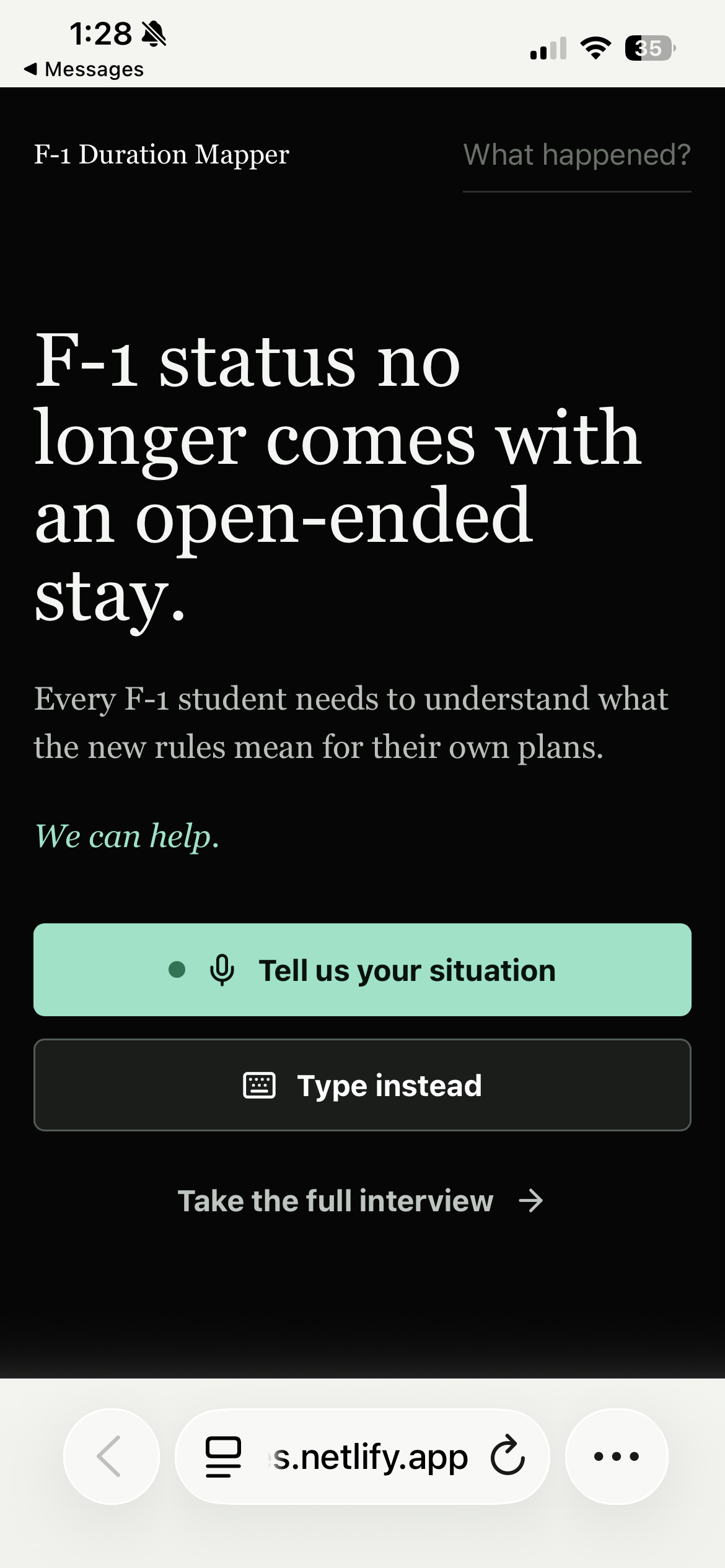
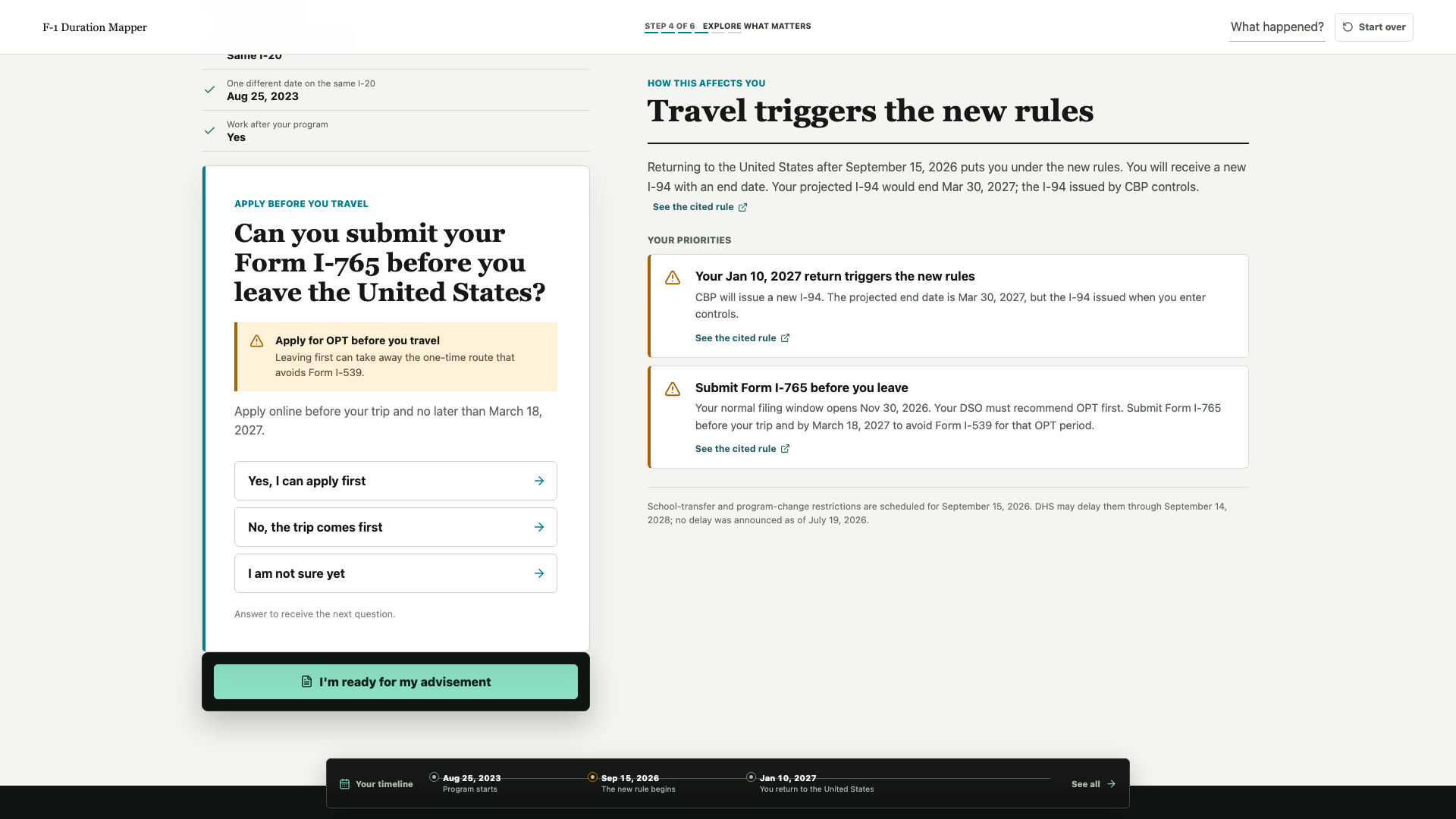
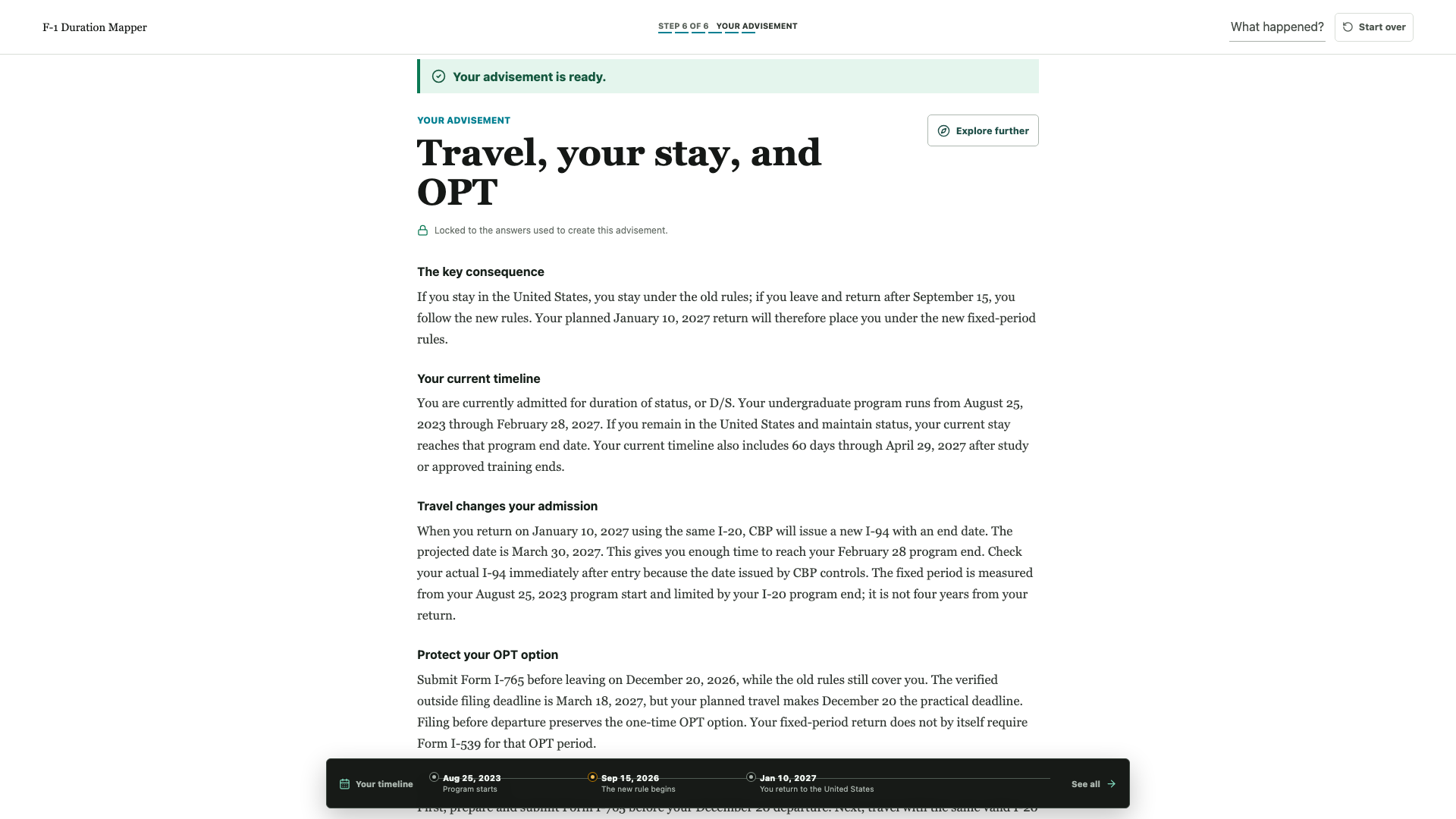
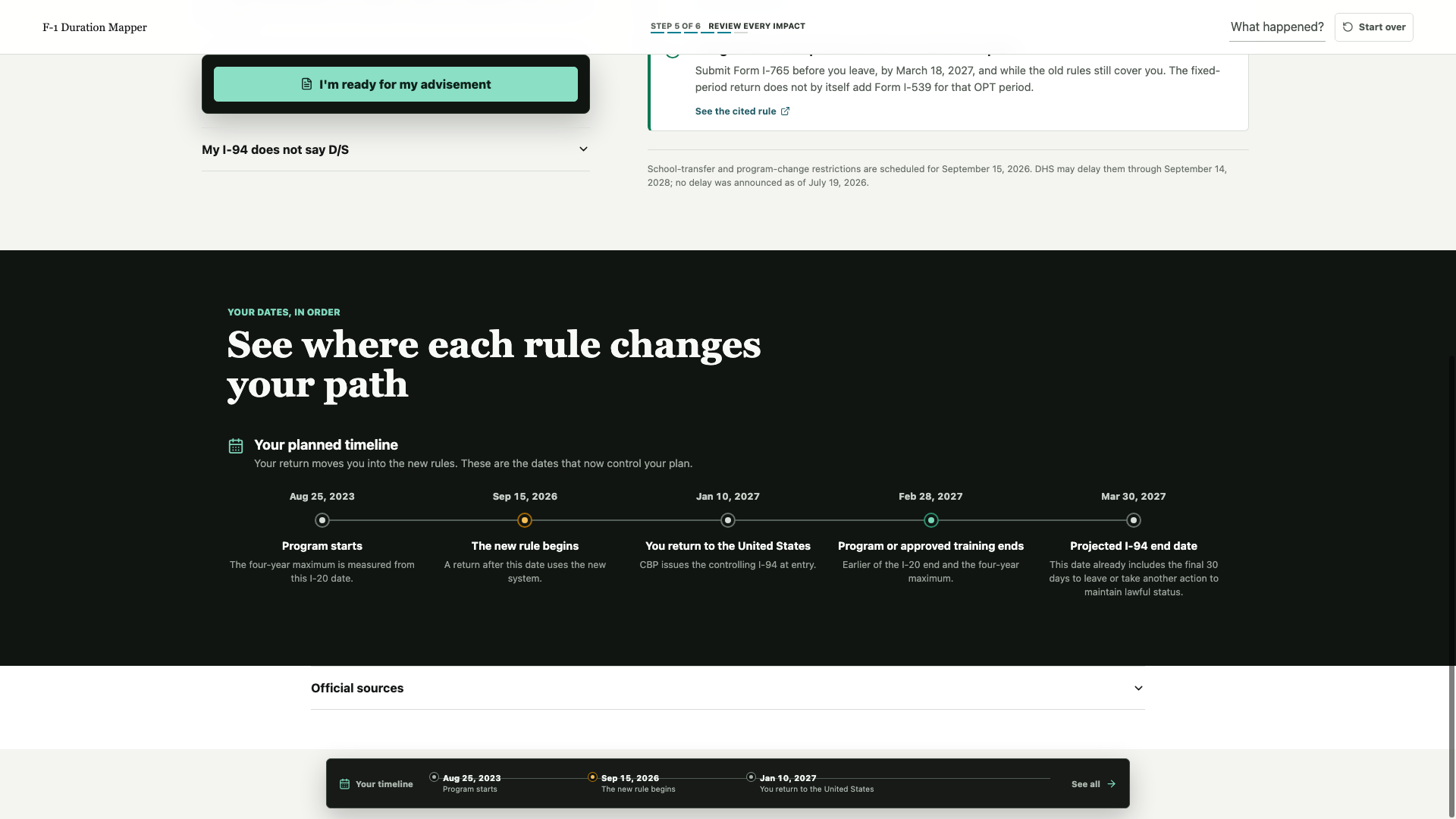
The F-1 Duration Mapper takes a student's actual situation, which they can describe in plain language, or through a guided intake and reasons through the new admission-period rules to a specific, personalized answer: what the September 15 effective date means for them specifically, what deadlines now apply, what actions to take and by when, and when to stop reading a website and talk to their DSO.
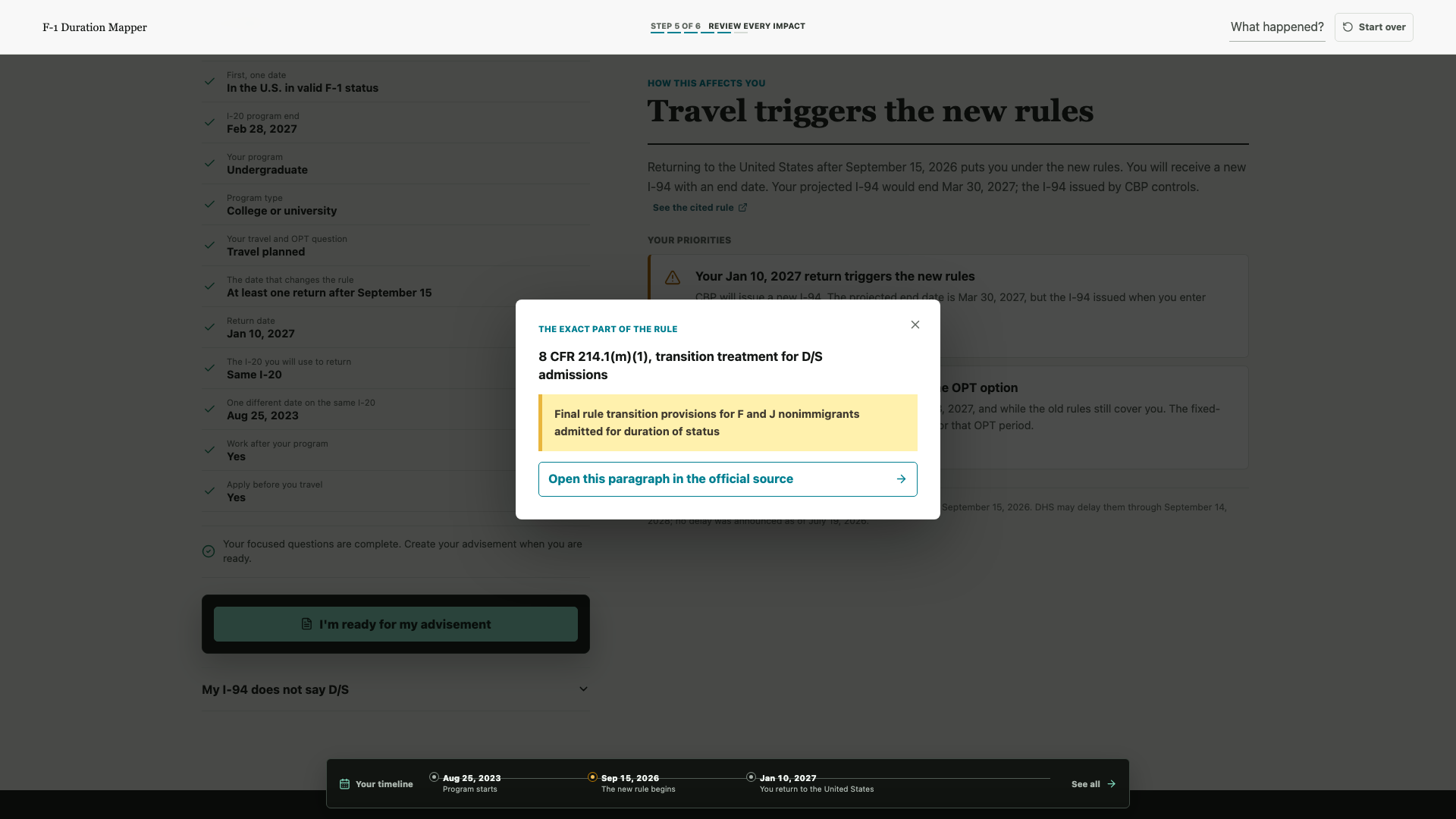
Every answer cites the operative regulatory text. This isn't a chatbot with vibes about immigration law — it's a reasoning layer over the precise corpus of the new rules, and built by someone whose day job is being accountable for getting these answers right.
But this is not a replacement for DSO advice. This two audiences, one tool: students get clarity and next steps; DSOs get triage — the tool absorbs the thousand identical questions so advising appointments can go to the hard cases where professionals excel.
How we built it
After having foundational conversations with multiple LLMs, including Chat GPT, I asked them to create a handoffs for Codex. I then built the mapper end-to-end in Codex with GPT-5.6. The final and implementation completed using GPT-5.6 Sol at Ultra.
The regulatory core: We translated the final rule into a deterministic TypeScript engine. Confirmed facts produce the same classification, deadlines, consequences, timeline events, and citations every time. GPT-5.6 never calculates a legal deadline or decides which rule applies. Before generating the final report, the server recalculates the case and gives the model only verified findings and source references to explain.
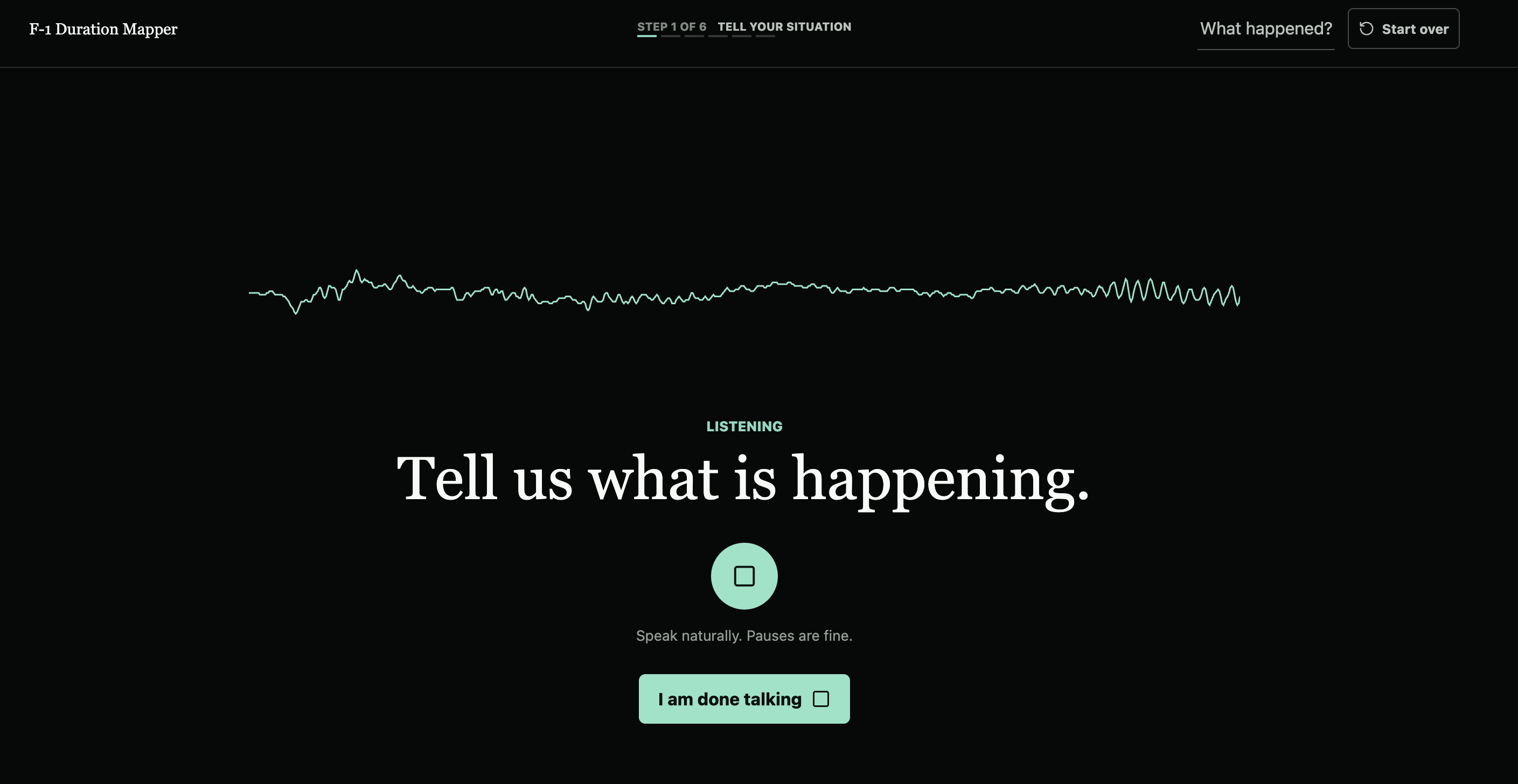
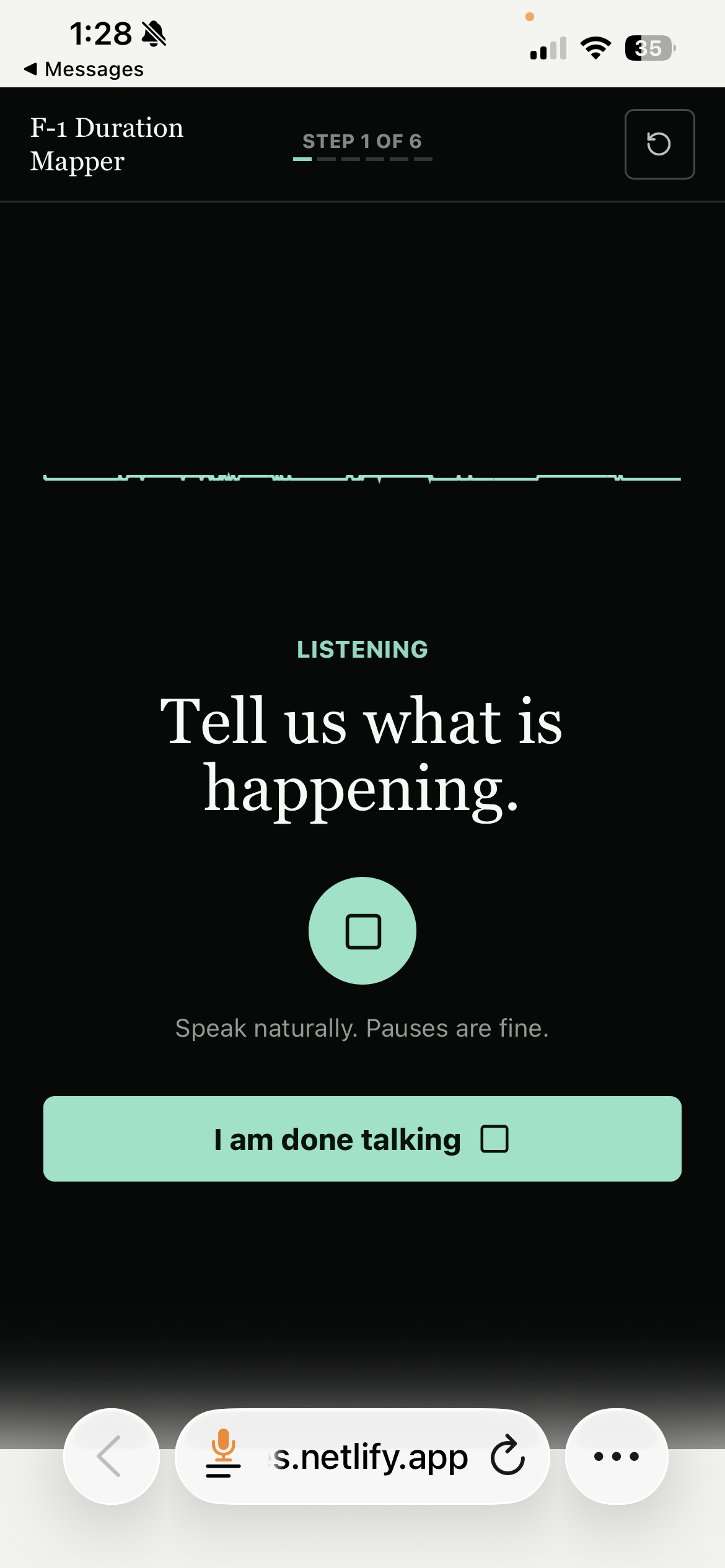
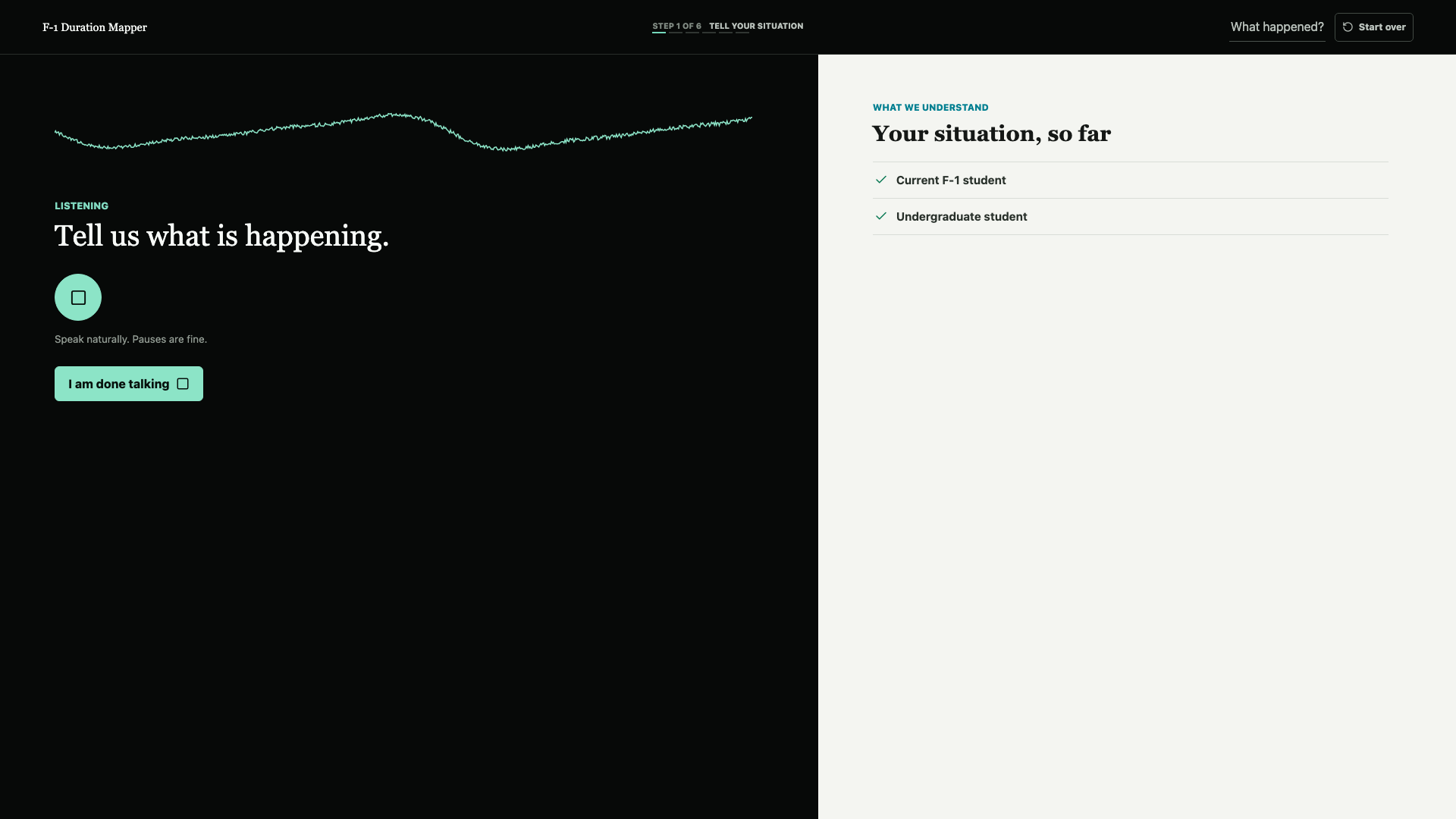
The intake: Every student first confirms whether they will be in the United States in valid F-1 status on September 15, 2026. They can then speak, type, or take a full interview. GPT-5.6 Luna converts their story into structured facts, concerns, and separate events such as completed study, current OPT, travel, and a future program. The student sees what was understood, while contradictions, uncertain dates, and missing controlling facts become plain-language follow-up questions asked one at a time.
The stack: React 19, TypeScript, Vite, and Vitest on the frontend; Netlify Functions and the OpenAI Responses API on the backend; GPT-5.6 Luna for bounded intake extraction and GPT-5.6 Sol for the final advisor report and follow-up conversation. Browser speech recognition captures the story, while the Web Audio API powers the live oscilloscope. GitHub is the canonical repository and Netlify handles the deployment.
Where Codex accelerated the work: Codex scaffolded the first rules engine, traced regulatory text into source-linked logic, and built the original scenario test suite. When a real-shaped student case exposed that one flat record could not represent completed study, active OPT, travel, and a future program at once, Codex refactored the app around connected temporal events. Browser testing also caught a false OPT-before-travel recommendation and a voice-request race condition that ordinary unit tests missed. Each became a regression test. The final suite contains 112 passing tests across eight files.
Challenges we ran into
-The difficult part was knowing which facts actually control the answer, which questions a student can understand, and which outcomes are fixed by the rule versus dependent on USCIS, CBP, SEVP, or future guidance. That boundary is a design feature: the app calculates what can be calculated, gives useful conditional guidance where it cannot, and tells the student when human advising is still necessary.
The rule is brand new and the edge cases are live. Some legal consequences are explicit, while implementation details and agency practice remain unsettled. The app does not turn uncertainty into confidence. It preserves partial dates as estimates, blocks contradictory facts, distinguishes rules from discretionary outcomes, and identifies the missing fact or future guidance needed for a firmer answer.
Grounding an LLM in law. Regulatory guidance is not a place where "close enough" is acceptable. The model receives a server-generated evidence package containing the deterministic result, applicable rule areas, case events, and approved source IDs. Strict structured outputs constrain intake and follow-ups. Exact citations come from a fixed source registry and link to verified Federal Register paragraph anchors. Generated reports are rejected if they contain malformed output, internal process language, repetition, unsupported claims, or unfinished prose.
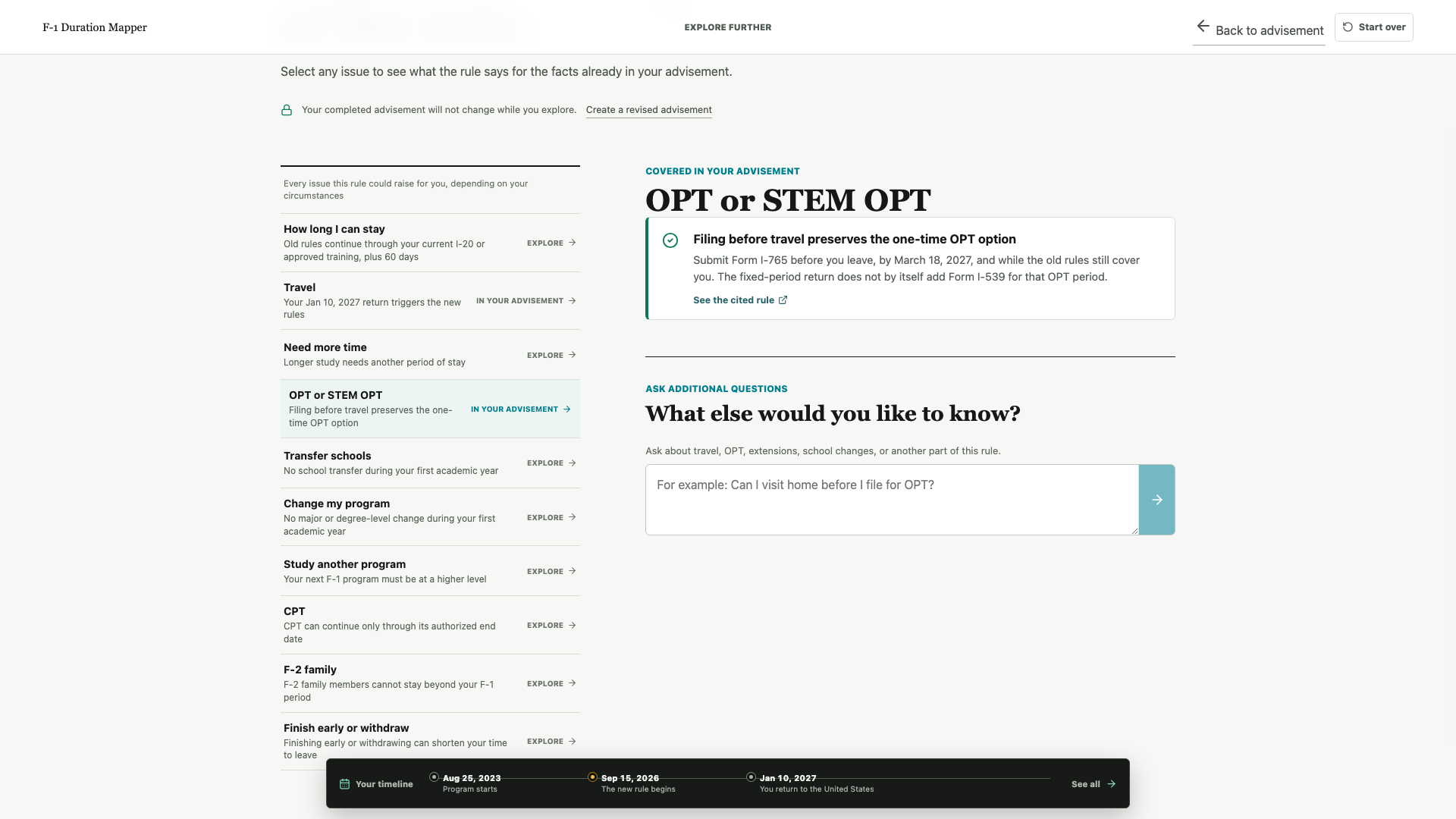
Scoping to four days. The complete problem could become an entire international-student compliance platform. The Build Week version focuses on one rule, one student, and one connected case. It covers the highest-value F-1 effects completely enough to produce a personalized map, dated timeline, source-linked advisement, and rule-scoped follow-up conversation.
Accomplishments that we're proud of
-Shipping a working tool for a rule in under a week. The gap between a Federal Register rule and a student checking their own situation closed in days, not months.
- Building in honest uncertainty. The app gives every supported result available, but it will not invent a date, conceal a contradiction, or present an agency decision as guaranteed.
- Creating a temporal case model that keeps completed programs, current training, travel, future study, and pending petitions distinct while showing how they interact under one rule.
What we learned
Technical lesson:** AI was most reliable when it had a bounded job. GPT-5.6 is excellent at understanding a student's unstructured story and assembling a coherent explanation, but deterministic code should remain authoritative for dates, legal classifications, contradictions, and citations.
Product lesson: A student is not one scenario. They are a sequence of connected events with overlapping concerns. A concern-first experience worked better than a traditional decision tree: address why the student came, show every other applicable impact briefly, and let the student choose how deeply to explore each one.
What's next for F-1 Duration Mapper
This sits inside a larger portfolio of tools I've built as a practicing DSO — including a DSO assistant grounded in 500+ F-1/SEVIS regulatory sources that I use daily in my own practice, a prototype i-20 intake portal, and other tools in development. The vision is a light-weight, AI-forward, intuitive workflow suite for smaller, lower resourced schools that enterprise SaaS overlooks.
The million students affected by this rule mostly don't know it exists yet. They have until September 15. This tool is what I'd like in their hands before they find out

Log in or sign up for Devpost to join the conversation.