Inspiration:
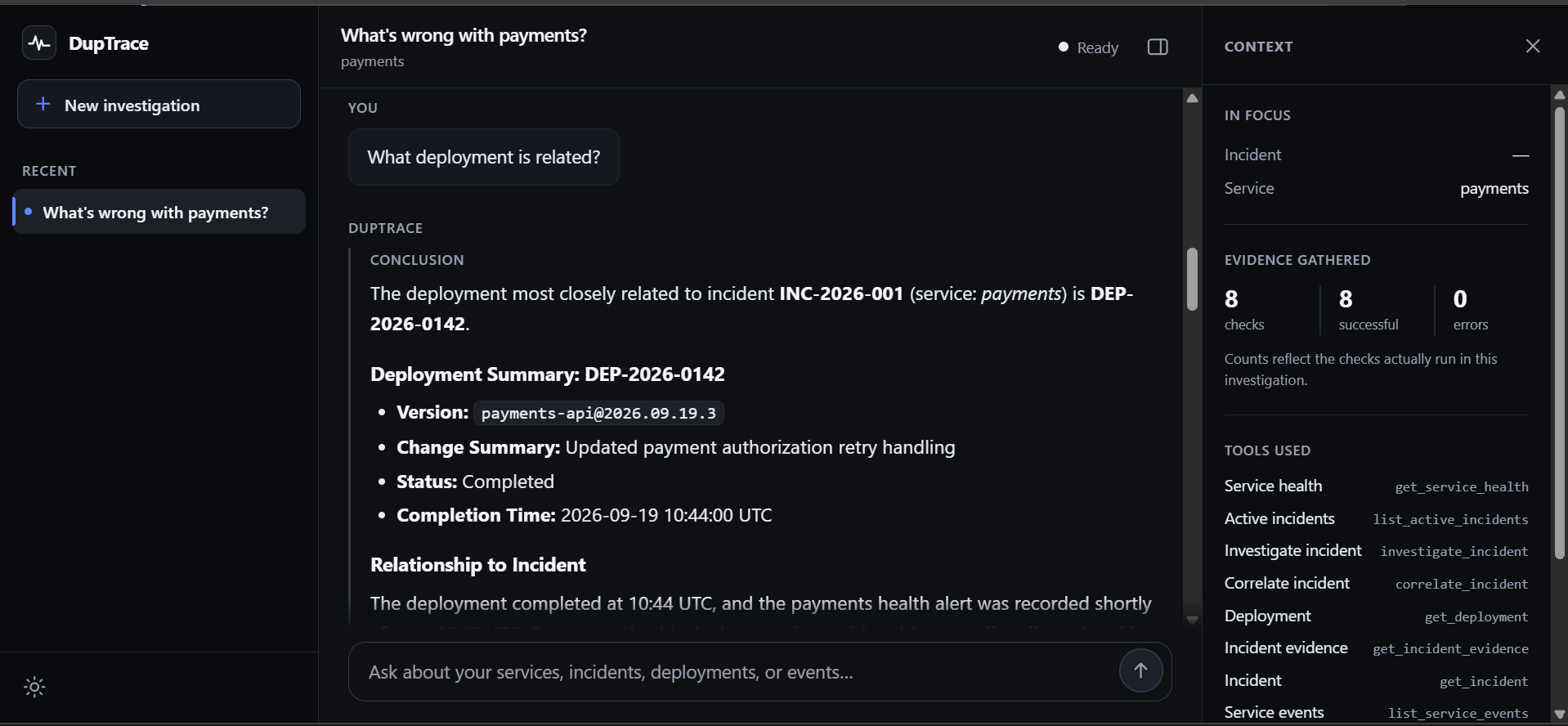
When a production incident occurs, developers often need to piece together information from service health metrics, deployment history, event logs, and incident timelines. Finding relevant evidence can be slow, and a deployment that happened shortly before an incident can easily be mistaken for its cause.
I built DupTrace to make incident investigation more structured, transparent, and evidence-driven.
What it does :
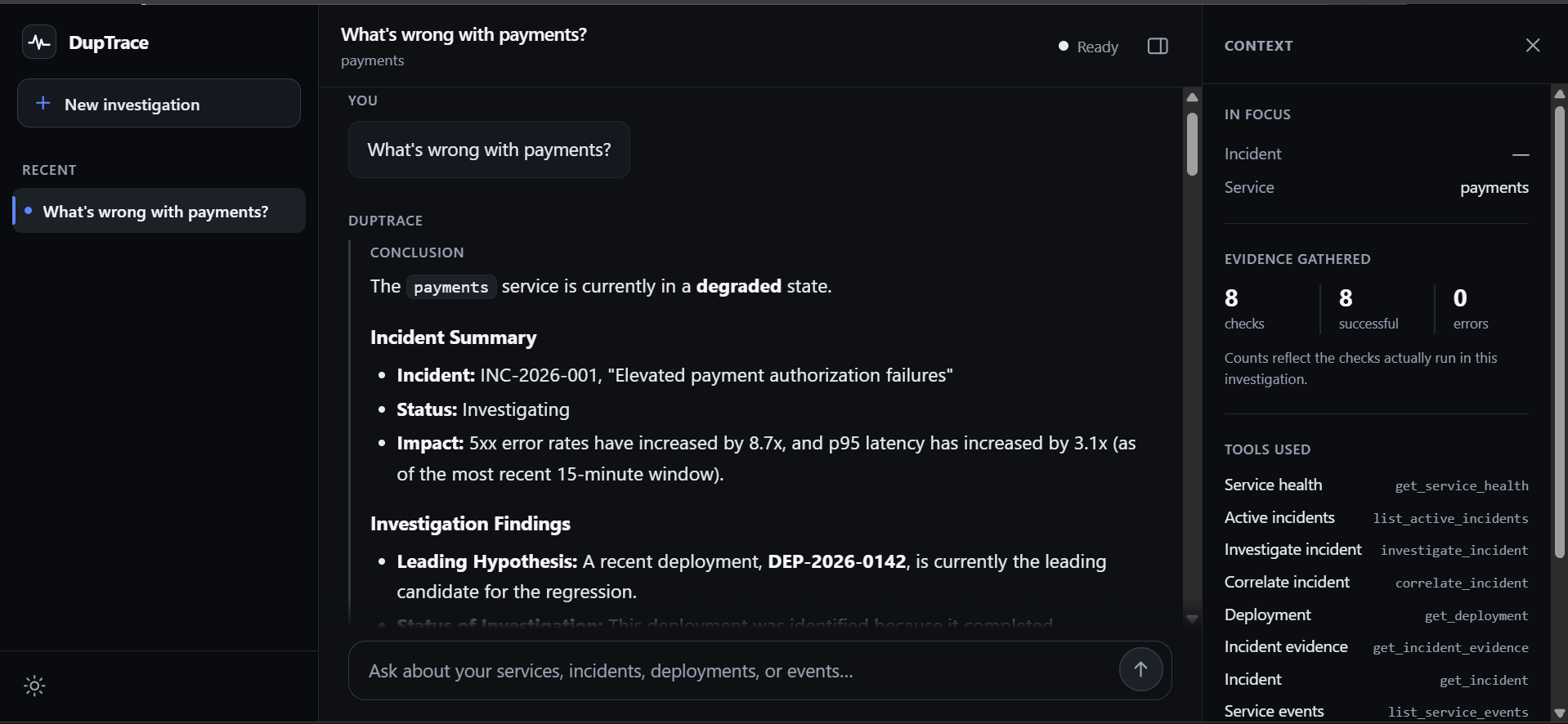
DupTrace is an evidence-first incident investigation assistant that helps developers investigate service failures by bringing incident details, service health, deployments, and service events into one workflow.
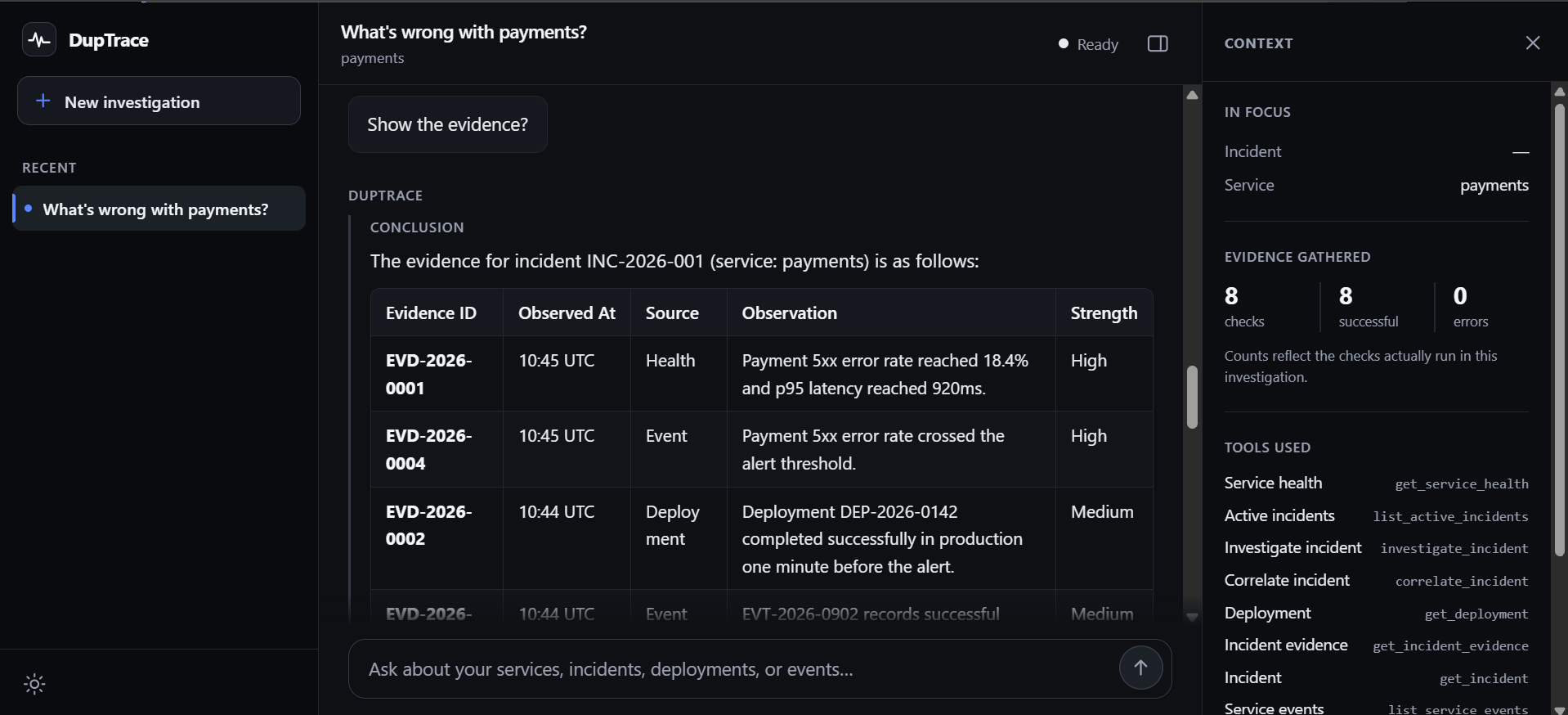
It uses the Model Context Protocol (MCP) to expose investigation tools that an AI assistant can use to retrieve information, correlate events across a timeline, and organise findings. Developers can inspect the supporting evidence instead of relying solely on an AI-generated explanation.
A core principle is that correlation is not proof of causation. DupTrace distinguishes observed evidence from hypotheses and makes uncertainty explicit when the available information does not establish a definitive root cause.
How I built it :
I built DupTrace using Node.js and Express for the backend, an MCP server for the investigation tools, and a web interface for exploring incidents and findings. The tools expose read-only operations for retrieving incident details, service health, deployment records, and service events.
The application coordinates tool calls, streams assistant responses, maintains relevant follow-up context, and presents investigation findings in an interface where evidence can be examined.
The demo uses deterministic scenario data so the investigation can be reproduced consistently without presenting simulated telemetry as live production data.
Challenges I faced :
One major challenge was keeping the investigation grounded in evidence. AI models can produce convincing explanations even when the available data only shows a relationship between events. I addressed this by separating observations from hypotheses and making the limits of the evidence clear.
Another challenge was coordinating the model, MCP tools, backend, and frontend into a coherent workflow. Deployment configuration, tool communication, error handling, and response rendering all required careful testing.
What I learned :
Building DupTrace taught me that useful AI developer tools need more than a capable model. They need reliable tool integration, inspectable evidence, controlled context, and clear boundaries around what the system can conclude.
MCP provided a structured way to expose investigation capabilities to an AI assistant. The project reinforced my belief that AI should help developers reason through evidence rather than ask them to trust unexplained conclusions.
What's next :
I want to extend DupTrace with integrations for real observability platforms, richer evidence visualisation, persistent investigations, and evaluation against known incident scenarios.
The goal is simple: help developers investigate incidents faster without confusing plausible explanations with proven causes.
Built With
- alexa+
- amazon
- analysis
- api
- application
- developer
- devops
- events
- evidence-based
- express.js
- incident
- integration
- intelligence
- javascript
- management
- mcp
- model
- monitoring
- node.js
- protocol
- reliability
- server-sent
- tools
- web

Log in or sign up for Devpost to join the conversation.