-
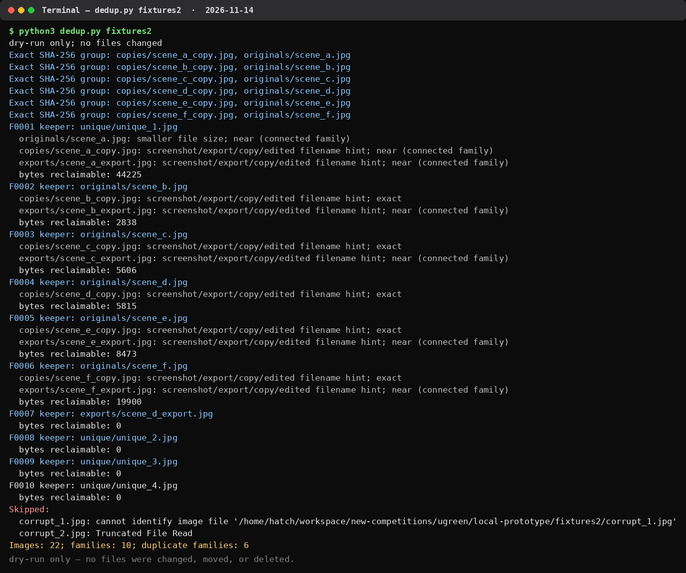
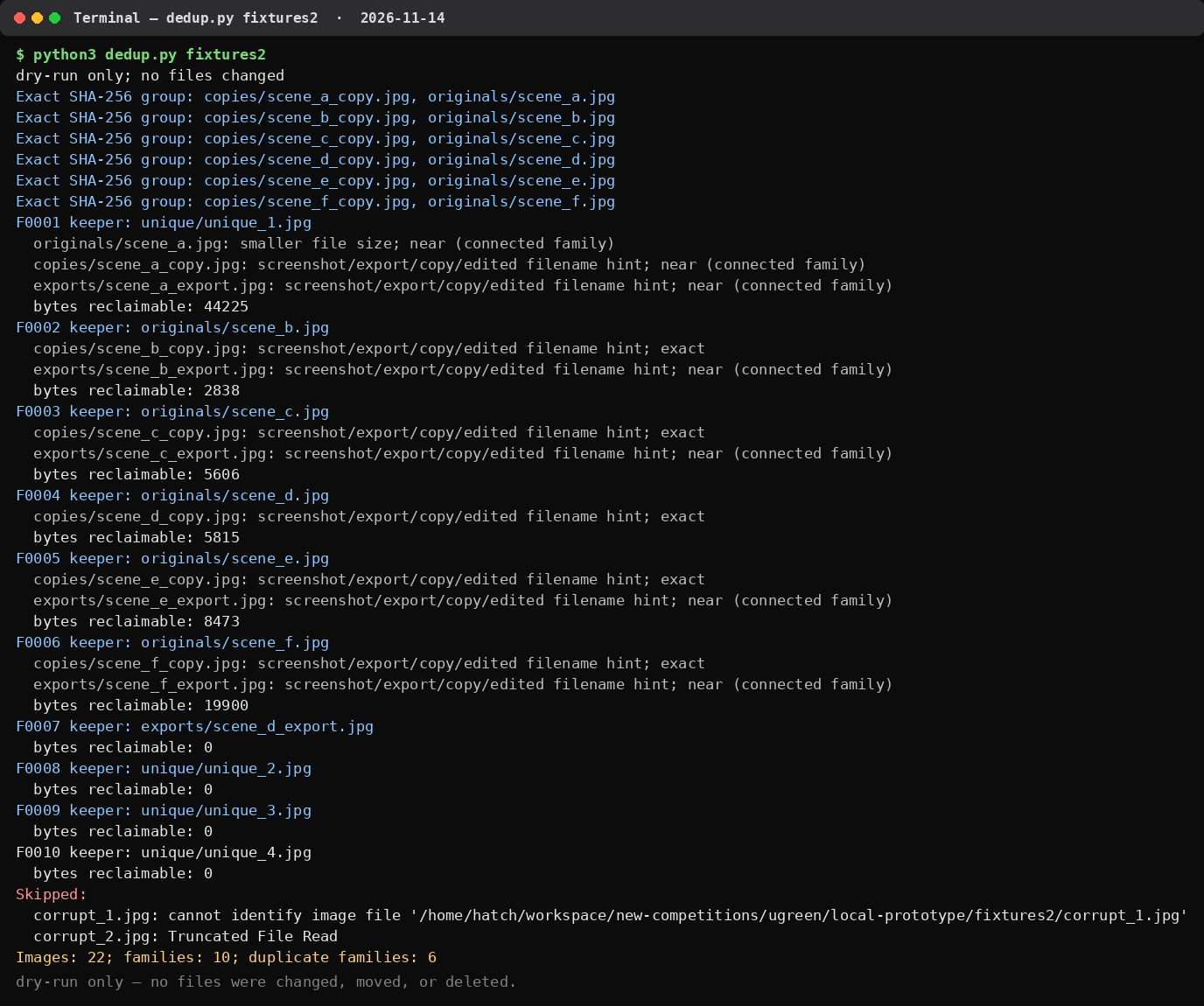
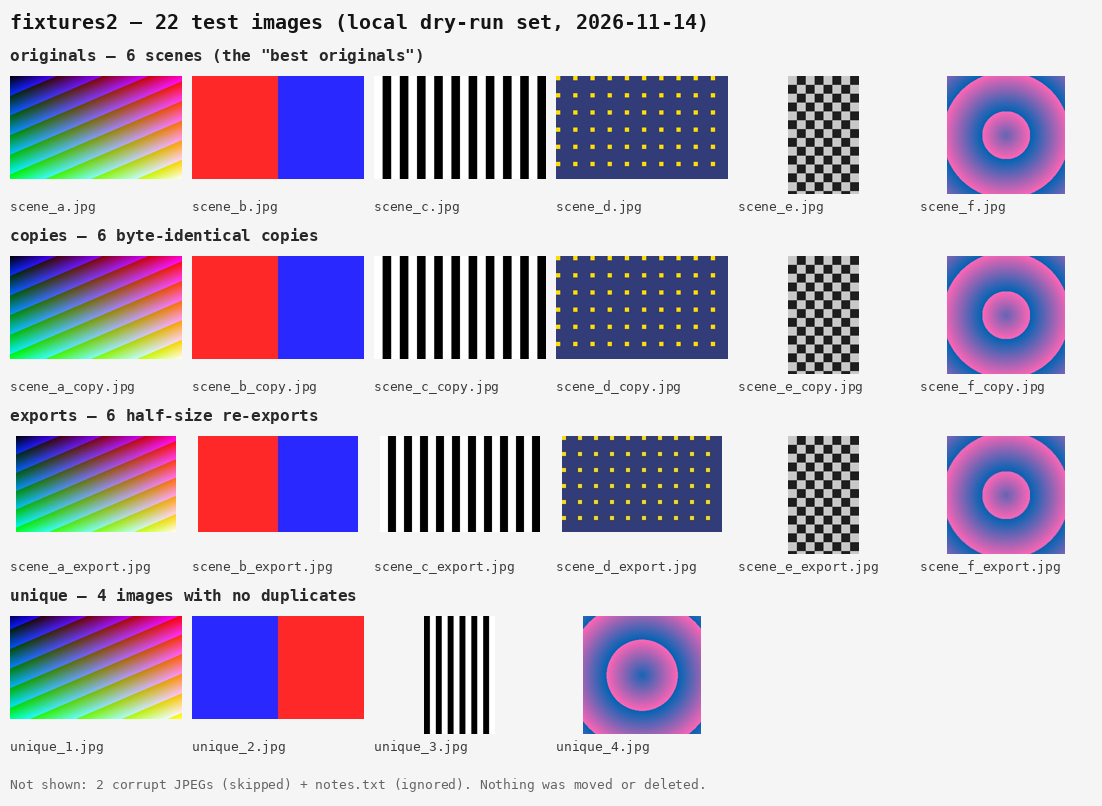
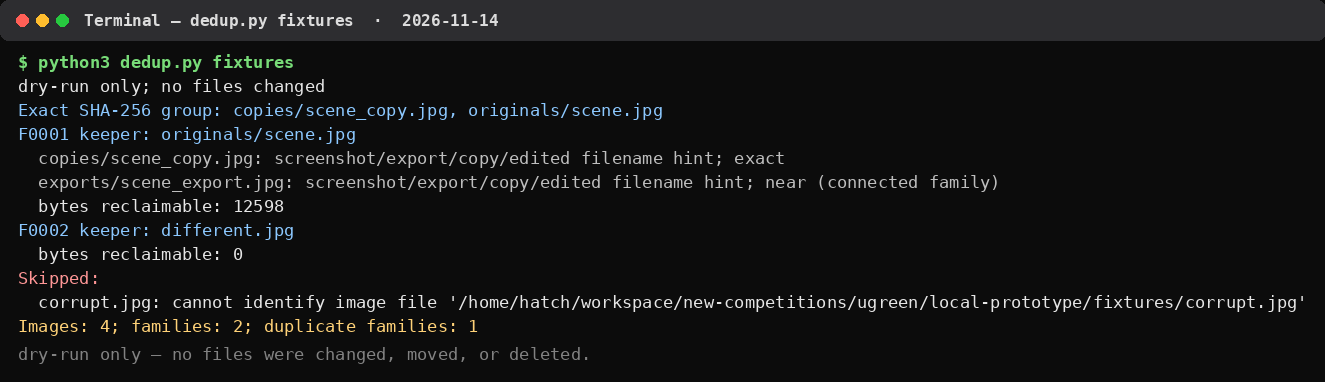
Dry-run output on the 22-image test set, 2026-11-14. Nothing was moved or deleted.
-
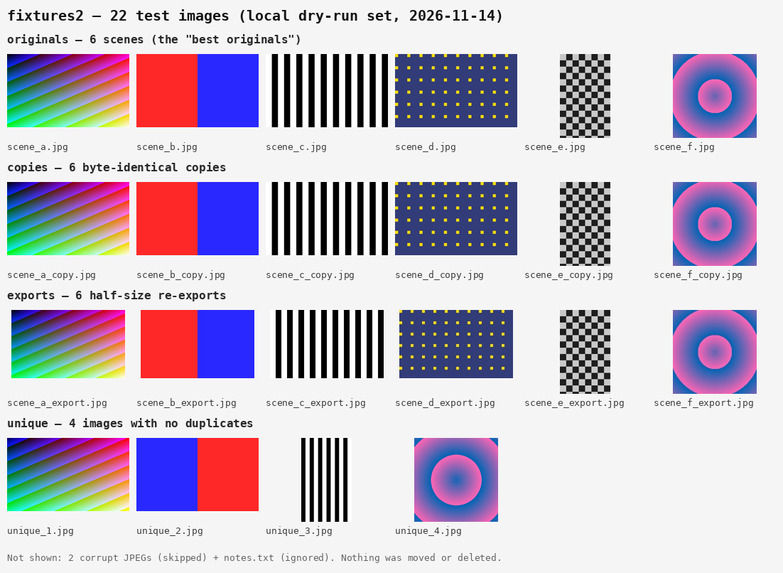
The test set: 6 originals, each with an exact copy and a half-size re-export plus 4 unique images. 2 corrupt files and 1 text file not shown
-
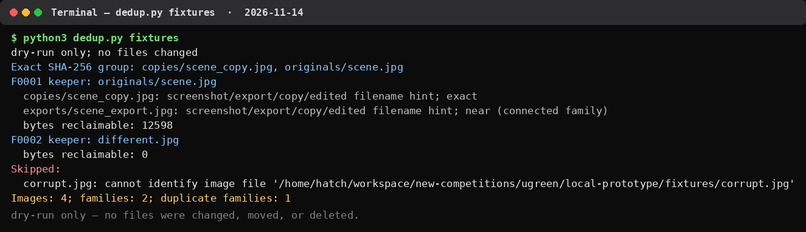
The original verification run, reproduced 2026-11-14: 1 duplicate family, 12,598 bytes reclaimable.
Duplicate Family Triage is a UGOS Skill (Automate Your Workflow track) that finds exact and near-duplicate photos plus exact-duplicate videos in authorized NAS folders. Each duplicate set is grouped into one family; the Skill picks the best original and — only after explicit confirmation — moves the rest to reversible quarantine (30 days by default) with a report. No file is ever deleted automatically.
Built so far: only a local dry-run prototype on test images on a computer. Real-NAS testing has NOT been done yet. UGOS installation and Uliya wiring are NOT built. Real photo libraries, album-membership updates, and quarantine restore on the iDX6011 Pro are planned for the Finalist stage only.
No demo video is required for Round 1.
What I measured (local dry-run, 2026-11-14)
Nothing on this page has been tested on a real NAS yet — that is Finalist-stage work. What I tested, for real, is the grouping logic, with a local dry-run prototype on test images. No file was moved, changed, or deleted in any run.
Small set (the original verification set, re-run 2026-11-14): 6 files (4 images) scanned — 1 exact SHA-256 pair and 1 half-size re-export grouped into one family with the original as keeper (12,598 bytes reclaimable, as in the 2026-10-25 verification); 1 different image kept separate; 1 corrupt JPEG skipped; 1 non-image file ignored.
Larger set (25 files, 22 images, built 2026-11-14 to mimic repeated imports — 6 originals, each with one byte-identical copy and one half-size re-export, plus 4 unique images, 2 corrupt files, 1 non-image file): All 6 exact copies found by SHA-256. 5 of 6 re-exports grouped as near-duplicates by perceptual hash. The tool reported 86,857 bytes reclaimable; 68,086 bytes of that are verified correct (see below). 2 corrupt files skipped, 1 non-image file ignored, nothing moved or deleted.
What the prototype got wrong — and why the safety design exists: the perceptual hash merged one genuinely different image (a smooth gradient that looks almost identical to another scene at 8×8 resolution) into the wrong family, and the keeper rule then picked the wrong keeper for that family — it kept the gradient and marked the real original as reclaimable. Separately, one re-export (a dot pattern at half size) was missed and left as a single. So the tool's own report of 86,857 reclaimable bytes is inflated by the false-positive family; the verified-correct figure is 68,086 bytes (non-keeper files in correctly grouped families only, with the false-positive family re-counted by hand — 18,771 bytes less, exactly the size of the real original that was wrongly marked reclaimable). This is exactly why the design requires per-family confirmation before anything moves, and why quarantine is designed to be reversible for 30 days: matching is imperfect, so the design does not let a guess delete — or even move — a file on its own. The report flags every keeper decision with its reason (as in this run's report), so a wrong keeper is visible before anything happens.
Still not built / not tested: UGOS installation, Uliya trigger wiring, real photo libraries, album-membership updates, and quarantine restore on the UGREEN AI NAS iDX6011 Pro. Those are Finalist-stage tests only.
Code (MIT): https://github.com/hahahahahahahahah6/duplicate-family-triage
Built With
- markdown
- ugos
- uliya
