-
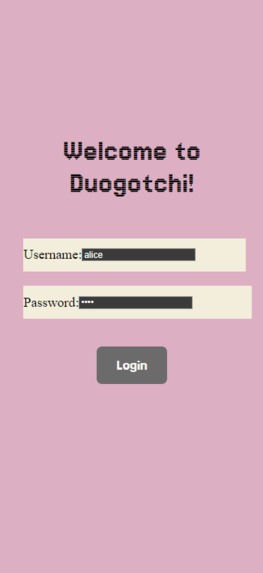
Login Screen
-

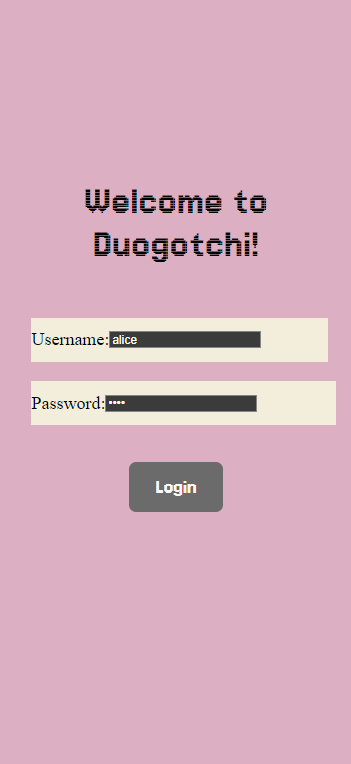
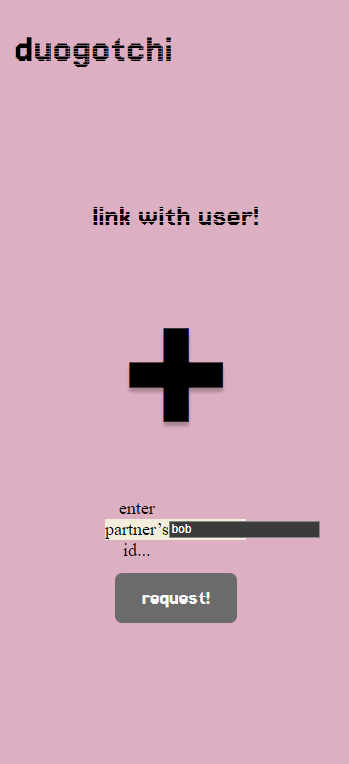
Partner Linking Page - Link by Username
-
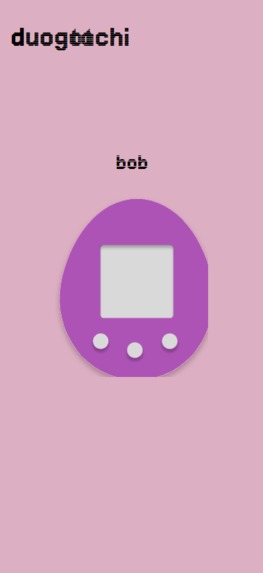
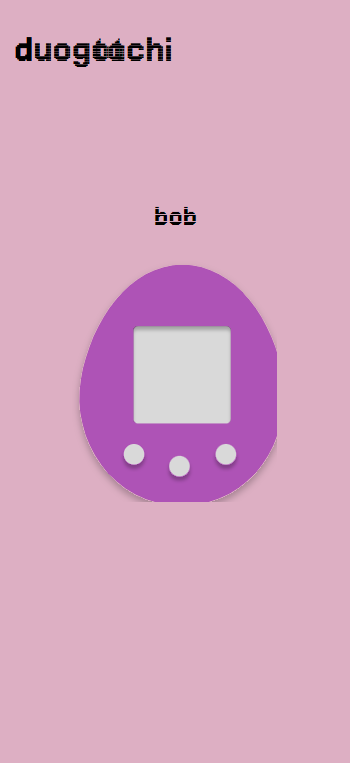
Selecting which pet to look at
-
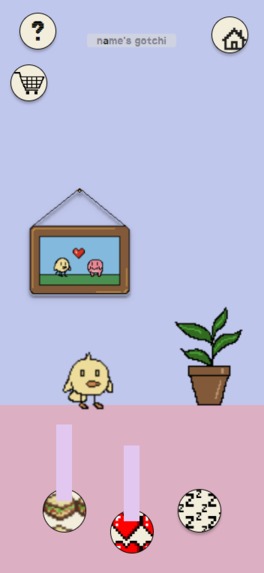
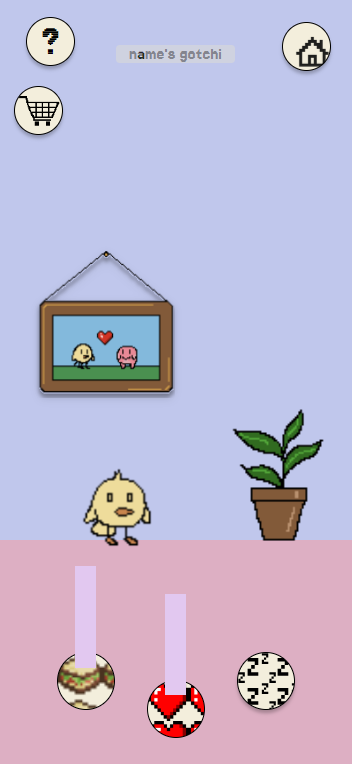
It's your partner's pet! Treat it well!
Introduction:
Our project is a JavaScript, HTML/CSS-based web app called Duogotchi. It’s a cute game for couples that emulates the retro charm of Japanese Tamagotchis, but with a reimagined virtual and collaborative element. In it, players can link with their partner’s account to take care of each others’ virtual pets by keeping their pets’ fullness, attention, and rest meters full. In practice, the gameplay is very simple: players only need to log in periodically and click three buttons to restore the meters. Couples are rewarded most (through pet growth, health, and in-game currency for visual customizations) when they both regularly contribute to taking care of each others’ pets, encouraging frequent connection between partners. Furthermore, the three actions associated with caring for the virtual pets – feeding, giving affection, and encouraging rest – were chosen to mirror essential acts of care in a healthy relationship, fostering habits of nurturing, love, and balance between partners. So, Duogotchi is really for any kind of relationship: whether it is new and fresh, older and more established, long-distance, or no-distance, our game is designed to help you flourish together.
Implementation and Challenges Faced:
This app is implemented using an object-oriented approach in the back-end and a vue.js interface for the front end. The UI was created using Figma and implemented into the GUI via HTML/CSS, with some pixel art sprites being drawn in Krita. This app is implemented using an express.js backend and Vue.js front-end. The backend is organized as an Object-Oriented program to implement data types while interfacing with an express.js REST API web server using GET and POST requests. Meanwhile, the client and UI was originally designed using Figma and is programmed with Vue.js and Vite. One of the biggest challenges on the backend was ensuring the functionality while development was ahead of the frontend. Unit tests were performed on the web server to ensure the functionality was behaving as intended, and this resulted in hours of ensuring the unit tests did what they needed to do. A major challenge overall was the lack of experience which most of our team had. Beyond having to learn multiple programming languages on the fly, this project was also the first web project which most of us had worked on, so the tech stacks and incredible number of tools available were somewhat overwhelming to our inexperienced members. Despite all the headaches and sleep deprivation we faced, we are proud to have created what we did.
Inspiration and Ideas for the Future:
Love is complicated! Our team, having a very diverse set of experiences with relationships, was inspired to create a simple and light-hearted game that could address relationship issues such as inconsistent communication in long-distance couples, apathy or boredom that may develop within a longer relationship, or tension relating to a partner not taking care of themselves. Of course, relationships come in many different forms; our intention is that our cute little web game is inclusive as possible. We refrain from using stereotypes about gender, race, and age in our game; however, we based Duogotchi around relationships between only 2 people for the sake of convenience (and a cute name) during development. Thus, a natural point of progression is to make it possible to link more than 2 accounts together. We also recognize that our concept, which at its core is about enabling regular and frequent human connection, can be grown in many directions. For instance, we could expand our collaboration system to non-romantic relationships such as friendships or parents and children; alternatively, we could maintain our focus on romantic relationships and incorporate a dating app-like matching system for players who don’t have someone to link with.
Built With
- defang
- express.js
- figma
- html
- javascript
- vue


Log in or sign up for Devpost to join the conversation.