-
-
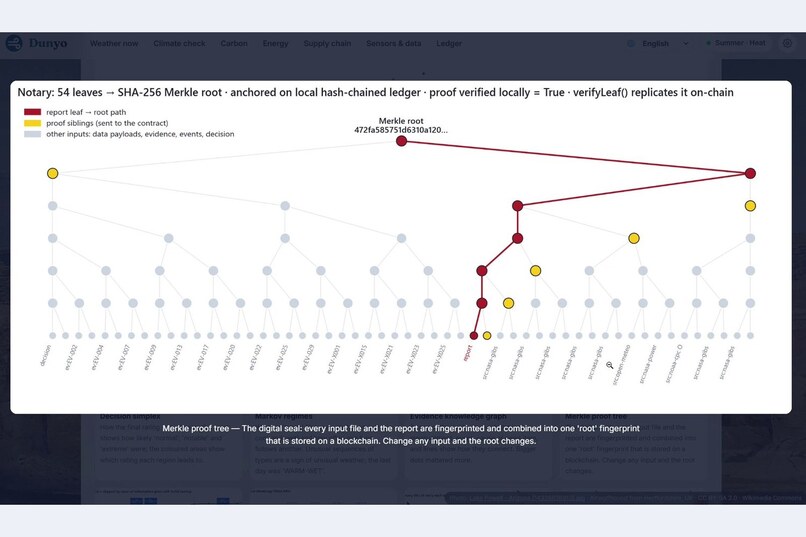
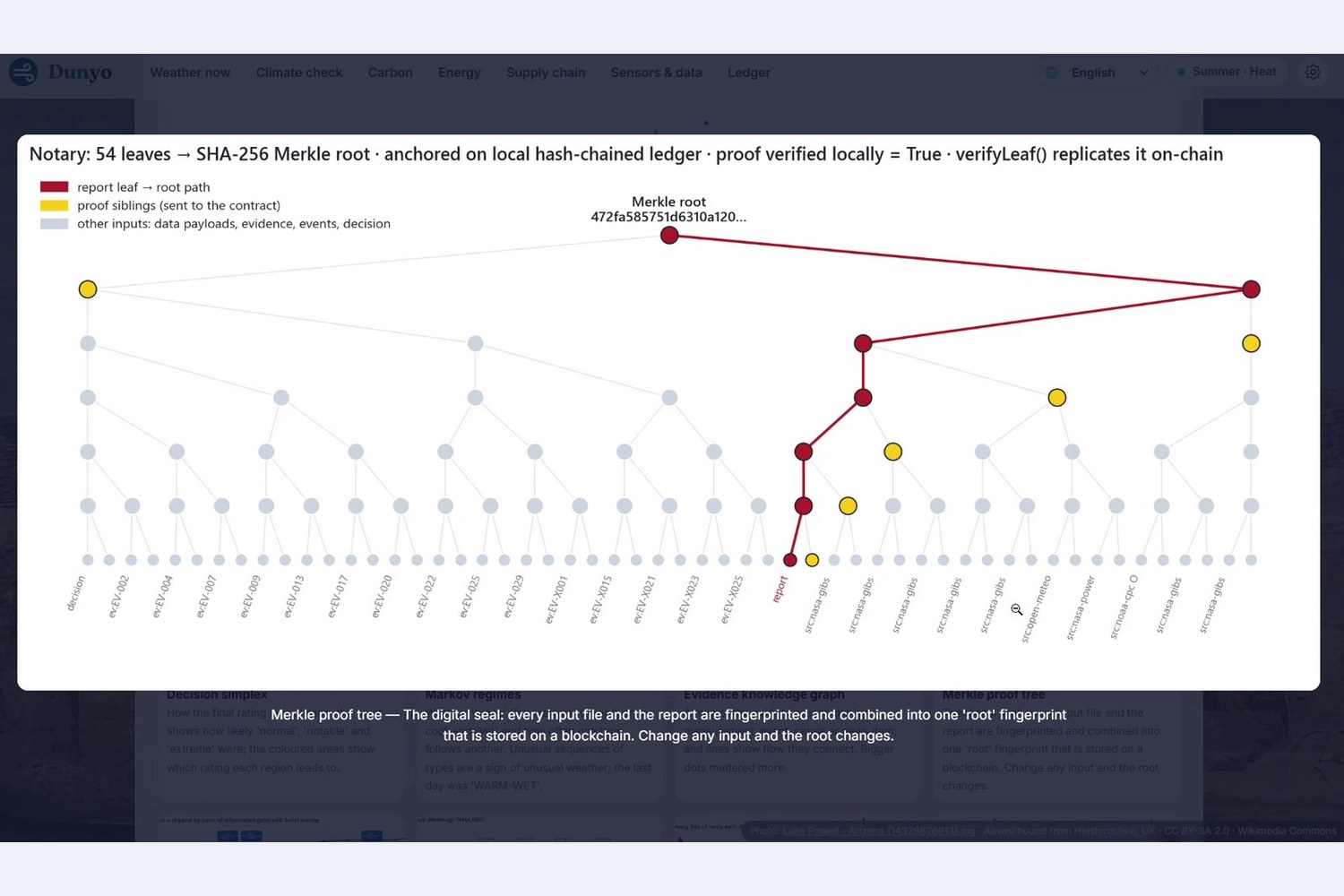
For experts: the Merkle proof that seals every input and result of an investigation.
-
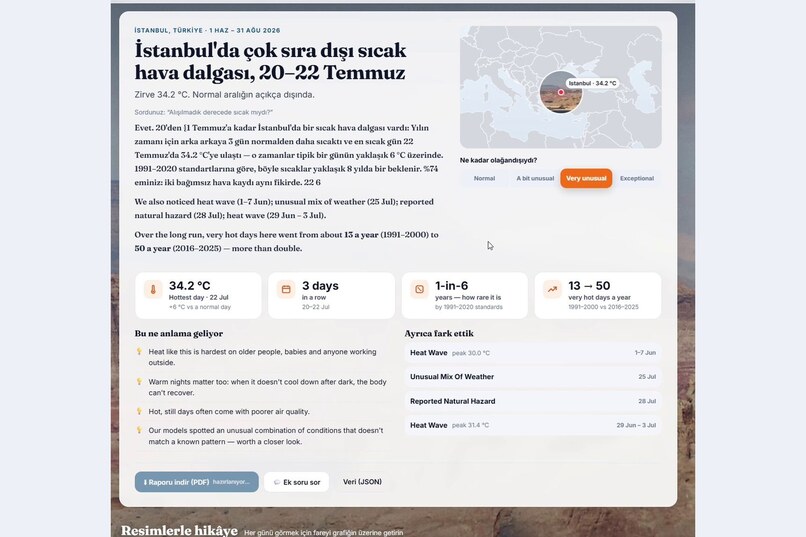
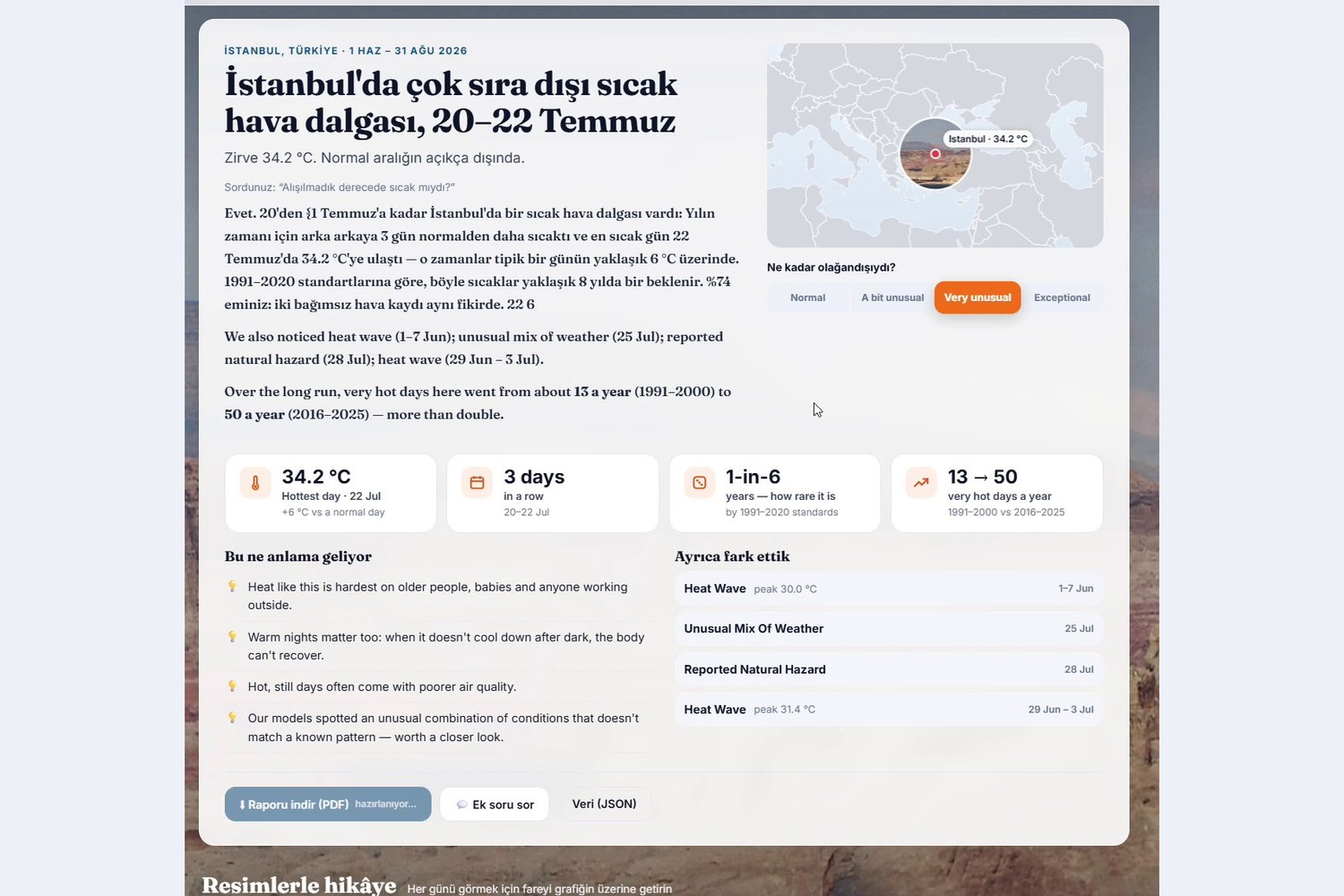
Istanbul in Türkçe: the whole app, the answer and the charts switch language instantly.
-
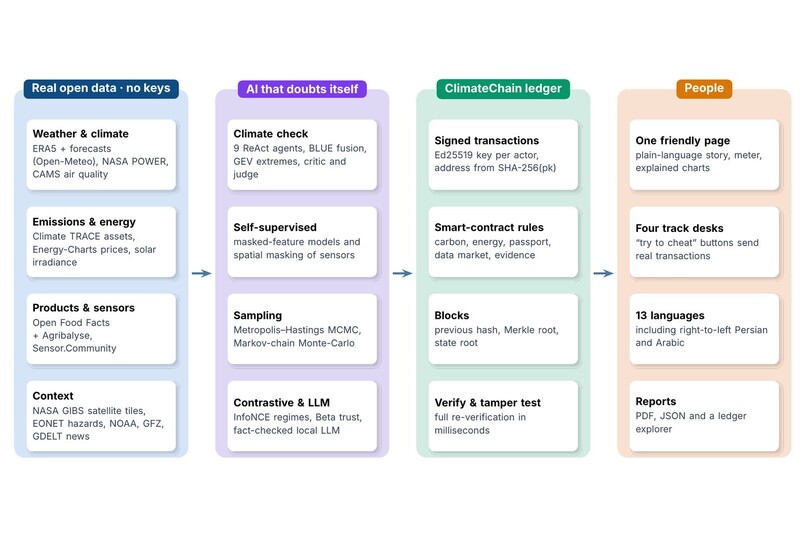
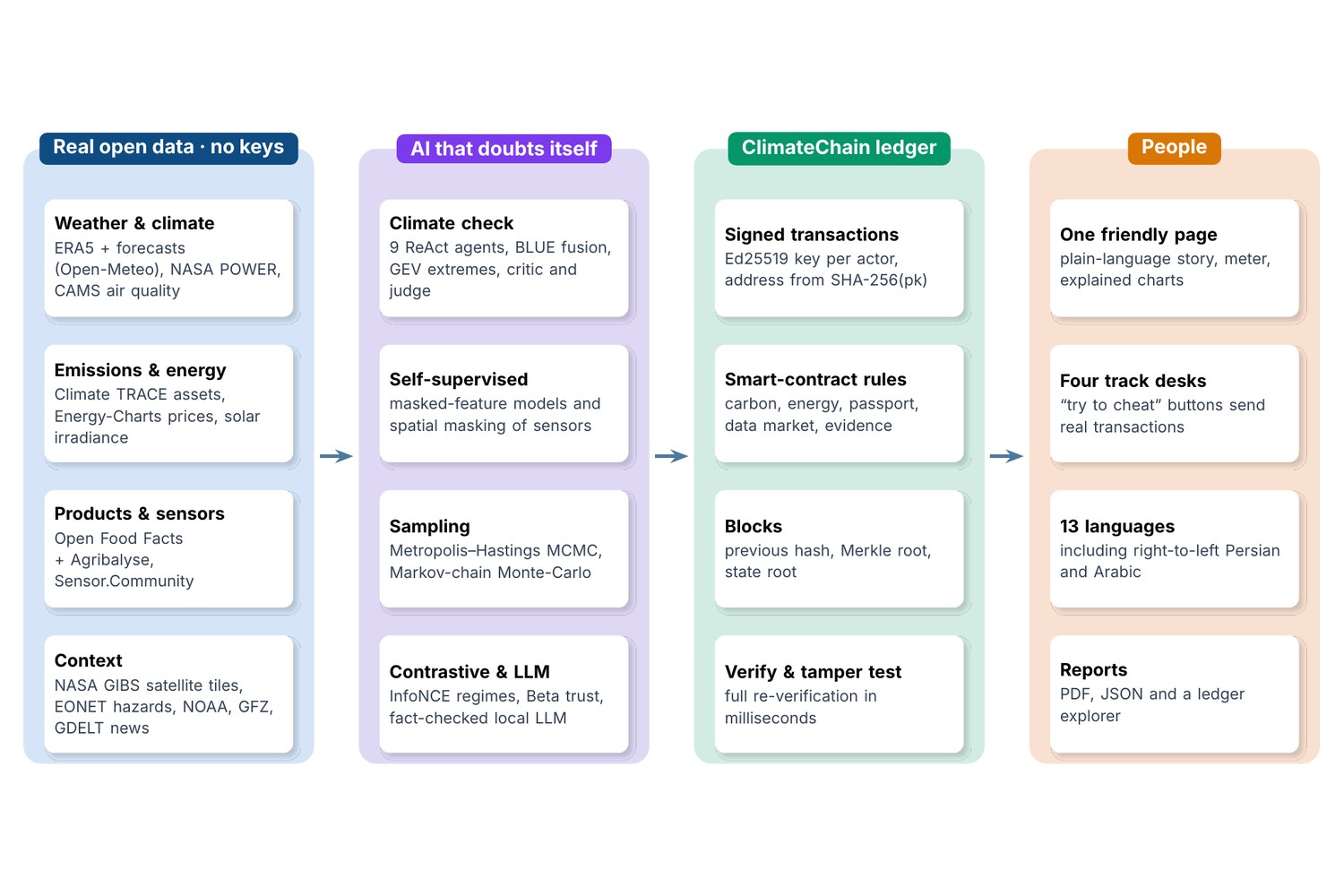
How Dunyo works: real open data, AI that doubts itself, ClimateChain, and a plain answer for people.
-
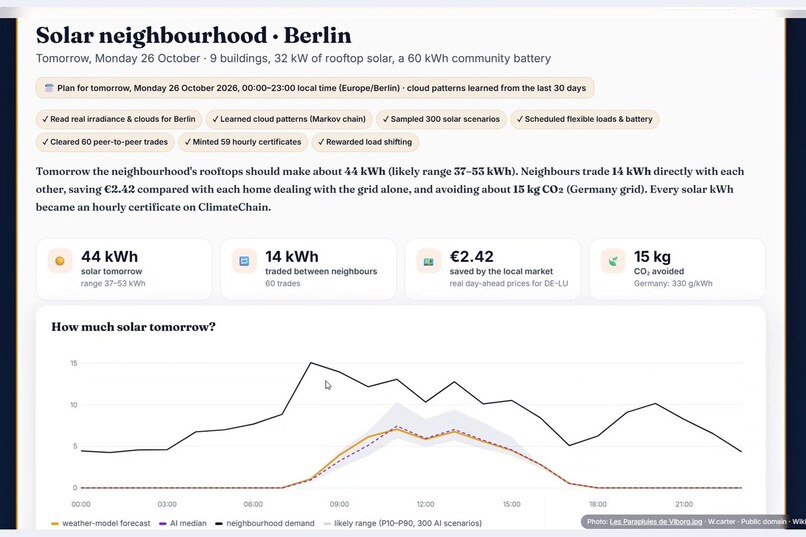
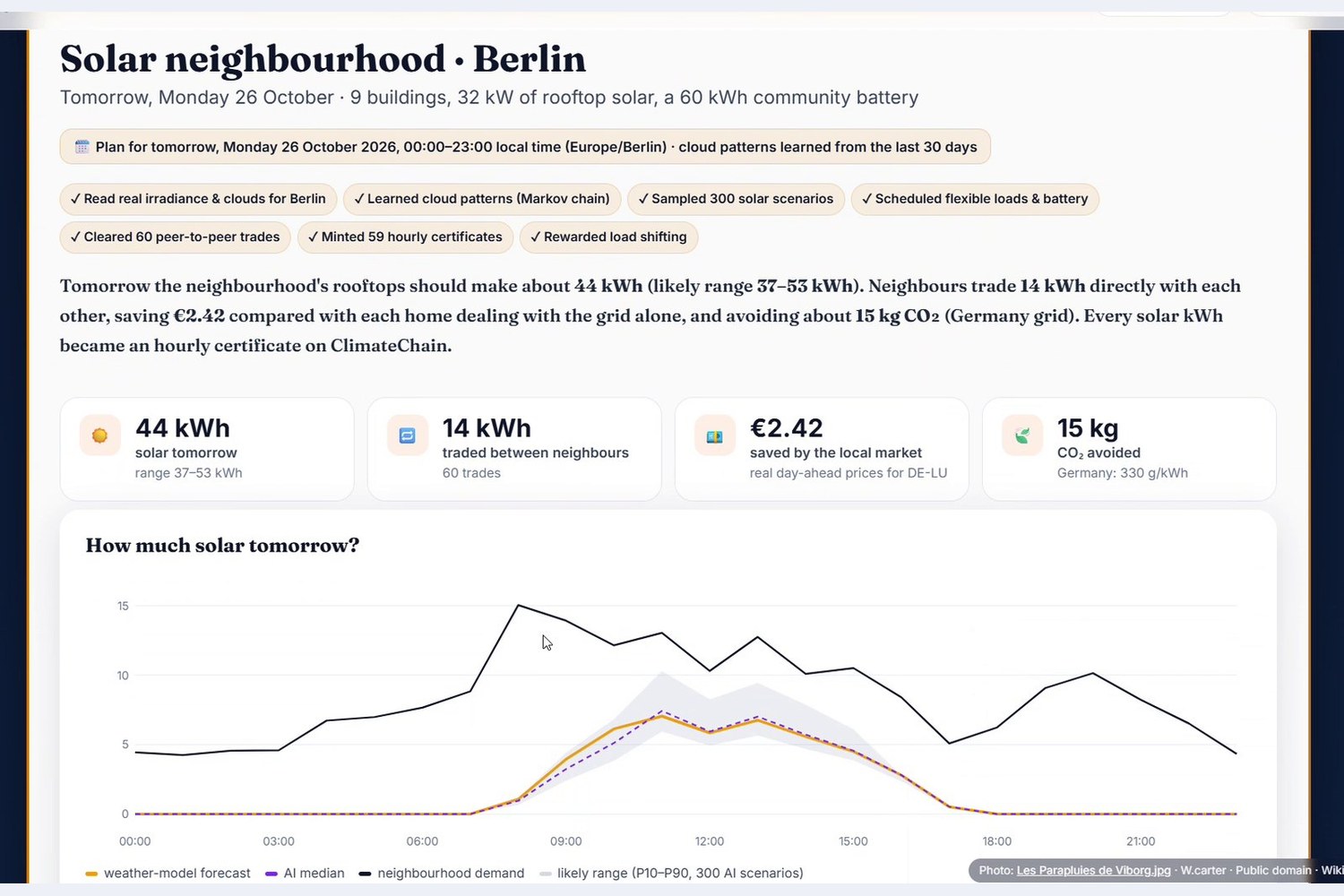
Track 2: a solar street plans tomorrow with the real forecast and prices, and neighbours trade energy hour by hour.
-
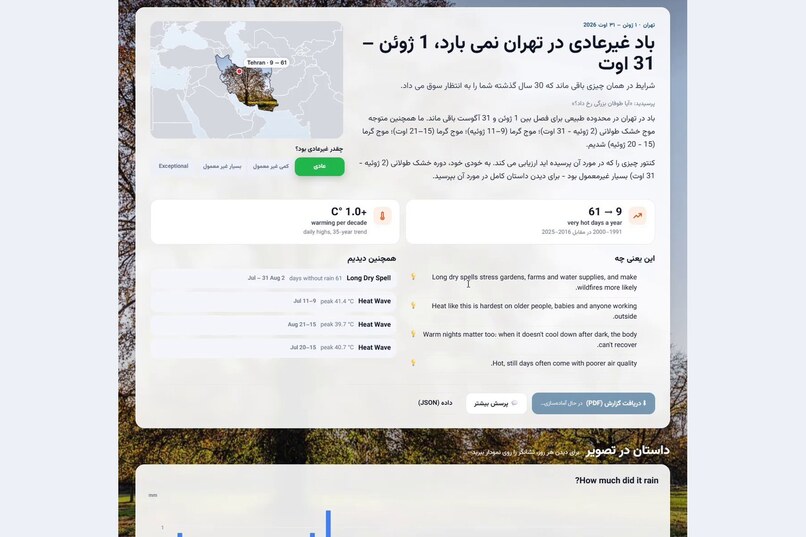
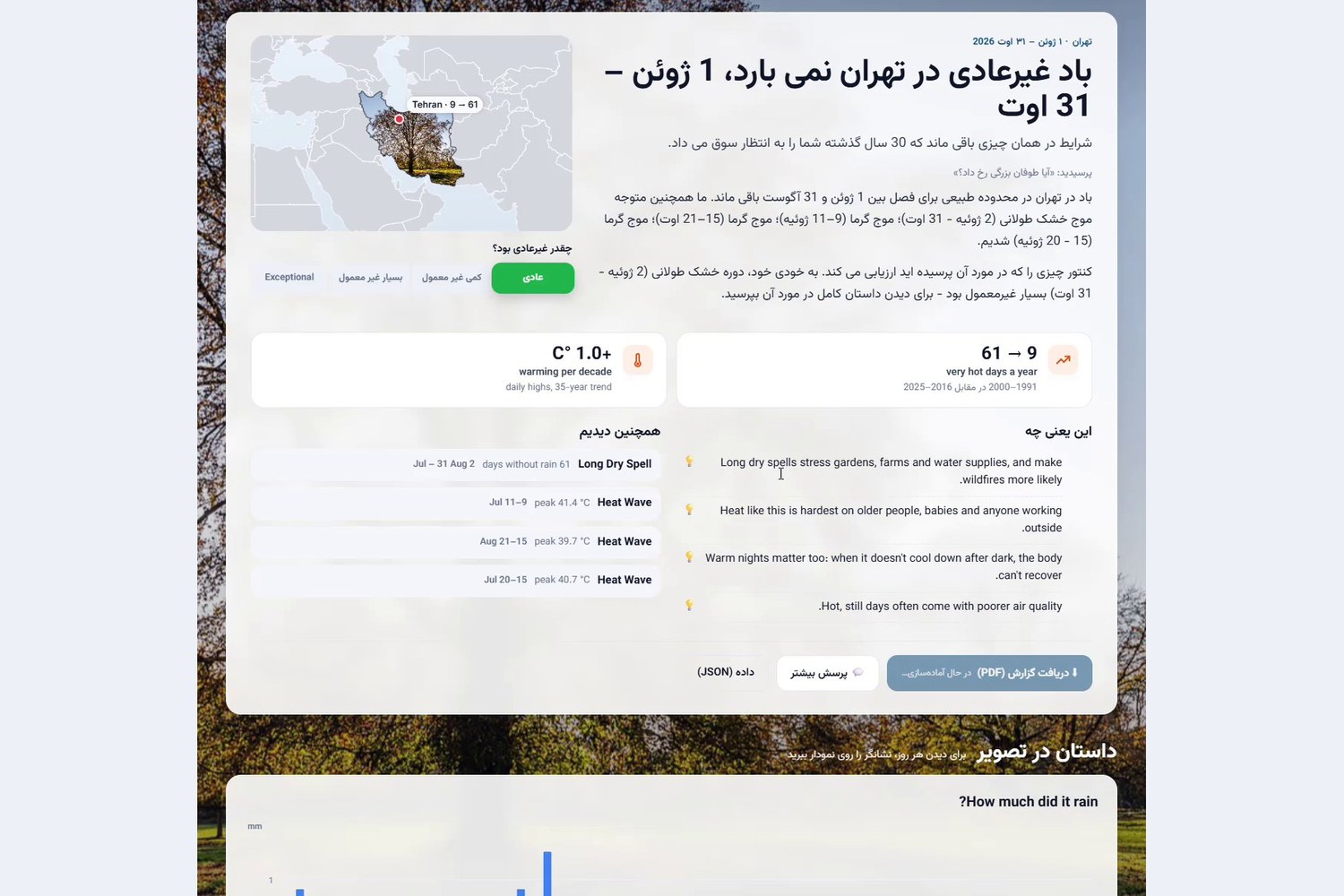
Tehran in فارسی: the layout flips right to left, and every translated number is checked.
-
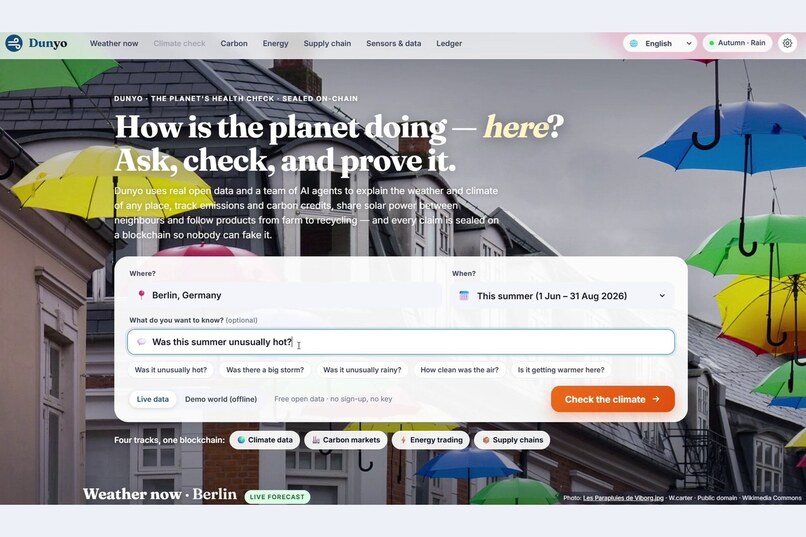
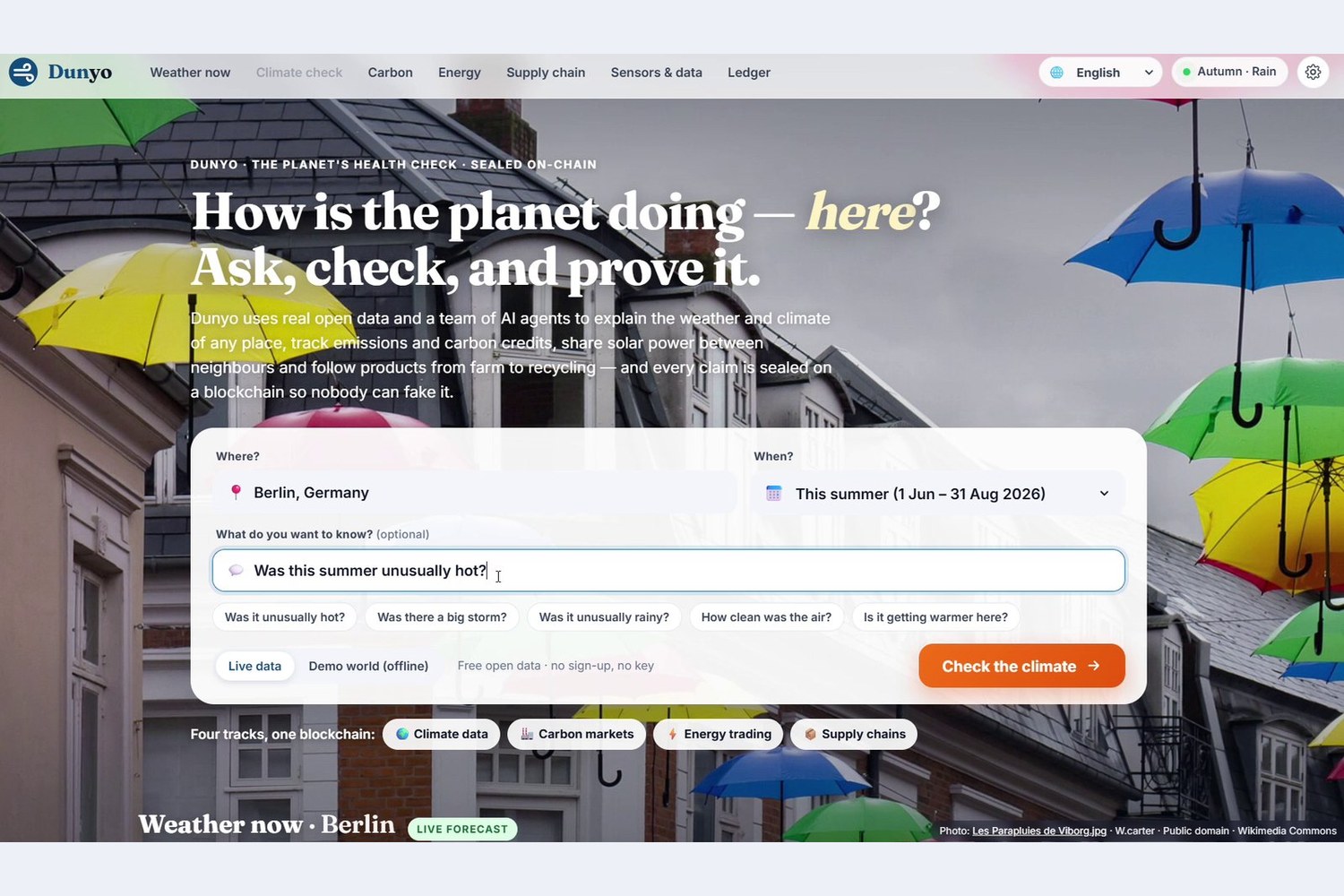
One simple page: pick any place on Earth, ask in plain words, get a checked answer. No sign up, no API keys.
-
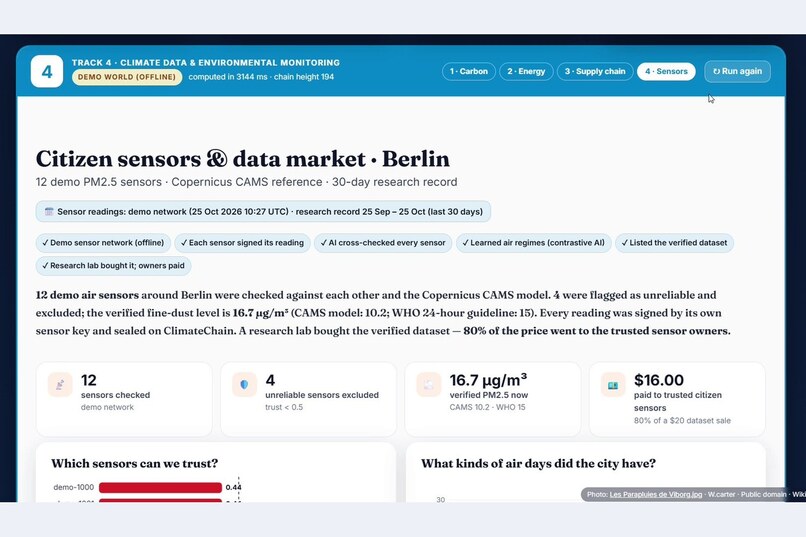
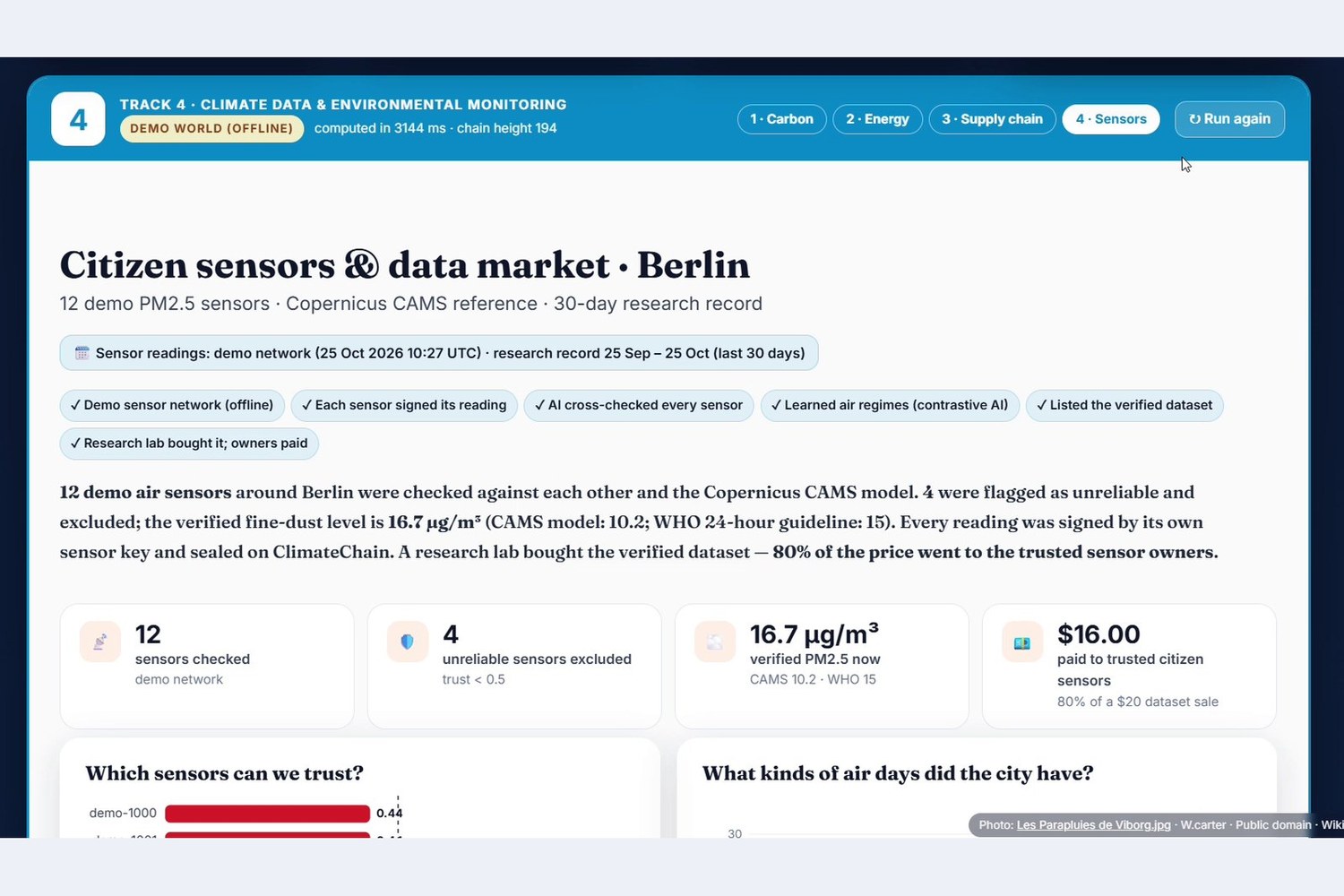
Track 4: AI gives every citizen air sensor a trust score, and trusted owners get paid when a lab buys the data.
-
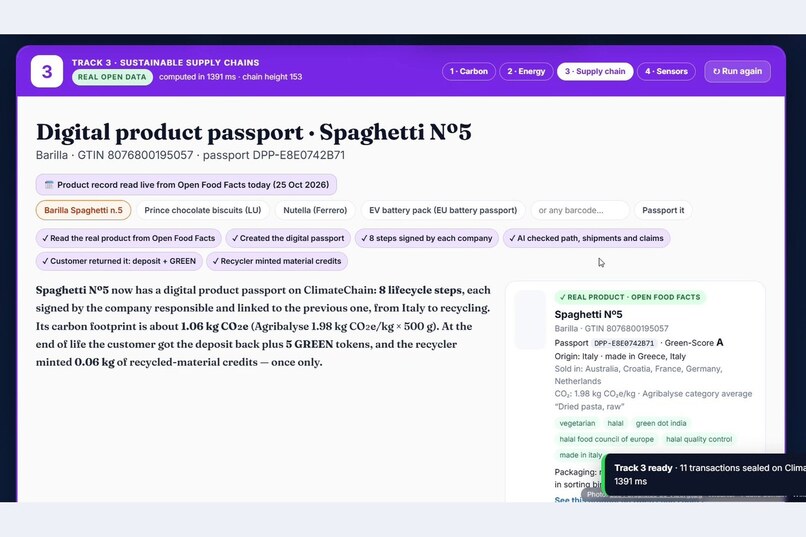
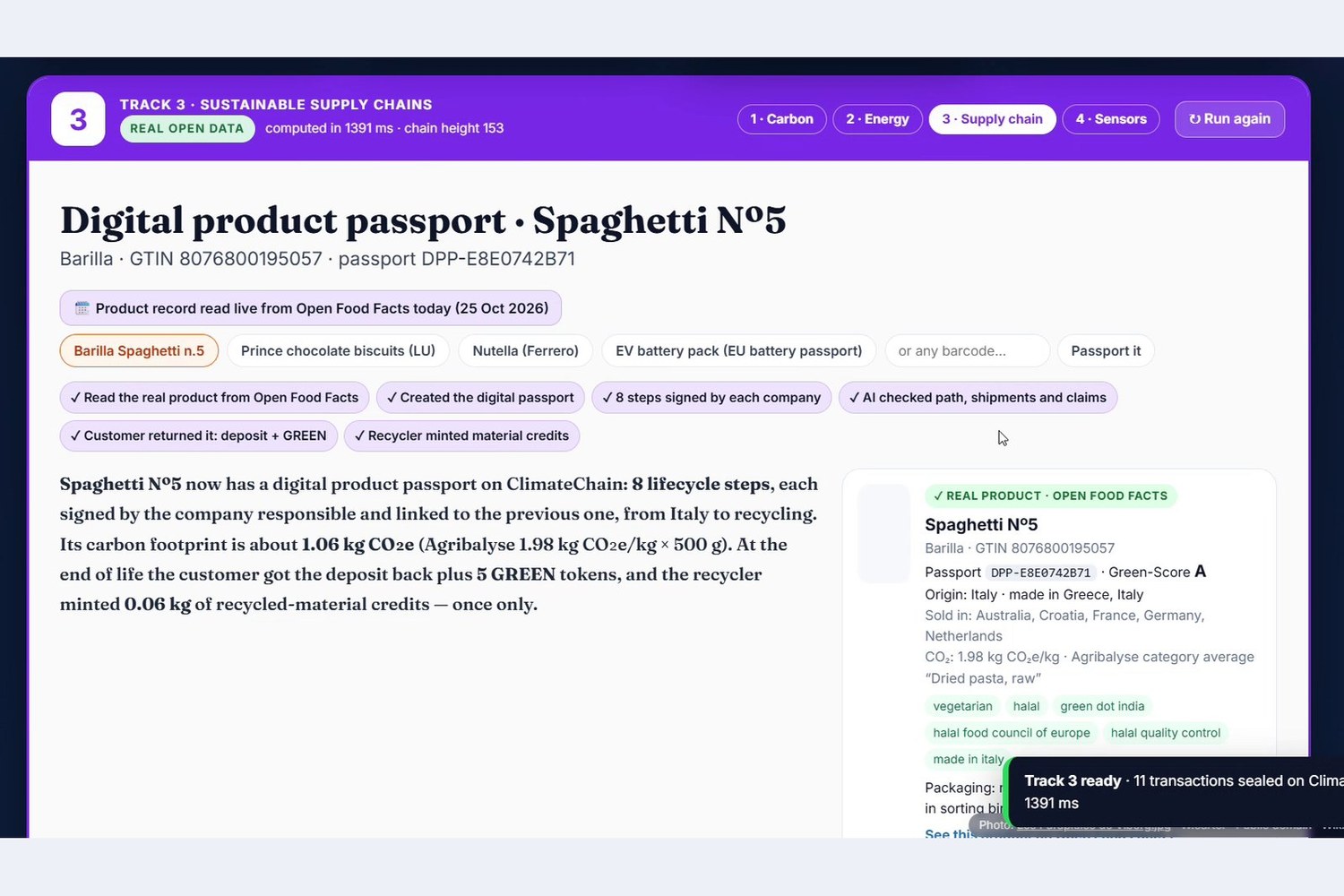
Track 3: a real barcode becomes a digital product passport, every step signed by the right company with its CO₂.
-
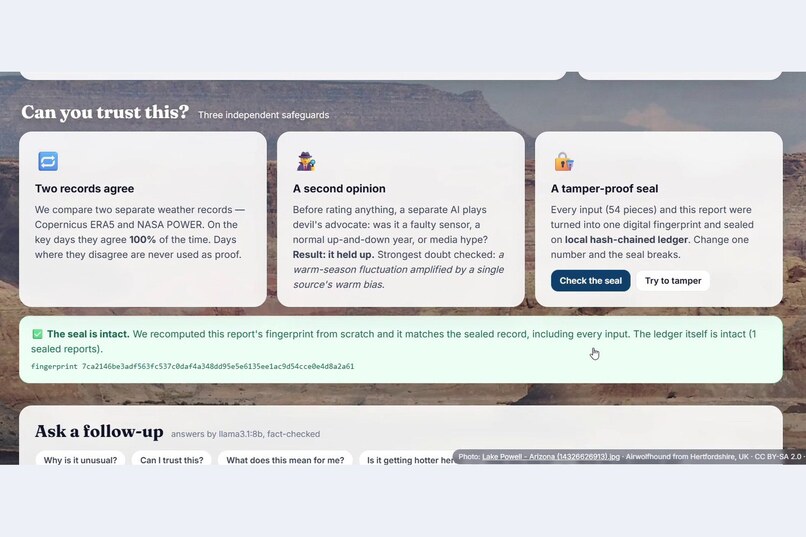
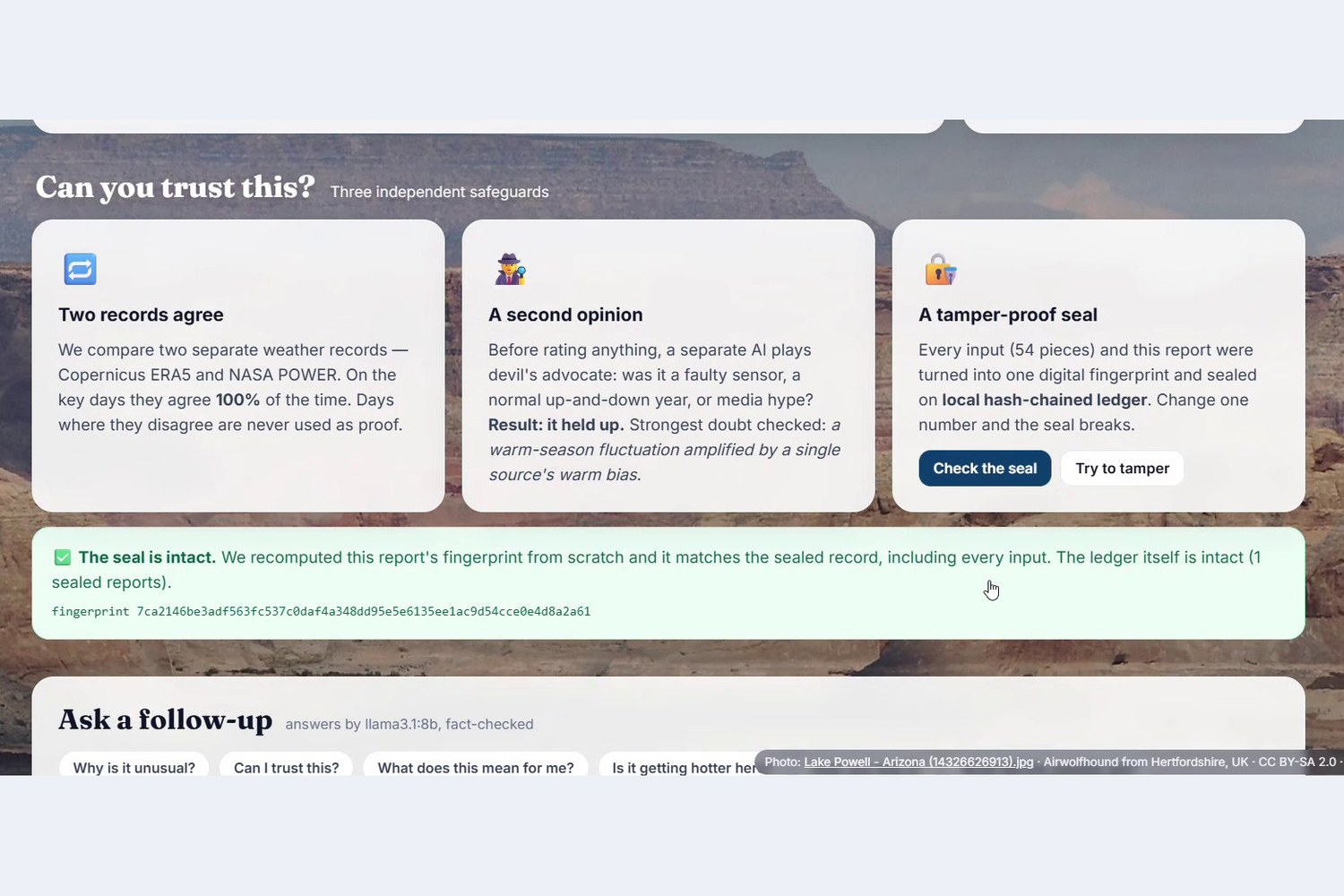
Two records agree, a critic AI tries to disprove it, and the report is sealed. Change one number and the seal breaks.
-
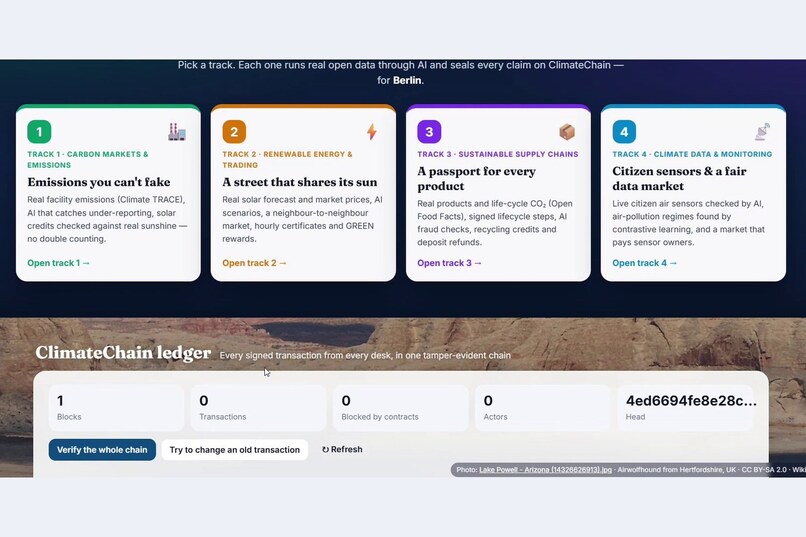
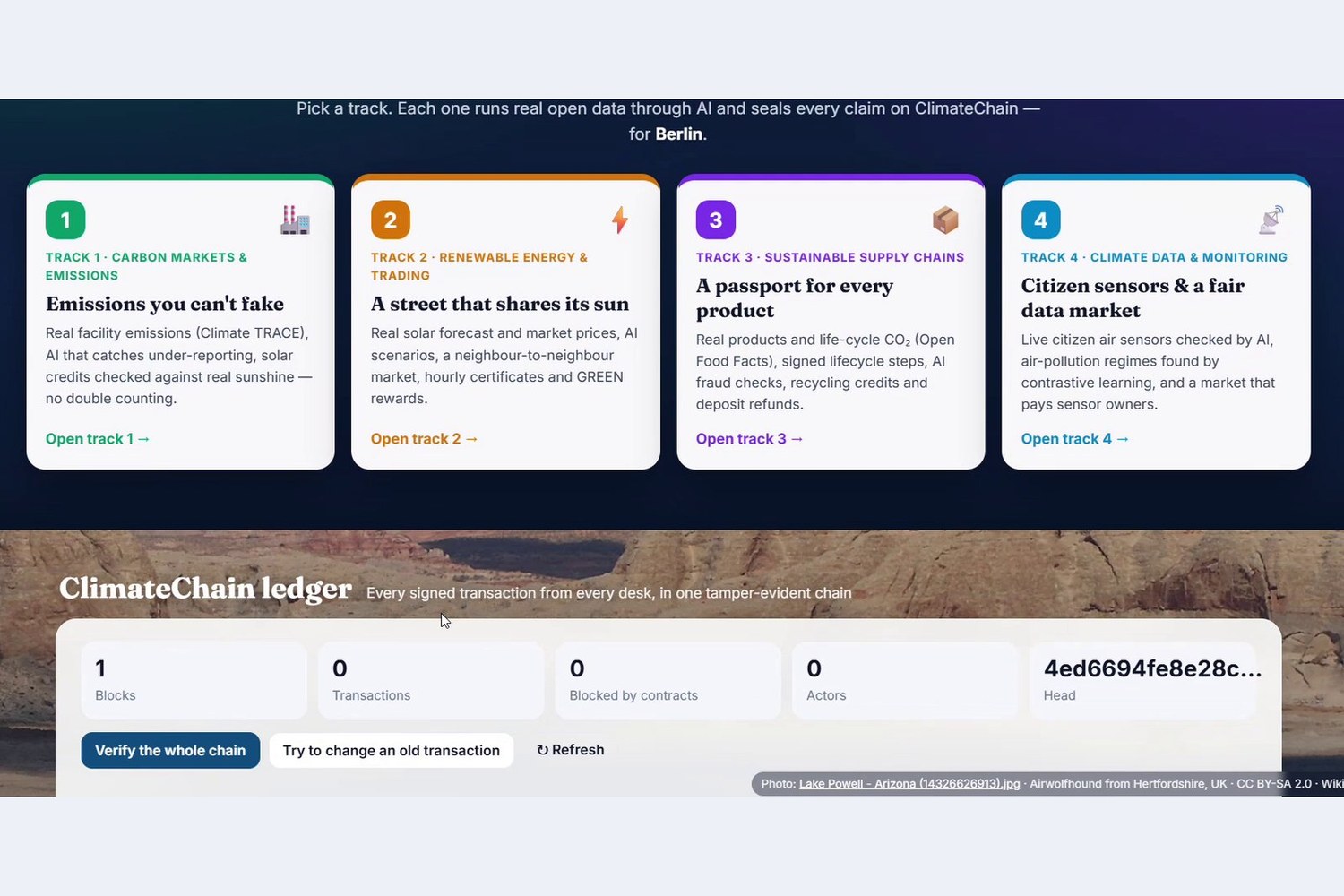
Four IEEE ClimateChain tracks on one shared blockchain: carbon, energy, supply chains and climate data.
-
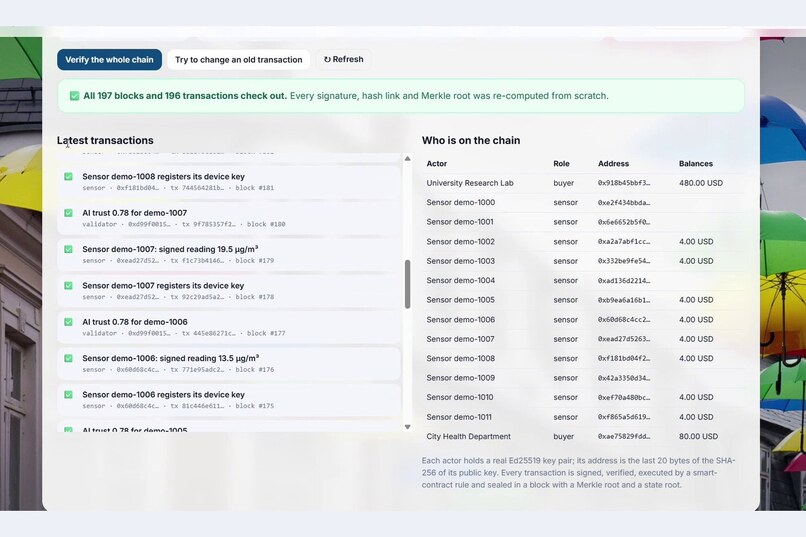
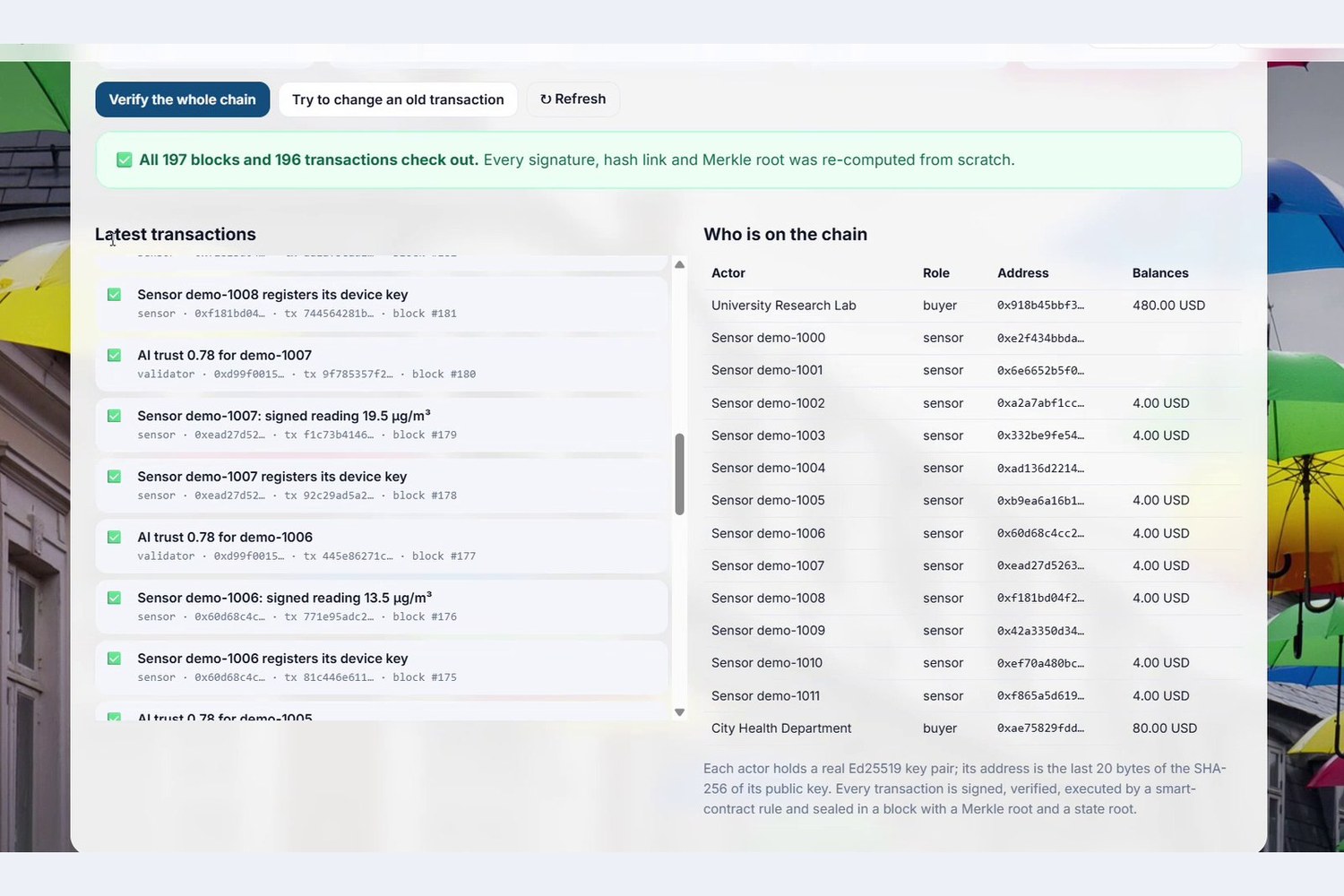
ClimateChain ledger: real Ed25519 signatures, Merkle roots and contract rules. Tamper with one block and verification fails.
-
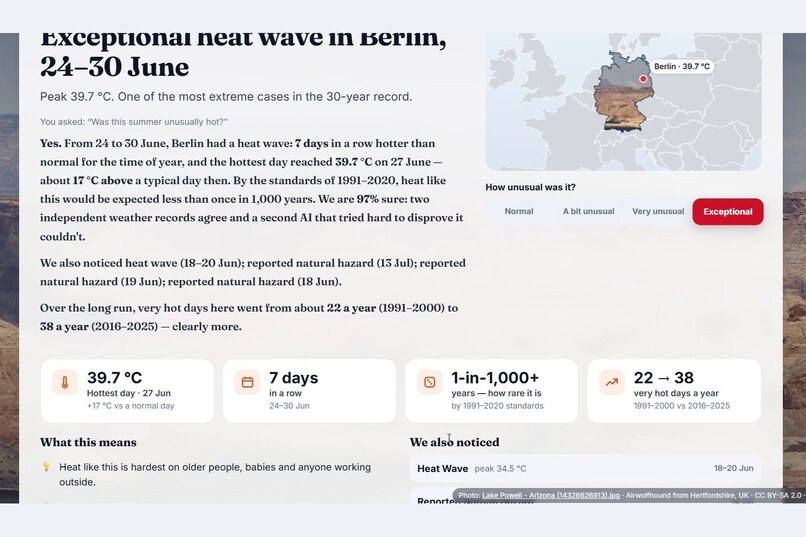
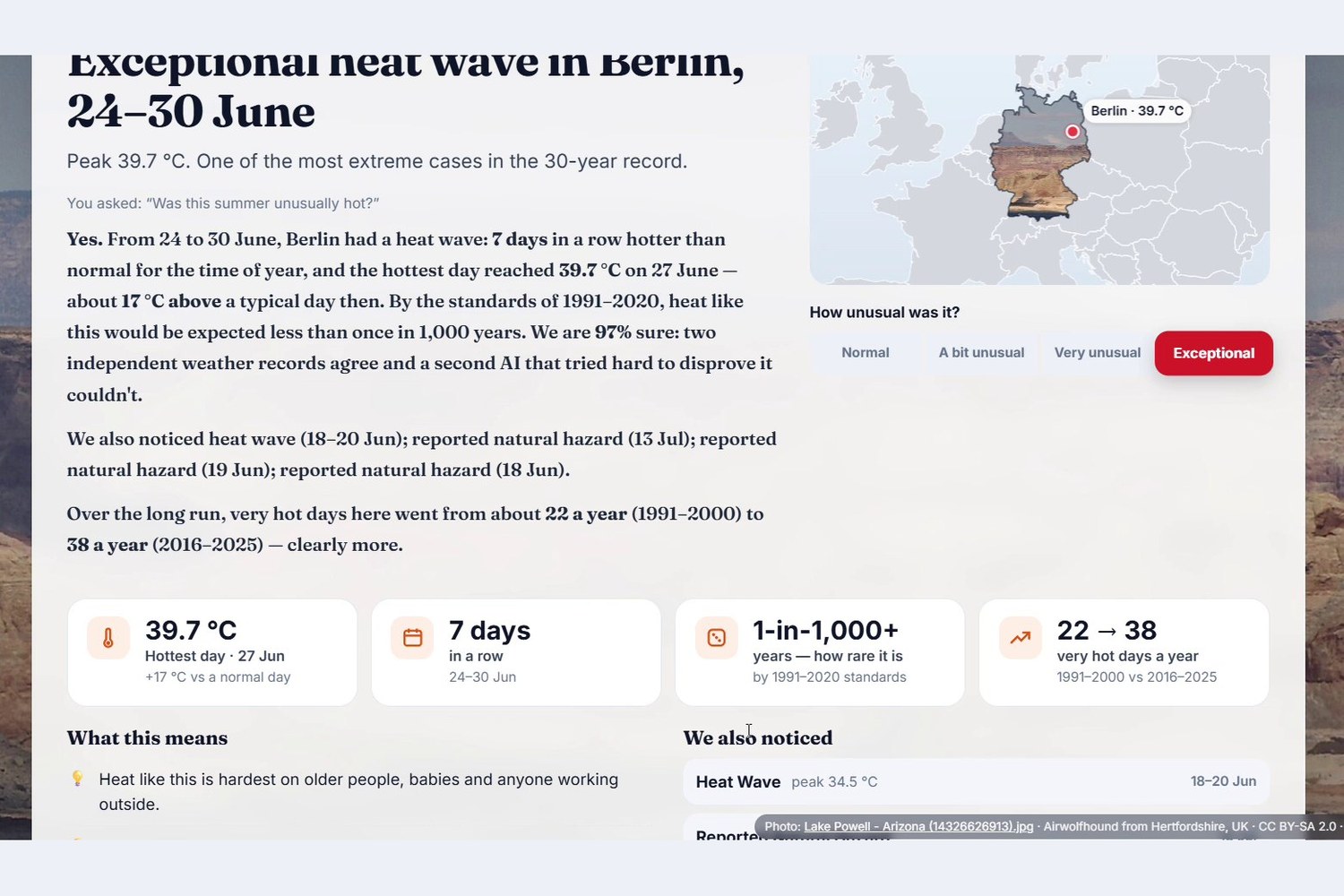
The answer in plain words: Berlin had an exceptional heat wave, peaking at 39.7 °C, rarer than once in 1,000 years.
-
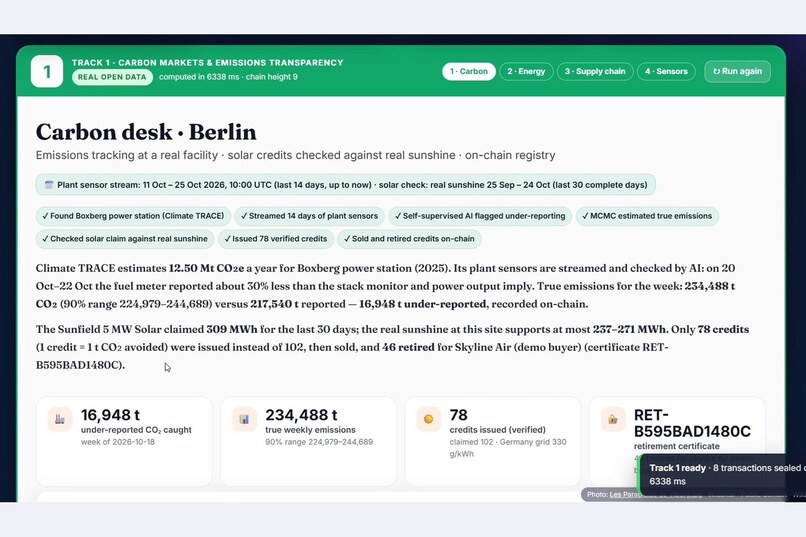
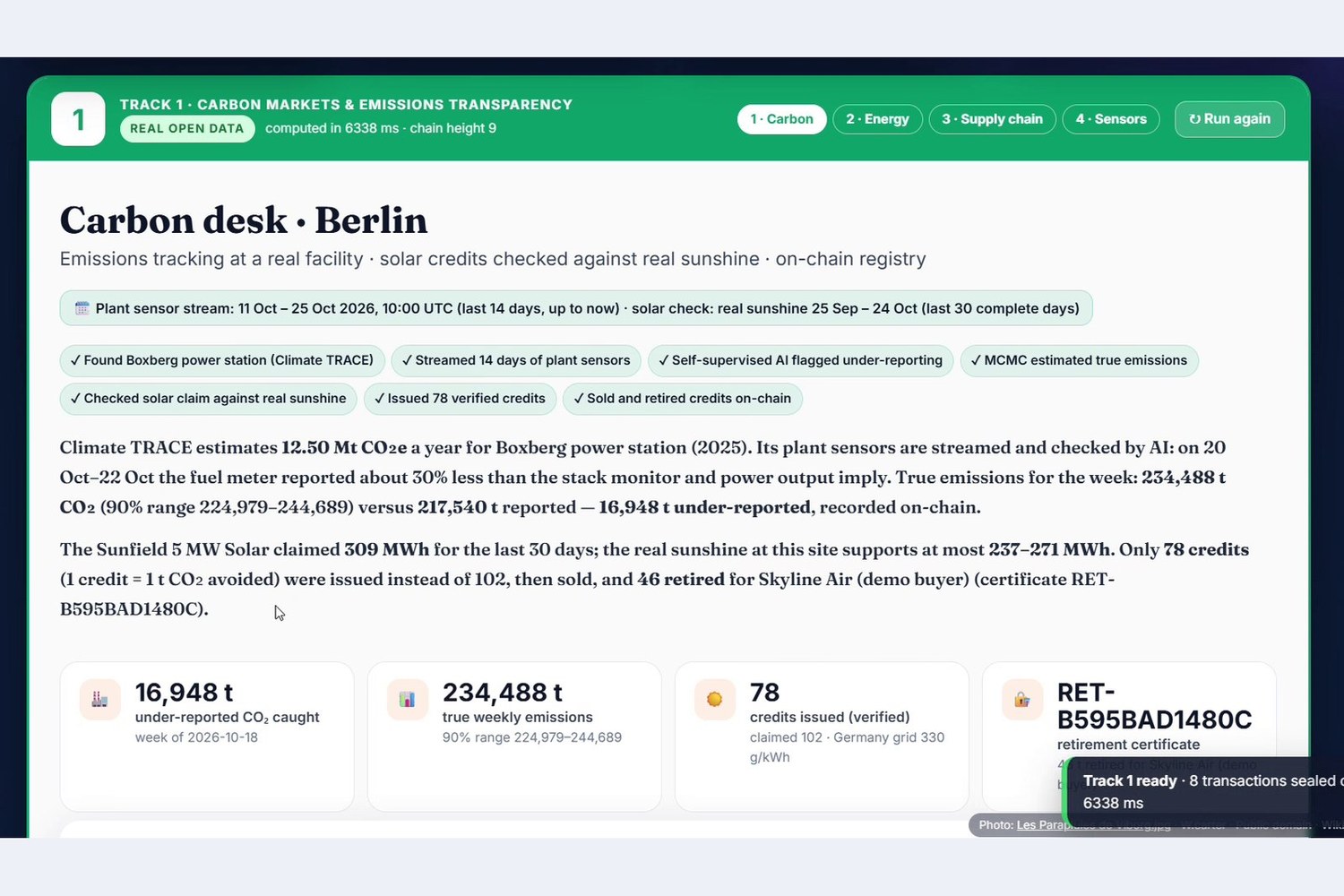
Track 1: AI catches 16,948 t of under reported CO₂ at a real plant; solar credits cut from 102 to 78 using real sunshine.
Inspiration
Climate action runs on claims: "this summer was exceptional", "our plant emitted less", "these credits are real", "this street runs on solar", "this product is low-carbon". The data behind them is scattered, hard to read and easy to fake or count twice. We wanted one place where anyone, from a student to a city planner, can check a claim, understand the answer, and trust that nobody changed it afterwards.
What it does
Dunyo ("world") checks climate claims against real open data with AI, explains the answer in plain words, and seals every input and result on ClimateChain, our ledger with real Ed25519 signatures, Merkle roots and smart-contract rules. It works for any place on Earth, in 13 languages, with no API keys. All 4 tracks run on the same chain:
- Climate check: nine AI agents compare 35 years of ERA5 + NASA POWER data. A critic agent tries to prove the result wrong. Answer: "Yes, an exceptional heat wave, 24–30 June, 39.7 °C, rarer than once in 1,000 years."
- Track 1 · Carbon markets: a real Climate TRACE plant. Self-supervised AI catches under-reported fuel, and MCMC estimates the true emissions. Solar credits are checked against real sunshine: 102 claimed → 78 issued.
- Track 2 · Energy trading: a solar street plans tomorrow with the real forecast and day-ahead prices. Markov-chain scenarios give a range, neighbours trade hour by hour, and every kWh becomes an hourly certificate.
- Track 3 · Supply chains: any barcode becomes a digital product passport (Open Food Facts + Agribalyse). Each step is signed by the right company, in order, with its CO₂. The deposit is refunded and recycling credits are minted once.
- Track 4 · Climate data: citizen air sensors are cross-checked by AI and get trust scores. Contrastive learning finds pollution regimes, and trusted sensor owners are paid when a lab buys the data.
- 🙀 Try to cheat: every track has buttons that send real transactions: issue credits twice, claim 12 kWh from a 5 kW roof, return a product twice, replay a sensor batch. The contract or the AI blocks each one, and the attempt stays on-chain as evidence.
How we built it
- Backend: a Python package with a standard-library HTTP server and live progress over Server-Sent Events. Frontend: a dependency-free HTML/CSS/JS page with a d3-geo map.
- ClimateChain: each actor has an Ed25519 key, and its address is the last 20 bytes of SHA-256(public key). Signed transactions with nonces go to five contracts (Carbon, Energy, Passport, DataMarket, Evidence) and into blocks with previous-hash, Merkle and state roots. One click re-verifies everything, and one click tampers with a block to show that verification fails. Solidity versions of the contracts are included.
- AI: masked self-supervised reconstruction, spatial masking + Beta trust, InfoNCE contrastive learning, Metropolis–Hastings MCMC, Markov chains, GEV extremes, and Bayes vs Γ-minimax decisions. An optional local LLM (Ollama) writes friendlier text, and every number it writes is fact-checked.
The contrastive encoder learns air-pollution regimes with the InfoNCE loss:
$$\mathcal{L} = -\frac{1}{N}\sum_{i}\log\frac{\exp(z_i^\top z_i^{+}/\tau)}{\sum_{j\neq i}\exp(z_i^\top z_j/\tau)}$$
and each sensor's trust is a Beta posterior \( t = \frac{\alpha + k}{\alpha + \beta + n} \), where \(k\) of its \(n\) readings agreed with its neighbours.
- Real open data: Open-Meteo (ERA5 + forecast), NASA POWER, Copernicus CAMS, Climate TRACE, Energy-Charts, Open Food Facts, Sensor.Community, NASA GIBS/EONET, Wikimedia.
Challenges we ran into
- Making statistics readable for a 12-year-old and a scientist at the same time.
- Half-hour time zones (Tehran is UTC+3:30) silently broke our data joins, so everything now runs in UTC.
- ERA5 arrives about 5 days late, so the latest days are filled from the forecast archive and bias-matched.
- Flaky public APIs: we added timeouts, circuit breakers, and clearly labelled fallbacks.
- Right-to-left languages (Persian, Arabic) without breaking numbers, charts or the layout.
Accomplishments that we're proud of
- All four tracks on one working blockchain, with every attack button really blocked by a contract rule or by the AI.
- An AI that doubts itself: a critic agent and a fact checker stand between the model and the user.
- 13 languages including right-to-left, and plain answers a non-expert understands in seconds.
- Real data, no keys, no sign-up: anyone can clone it and check their own city in a minute.
- 25 automated tests plus browser tests, an explained PDF report for every check, and a full technical report.
What we learned
Blockchain earns its place in climate work when it guarantees that claims are unique, final and tamper-evident, while AI and physics check whether they are true. We also learned that explaining a result clearly is as important as computing it.
What's next for Dunyo
- Deploy the contracts to a public testnet.
- Connect real MRV meters and carbon registries.
- Add more product categories as the EU digital product passports arrive.
- Launch city portals where residents and officials check the same numbers.
Built With
- blockchain
- climate-trace
- copernicus
- cryptography
- css3
- d3.js
- ed25519
- html5
- javascript
- latex
- machine-learning
- matplotlib
- nasa-power
- numpy
- ollama
- open-food-facts
- open-meteo
- pandas
- playwright
- python
- reportlab
- scipy
- sensor-community
- smart-contracts
- solidity

Log in or sign up for Devpost to join the conversation.