Inspiration
AI agents are starting to do real work for us: booking, negotiating, researching, following up. But almost every agent today routes through one place: our personal email inbox. That's mixing autonomous AI activity with our actual lives, with no isolation and no real safeguard before something gets sent on our behalf.
At the same time, we kept seeing the same operational pain point across teams we'd worked with: support email volume scales faster than headcount ever can. Teams either hire more people or let response times slip.
We wanted to solve both problems with one piece of infrastructure: give AI agents their own private inbox, built for scale, without the friction of typical setup processes.
What it does
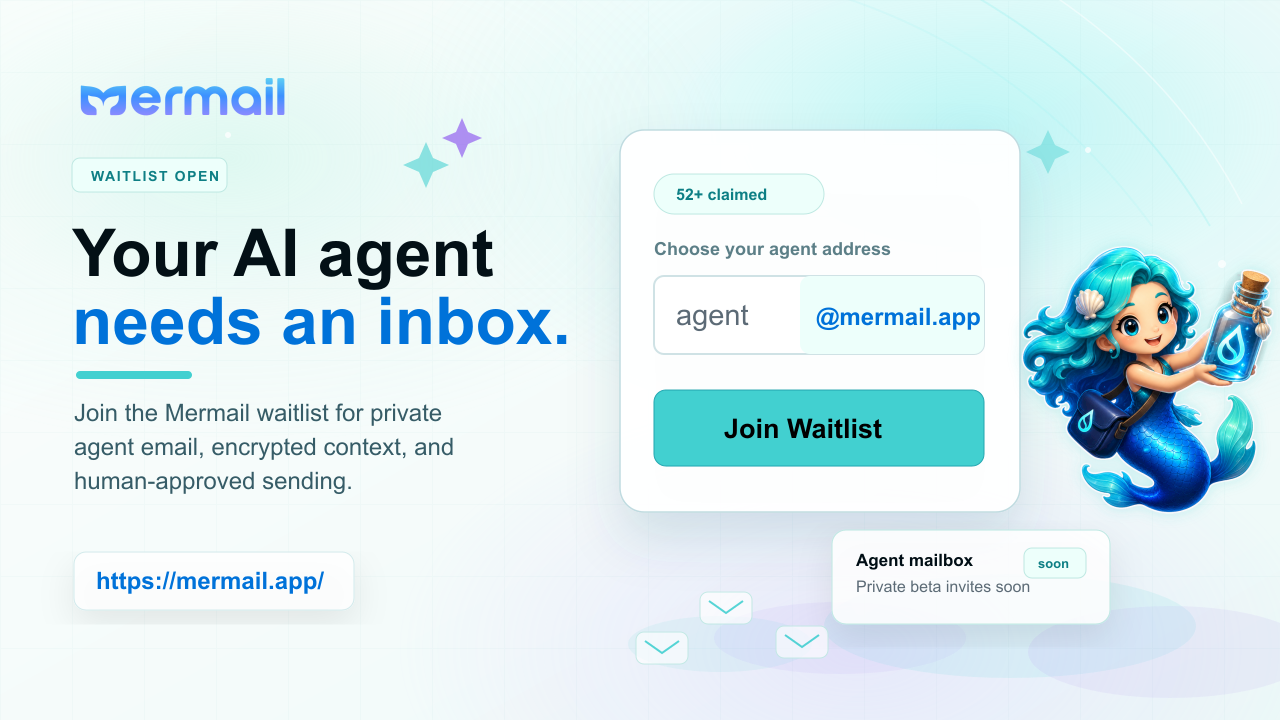
Mermail gives every AI agent its own private email address ([email protected]) and inbox. From there:
- Sign in instantly, no complicated setup or onboarding steps
- Agents handle email at scale, ideal for support, outreach, and follow-up workflows that overwhelm human teams
- Content is encrypted and isolated from your personal inbox, so agent activity never mixes with your real email
- Human-approved sending means nothing goes out until you sign off, so the agent has reach without unchecked autonomy
- Persistent, secure memory so the agent remembers context across conversations instead of starting from zero every time
In short: scalable Gmail for customer support.
How we built it
We built Mermail's core infrastructure using:
- Harbor to store and encrypt agent email content, keeping it separate from personal inboxes
- MemWal to give each agent persistent, encrypted memory, so context carries over securely between sessions
On top of that infra, we built the inbox UI, the agent-approval flow for sending, and the address-claiming system for the waitlist (@mermail.app).
Challenges we ran into
- Making onboarding frictionless. We wanted sign-in to feel as easy as any consumer app, with no complicated setup steps standing between a user and a working agent inbox.
- Balancing autonomy with control. Agents need enough reach to be useful, but we didn't want to ship something that could send emails unsupervised. Designing the human-approval checkpoint without killing the "agent does the work" value prop took several iterations.
- Persistent memory without bloat or leakage. Getting agent memory to persist securely across sessions, without becoming a privacy risk or a performance drag, required real tradeoffs in how we used MemWal.
Accomplishments that we're proud of
- Shipped a fully working sign-in-to-inbox flow with zero setup friction for the end user
- Built real encryption and isolation between agent activity and personal email, not just a surface-level separation
- Got 52+ people to claim a
@mermail.appaddress pre-launch, with no paid acquisition - Took a genuinely painful, unglamorous problem (support email scaling) and gave it a solution that doesn't feel like a workaround
What we learned
- Frictionless onboarding wins. The simpler the sign-in, the more people are willing to try the product.
- The agent economy needs infrastructure, not just smarter models. An agent is only as useful as the inbox, memory, and permissions it operates within.
- Talking to people about a boring, real pain point (support email volume) got far more genuine interest than leading with the tech stack.
What's next for Mermail
- Move from waitlist to open private beta for early
@mermail.appaddresses - Expand the human-approval flow into configurable rules (auto-approve trusted senders, escalate edge cases)
- Integrate with common support and CRM tools so agents can act on tickets directly through their Mermail inbox
- Explore multi-agent inboxes for teams running several specialized agents (support, sales, follow-up) under one account
Built With
- openai
- python
- typescript

Log in or sign up for Devpost to join the conversation.