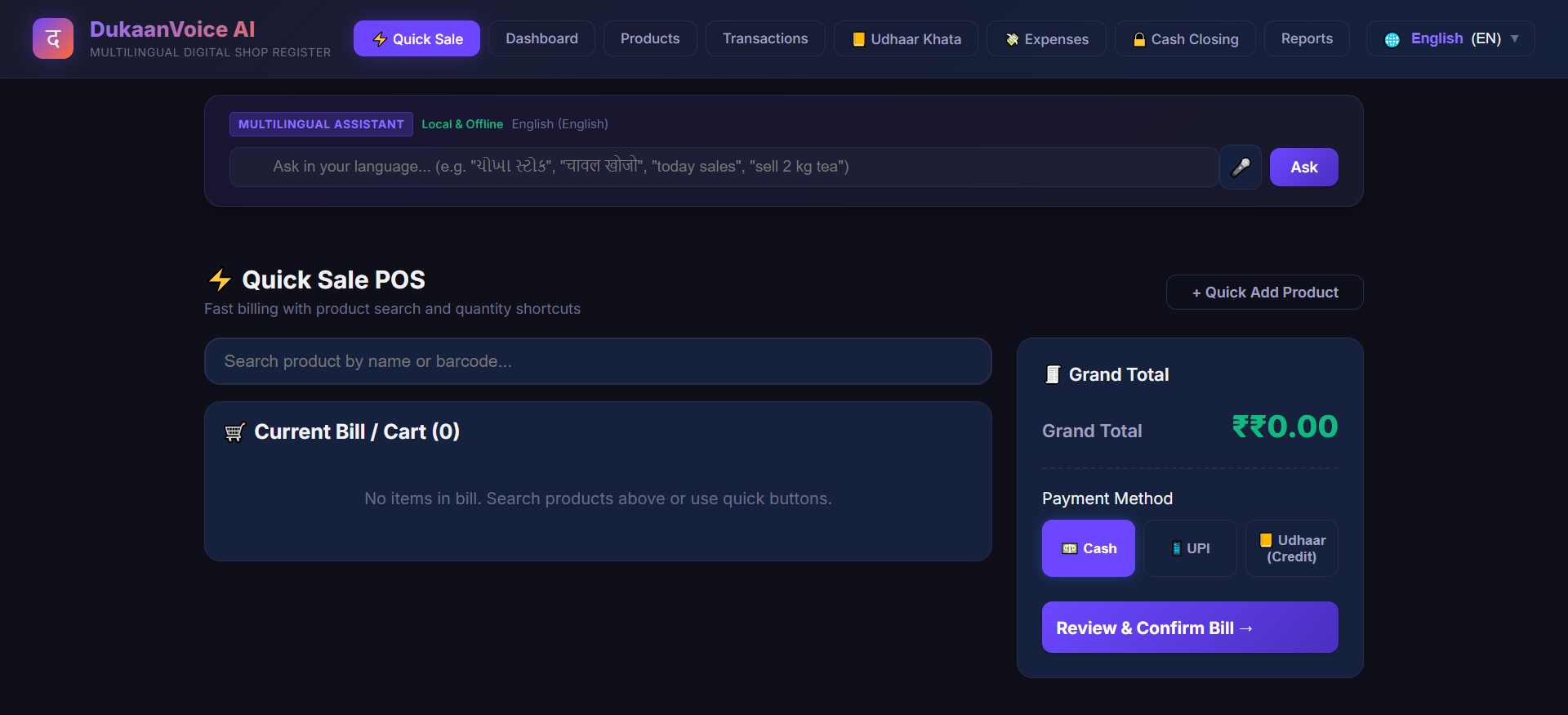
Many small shopkeepers still manage sales, inventory, customer credit (Udhaar), and daily expenses using notebooks or disconnected tools. DukaanVoice AI brings these everyday workflows into one application.
What it can do
Quick POS: Record sales, confirm transactions, update stock, and generate a print-ready receipt preview. Product Management: Add products without requiring a barcode or SKU. Udhaar Khata: Track customer credit, record repayments, and generate shareable customer statements. Expense Register: Record operating expenses and track their effect on the cash drawer. Daily Cash Closing: Reconcile expected cash with the amount counted at the end of the day. Inventory Reconciliation: Compare calculated stock with recorded stock. Multilingual Interface: Support for 23 language dictionaries, including Gujarati, Hindi, Tamil, and right-to-left layouts for supported languages. The goal is simple: help small retailers manage their daily business with a practical, locally operated application.
Demo The project includes a five-minute evaluator walkthrough covering the complete retail workflow.
Project repository: https://github.com/gunmasterg9/DukaanVoice-AI
Demo guide: https://github.com/gunmasterg9/DukaanVoice-AI/blob/main/docs/SUBMISSION_DEMO_GUIDE.md LIVE https://dukaanvoice-ai.vercel.app/ The walkthrough demonstrates product entry, a point-of-sale transaction, customer credit and repayment, expense recording, daily cash closing, and inventory reconciliation.
The application currently runs locally on Windows. A publicly hosted interactive demo is not available in this release.
Code
The complete source code is available on GitHub:
Repository: https://github.com/gunmasterg9/DukaanVoice-AI
Release: v1.0.1
Release notes: https://github.com/gunmasterg9/DukaanVoice-AI/releases/tag/v1.0.1
The project is built with React, Vite, Python, FastAPI, and SQLite.
The repository includes the source code, testing instructions, regression tests, isolated end-to-end test runners, and the evaluator demo guide.
How I Built It
I built DukaanVoice AI using a local-first architecture:
Frontend: React and Vite Backend: Python and FastAPI Database: SQLite Testing: Pytest, frontend tests, Oxlint, and isolated end-to-end test runners One of the most important engineering decisions was to make retail transactions auditable and predictable.
Money is stored in integer paise, inventory quantities use integer milli-units, stock movements are recorded for auditing, and sales require explicit confirmation. Customer payments and cash-drawer calculations are kept distinct so that digital payments are not incorrectly counted as physical cash.
I also added regression coverage for duplicate product lines, customer-credit reversals, cash refunds, daily closing records, and database persistence.
Current scope: Version 1.0.1 focuses on reliable local-first retail workflows and multilingual usability. It does not yet integrate an open-weight language model for inference. Adding a locally runnable assistant for natural-language sales and inventory commands is a potential future extension, not a feature claimed by this release.
Why Does Open Innovation Matter? Small businesses need affordable software that they can understand, adapt, and operate without depending entirely on expensive cloud services.
Open-source development makes it possible for developers and local communities to inspect the code, report bugs, contribute improvements, and adapt workflows for their own needs.
For a project like DukaanVoice AI, this matters because retail practices differ across regions and languages. A transparent, extensible application can evolve around the needs of real shopkeepers.
The current release demonstrates the local-first application and its auditable workflows. Integrating open-weight AI in a future version could extend this approach to natural-language product entry, sales drafting, and multilingual assistance while keeping transaction confirmation and financial calculations under deterministic application control.
My Agent Session
DukaanVoice AI was developed through an iterative workflow of implementation, code review, regression testing, and release verification.
The project repository includes the implementation and testing artifacts:

Log in or sign up for Devpost to join the conversation.