-
-
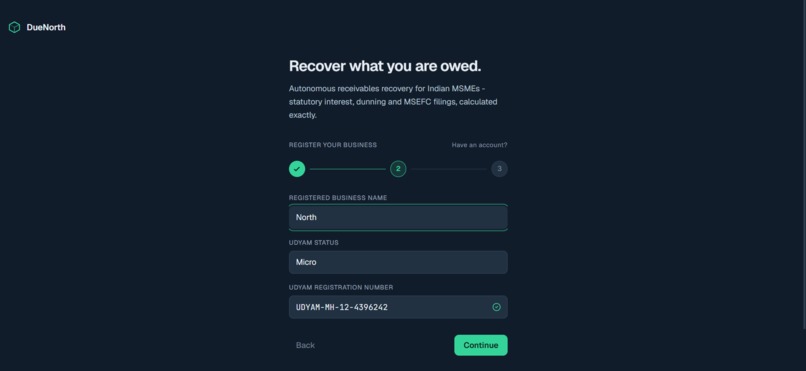
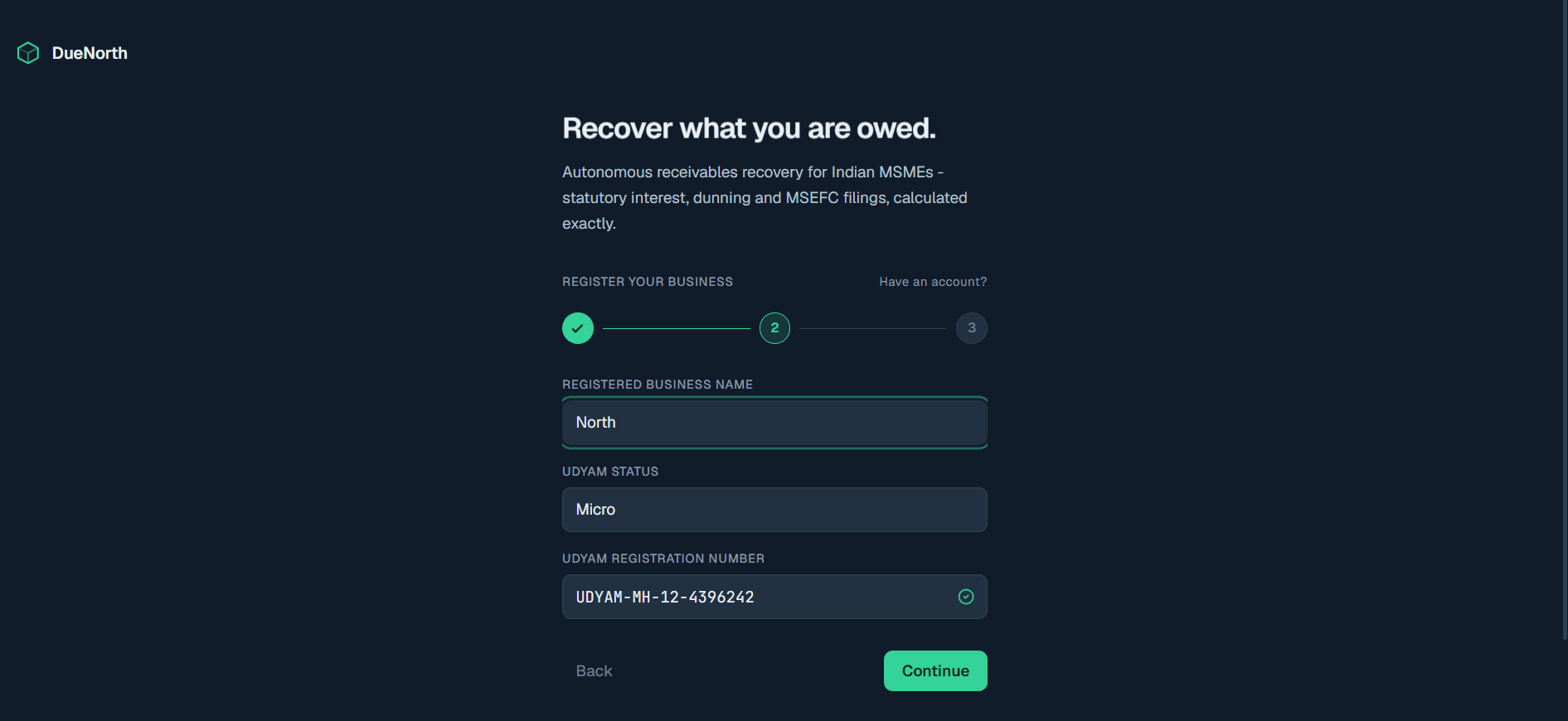
Registering a business
-
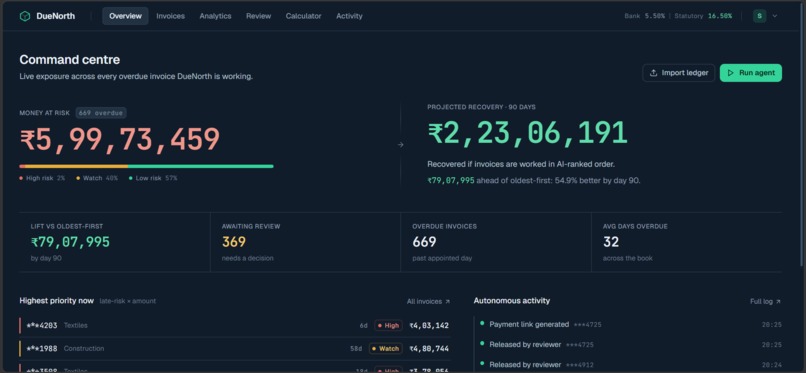
Dashboard
-
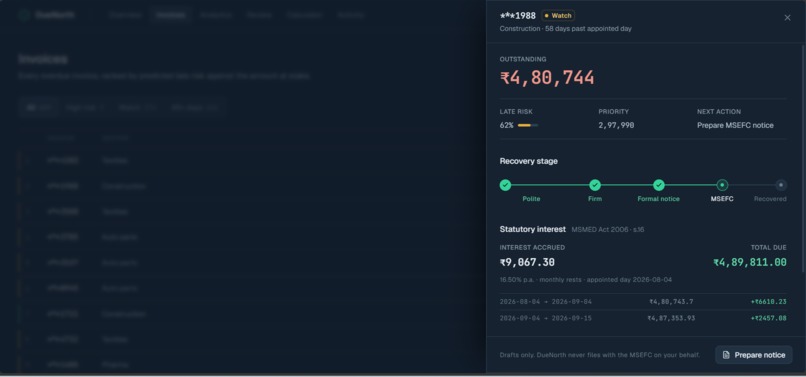
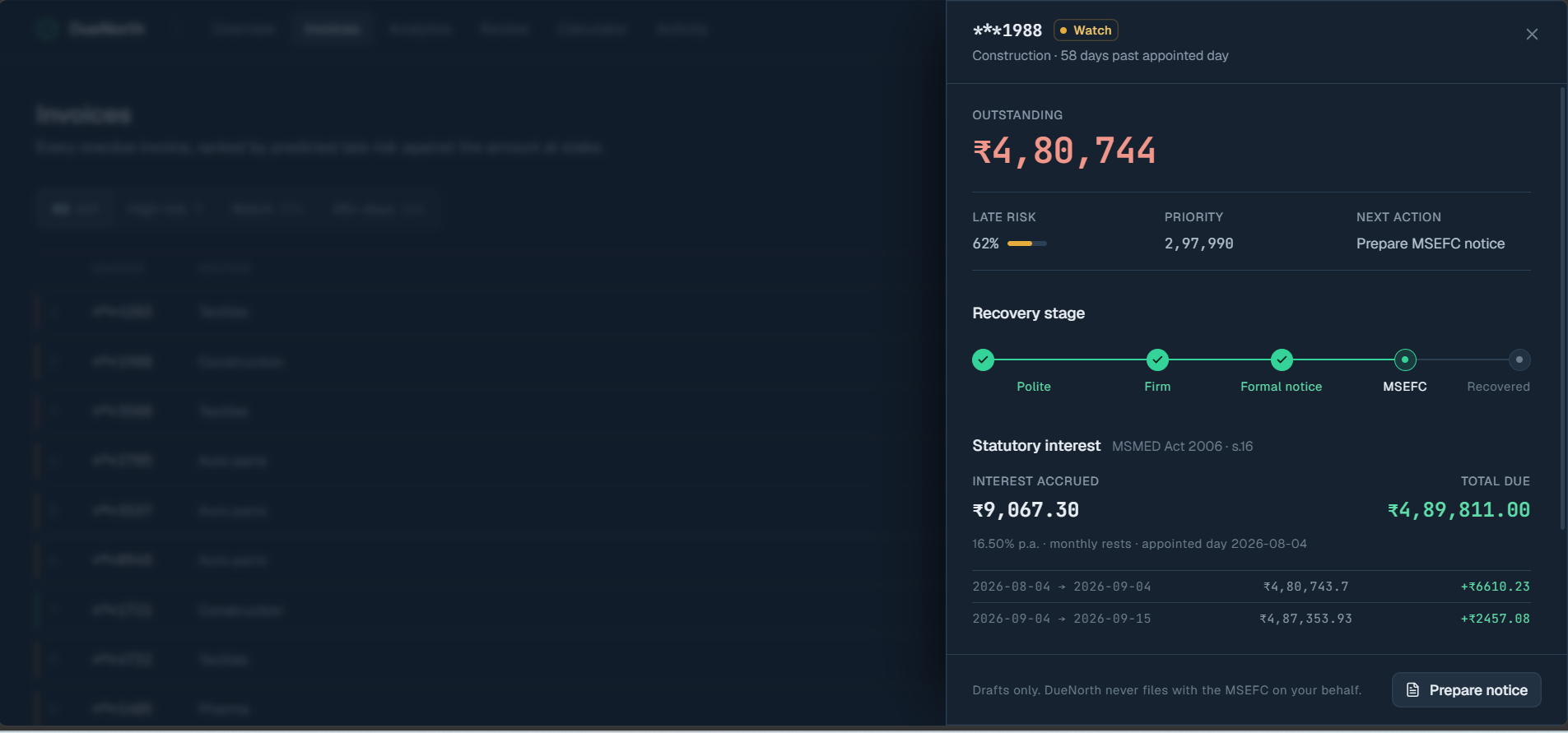
Invoices: The risk score, the recovery stage, the appointed day, every monthly compounding step, rupees and paise
-
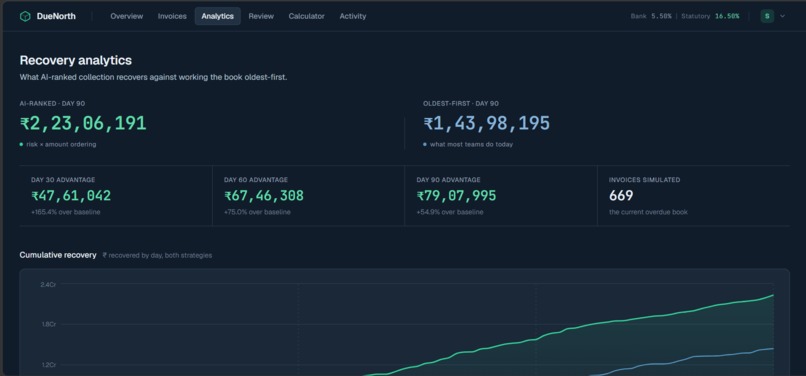
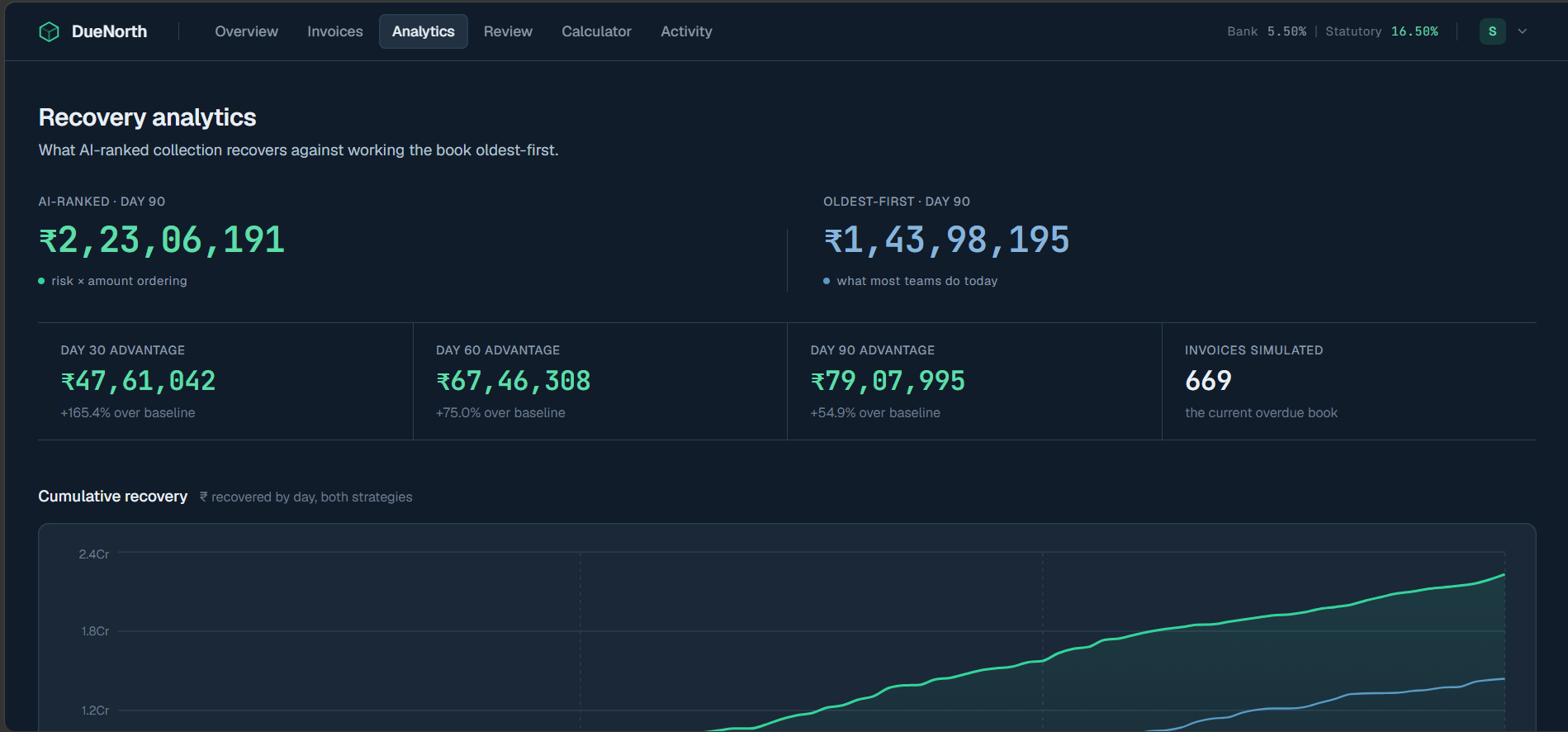
AI-ranked chasing recovers 165% more cash by day 30 than oldest-first, and ₹2.23 crore versus ₹1.44 crore by day 90
-
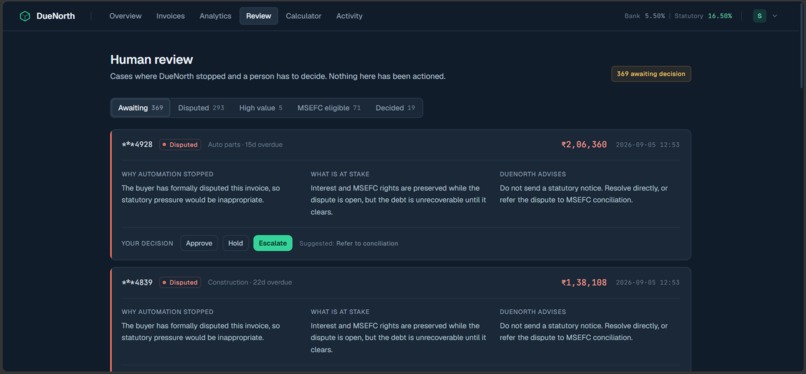
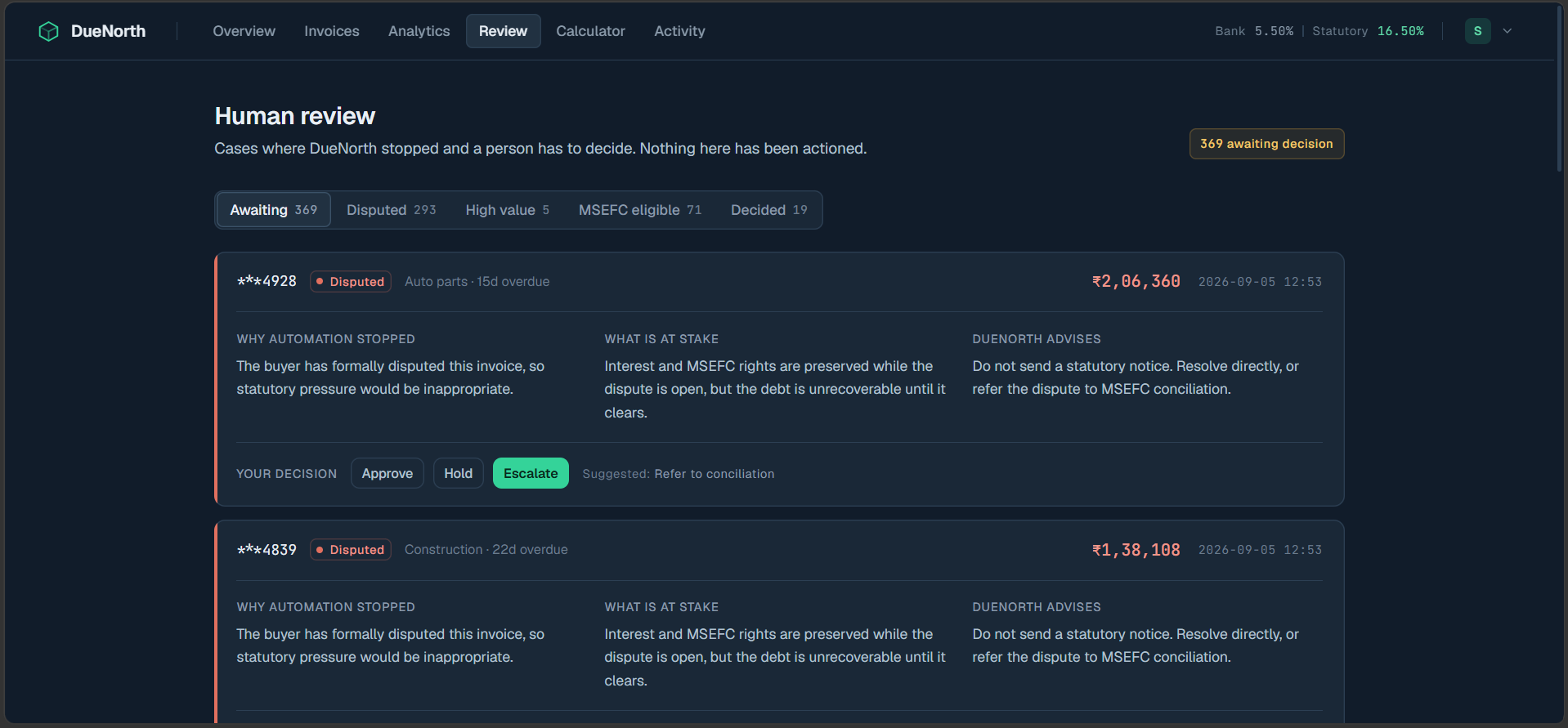
Where the human steps in: Every held case tells you why automation stopped, what's at stake, and what we advise.
-
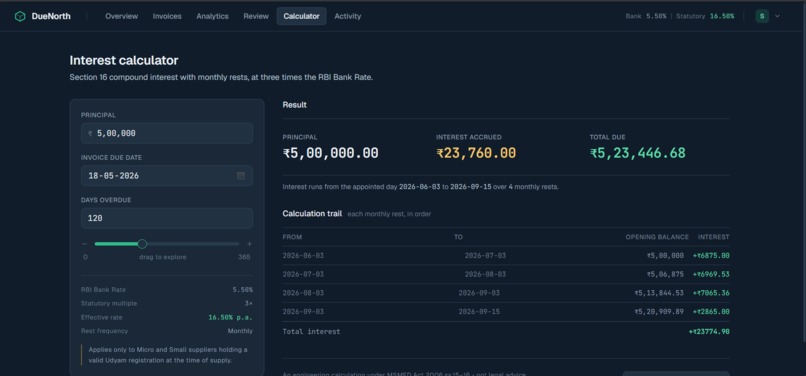
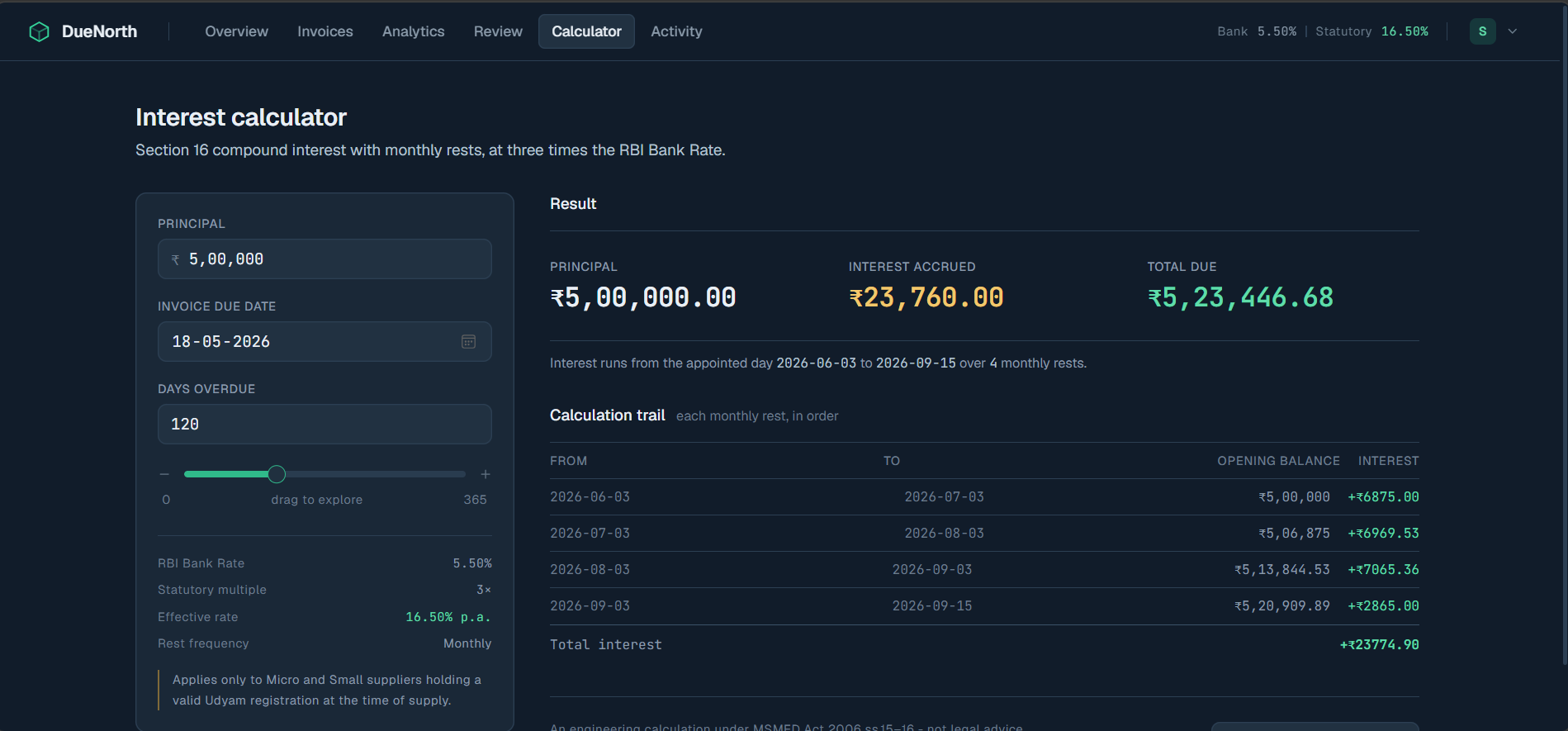
Calulator to calulate interest accrued
-
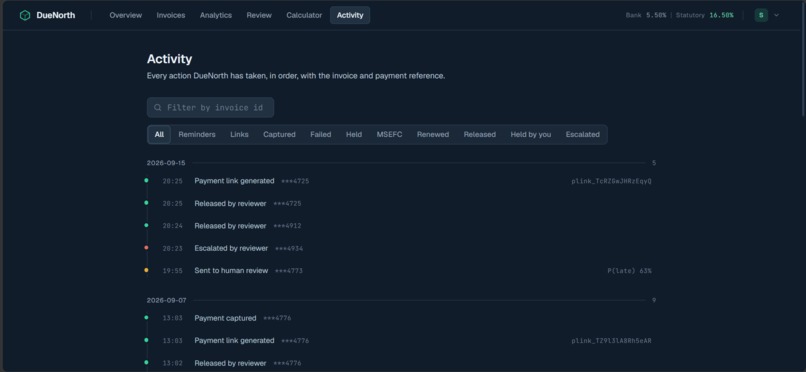
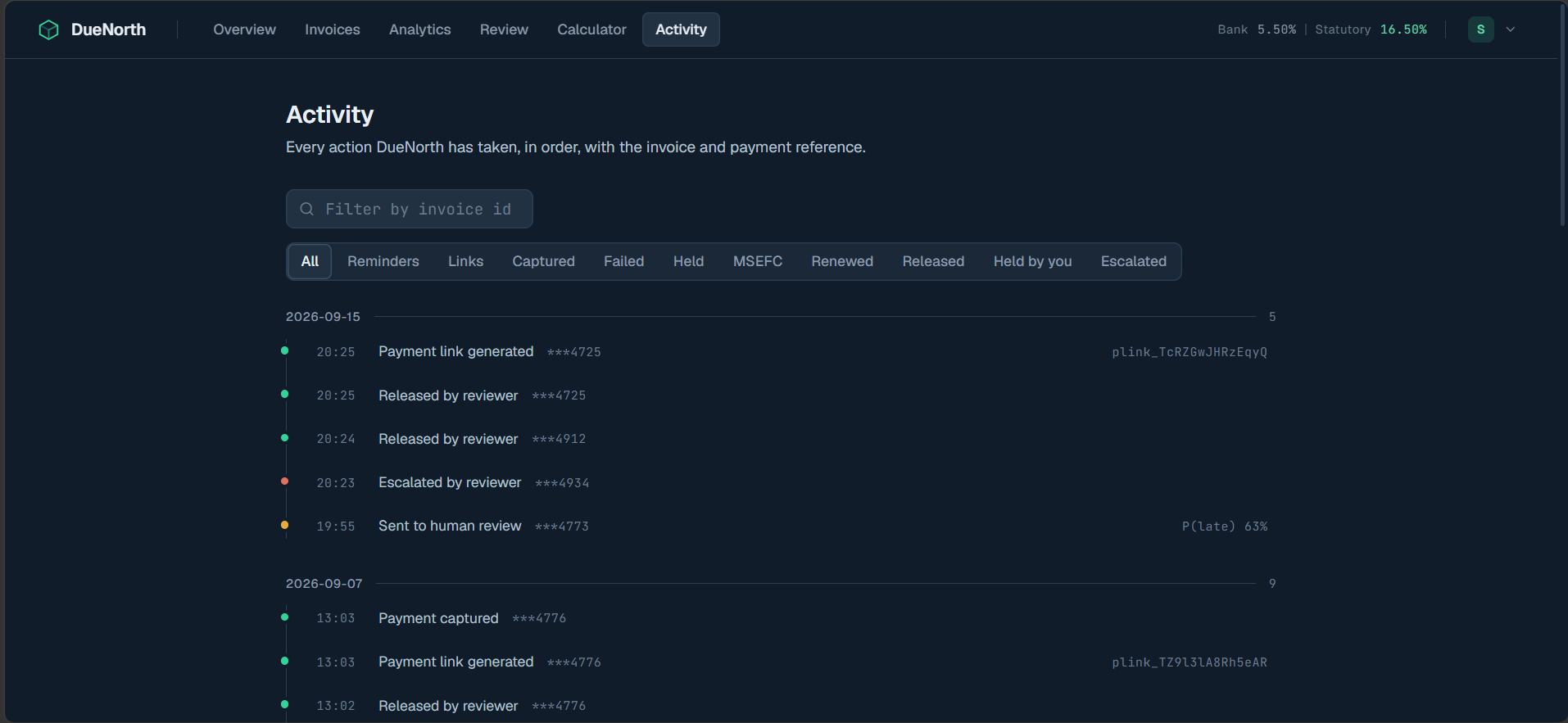
Complete Audit Page
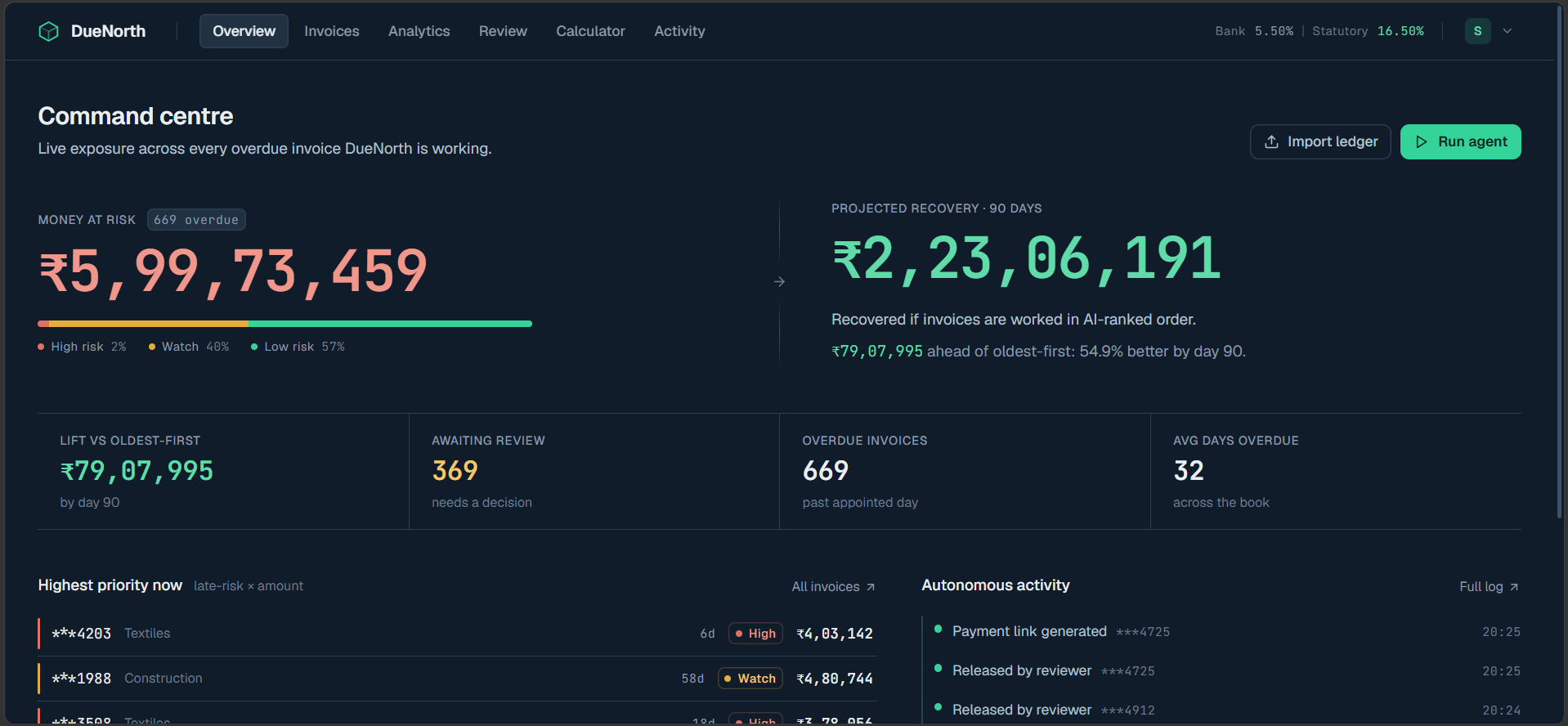
Inspiration
Indian MSMEs are owed ₹10.7 lakh crore in late payments. The MSMED Act already entitles Micro and Small suppliers to compound interest at three times the RBI Bank Rate, and buyers cannot contract out of it. Yet almost nobody claims it: the maths is hard, asking feels risky, and small accounts teams chase invoices oldest-first. Even willing buyers fail to pay, because UPI caps at ₹1 lakh per transaction. We wanted to turn an unused legal right into collected cash.
What it does
DueNorth is an AI collections agent that works a supplier's receivables like their best analyst. It ranks overdue invoices by $\text{priority} = P(\text{late}) \times \text{amount}$ and computes Section 16 interest with monthly rests:
$$B_{k+1} = B_k\left(1 + \frac{3r}{12}\right)$$
where $r$ is the RBI Bank Rate, so today's statutory rate is $3 \times 5.5\% = 16.5\%$ a year. It routes invoices up to ₹1 lakh to a payment link and larger ones to a bank-transfer virtual account, escalates reminders from polite to firm to formal, and drafts MSEFC filings that a human always signs.
How we built it
Three layers that never mix. Deterministic Python engines handle the law and the money. Two XGBoost models handle prioritisation: one predicts late payment, the other predicts whether a buyer keeps a promise to pay ($R^2 \approx 0.88$), which sets the follow-up cadence. An LLM handles wording only, and a template takes over if it fails. The stack is FastAPI, React, PostgreSQL and Razorpay webhooks, backed by 253 automated tests.
Challenges we ran into
The hardest part was making sure AI could never override legal logic. We also had to guard against target leakage, where outcome data quietly slips into a model's inputs. Noisy labels in our synthetic ledger capped classifier accuracy, so we proved value through a recovery simulation instead. Payment webhooks had to process exactly once, and one data layer had to run on both SQLite and PostgreSQL.
Accomplishments that we're proud of
On a 5,000-invoice test ledger, AI-ranked chasing recovered 165% more cash by day 30 than oldest-first, and ₹2.23 Cr vs ₹1.44 Cr by day 90. One agent run processed 669 invoices: 281 reminders drafted, 311 held for human review and 77 legal notices prepared, with zero automatic filings.
What we learned
Trust comes from knowing exactly where automation should stop. Three human-review gates (disputed invoices, Medium suppliers and large amounts) made the agent more useful, not less.
What's next for DueNorth
Scheduled autonomous runs, live WhatsApp and email reminders, multi-tenant accounts, Tally and Zoho integrations, AI that reads buyer replies, and reminders in Hindi, Marathi, Gujarati and Tamil.
Built With
- fastapi
- javascript
- motions
- node.js
- pandas
- postgresql
- pytest
- python
- react
- recharts
- ruff
- tailwind
- uvicorn
- xgboost

Log in or sign up for Devpost to join the conversation.