-
-
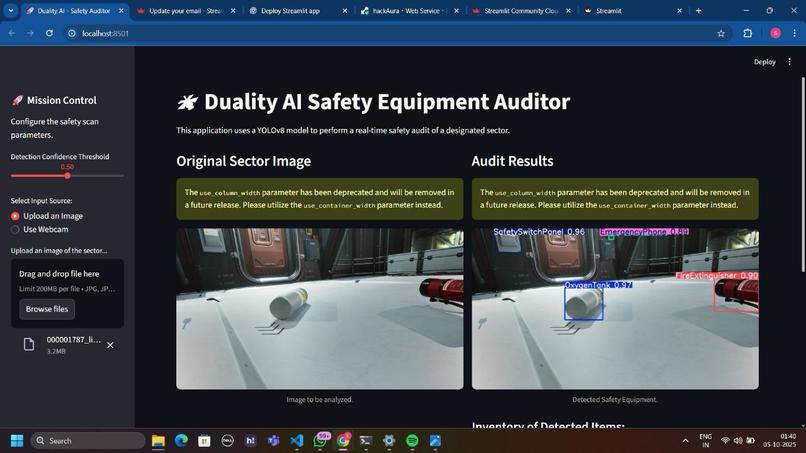
Our space-themed application provides an interface for safety audits. Users can either upload an image or use a live webcam feed.
Inspiration
Ensuring safety in space stations is critical, yet manual inspection of safety equipment is slow, error-prone, and difficult in complex environments. Inspired by real-world needs in aerospace safety and industrial compliance, we wanted to explore how computer vision could automate safety audits.
Since synthetic data generation is becoming important in AI research, we also wanted to experiment with Duality AI’s Falcon platform to build a realistic detection system trained without relying solely on real-world images.
Our goal was to create an intelligent system that could support astronauts, engineers, and safety inspectors by automatically detecting safety equipment in real time.
What it does
Duality AI Space Station Safety Auditor is an AI-powered application that:
• Detects 7 classes of safety equipment in space-station environments • Provides real-time safety auditing using images or webcam input • Highlights missing or misplaced equipment • Allows adjustable confidence thresholds • Runs through a user-friendly Streamlit web interface
Our final model achieved 80.1% [email protected], significantly outperforming baseline performance.
The system can also be extended to factories, hospitals, construction sites, and other safety-critical industries.
How we built it
We followed a structured pipeline:
Dataset Creation Used Duality AI Falcon to generate high-fidelity synthetic images simulating space-station environments.
Model Training Fine-tuned a YOLOv8s object detection model using PyTorch and Ultralytics.
Optimization Experimented with hyperparameters, augmentations, and training strategies to improve performance from 58.6% to 80.1% mAP.
Application Development Built an interactive web application using Streamlit with OpenCV for real-time detection.
Deployment Hosted the app on Render for global access.
Challenges we ran into
• Synthetic-to-real domain gap affecting detection accuracy • Class imbalance in generated dataset • Model overfitting in early training stages • Deployment optimisation for real-time inference • Handling false positives and confidence thresholds
Debugging these issues helped us improve both model accuracy and usability.
Accomplishments that we're proud of
• Achieved 80.1% [email protected], beating baseline benchmarks • Built a fully functional real-time auditing web app • Successfully used synthetic Falcon data for training • Documented a clear optimisation journey • Created a scalable solution applicable beyond space stations
As students, building an end-to-end AI system from dataset to deployment was a major milestone.
What we learned
Through this project, we gained hands-on experience in:
• Object detection using YOLOv8 • Synthetic dataset generation • Model evaluation and optimisation • Real-time AI deployment • Ethical considerations in safety-critical AI systems
This project strengthened our understanding of computer vision pipelines, similar to our ongoing work in medical image segmentation and applied AI research.
What's next for DualityAI
In future versions, we plan to:
• Improve performance using YOLOv8x and ensemble models • Add video-stream monitoring for continuous audits • Integrate anomaly detection for unknown hazards • Train on mixed synthetic + real datasets • Expand to industrial PPE detection systems
Our long-term goal is to build a scalable AI safety assistant usable in aerospace, healthcare, manufacturing, and construction environments.

Log in or sign up for Devpost to join the conversation.